Federal ballast water regulations run afoul of Canada’s environmental goals
New ballast water regulations released by Transport Canada on Wednesday unfairly target Canadian ship operators — who have spent billions of dollars on new fuel-efficient, eco-ships — while giving an extra six years for compliance to owners of older vessels, including those of virtually all U.S. ships operating in the Great Lakes-St. Lawrence inland waterway. Ballast water refers to the water ships have to regularly take on, and discharge, at each port of call for stability/safety reasons.
The Chamber of Marine Commerce has repeatedly alerted federal regulators and politicians that this inequitable treatment creates an unlevel playing field between Canadian and U.S. domestic fleets (which operate virtually all older vessels) and discourages further investment in new, more fuel-efficient ships that produce significantly lower greenhouse gases.
The ballast water regulations correctly recognize that ships operating solely in the Great Lakes-St. Lawrence waters have unique technical and operating challenges and that more time is needed to find ballast water treatment systems that meet compliance requirements. It gives those ships until 2030 to install systems. However, without any justification, the regulations have given ships built on or after 2009, operating in the same waterway, a compliance deadline of 2024, despite the absence of any suitable available technology that can ensure compliance by that date.
Bruce Burrows, President and CEO of the Chamber of Marine Commerce, says: “This is a very disappointing development that will risk jobs and stall economic recovery, while doing little to protect the environment. The regulations as they stand may actually impair rather than protect the environment, as shipowners with newer ships will have to seek extensions or will be installing systems at great expense that don’t work. At the same time, the exorbitant and escalating costs of attempting to install systems will make new ships less competitive and completely undermine the Canadian government’s goals to reduce emissions and support the advancement of technology.”
If new ships are forced to meet the 2024 deadline, extra costs will likely be passed on to Canadian manufacturing and agricultural customers, making them less competitive than their U.S. counterparts that use U.S. domestic ships without systems on the same Great Lakes. These costs would be added at a time when inflation on raw materials and consumer goods is already at a 10-year high and the world attempts to recover from the pandemic.
There have been no new introductions of non-native invasive species in the Great Lakes (attributed to ships ballast water) reported since 2006 when new Canada/U.S. ballast water requirements jointly came into effect. It’s also important to note that both Canadian and U.S. domestic vessels do not travel overseas and pose no risk of introducing new invasive species.
The Canadian government says that the rules are being applied to domestic ships to reduce the risk of spread of potential, future species that might be introduced in the bi-national connected waters. Their calculation of the benefits of these regulations are almost entirely based on theoretical future invasions – which do not match the real-world experience of the Great Lakes for the past 15 years – and to which domestic vessels do not contribute.
Transport Canada’s calculation of the costs associated with installing treatment systems on domestic ships is also significantly underestimated.
A recent study by Research and Traffic Group, showed that it would cost more than $560 million to finance, install and operate treatment systems on all Canadian domestic ships working in the Great Lakes-St. Lawrence River exclusively, versus $31 million in expected environmental benefits.
The Canadian rules also contradict American rules in the bi-national waterway. The U.S. Environmental Protection Agency recently decided that new ships that operate solely in the Great Lakes-St. Lawrence, and are built after 2009, face the exact same hurdles to install systems as older ships. The EPA’s rationale is that due to vessel design, operating conditions such as water temperature and turbidity, trade patterns, voyage length and other issues, there are no current ballast water management systems that are practical or suitable for Great Lakes-St. Lawrence vessels. Accordingly, the reasons for the pre- and post-2009 distinction drawn by the Canadian government for purposes of an earlier (2024) compliance date, without any proven evidence in support of it, remain completely irrational and puzzling in the circumstances.
Gregg Ruhl, CEO of Algoma Central Corporation, which owns and operates the largest Canadian domestic fleet on the Great Lakes, says targeting new vessels could perversely lead to ship operators prolonging the life of older, less-efficient ships.
“Algoma Central has spent over $500 million to renew our Great Lakes fleet with 11 brand new vessels that are 40% more carbon-efficient and are equipped with scrubbers that virtually eliminate many air pollutants,” says Ruhl. “We are environmental leaders and yet we are being penalized with unfair and impossible expectations. Does it make sense for companies to invest in fleet renewal if it puts them at a disadvantage to their competitors?”
Canada Steamship Lines, a division of The CSL Group (CSL), which has also built seven new ships in the last decade, recently trialed a ballast water treatment system on a Great Lakes vessel built in 2012. Louis Martel, President and CEO of CSL, says the early results show that the purchase and installation costs are well above government modelling, that the operational costs of the system, including trading delays caused by system constraints are higher than anticipated and, most importantly, that the system is not yet able to consistently meet regulatory environmental performance criteria.
These amendments also violate several policy objectives in its enabling legislation, the Canada Shipping Act, including the development of a regulatory scheme that encourages viable, effective and economical marine transportation and commerce; the promotion of an efficient marine transportation system; encouraging the harmonization of marine practices; and the establishment of an effective inspection and enforcement program (e.g. as ships would be penalized for not complying with something currently impossible to comply with.)
Burrows concludes: “The Canadian government is imposing a half-baked solution onto Canada’s ‘hometown’ fleet that would add minimal environmental benefit while imposing a significant economic impact on the important Great Lakes – St. Lawrence trade corridor. Simply put, some of our shipowners will be spending millions on technology that may not work, while our government provides favorable treatment to our U.S. competitors.”
Chamber of Marine Commerce
Seaway Visitors’ Center opens July 2
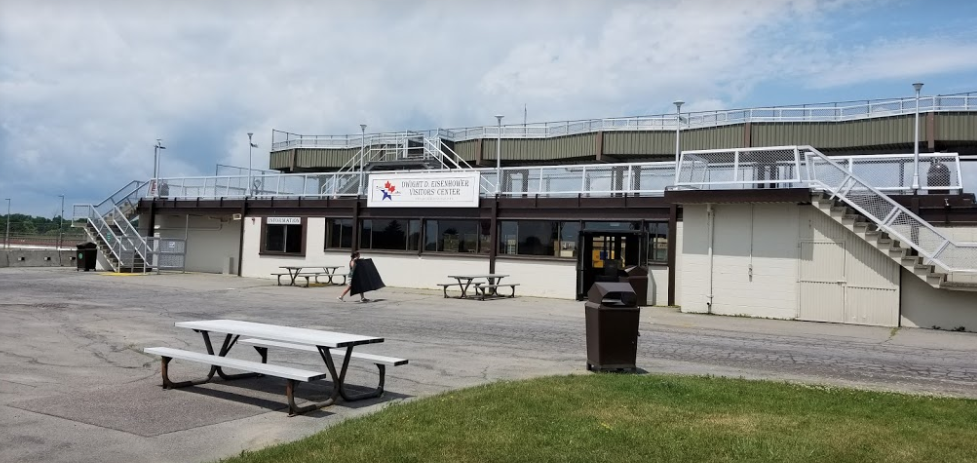
Massena, NY – The Great Lakes St. Lawrence Seaway Development Corporation (GLS) is announcing that the Dwight D. Eisenhower Visitors’ Center, located at the U.S. Eisenhower Lock in Massena, NY, will open to the public on a limited basis on Friday, July 2. It will remain open daily, including weekends, through Labor Day, September 6, 2021. The hours of operation are from 10:00 a.m. to 6:00 p.m. daily
The Seaway Visitors’ Center at the Eisenhower Lock provides tourists and ship watchers with an observation deck where they can view commercial vessels as they transit the lock that raises and lowers ships more than 40 feet. The center’s exterior grounds and observation deck will be open, while the main indoor building facility will remain closed except for elderly visitors and persons unable to walk the steps to the observation deck. A number of safety precautions will be in place and there will be strict enforcement of social distancing, mask wearing if unvaccinated, a temperature check for all visitors, and additional measures consistent with current COVID-19 safety protocols for Federal facilities.
The Center is located off Route 37 in Massena, NY. Turn right at the traffic light at the St. Lawrence Centre Mall entrance if approaching westbound or left if heading eastbound. The Visitors’ Center entrance is 1.5 miles on the right. Parking is free in the lot adjacent to the Center.
For up-to date information on estimated vessel transit times, call (315) 769-2422 for a voice recording of that day’s projected lockage schedule. Additional information is on the website at https://greatlakes-seaway.com/en/navigating-the-seaway/seaway-map/. This map updates every 15 minutes with details on those ships currently in transit within the Seaway System. To obtain specific lock information, visit our Vessel Transit Information page (https://www.glslw-glvm.com/R2/jsp/R2.jsp?language=E&loc=VT00.jsp) and pull down the Order of Turn information. This offers real-time information on those vessels preparing to enter any of the locks.
Boatnerds gather in Soo for annual picnic
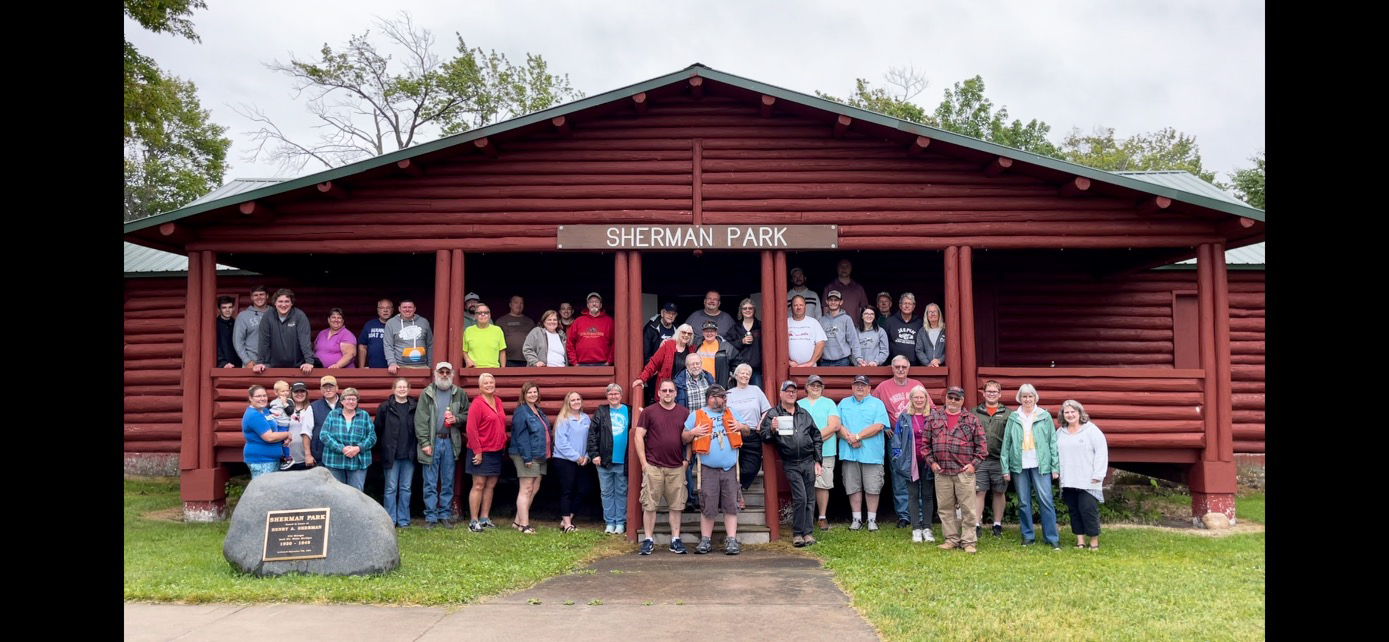
Sault Ste. Marie, MI – Around 50 Boatnerds gathered at Sault Ste. Marie for an informal picnic on Thursday in conjunction with the annual Engineers Day on Friday. The event was held at the Sherman Park pavilion, with hamburgers and hot dogs provided by the book Know Your Ships.