Gales of November virtual program continues Saturday evening
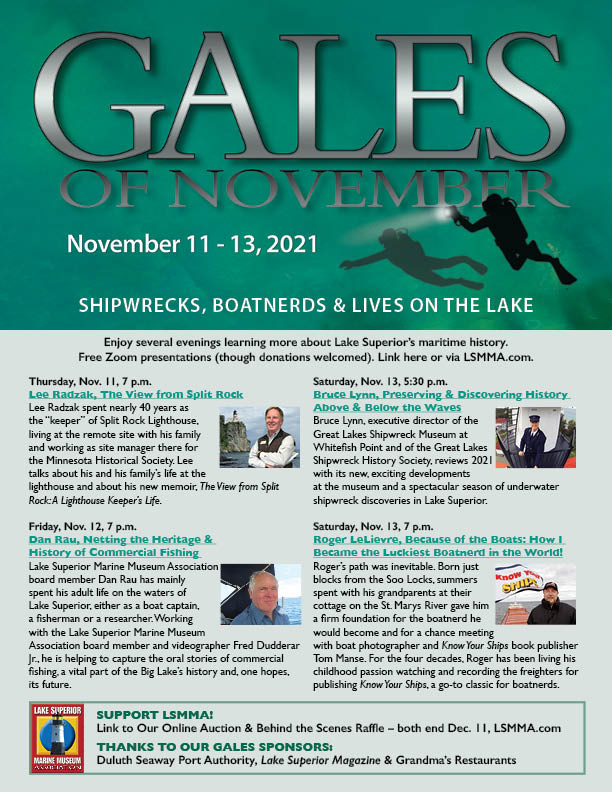
Duluth, MN – Gales of November, the LSMMA’s premier fundraising event for the Lake Superior Maritime Visitor Center, continues Friday and Saturday with several virtual presentations.
Saturday, Nov. 13, 5:30 p.m. Bruce Lynn,Preserving & Discovering History Above & Below the Waves Hosts: Sara Blanck & Konnie LeMay
Bruce Lynn, executive director of the Great Lakes Shipwreck Museum in Whitefish Point and of the Great Lakes Shipwreck History Society, reviews 2021 with its new, exciting developments at the museum and a spectacular season of underwater shipwreck discoveries in Lake Superior. Please click the link below to join the webinar: https://us02web.zoom.us/j/87540432301?pwd=bkxwb0pBZHd3cjJtbTNvRnVJbUNEZz0 9
Saturday, Nov. 13, 7 p.m. Roger LeLievre,Because of the Boats: How I Became the Luckiest Boatnerd in the World!
Hosts: Konnie LeMay & Sara Blanck
In retrospect, Roger’s path was inevitable. Born just blocks from the Soo Locks, summers spent with his grandparents at their cottage on the St. Mary’s River gave him a firm foundation for the years to follow. A chance meeting with boat photographer and Know Your Ships book publisher Tom Manse – who taught a young Roger to take pictures and work in the darkroom – was a turning point in his life. For the past four decades, Roger has been living his childhood passion watching and recording the freighters that ply the Great Lakes waters and, after taking over from Tom, publishing Know Your Ships, a go-to classic for boatnerds. Please click the link below to join the webinar: https://us02web.zoom.us/j/87182232369?pwd=QWJjdGRCalppYmZObktERitMTldydz0 9
Ottawa buys another second-hand icebreaker for the coast guard
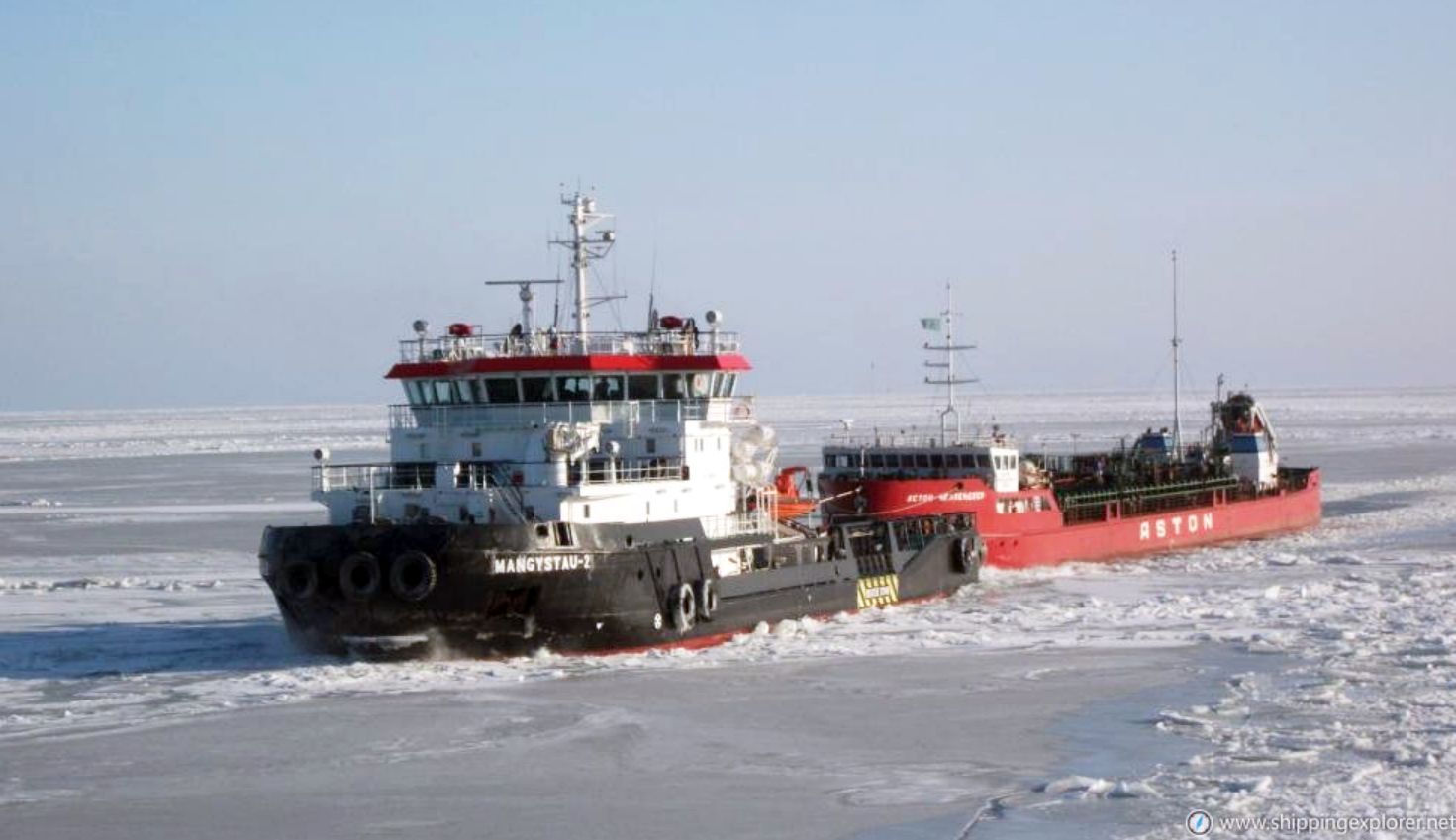
Ottawa, ON – The Canadian Coast Guard is adding a new ship to its fleet, so to speak, as the federal government announced Wednesday it is paying $45 million to purchase a second-hand icebreaker that has been working in the Caspian Sea.
The decision to purchase the Mangystau-2 light icebreaker is meant to ensure the coast guard has enough working ships to keep Canada’s waterways open, Fisheries Minister Joyce Murray said in a statement announcing the move.
“The purchase of this light icebreaker will allow for the continued delivery of Coast Guard services, while ensuring the existing fleet can be repaired and renewed,” she said.
“This purchase will ensure vital shipping routes remain navigable year-round while generating good jobs in our Canadian shipyards.”
The coast guard’s existing icebreaker fleet is extremely old, which has resulted in several breakdowns in recent years.
The Canadian Press has previously reported on the impacts of that aging fleet, including disruptions to search-and-rescue efforts, ferry services and Arctic resupply runs, as well as millions in lost navigational buoys.
Yet while the federal government has tapped Vancouver-based Seaspan Shipyards and Chantier Davie in Quebec City to build replacements for the fleet, those new ships are still years away from being delivered.
The Mangystau-2 is being purchased from New Brunswick-based Atlantic Towing Ltd. and will travel from its home port in Turkmenistan to a new temporary home in Prescott, Ont., by the end of the year, according to the government.
Canadian Coast Guard
Warm fall has Great Lakes slow to cool
Traverse City, MI – For the small swim group TJ Andrews and Ashlea Walter belong to, Sunday’s paddle wasn’t just another dip in Lake Michigan. It was the latest that either one had ever been in the lake, they said — Walter didn’t even use a wet suit.
“They do seem to be stretching further into the fall every year, these warm water temperatures,” Walter said. “It seems like it’s trending that way. I can remember last year we had some later swims too, not quite as late as this year though.”
It’s not just her imagination. Heather Smith, Grand Traverse Baykeeper for the Watershed Center Grand Traverse Bay, said Great Lakes temperatures have gradually been getting warmer for the last few decades.
Lake Michigan temperatures this time of year are typically 50 degrees, Smith said. A buoy off Muskegon read 55 degrees Wednesday, while two in the Straits of Mackinac were close. Warmer temperatures in October kept the lakes warmer, too.
“It just takes a lot of energy to cool down our lake water temperatures,” she said. “We need prolonged cool periods to cool our water down and start to form ice.”
Warmer waters could have implications for ice cover, evaporation and lake-effect snow going into the winter, Smith said. Cold, dry air moving over relatively warmer water could lead to more snow, depending on variables like wind directions and air temps that are too hard to predict at this point.
There are also ecological impacts, as ice cover shelters fish eggs from rough seas in the winter, Smith said. But there’s more to it than just the short-term effects, Smith said.
“I think that one thing that we can potentially take away from this is, since 1995 the surface water temperatures in all of our Great Lakes have increased, and I think that we need to think about this in kind of that longer context,” she said. “It’s not just what’s going to happen this winter or next month or next summer, but think about what a changing climate might do to the lakes.”
Rising water temperatures could cause a shift in species, Smith said — warmer waters are tough on some fish while a boon to others. That could include invasives, and higher water temps could lead to more toxic algae blooms.
Smith said it’s another sign of the need to think about resiliency in the face of a changing climate. Along with ecological impacts, less ice cover, more evaporation and frequent heavyrains can lead to more variable lake levels and more intense coastal flooding.
Andrews, the Watershed Center Grand Traverse Bay’s attorney, said the swim group took advantage of the conditions Sunday, but the broader implications weren’t lost on her. “I would just as soon be in the pool with normal weather patterns, but I don’t even know what that means anymore,” she said.
Late swims are a “silver lining” but they’re definitely not normal, Walter said. She agreed climate change is cause for concern, and action.
While the water was warm enough to let Andrews, Walter and two more in, it was too cold for a longer swim, Andrews said. Afterward, they warmed up by renting a nearby sauna. “If that’s cheating, I admit it,” Andrews said.
Traverse City Record Eagle
Captain of Park Point, neighborhood uniter, has died
Duluth, MN – Near the S curve on Duluth’s Park Point on Monday morning, there was a new handmade sign attached to a fake buoy — a tribute to a boat aficionado, retired Vista Fleet captain and the community’s great uniter who died last week.
“Bon voyage, Capt. Tom Mackay,” the sign read. Across the street was another: “Aye Capt Tom Mackay Always helping and a friend. Park Point will miss you. Farewell.”
Mackay, a 77-year-old lifelong Park Pointer, known by many as “Captain Tom,” died unexpectedly Thursday, Nov. 4. He was remembered this week by friends, family and neighbors as an artist, an iceboat — and regular boat — enthusiast, a helper, a problem solver, a protector, someone who was easy to get along with and a man proud of his Scottish heritage.
“He was just a regular (Park) Pointer,” said Mark Elden, a longtime friend who grew up admiring Mackay and made the buoyed sign at the curve to send him off.
“Some people are just really great neighbors. A big chunk of our heart and soul is torn out. He’s been around forever.”
Mackay was among a small group of Park Pointers who have lived on the sandbar for their entire lives — save for four years with the U.S. Navy. He had lived on both the Lake Superior side and the bayside. He kept a ship wheel in his front yard. In the back, he kept a collection of national flags, a dock with decorative plates bearing his last name, and a glowing buoy ball that changed to muted neon shades.
Elden, about a decade younger than Mackay, remembered seeing him riding in a car with two bench seats and no body, just the chassis, after Mackay came home from Vietnam.
“That was pretty hilarious,” Elden said, and then added. “You don’t realize how much somebody can be a part of your life until they’re gone.”
Mackay started working on the Vista Fleet in 1970 and once told the News Tribune that it was “the only tourism thing in this part of town at the time.”
It was work he continued to reference even after retirement. He told a reporter in 2005 that he had probably caused the Aerial Lift Bridge to raise more than anyone else — a statistic he had recently offered to a neighbor while bridged, according to fellow Park Point friend Diane Gould.
Captain Tom and Liz Mackay met and fell for each other during gatherings at the Lafayette Community Center, according to family. They were married for 38 years. “They’ve been ideal,” said Mary Mackay Gaidis, Tom Mackay’s younger sister. “Such a good team.”
Gaidis described her older brother as her protector and best friend. He opened doors for her. He was close to her children and taught her 9-year-old grandson to use a runabout. “His absolute love for every child was immeasurable,” she said.
For the artist behind Dock 5, meeting Mackay was integral to creating the life she wanted when she moved back to Duluth from San Francisco in 2008.
“One of the things motivating me: I was hoping to find a real sense of community by living on Park Point,” said Natalija Walbridge, who creates hand-illustrated canvas bags and more in her home. “Being just two doors down, he was one of the first people to reach out to me. He was ready to be friends with anyone who passed by here and he helped us to get to know each other.”
He was one of her best friends, she said, and biggest supporters. He had recently sent a news tip to a local television station about all the masks Walbridge made during the pandemic. And after her car was totaled in 2014, Mackay offered up his red truck labeled “Park Point Affluent Poor” to use weekly for her errands.
She described the neighborhood as one with residents who look out for each other — and Mackay as the instigator behind that sense of community. He was someone who regularly shared with those around him.
David Johnston has lived across the street from the Mackays since he moved to Duluth from Ely in 2010. He described standing in the yard with Mackay, who stopped passersby to introduce both of them. Mackay’s familiarity with Park Point gave him access to the house histories of newbies who had moved to the island, even on homes 10-15 blocks away. “A lot of people thought of him as a ship captain,” Johnston said. “I thought of him as a bridge builder.”
Gould, who has lived on Park Point since the mid-1980s, said that after she and her husband have put away the boat for the season, Mackay would let he and their dog use his skiff to get to Hearding Island. “Everybody on Park Point is a neighbor of Tom Mackay,” she said.
Mackay was a regular source for News Tribune reporters on all things Park Point, whether it was a question about water levels, the muddiness of water on the bay, or the frequency of bear sightings on the island (before 2011, he told the News Tribune that he had only once before seen a bear out there).
But Mackay wasn’t just a go-to source — he also wrote letters to the editor and was in communication with reporters and editors at the newspaper. Especially if something was incorrect.
“Capt. Mackay called us frequently over the years to discuss stories we had published, offer story tips and gently correct us from time to time if we had an error about Lake Superior or the bay,” Executive Editor Rick Lubbers said. “He was passionate about that geography and was never shy about making sure we got it right.”
This was important to him, Mackay explained in a 2007 letter to the editor, because he had seen emergency responders misdirected by bad information.
“Superior Bay is between Park Point and the Blatnik Bridge,” he wrote. “St. Louis Bay is between Blatnik Bridge and Bong Bridge. Emergency responders rely on accurate information.”
Mackay had an annual tradition to remember an old friend who died tragically while trying to save three boys who had been caught in the big winds and waves over Duluth ship canal’s north pier on an April night in 1967.
Every year, Mackay brought flowers to the pier’s plaque to honor Culbertson — three flowers on one side, one on the other.
His community-mindedness continued even this fall. Mackay had donated a golden anchor that could serve as a trophy in border battles between the College of St. Scholastica and the University of Wisconsin-Superior’s women’s soccer teams, according to a news story reported by Fox 21.
And on his last day, Mackay and his friends, Dan O’Neill and Elden, removed Walbridge’s dock for the season — the same crew that had put the dock in the water in mid-May.
“It was a beautiful day and everyone was in good spirits,” Walbridge said. “They stood around afterward and had a nice long visit and were talking about different fishing adventures they’d had. I was soaking it in. I look forward to it every year.”
Duluth News Tribune
‘Great Lakes Simulator’ game to release in December
Jason Dial and Digital Light have announced the release of “Great Lakes Simulator,” a video game in which players drive one-to-one scale lake freighters around the Great Lakes. The game is set to launch on Dec. 15.
Dial currently lives in Alabama but has family in Michigan and, if the game does well, plans to own a home in Michigan one day. He has been involved in programming on and off for the last couple of decades and has worked at a computer company, where he has built and repaired computers as an ISP technician and web designer.
The simulator genre has always been of interest to Dial and, as a result, he has spent thousands of hours in driving and flight simulators. His passion for simulators has even driven him to make his own games. Dial made his first downhill skiing game, Basic 1.0, when he was 11.
Dial began developing simulators with the hopes of releasing them to the public a few years ago and he released his first simulator earlier this year, “Suez Canal Simulator,” on Steam. He added that he publishes his games through his own publishing company, Digital Light.
“Development on ‘Great Lakes Simulator’ began in July 2020 immediately upon returning home from a trip I took with my dog Lewis to Port Huron, where we swam in the Great Lakes for the first time at Lighthouse Park Beach,” Dial said in an email. “I had the idea for this simulator a few years ago and spent a lot of time thinking about what I would like for it to be, but for a long time, it all seemed like a pipe dream because the massive scale made it seem like a project that would be unfinishable.”
Created on a 1-to-1 scale, players can drive massive lake freighters the full 750-mile distance from Duluth, Minnesota, to Port Huron, Michigan, and sail the full length of both Lake Huron and Lake Superior.
In the game, players can drive massive lake freighters the full 750-mile distance from Duluth, Minnesota, to Port Huron, Michigan, and sail the full length of both Lake Huron and Lake Superior. This includes passing through the Soo Locks. At scale speeds in real-time, a round-trip journey will take days to complete. Players will have the option to compress time when they want.
Players will also have the opportunity to sail past some of the most well known locations on the Great Lakes and use the lighthouses and range lights to guide them on their way.
Dial attributed his inspiration for this simulator to his grandfathers, who were fascinated with lakes and water and both built large lake complexes. Dial also said he personally has a fascination with water, especially with creating water-based worlds with 3D software. This game, he said, was also built as a thank you to every person who has ever sailed the lakes, especially for everyone who ever dedicated their lives to working on the Great Lakes as well as their family members and their communities.
At this time, “Great Lakes Simulator” is slated only to release on the personal computer, or PC.
Dial was also inspired by the challenge of creating an expansive game world. At the time, he had hit a wall in the maximum size he could get the game world to be. As a result, Dial had to develop new techniques to overcome those limitations. Now, the “Great Lakes Simulator” game world, including a 50-mile view distance, is 135,000 square miles.
Hand dredging large parts of the Great Lakes, such as the St. Marys River and Whitefish Bay, posed a significant challenge to Dial since he couldn’t find any publicly available data sets for the bathymetry of the lakes, rivers and channels. Since NASA terrain data shows only the water’s surface, he was required to reference depth charts online and manually dredge great areas of the three-dimensional terrain mesh by hand using a terrain sculpting tool.
“There are hundreds of miles of shoreline visible in the game which means hundreds of thousands of trees had to be positioned, quite a few by hand, but most using procedural generation code to save time, but even that took a great amount of time,” Dial said via email. “There are also the ship tracks, which total over 2,000 miles and had to be positioned by hand, a process that required new techniques and much trial and error to get it all the way I wanted.”
Sault News
Read more about the game here: https://store.steampowered.com/app/1398280/Great_Lakes_Simulator/
Enbridge contract boat crashed into Mackinac Bridge, authorities say
St. Ignace, MI – Authorities confirmed that a small craft operated by a Canadian oil pipeline company contractor crashed into the Mackinac Bridge after nightfall this month.
According to the U.S. Coast Guard, a 33-foot construction vessel struck a bridge pier on Wednesday, Nov 3, resulting in minor injuries among crew members on board.
The boat, owned by J.F. Brennan Co. of Wisconsin, struck a pier on the north end of the bridge about 7:30 p.m. while transporting crew from St. Helena Island to St. Ignace. The boat returned to harbor under its own power. The crash was reported the next morning. It’s unclear what caused the crash.
“Our staff did go out to inspect the pier and found only a cosmetic scrape on the steel that surrounds the concrete pier,” said James Lake, spokesperson for the Mackinac Bridge Authority.
MLive