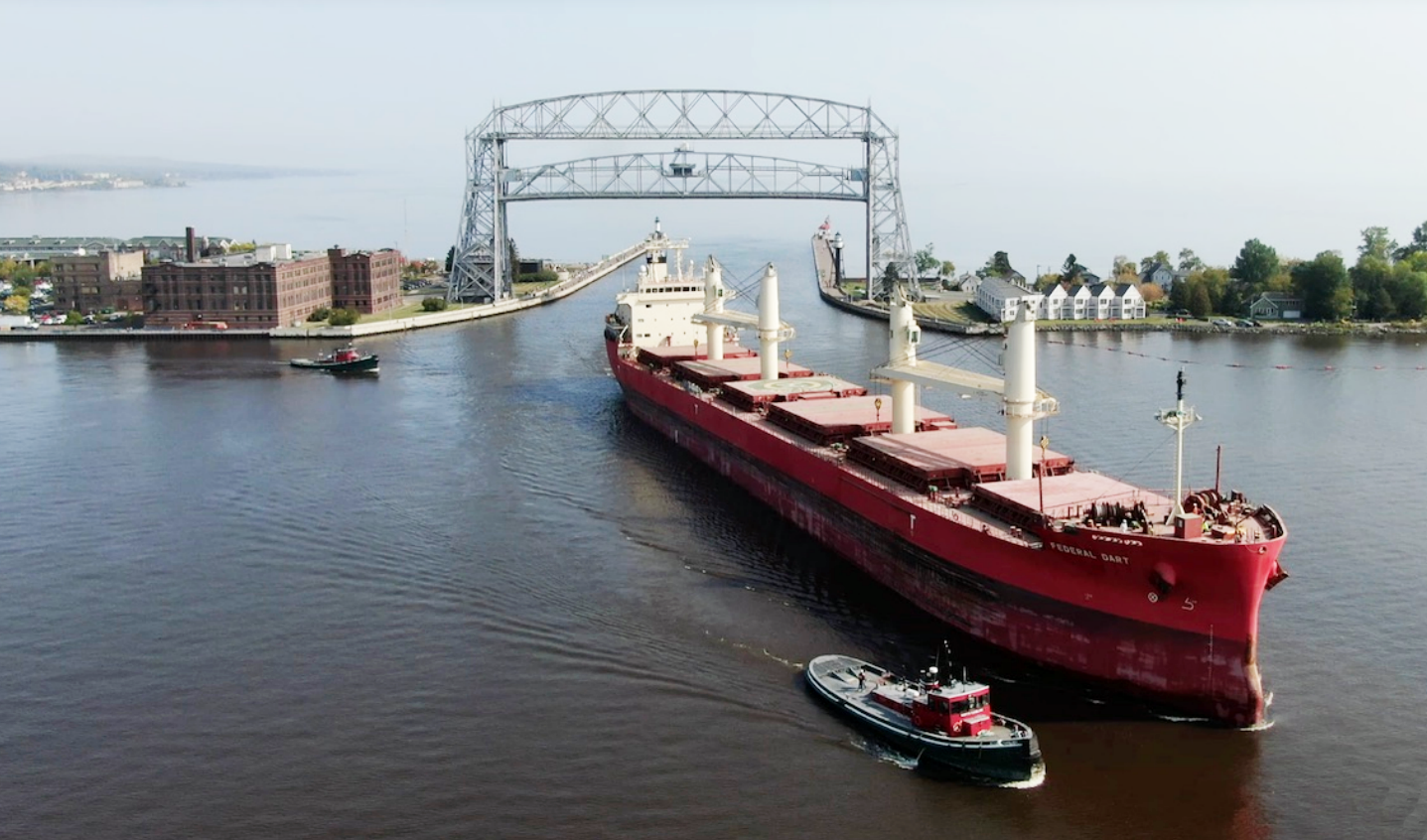
Smooth sailing on Great Lakes as Seaway shipping increases steadily
With the nation’s ports struggling under the weight imports, it seems to be smooth sailing on Great Lakes.
The Great Lakes Seaway Partnership has reported an increase of 1.92 percent for St. Lawrence Seaway traffic, consistent with previous growth trends. An overall total of 28,494,000 metric tons of cargo shipped through the Seaway from the opening of the Seaway on March 22, 2021, through October 31, 2021. Additionally, total transits YTD reached 2,976 vessels, a 1.33 percent increase compared to transits through October last year.
“This consistent growth in traffic for the Great Lakes Seaway System is evidence that the system is not experiencing the same degree of supply chain disruptions or congestion compared to coastal ports or elsewhere globally,” the Great Lakes Seaway Partnership said.
In October, the Seaway System saw a noticeable increase in cargo movements, particularly during the last week of the month, said Craig H. Middlebrook, Deputy Administrator at the U.S. Great Lakes St. Lawrence Seaway Development Corporation.
“These next few months are typically the busiest of the Seaway’s navigation season,“ said Middlebrook. “The harvest is in, U.S. export grain is moving through our Great Lakes ports and the Seaway. As global demand increases, we anticipate this upward trend in outbound grain shipments to continue through the end of the year.”
Through October 2021, tonnage surpassed 9 million tons for the Port of Toledo, an increase of over 25 percent. Domestic tonnage is up over 48 percent and trade with Canada has increased by 14 percent. Iron ore, coal, general cargo, and dry bulk commodities are all tracking ahead of last year.
“We have nearly surpassed our 2020 tonnage total and we’re only in October,” said Joseph Cappel, VP, Business Development, Toledo-Lucas County Port Authority.
General cargo shipments for the Seaway continue to increase, showing a 65 percent increase year-over-year due to top performing ports for iron ore and steel slabs, such as Toledo. Other traditional “steel” American Great Lakes ports include Cleveland, Detroit, Milwaukee, Chicago and Burns Harbor. In total, these ports saw 10 vessel port calls with diverse steel products from approximately 10 countries.
For the Port of Toledo, most of the increase is attributed to additional domestic iron ore shipments associated with the Cleveland Cliffs direct reduction plant, however Toledo is also experiencing increases in coal, dry bulk, and general cargo. Commodities such as salt, aluminum, and other bulk material have been strong this year.
“We are always working on accelerating the supply chain for these cargos through our terminals. To that end, we have acquired and started using our new Liebherr 550 mobile harbor crane in combination with our two Liebherr 280 cranes for material handling at Midwest Terminals,” said Cappel. The new Liebherr 550 crane has lift capacity of 154 metric tons and can be utilized for project cargo, break bulk, and bulk commodities.
Overall, iron ore continues to be a standout export commodity for Seaway traffic, with a 20 percent increase year-over-year. Minnesota ports saw 11 Lakers export iron ore to the Port of Quebec, for trans-shipment to high-demand countries.
Total tonnage for the Port of Duluth-Superior is tracking 2.5 percent ahead of the five-season average and 33 percent better than the COVID-slowed 2020 pace. Iron ore remained a hot commodity, with more than 2 million short tons leaving the port in October. That pushed Duluth-Superior’s season total to 16.4 million short tons, which exceeded the five-season average by 16 percent.
“The flexibility we offer shippers to switch between modes of transport to and from our multimodal general cargo terminal has been an advantage for them in navigating the global supply chain challenges of 2021,” said Deb DeLuca, Executive Director, Duluth Seaway Port Authority. “So far, it’s truly been a season that emphasizes the importance of supply chain reliability and versatility, and we deliver on those in Duluth-Superior.”
Record warm water temperatures now on most Great Lakes
Warm weather in September and October has kept the Great Lakes’ water temperatures much warmer than normal for mid-November. A few of the Great Lakes are warmer than they have ever been since consistent water temperature tracking has been developed.
Lake Superior still has surface water temperatures in the high 40s. Lake Michigan still has water temperatures in the mid-50s. Lake Erie was still almost near 60 degrees last week.
Read more and view charts, graphs at this link: https://www.mlive.com/weather/2021/11/record-warm-water-temperatures-now-on-most-great-lakes.html
U.S. Senator Gary Peters is 2021 Legislator of the Year
Cleveland, OH – Today the Great Lakes Maritime Task Force (GLMTF) recognized the tremendous work done by Michigan U.S. Senator Gary Peters for protecting and advancing the Great Lakes Navigation System.
Senator Peters has moved the needle on several extremely important projects in the Great Lakes. He continues to be instrumental in efficiently funding the construction of a new large navigational lock in Sault Ste Marie, Michigan. Senator Peters understands the economic benefits of Great Lakes shipping and the need to make our ports competitive and reliable even during the winter season. To that end, he cosponsored the “Great Lakes Winter Commerce Act” which would make icebreaking a higher priority for the U.S. Coast Guard and ensured $350 million was included in the pending House Reconciliation Bill for another heavy Great Lakes icebreaker. In addition, he has worked tirelessly with the Port of Monroe to resolve import and export issues associated with U.S. Customs and Border Protection’s interpretation of rules that hampered further port development with containerized cargo.
“The Great Lakes have and continue to be at the heart of Senator Peters’ leadership. His deckplate approach and unrelenting support have allowed the Port of Monroe to prosper while setting the course for our future as a sustainable seaport. I am humbly appreciative that the Senator’s efforts are being recognized with this award as his identity as a true champion of the Great Lakes maritime industry is rivaled only by the admiration we have for his efforts,” stated Paul LaMarre, GLMTF member and Port Director for Monroe, Michigan.
Senator Peters was a strong advocate for the passage of the Water Resources Development Act (WRDA) 2020 which ensures consistent funding from the Harbor Maintenance Trust for the U.S. Army Corps of Engineers. The funds are critical to maintaining the 60 federally-maintained deep-draft ports on the Great Lakes along with navigational structures which have suffered severe damage due to higher water levels.
The Senator has made protecting the Great Lakes one of his top priorities. In late 2020, he secured a bipartisan provision that was signed into law as part of the year-end funding bill to provide the first increase in the Great Lakes Restoration Initiative (GRLI) funding since the program was established in 2010. The GLRI is critical to cleaning up the Great Lakes and protecting them for future generations.
In addition, Senator Peters was able to get bipartisan legislation signed into law called the STORM Act to support local communities facing rising water levels, coastal erosion, and flooding that have put homes, property, and communities at risk. The bill authorizes FEMA to help states establish revolving loan funds that local governments could access to help mitigate the impacts of rising water levels, coastal erosion, and other natural disasters in a more cost-effective way. He secured an initial $500 million for the program in the bipartisan infrastructure bill. He also announced that the Coast Guard’s National Center of Expertise – which he envisioned, got signed into law and secured funding for – will be headquartered in Michigan at both Lake Superior State University and the Great Lakes Environmental Research Lab in Ann Arbor. The Center of Expertise will research and examine the impacts of oil spills in freshwater environments – for which there is little publicly available information on – and help develop effective responses.
Finally, Senator Peters introduced the “CADETS Act” in June 2021. The bill would expand the age eligibility for the Student Incentive Payment (SIP), which provides financial assistance to cadets who attend one of the six State Maritime Academies – including The Great Lakes Maritime Academy in Traverse City, Michigan. In return for their commitment to serve in the U.S. Navy Reserve at their time of graduation, cadets can receive up to $32,000 in incentive payments over four years to help offset the cost of tuition, uniforms, books, and living costs. “As a former Naval Reservist, Senator Peters recognizes the importance of this program to both the cadets and our national security,” noted Jim Weakley, GLMTF’s Vice President and co-chair of Great Lakes Maritime Academy’s Board of Visitors.
“The Great Lakes Maritime Task Force is grateful for Senator Peters’ leadership and ambition to ensure the Great Lakes remain protected and forever the pilot light of the North American economy. The Fourth Sea Coast needs relentless champions like Senator Peters,” stated John Clemons, President of the GLMTF.