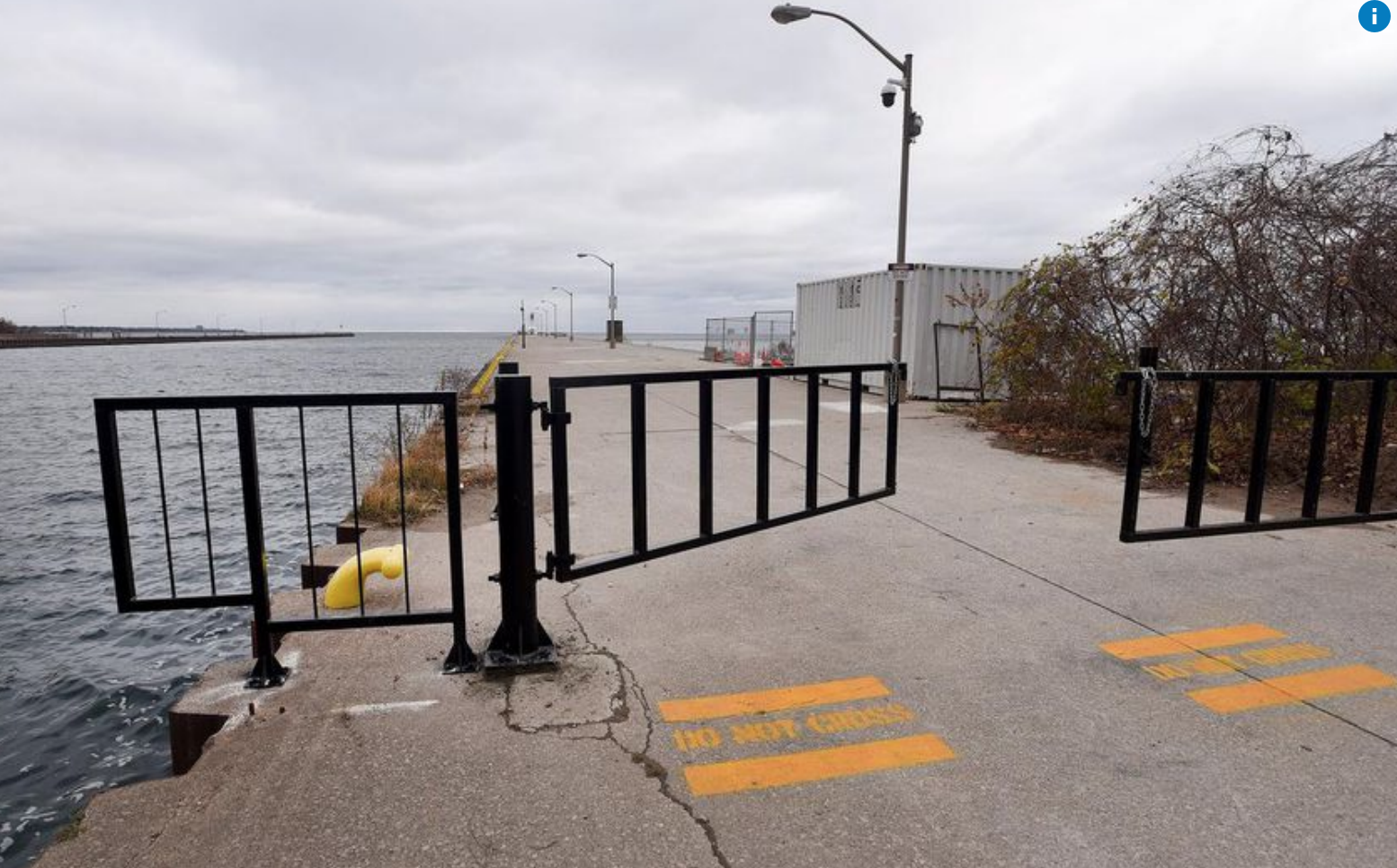
Popular Burlington canal piers to be gated, closed even as cities try to negotiate public access
Burlington, ON – Transport Canada will use gates to close the popular Burlington shipping canal piers to pedestrians in December even as neighboring cities negotiate to preserve public access.
The federal agency angered local residents last year by threatening to ban the public from the pair of 321-metre-long piers that usher ships into Hamilton Harbour and serve as popular walking paths into the lake as well as popular vantiage points for ship photographers. Public pressure and advocacy from former MP Bob Bratina spurred a closure “pause” last year to allow talks with Burlington and Hamilton.
But residents watched nervously this month as three new swing gates were installed to block entrance to the piers from the waterfront trail. Transport Canada confirmed it will begin “restricting access” ahead of winter conditions, but added future recreational use is still up for negotiation.
Gates have been installed on both sides of the shipping canal piers near the lift bridge, which will cut off access for walkers and fishers.
“Our biggest fear is that if they don’t reach an agreement, they will close them completely,” said Matt Francis, an east-end resident who organized a Save Our Pier! group last year. “Hopefully we’ve demonstrated to (Transport Canada) that we won’t stand for that.”
Hamilton Mayor Fred Eisenberger said Friday cities on both sides of the canal would consider taking responsibility for pier maintenance and controlling access in dangerous weather — if the federal government first pays to make the crumbling concrete safe.
That could cost anywhere from hundreds of thousands of dollars to the low millions.
“We certainly expect that the federal government will make those investments,” said Eisenberger. “I imagine it’s not a small investment, but certainly not in the tens of millions of dollars, either.”
New Hamilton East-Stoney Creek Liberal MP Chad Collins said he will “absolutely” lobby for federally funded repairs to the piers. “I think at this point both (levels of government) want the same thing,” he said. “We want to maintain public use and we want those users to be safe.”
Hamilton Spectator
Legislation looks to improve maritime conditions in Michigan
Manistee County, MI – Legislation aimed at improving maritime commerce in Michigan could benefit lakeside communities like Manistee, according to the bill’s sponsor, Rep. Jack O’Malley (R) Lake Ann.
House Bill 5291 would establish a Port Facility Improvement Grant program for the expansion and creation of public and private ports within the state. It also creates the Maritime and Port Facility Improvement office within the Michigan Department of Transportation — devoting a specific office to Great Lakes commerce.
O’Malley chairs the House Transportation Committee. The second-term legislator underscored the need to focus on maritime activities, just as the state does for roads, bridges, aviation and railways.
Appropriations would still be needed to address the grant process, but O’Malley maintains that establishing a framework for the program is a necessary first step.
“Michigan really does nothing to support its maritime community,” O’Malley told the News Advocate. “When you look at the amount that the other states are doing: Ohio is cleaning our clocks. Billions of dollars are going to Toledo and Cleveland because Michigan just hasn’t supported things.”
Michigan has around 36 ports in operation, but Great Lakes freighters often arrive at ports in places like Wisconsin and Ohio, which have similar legislation already in place, according to O’Malley.
“We’ve all heard and seen the Tim Allen Pure Michigan commercial where he talks about sitting on the shore watching the Great Lakes freighters slide by. The problem is that boat doesn’t stop in Michigan. It’s going to Duluth, it’s going to Milwaukee, it’s going to Chicago, it’s going to Cleveland — it’s going somewhere else. They really don’t stop anywhere in Michigan,” O’Malley said.
“Michigan is basically considered passive in our assistance to the maritime and shipping community in the Great Lakes region. We’re the last to the table and we’ve got to change that,” he continued.
While Great Lakes freighters still arrive at cities like Manistee and Ludington, O’Malley said that creating a new maritime office and grant program would open up state and federal funding for local port authorities to improve their facilities.
In particular, O’Malley highlighted a port in Muskegon which he said is “a good sized port” that could still “grow a lot.”
“What that means is a port facility could ask for a grant that could then be used as the local portion of paying down to a match with a federal grant (and) it would open us way up to federal monies and other grant processes that we don’t have access to right now because there’s no money to back them,” O’Malley said. “So it would be a grant process and … Manistee, Muskegon, Ludington if they wanted to build up their port facilities, this grant would help them do it.”
Port officials who spoke in support of the bill when it was under consideration in the House Transportation Committee, said the legislation was needed to make the state a water transportation hub. This includes Kyle Burleson, director of operations at the Detroit-Wayne County Port Authority and Paul LaMarre III, Port of Monroe director, according to a press release from O’Malley’s office.
“When (the bill) was in the House, and we had testimony on it, no one spoke in opposition — everybody was in favor,” O’Malley said. “That includes every chamber of commerce from around the state (and) the port associations.”
The bill passed Nov. 10 in the Michigan House of Representatives by a vote of 94 to 11, and has gone to the state senate transportation committee for consideration. If passed, O’Malley said that places could start applying for grants to build or improve their ports within a year.
“We are the Great Lakes State, let’s utilize it and let’s get some of those freighters stopping in Michigan,” he said.
Manistee News Advocate
Red more and view photos at this link: https://www.manisteenews.com/local-news/article/Legislation-looks-to-improve-maritime-conditions-16653562.php
Great Lakes’ warming has wintertime domino effect
Chicago, IL – Winter is just around the corner, but experts say the Great Lakes haven’t gotten the message. After summer and fall evenings that failed to cool sufficiently, surface temperatures in the massive bodies of water are trending above average, the Chicago Tribune reported. It’s an example of climate change.
“What was kind of jarring was the consistency of the warmer-than-normal conditions,” state climatologist Trent Ford said. “And the lack of cool nights.”
Blame states boasting Great Lakes shorelines. Minnesota and Wisconsin recorded their third-hottest Junes in history. New York had one of its hottest summers. Lake Huron set a record when it reached nearly 74 F (22 C) in late August.
Illinois brought the heat, too. The state’s minimum average temperature for July through October was the highest ever next to 2016, according to National Oceanic and Atmospheric Administration records dating to 1895. The average October temperature set a record at 8 degrees above average. The disruption in expected seasonal temperatures produces a domino effect.
A hard frost was delayed until the last week of October, Ford said. Allergy season seemed longer. Bugs had an extended biting season. Ford was picking backyard tomatoes far into October. It continues throughout the calendar. Illinois’ most pronounced warming has occurred in winter — minimum temperatures have warmed by more than 3 degrees.
That stretches out warmer water temperatures, which can produce more lake effect snow, according to Ford. Snow slows with the arrival of ice, which itself is delayed by warmer water.
Ice can diminish the damage of coastal erosion. And warmer water, even at depths found in the Great Lakes, pose challenges by welcoming invasive species and generating harmful algae blooms.
The Associated Press
New address for BoatNerd donations
Great Lakes and Seaway Shipping Online Inc., the nonprofit organization that operates the BoatNerd website and vessel tracking service, has a new mailing address to accept donations. The change was made after one of our longtime volunteers decided to start spending winters in another (warmer) state. Maintaining the old address would have required seasonal address changes each spring and fall. The new address can be maintained year-round.
Great Lakes and Seaway Shipping Online is a 501c(3) non-profit organization incorporated and registered in Michigan. Our primary purpose is to enhance the general public’s knowledge of maritime commercial operations and history on the Great Lakes and St. Lawrence Seaway. To that end, we operate the BoatNerd website and vessel tracking service. In pre-pandemic times, we also sponsored multiple ship-watching gatherings and day cruises around the lakes, and hope to resume those soon.
Monetary donations are greatly appreciated and can be made via check (in US funds) made out to Great Lakes and Seaway Shipping Online, Inc. and sent to:
Great Lakes and Seaway Shipping Online, Inc.
PO Box 304
Paris, MI 49338
Monetary donations are also accepted via PayPal at the DONATE link on the BoatNerd home page. Please note that PayPal deducts a nominal processing fee from all donations made via PayPal.
Braving the Waves” completes Fall 2021 Lecture Series
WHAT: Fall Lecture Series: Braving the Waves: Life-Saving Service
on the Shipwreck Coast
WHEN: Wednesday, December 1, 2021; 7 – 8:30 pm
WHERE: National Museum of the Great Lakes 1701 Front St., Toledo, OH 43605 OR, online via Zoom
ADMISSION: FREE (Donations encouraged and can be given upon registration.) Registration required at: nmgl.eventbrite.com or nmgl.org/events
On Wednesday, December 1, at 7 p.m., the National Museum of the Great Lakes (NMGL) will present the final lecture in their annual fall series titled Braving the Waves: Life-Saving Service on the Shipwreck Coast. The presentation features Bruce Lynn, Executive Director of the Great Lakes Shipwreck Museum, and will explore the stories of the ‘Storm Warriors’ along the desolate shoreline between Whitefish Point and Pictured Rocks to shed light on a little-known chapter of Great Lakes history.
As in the previous lectures, the National Museum of the Great Lakes will offer this presentation as a hybrid event using Zoom with one noted difference—the presenter will be delivering the lecture virtually. Individuals wishing to participate in person may come to the museum for a watch party and be a part of the live-streamed question and answer session following the presentation.
The lecture is free to all, but registration is required. Participants can choose when registering to take part in person at the museum or online via Zoom. Donations are encouraged and can be given upon registration. For more information on this lecture or to register to join the event, visit nmgl.org.