U.S.-flag shipping on the Great Lakes up 16.8 percent in 2021
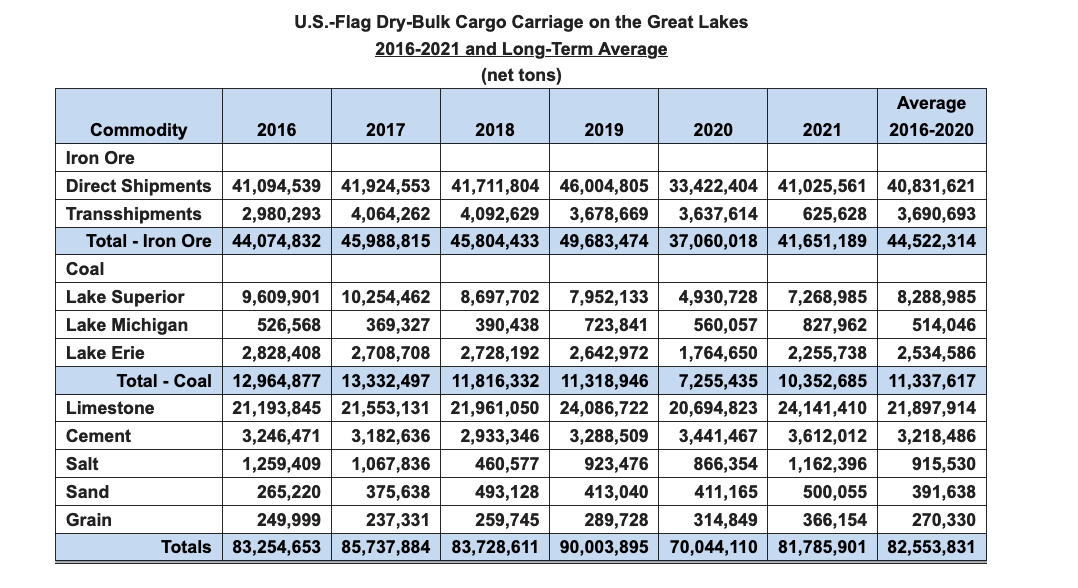
Cleveland, OH – U.S.-flag Great Lakes freighters (lakers) moved 81.8 million tons of cargo in 2021, an increase of 16.8 percent compared to 2020. The 2021 float was less than 1 percent below the fleet’s 5-year average.
Iron ore cargos totaled 41.7 million tons, an increase of 12.4 percent compared to a year earlier. Shipments of all other commodities increased as well in 2021. Coal cargos were up 42.7 percent to 10.4 million tons. Limestone and cement shipments increased by 16.7 and nearly 5 percent, respectively. Salt cargos were up by 34.2 percent. Shipments of sand were up by 21.6 percent, while grain cargos increased by 16.3 percent.
See chart below.
The mighty St. Lawrence, from a maritime pilot’s bird’s-eye view
Simon LeBrun sails the St. Lawrence River, running cargo between Montreal and Trois-Rivières. His social media posts offer marine enthusiasts and landlubbers alike a window into his world.
View the video here: https://www.cbc.ca/player/play/2003799619851?fbclid=IwAR2u81-71IQugRmuMOpcZrqOSfxna909AKvvGXwTkPbFxUTmPpvrhYU4KTA
Lake Michigan cyanide spill results in $3M fine for steel mill owner
Burns Harbor, IN – An Indiana steel mill owner will pay a $3 million fine and donate property for land conservation as part of a court settlement following a toxic chemical spill that killed thousands of fish in a Lake Michigan tributary.
On Monday, Feb. 14, Ohio-based Cleveland-Cliffs agreed to settle a lawsuit filed by two environmental groups in the wake of the 2019 spill, which released thousands of pounds of ammonia and cyanide into the waters around Portage, Ind. The lawsuit was originally filed against ArcelorMittal, which Cleveland-Cliffs acquired in 2020.
This week’s consent decree, filed in U.S. District Court by federal and state officials, includes an agreement from the company to upgrade its facilities to prevent future discharge violations, improve notification procedures, and transfer 127 acres of land for future conservation use.
The settlement must be approved by a judge. It will be open to public comment for 30 days afterward.
Read more at this MLive link: https://www.mlive.com/public-interest/2022/02/lake-michigan-cyanide-spill-results-in-3m-fine-for-steel-mill-owner.html
Canada eyes ‘green steel’ as way to catch up on cutting carbon emissions
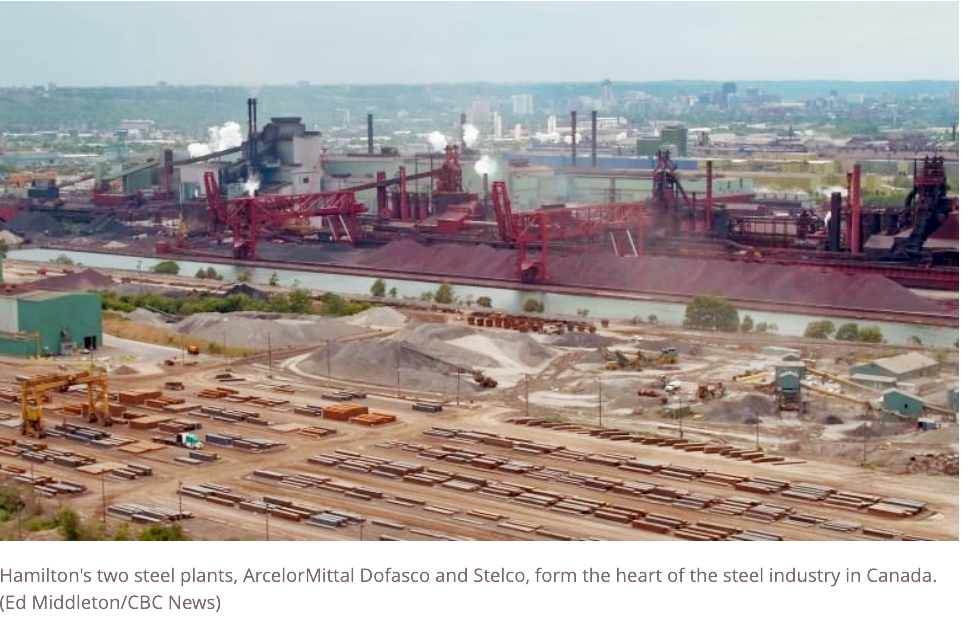
Ontario’s steel industry is aiming for a dramatic reduction in its greenhouse gas emissions, a move that will help Premier Doug Ford’s government get closer to achieving its climate-change targets.
The three biggest industrial emitters of CO2 in Ontario are all steel plants. Steel production alone accounts for more than 40 per cent of all industrial greenhouse gas (GHG) emissions in the province, more than the refinery, forestry, mining and chemical sectors combined.
But a push is now on — funded in part by nearly $2 billion from provincial and federal taxpayers — to convert Ontario’s steel plants to using lower-carbon sources of energy. The expected reductions in CO2 emissions stand to make this the Ford government’s single biggest initiative on climate change.
The latest step toward what’s being dubbed “green steel” is Ford’s announcement of a $500 million provincial government contribution to ArcelorMittal Dofasco in Hamilton, the biggest producer of flat-rolled steel in the country and the single biggest industrial source of CO2 emissions in Ontario.
The plan is to convert Dofasco’s coal-fired blast furnaces to electric-powered systems by 2028.
“Car-makers are investing billions and billions of dollars searching for ways to reduce carbon emissions along their supply chain,” Ford said in a news conference Tuesday. “Well, I have news for all of them. That search starts and ends right here in Hamilton with Dofasco Steel.”
Ford’s announcement comes six months after the federal government announced it’s putting $400 million into the Dofasco plant’s conversion, which means taxpayers are contributing about half of the $1.8 billion cost of the project.
The province and the feds are also backstopping another coal-to-electricity conversion project at Algoma Steel in Sault Ste. Marie, number two on Ontario’s list of biggest industrial greenhouse gas emitters.
The projects will reduce the two steel plants’ combined annual CO2 emissions by as much as six megatonnes (MT). Ontario needs to reduce its total annual emissions by about 18 MT from current levels to meet the government’s target for 2030 under the Paris Accord.
“I think it’s a positive development,” said Keith Brooks, programs manager for Environmental Defence, a Toronto-based advocacy group.
“The steel industry is a large emitter, it’s one of the harder-to-decarbonize sectors, and we’re not in a world where we’re trying to phase out steel,” Brooks said in an interview Wednesday.
Premier Doug Ford came to Hamilton’s ArcelorMittal Dofasco plant to announce the provincial government’s $500 million contribution toward the steel-maker’s efforts to reduce CO2 emissions. (CBC)
Despite the potential significance of these emission reductions from the steel industry, Brooks says the Ford government is still a long way from achieving its climate change targets, which are less ambitious than the previous Liberal government’s targets and those now set at the national level.
“We have no policy in place to increase the uptake of electric vehicles. We have no policies to reduce emissions from buildings. We have no policy actually to deal with emissions from industrial facilities,” said Brooks.
Steel production is carbon-intensive because the blast furnaces used in the smelting process are fuelled by coal and coke (metallurgical coal).
Since Ontario’s electricity generating system is more than 90 per cent free of CO2 emissions, converting the steel plants’ coal-fired blast furnaces to electric arc furnaces will substantially reduce the carbon emissions. “We will fundamentally change the way we make steel,” said Ron Bedard, president and CEO of ArcelorMittal Dofasco.
“We will decommission our coal plants and our blast furnaces. Coal will not be used in our future processes here at Dofasco.”
CBC
Indiana leads nation in steel production after 12.5% jump
Indiana led the nation in steel production last year, maintaining the top spot it has held nationally for more than four decades.
“Indiana was No. 1,” said Ashley Romberg, the digital and online manager of the American Iron and Steel Institute, a Washington D.C.-based trade association that represents the United States of America’s steel industry.
The Hoosier State made 24.3 million tons of steel in 2021, up from 21.6 million tons in 2020. Neighboring Ohio, the home of North America’s largest flat-rolled steelmaker Cleveland-Cliffs, ranked No. 2 nationwide in steel production.
Much of the steel production in Indiana occurs at the hulking integrated steel mills that ring Lake Michigan’s South Shore in Northwest Indiana, where Cleveland-Cliffs, U.S. Steel and NLMK Indiana operate mills. Lake and Porter counties account for about half the nation’s blast furnace capacity.
Many major steel distributors move metal in Northwest Indiana, including Republic Steel, Alliance Steel, AAA Supply Corp., Kenwai Steel, TMS International, Ratner Steel Supplies, Crossroads Steel Supply, Adriatic Steel Co., Leeco Steel, Bayshore Metal, Serve Steel, Coltrade Inc., RW Conklin Steel Supply, Steel Cities Steels, Chicago Specialty Steels and Steel Supply Corp.
NW Indiana Times