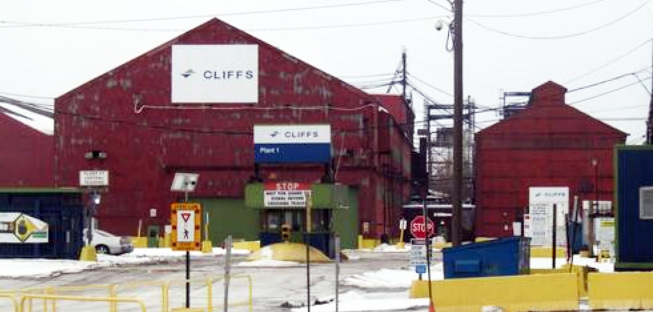
Cleveland-Cliffs to indefinitely idle Blast Furnace No. 4 at Indiana Harbor
Indiana Harbor, IN – Cleveland-Cliffs plans to indefinitely idle Blast Furnace No. 4 at the Indiana Harbor steel mill, the second blast furnace in East Chicago to be taken offline in the last three years in a major blow to and further erosion of integrated steelmaking in the Calumet Region.
The Cleveland-based steelmaker said no jobs will be lost as workers will be transferred to other positions at the sprawling mill along the Lake Michigan lakefront. The dwindling amount of steelmaking capacity along the Lake Michigan lakefront will, however, have long-term effects on employment opportunities at the Region’s steel mills. Indiana Harbor had still operated five blast furnaces a little over a decade ago.
Cleveland-Cliffs announced it would raise steel prices as it took the steelmaking capacity offline, reducing the overall supply on the market at a time of strong demand. It plans to increase the price of carbon hot rolled, cold rolled and coated steel products by at least $50 per ton.
The flat-rolled steelmaker plans to idle Indiana Harbor Blast Furnace No. 4 because of operational improvements that include adding hot-briquetted iron to the blast furnaces and maximizing the use of scrap in basic oxygen furnaces.
All the employees will be transferred to other positions at Cleveland Cliffs Indiana Harbor Works, which combines the former LTV and Inland steel mills that were consolidated under previous ownership. The company said it currently has more available job openings at Indiana Harbor in East Chicago than it had workers at the blast furnace, which forged raw materials into iron, the precursor for the steel that goes into cars, appliances and buildings nationwide.
Cleveland-Cliffs expects the closure will reduce its carbon emissions as integrated steelmaking is a carbon-intensive process that involves burning coke, a form of coal that’s been stripped of impurities.
“Our strategy of increasing productivity at our ironmaking and steelmaking facilities through the use of both in-house produced HBI and additional scrap has allowed us to reduce coke rate and consequently reduce CO2 emissions, as well as to stretch hot metal utilization and still be able to produce similar amounts of crude steel with fewer blast furnaces,” Chairman, President and CEO Lourenco Goncalves said. “Said another way, by concentrating the operation and maximizing productivity at IH No. 7 we are improving our carbon footprint and, at the same time, lowering our cost structure for the same level of steel production and shipments. Most importantly, as we have enough job openings on site for all impacted employees, we are now able to fill several available job openings at Indiana Harbor Works with the current workforce of IH No. 4.”
Cleveland-Cliffs said normal operations will continue at the Indiana Harbor steel mill and the Riverdale Works mill it supplies just across the state line. Indiana Harbor Works still has two steel shops, the hot strip mill and finishing facilities.
Once the largest steelmaker complex in the world, the mill in East Chicago is down to just a single blast furnace. Indiana Harbor Blast Furnace #7 will now supply all operations at the steel mill in East Chicago and Riverdale Works in Riverdale, Illinois.
CEO: ‘The future is bright for Cleveland-Cliffs’ as steelmaker works to limit volatility
Cleveland-Cliffs looks forward to a bright future after posting record profits last year.
The steelmaker is projecting another strong year as automotive demand picks back up, it locks down more long-term contracts and shifts focus to bigger, more stable customers.
“The future, and specifically, 2022, is clearly bright for Cleveland-Cliffs,” CEO Lourenco Goncalves said in a conference call for investors. “Underlying demand remains strong, infrastructure-related spending has started, particularly regarding electrical steels. And the chip shortage affecting the automotive has begun to ease, leading to meaningful pent-up demand for cars and trucks.”
The Cleveland-based steelmaker, which has a large presence in Northwest Indiana, expects to benefit from the auto industry’s rebound from the global semiconductor shortage.
“That should benefit Cleveland-Cliffs a lot more than any other steel company in the United States,” Goncalves said in the conference call. “Let’s make this abundantly clear to our investors. There is no other steel company, integrated or mini-mill, in the U.S. or more broadly in North America capable of supplying all the specs and all the tonnage we supply the American automotive industry. Cleveland-Cliffs already has all the equipment and technological capabilities that other companies are only now spending several billions of dollars to try to replicate by building new melt shops and new galvanizing lines.”
New owner of M.S. Norgoma has no definite plans for ship
Port Colborne, ON – Jeff Dwor, the new owner of the M.S. Norgoma (which at one time plied the waters of Manitoulin Island as a ferry), has no definite plans as to what he is going to do with the ship at this time.
“I like its lines, this vessel could be converted into something else,” said Mr. Dwor, who lives in Port Colborne, after having purchased the ship from the City of Sault Ste. Marie. “The ship is not too big, but not too small either. It is about 185-188 feet in length and 38 foot wide. It is a substantial vessel.”
“It is in good enough shape with ample space. I was thinking of turning the ship into living quarters for now, but I’m open to any kind of idea,” said Mr. Dwor. “I really don’t know yet what I am going to do with the ship. But I am open and flexible to any ideas.”
“One thing about it, I can’t move anything on the lakes until May,” quipped Mr. Dwor.
Earlier this month, Mr. Dwor, a retired ship salvager, purchased the Norgoma for $2,500 from Sault Ste. Marie. City council approved the sale of the 188-foot former package freighter/passenger ferry/museum ship. Tom Vair, the city’s deputy chief administrative officer for community development and enterprise services told Soo Today.com Mr. Dwor has sold his business (Dwor Metal Co. Ltd. of Port Colborne) but is looking at the M.S. Norgoma as a personal project and renovating her for private use. Recently, Mr. Dwor came forward with interest in acquiring the vessel. He flew to Sault Ste. Marie, toured the vessel and expressed interest in purchasing it.
Mr. Vair told The Expositor “council approved the sale of the ship to Mr. Dwor. “The agreement was reached January 31 and concludes in May, so there is a bit of finalization to be done. Part of the decision by council was so the marina by the Roberta Bondar Park marina can be redone. Council had to force the decision and have the Norgoma moved, and currently it is parked at the docks at Algoma-Steel and the town has been paying $40 a day in docking fees (since 2019).”
The city had planned to sell the Norgoma to The Sweet Shop in Tobermory but that deal fell through when the potential owner couldn’t find a berth in the municipal marina there.
Mr. Vair told The Expositor that since then, city staff has been looking for a new location for the Norgoma while also obtaining estimates to decommission the vessel. A recent updated budget revealed decommissioning the vessel would have cost between $275,000-$325,000.
Mr. Dwor will take possession of the Norgoma some time in May. “If someone has a great idea for the ship that I can explore, bring it to me and I will listen. I’m not opposed to anything. Maybe people on Manitoulin could find things that it could be used for.”
MS Norgoma was a Canadian package freighter and passenger ferry that could also transport automobiles on a limited basis. Originally constructed as steam-powered ship in 1950, SS Norgoma primarily sailed the route from her home port of Owen Sound to Sault Ste. Marie, providing a five-day round trip, once a week, serving isolated communities along the North Shore. After conversion to a motor ship, Norgoma was transferred to the Manitoulin Island ferry route between Tobermory and South Baymouth along with her sister ship SS Norisle, replacing the smaller ferry, MS Normac on that route.
Norgoma, owned by Owen Sound Transportion Company Limited, was built at the Collingwood shipyards in 1950. She replaced the SS Manitoulin, which was retired in 1949.
Norgoma travelled mainly on the North Channel route until 1963. Improvements to Ontario’s highways, such as the Trans-Canada Highway (Georgian Bay route) completed in 1962, brought about stiff competition for the company. In that year, a 60-kilometre road was constructed into Killarney from Highway 6, the first port of call for the steamer. At the time, increased traffic on the Manitoulin Island-Tobermory route demanded a greater automobile capacity than her sister ships SS Norisle and MS Normac could handle.
In 1974, both Norgoma and Norisle were replaced by the much larger and more modern MS Chi-Cheemaun which could accommodate more vehicles than both sister ships put together. Norgoma was berthed as a museum ship in Sault Ste. Marie, Ontario. In 1981 the ship was transferred to a charity, the St. Mary’s River Marine Heritage Centre. The Norisle was purchased at the same time. By Assiginack Township and is still berthed at the Manitowaning Marina.
Manitoulin Expositor
U.S. Coast Guard rescues missing person on ice
Sault Ste. Marie, MI ⎯ Members of U.S. Coast Guard Station Sault Sainte Marie and Air Station Traverse City rescued a missing ice fisherman on Lake Superior Feb. 20, 2022. Chippewa County reported the missing individual as a 63-year-old male on a snowmobile towing an ice shanty who was last seen approximately one and a half miles off the shore of Lake Superior in Emerson, MI.
U.S. Coast Guard Sector Sault Ste. Marie launched an Ice-Rescue Team from Station Sault Ste. Marie and the Coast Guard Ninth District launched an MH-60 helicopter from Air Station Traverse City. The crew of the MH-60 immediately located a heat source approximately two miles south of the missing person’s last known position.
The Ice-Rescue Team proceeded to the identified location and found the missing person. The person was taken back to a staging area for evaluation by awaiting Emergency Medical Service personnel. No injuries were reported.
USCG
Collingwood museum launches new exhibit on shipbuilding industry
Collingwood, ON – Collingwood Museum has launched a new exhibit in honor of the inter-generational tradition of Collingwood’s ship-building industry. “Launch Day” focuses specifically on Collingwood’s most photographed and cherished event – the side launch.
The exhibit explores the history of shipbuilding in Collingwood, a century-long tradition that saw more than 200 steel ships plunge sideways into the harbour. Collingwood’s shipyard was one of the last to perform the traditional side launch in Canada. With a small and shallow harbor, side launching was a dramatic solution to this spatial challenge.
Visitors to the new exhibit will experience what it was like to watch, along with thousands of spectators, as five-story-high steel vessels crashed into the water below. They will also learn about the stages of the launch and the unique stories behind some of Collingwood’s most notable ships.
The potential and realized dangers of shipbuilding are also explored through a small section of rope connected to one of the Collingwood Shipyards’ most devastating days, the launch of Tadoussac on May 29, 1969.
From shipbuilding tools and ship models to a stunning silk dress, this new exhibit has something of interest for everyone!
Advanced bookings are recommended by calling museum staff at 705-445-4811 Ext. 7211. Please note that Proof of Vaccination is required for indoor participation. Collingwood Trails maps will be available for those wishing to explore the Promenade Trail alongside the rectangular launching basin as well as the Shipbuilders’ Memorial on Heritage Drive.
The Collingwood Museum is located at 45 St. Paul Street. Please consult the Collingwood Museum’s website for up-to-date COVID-19 protocols. https://www.collingwood.ca/culture-recreation-events/heritage-museum/collingwood-museum