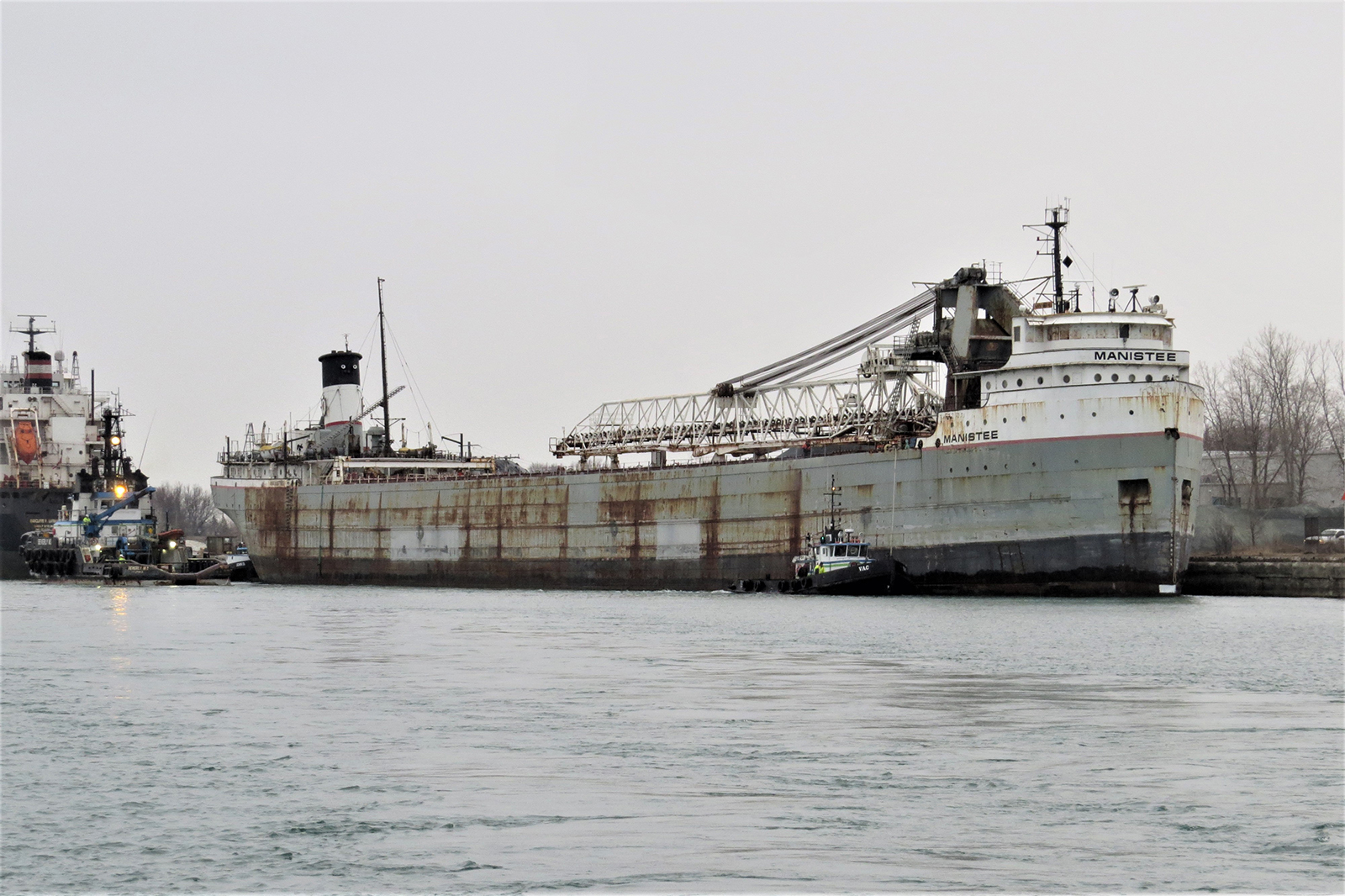
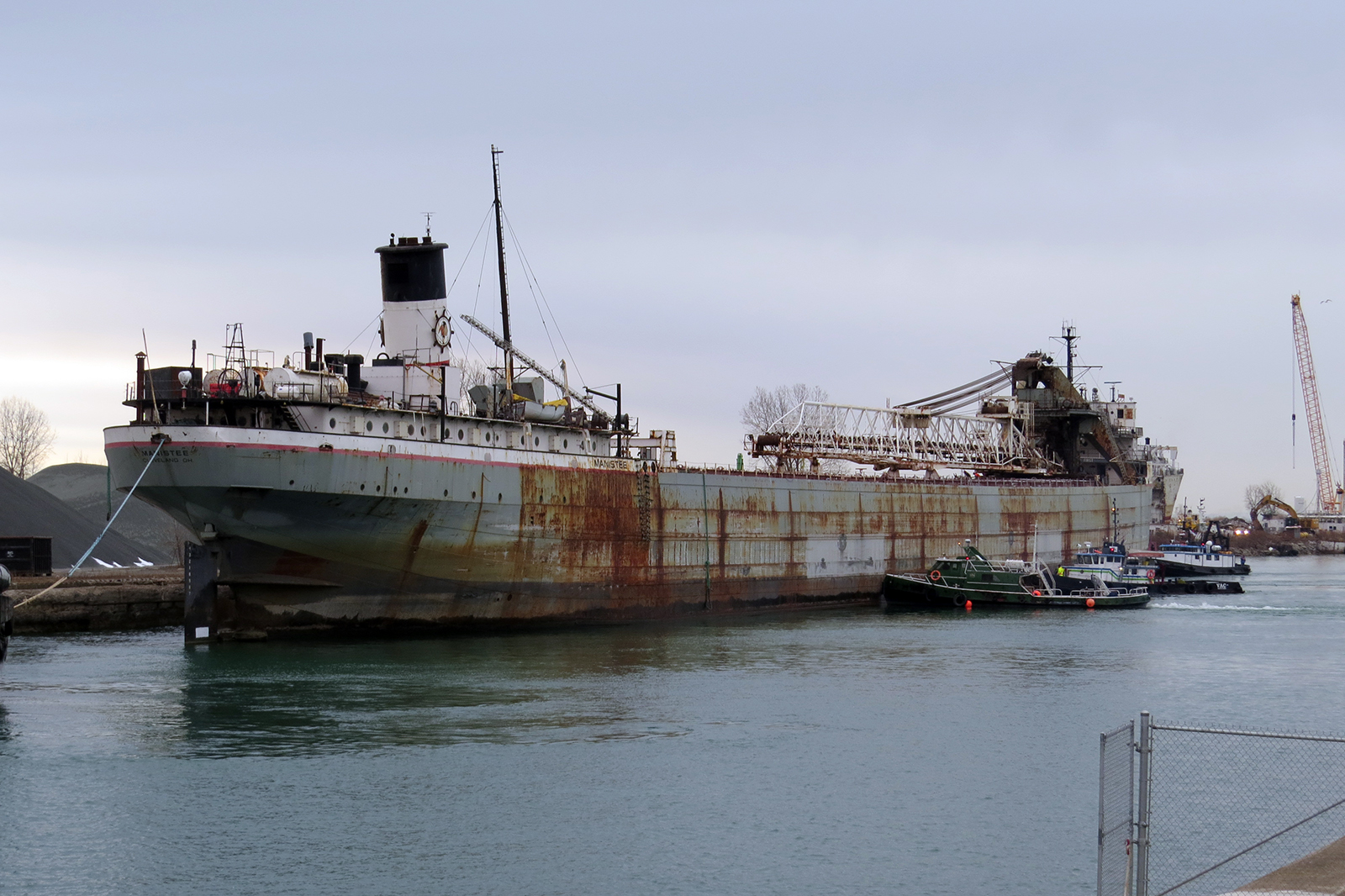
Long-idle Manistee reaches her final dock
Port Colborne, ON – Manistee arrived at Wharf 17 Marine Recycling Corp. in Port Colborne about 0830 March 30. She was towed from Toledo to MRC by tug Beverly M 1 and assisted by tugs Vac and John D. to the scrap yard.
Built in 1943 at Great Lakes Engineering Works, River Rouge, Michigan, Manistee sailed originally as Richard J. Reiss. Her name was shortened to Richard when she was sold to the Erie Sand fleet in 1986. A sale to Grand River Navigation Co. in 2005 saw her name changed to Manistee. She went into permanent layup at Toledo in 2015.
Two lakers arrive Wednesday to open Port of Thunder Bay
Thunder Bay, ON – Two domestic vessels arrived in the early morning hours Wednesday, March 30, marking the official opening of the navigation season in the Port of Thunder Bay. M/V Michipicoten came abeam of the light marking the Mission Bay entrance to the Port at 04:31 a.m. local time. M/V Captain Henry Jackman crossed the north entrance at 05:04 a.m.
The Michipicoten, namesake of the river that empties into Lake Superior near Wawa, Ontario, achieved the honor of being the Port’s Top Hat recipient for 2022. A seasoned vessel on the Great Lakes – St. Lawrence Seaway, this is the first time Michipicoten has received Thunder Bay’s Top Hat. Michipicoten is owned and operated by Lower Lakes Towing, subsidiary of Rand Logistics.
Both vessels are taking on grain shipments. Michipicoten is currently receiving 9,000 metric tonnes of oats at Superior Elevator and will depart overnight for Toledo, Ohio.The Michipicoten’s crew is led by Captain Adam Barnes and Chief Engineer Ralph Reeves.
Due to weather and other factors, a ceremony was not held.
Meanwhile, a winner has been declared in the Port of Thunder Bay’s Top Hats 2022 Laker Contest. With a guess of March 30 at 04:30 a.m., Michael Hull was the closest to the actual date and time of the first vessel’s arrival.
Lake Superior News
Nine Freedom-class Littoral Combat Ships in commission tapped for early disposal
The Pentagon – The nine Freedom-class Littoral Combat Ships currently in Navy service – built in Manitowoc, WI, the youngest of which was commissioned in 2020 – have been marked for disposal as part of the Department of Defense’s Fiscal Year 2023 budget proposal, USNI News has learned.
The ships – USS Fort Worth (LCS-3), USS Milwaukee (LCS-5), USS Detroit (LCS-7), USS Little Rock (LCS-9), USS Sioux City (LCS-11), USS Wichita (LCS-13), USS Billings (LCS-15) and USS St. Louis (LCS-19) – are part of the 24 ships the service has chosen to decommission in FY 2023 for an estimated $3.6 billion in savings.
In the Navy’s last plan for the Littoral Combat Ship program, the Freedom-class ships had been tapped to shoulder the anti-submarine warfare role with the LCS ASW mission package. The key component was a towed variable depth low-frequency active sonar that the Navy doesn’t have in the fleet. The promise behind the VDS was to give the Navy more tools to find the more sophisticated Russian submarines that have been entering service in the last several years.
Flourish logoInteractive content by Flourish
While it showed promise in early testing, the Raytheon-built AN/SQS-62 VDS suffered stability problems and had towing issues with the Freedom-class, several Navy officials have told USNI News. As a result of the poor performance, the Navy announced it had terminated the mission module on Monday.
A Raytheon spokesperson referred all questions on the sonar to the Navy when contacted by USNI News on Tuesday.
With no mission module and unexpected costs for the repair to a complex combining gear for the Freedom-class ships, Navy officials said it wasn’t worth keeping the ships in commission.
“As we look across LCS, this is a place where we have identified that there are real costs, especially – for the Freedom-class to be able to make some of the repairs that are needed on those as we measure that against what is the best contribution to the capabilities that we need,” Meredith Berger, who is performing the duties of Under Secretary of the Navy, said on Monday.
In the same briefing, Navy budget chief Rear Adm. John Gumbleton said the ASW mission would be a major part of the emerging Constellation-class (FFG-62) frigate program.
“This is about opportunity cost. ASW mission, that went away. Roughly $50 million a year support cost for these vessels and an opportunity to reinvest $1.8 billion when this ASW mission sets [are] going to be taken up by the frigate, of which we’re buying the fourth of the line in this budget request,” he said. “It speaks to a return on investment to get at the lethality we need for our near-peer competitor.”
The Navy planned to field the VDS Raytheon sonar on the frigates, but the service now intends to use Thales’ CAPTAS-4, a Navy official confirmed to USNI News on Tuesday.
CAPTAS-4 is widely in use by “anti-submarine warfare (ASW) frigates such as the Royal Navy Type 23 and Type 26 frigates, the French Navy FREMM and FDI frigates, the Italian FREMMs, the Spanish F110 frigates, and the Chilean Type 23,” reported Naval News.
The Navy intends to take the remaining six Freedom-class ships under construction and fit them with a variation of the surface warfare mission package for missions in U.S. Central and Southern commands, a service official told USNI News.
The move from the Pentagon to shed the Freedom-class ships comes days after Congress officially rejected the Navy’s Fiscal Year 2022 proposal to decommission Fort Worth, Detroit and Little Rock as part of the FY 2022 defense budget.
Freedom-class shipbuilder Lockheed Martin told USNI News on Tuesday, “we look forward to working with the administration and the Congress as the President’s Fiscal Year 23 budget receives full consideration in the months ahead.”
USNI News
New report reveals biggest barriers to recruiting younger workforce to Canadian marine sector
Ottawa, ON – A new survey of Canadian youth confirms that the biggest barrier to recruit new candidates is a lack of knowledge of the diversity of jobs available in the marine sector — with 67% of those in the millennial and Gen Z generations believing the industry is hard to get into and 60% saying they can only think of a few types of jobs.
The findings of the National Youth Report: Marine and the Next Generation, which was commissioned by the Canadian Marine Industry Foundation (CMIF) and conducted by Abacus Data, reinforce the need for the public and private sector to accelerate awareness efforts in the face of a looming labour and skills crisis.
Canada’s marine sector includes over 1,000 employers — both in the private and public sectors — and employs more than 100,000 skilled workers and professionals across Canada. The diverse sector offers job seekers exciting opportunities in everything from shipping and logistics to ports to marine services to infrastructure to government services.
However, maritime workforce recruitment and retention has become an increasing challenge with positions going unfilled both on ships and ashore — a problem expected to only get worse.
Transport Canada estimates that 43% of the marine transportation workforce (onboard commercial vessels and ferries) is expected to retire over the next 10 years. There is also the need to replace workers who voluntarily leave the marine sector or who move to shore-based positions. It is projected that there will be a need to hire approximately 19,000 new seafarers over the next 10 years. And that doesn’t include marine-related job opportunities in the public sector or in ports or other shore-based marine operations.
A first of its kind, the CMIF’s National Youth Report details the current landscape of marine sector career awareness and value in young people (aged 14 to 29) – serving as a baseline to track against over time. The report also indicates:
Overall, the marine industry is in a good starting position. Many young people think highly of the industry, especially when it comes to aligning with their own values.
Just under half of young people are open to considering a career in the marine industry, 20% have thought about a career in the industry before today and are at least open to pursuing this interest.
Compared to other industries, 69% of respondents believe that the marine industry provides interesting and fulfilling work; 67% believe it offers good pay and benefits; 56% believe that it values corporate/environmental responsibility; and 57% believe there are lots of opportunities to advance.
Millennials and those in Generation Z place a lot of importance on pay and stability. But pay and security are not their only priorities. Young people are also concerned about flexibility and finding a job that affords them a life that includes more than work. They want a job that affords a work-life balance every day, not just generous vacations, and they want a job that seamlessly fits into their goals, values, and interests.
The biggest barrier for the sector is a lack of knowledge on the diversity of jobs offered in the marine sector. 40% of respondents had “never heard anything about it.” However, among this 40%, a third still say they would consider a career in the industry.
The National Youth Report research, which was sponsored by the Chamber of Marine Commerce, is part of the CMIF’s Imagine Marine communication campaign. Through this campaign, the CMIF combines dynamic storytelling and targeted outreach to deliver marine’s substantial career offerings to students, young adults and other new candidates. The CMIF’s efforts address the marine sector’s near- and long-term talent development objectives by creating campaigns to grow awareness and providing information and resources necessary to those interested in taking the first steps toward a rewarding future in marine.