Discovering the three largest shipwrecks in the St. Lawrence River
Of all the rivers in the world, the St. Lawrence River is undeniably one of the most challenging for mariners.
This water highway is at some spots as narrow as a large river and, at others, as wide as a small sea. It has played a vital role over the last three centuries as an important artery for trade, communication, transportation and settlement. And since 1959, the year the St. Lawrence Seaway was inaugurated, it has been a gateway to the heart of the continent.
The first European explorers who sailed the St. Lawrence discovered it was not easy to master: it was long, but never calm. After crossing the Gulf, mariners would face many difficulties navigating up the river to Québec City, including narrow, sinuous channels, shallow waters, shoal deposits and strong tides. Currents are sometimes unpredictable, there can be very dense fog, and, of course, the river is impossible to navigate in winter. No one ventured on its waters from the end of November to the beginning of May.
Qualified maritime pilots are a must on the capricious and indomitable St. Lawrence, which has the reputation of being one of the most difficult rivers to navigate in the world. The risk of collisions, groundings and shipwrecks is high, which led to tightened navigation safety regulations, particularly in response to the accidents involving large ships that occurred in the 1960s.
It is estimated that there are several thousand wrecks below the surface of the river.
As a doctoral student in geographic sciences at Laval University and president of the Technical Wreck Divers of Québec (PETQ), I propose introducing you to the three most important shipwrecks in terms of size that took place in the river. Our diving activities push the very limits of exploration. Notably, we use diving techniques adapted to the particularly restrictive underwater context of the St. Lawrence, with its strong currents, often reduced visibility and cold, black water, among other hazards.
Our expeditions allow us to share the passion of diving by exposing the results of our research and discoveries, while making the public aware of the history and hidden relics that are just a few steps from the shore of the river.
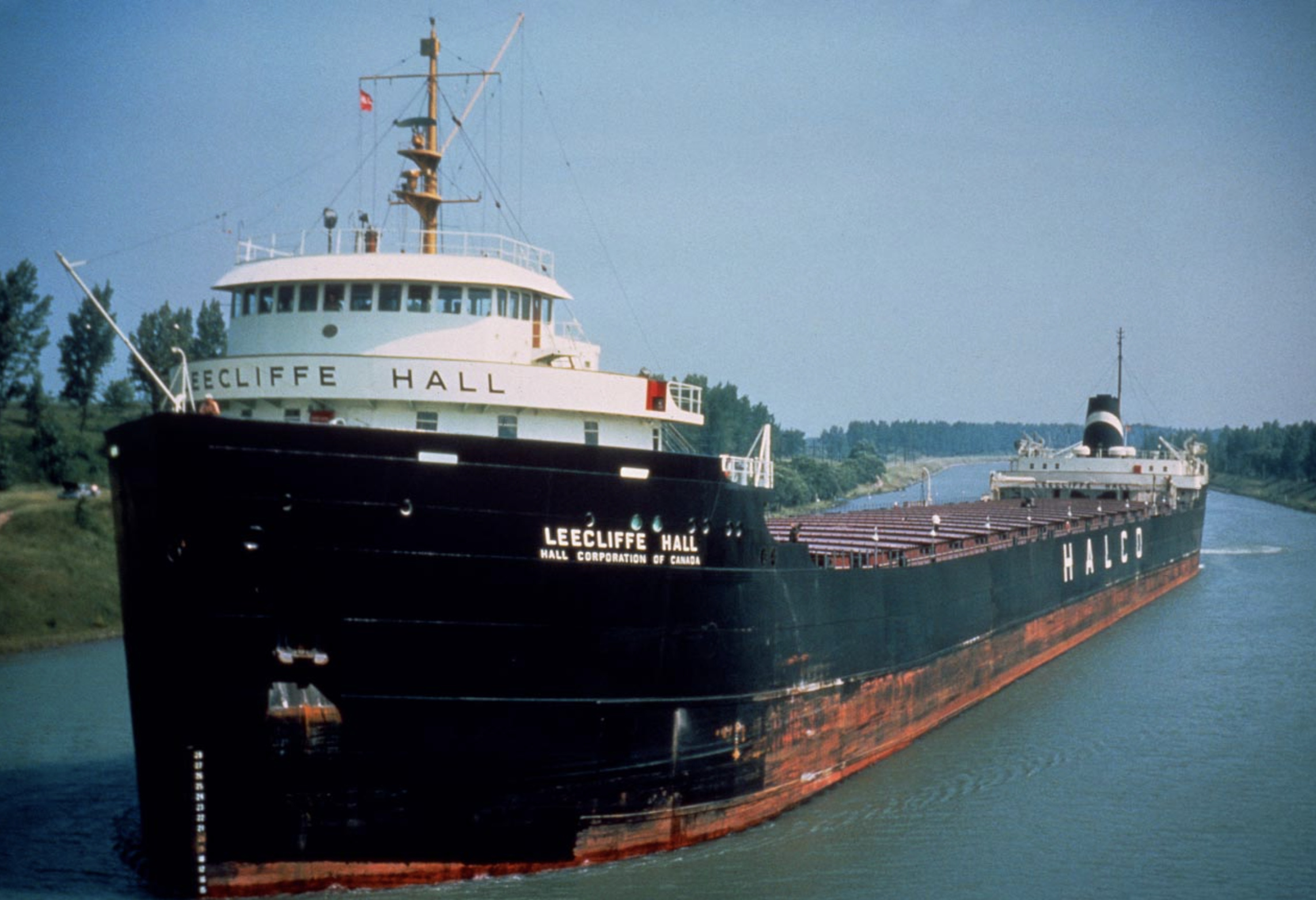
SS Bulk Carrier Leecliffe Hall (1961-1964)
At 222.5 metres long and 23 metres wide, the Leecliffe Hall ranks first among the largest wrecks in the St. Lawrence River.
Built by the Scottish shipyard Fairfield Shipbuilding and Engineering Ltd. — the same yard as the RMS Empress of Ireland — and launched in Port Glasgow on May 18, 1961, this colossus was an impressive 18,071 gross registered tons (GRT). The ship’s length from stern to bow is the equivalent of two American football fields glued together.
On Sept. 5, 1964, in the middle of a foggy day, the ship, loaded with 24,500 tons of iron ore, collided with the Greek freighter MV Apollonia off Île aux Coudres, in Québec’s Charlevoix region. The ships remained stuck together and did not sink.
The crew members were evacuated, safe and sound. But some of them, a few hours later, voluntarily returned to the ship, which was drifting alone, to attempt a rescue in extremis. While the men were in the midst of trying to regain control of the ship, the hull suddenly broke apart, resulting in the deaths of three brave sailors. The Apollonia escaped with a badly damaged bow, but was able to sail again.
On Sept. 9, 2017, a little less than two years after our divers first visited the wreck, a commemorative ceremony was held at the Charlevoix Maritime Museum. In the presence of the widow of one of the missing sailors and some descendants of the other two victims, the ship’s bell and the builder’s plate, which had been recovered the previous year by our team and declared to the Receiver of Wreckage (a federal official whose key role is to act as the custodian of a wreck in the absence of the rightful owners, were handed over to the museum in an effort to maintain the collective memory of Charlevoix’s subaquatic heritage.
Read the rest at this link: https://theconversation.com/discovering-the-three-largest-shipwrecks-in-the-st-lawrence-river-191979
The Conversation
Cruise ship industry basking in banner year for Great Lakes
The cruise industry is experiencing a banner year after one of the busiest seasons, it’s ever had in the Great Lakes.
“This was the strongest year on record, in the last twenty years that I’ve been involved with cruise ships on the Great Lakes,” Bruce O’Hare, president of Lakeshore Excursions, told CTV News.
“It probably grew by about 30 to 40 per cent, lots of demand, more importantly lot of new ships coming into the Great Lakes, it made a heck of a difference.”
Nine cruise ships made their way past the St. Lawrence Seaway, servicing the region this year.
Ferrying passengers from all over the United States and some, from as far away as France, the idea was to create memories and showcase a feature that many might take for granted.
“Great Lakes cruising is very different, first the ships are smaller, they have to fit through the Welland Canal,” said O’Hare.
“These ships are typically 200 to 400 passengers, they don’t have any casinos, they’re very limited in terms of shopping. The destination is really the draw.”
Ports of call in the region, Parry Sound, Little Current and Sault Ste. Marie also reported an uptick in visits from these tourists. This year, Killarney saw its first passenger ship stop in more than 80 years with the Viking Octantis. Tourism officials say getting Viking on board was a big win for the industry.
Cruise ships returned to Little Current in 1997, it’s long been seen as the gateway to Manitoulin Island. Marine traffic has become a staple of its economy.
“Cruise opens up a whole new opportunity to bring new people into the region, we sometimes refer to them as floating bank vaults, they show up and they leave nothing behind but money and they take away memories so it’s a pretty big deal for the local economy,” said O’Hare.
“For overseas visitors it (Great Lakes cruising) has an incredible appeal, we have five inland oceans, they’re so large they’re equivalent to oceans, we have renaissance cities, we have marvellous, wilderness, nature-based environments,” said Stephen Burnett, of the Great Lakes Cruise Association.
Burnett says he’s been talking with five other cruise lines about starting operations in the region. Three more ships are expected next summer. He figures the number of boats sailing through the region could grow from nine to 18 in the coming years.
“It is a more intimate cruise experience, it’s been called boutique cruising if you like and it’s the type of cruising where the guests get to know each other and more importantly, they get to know the crew,” he said.
Visitors to Manitoulin Island are treated to an Indigenous experience, once arriving, thanks to a partnership with Wikwemikong Tourism. Craig Fox is one of the guides they meet on the island.
“It’s important to share who we are as Anishinabek people and to follow along in what we’ve been trying to say for years, about the beauty of this island and who we are as Anishinabek people. That’s one thing I really want to hit home with these tours that we have and let them know exactly where they are on Turtle Island,” said Fox.
Once a ship arrived in Little Current, passengers are shuttled to other sites on the island, in Wiikwemkoong or at the Ojibwe Cultural Foundation in M’Chigeeng.
Fox expects the addition of more cruise ships will only be a benefit to the island economy in the years to come.
“One of the things I always talk about is how things are passed down from generation to generation,” Fox explained. ”The importance of our oral culture and things being taught face-to-face. We give them a tour of the museum, there’s a healing lodge as well where we give them a talk about our traditional medicines.”
“Most of the ships have wonderful lectures on board, guest lectures from the Great Lakes and the experience is a far more in-depth, perhaps even a cerebral experience,” Burnett told CTV News.
“They learn about our province, the U.S States and the difference between Canadian and American politics, the difference between our health systems, a huge amount to learn.”
“I think guests coming off a Great Lakes cruise return home with an amazing sense of accomplishment, they’ve learned a great deal about the area,” he added.
Northern Ontario CTV
U. S. Steel celebrates advancement in metallics strategy with DR-grade pellet capability at Keetac
United States Steel Corporation leadership and employees were joined by Minnesota Governor Tim Walz, other elected officials, and key partners to celebrate the Company’s investment in direct reduced (DR)-grade pellet capabilities at its Minnesota Ore Operations Keetac plant today. The investment marks a step forward in U. S. Steel’s metallics strategy by supplying the increasingly tight DR-grade pellet market and provides the company with the flexibility to feed a potential future direct reduced iron (DRI) or hot briquetted iron (HBI) facility. DRI and HBI are important electric arc furnace metallics inputs.
Read the full story here: https://investors.ussteel.com/news/news-details/2022/U.-S.-Steel-Celebrates-Advancement-in-Metallics-Strategy-with-DR-Grade-Pellet-Capability-at-Keetac/default.aspx
U.S. Steel