Historic load: Mark W. Barker takes on steel bars at Monroe
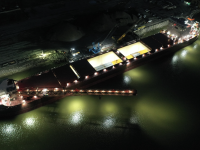
A historic first load of special bar quality (SBQ) steel in the M/V Mark W. Barker, our 639-foot new build in her maiden season sailing on the Great Lakes. The steel bars were loaded overnight at the Port of Monroe, Michigan’s only port on Lake Erie.
Thanks to her large, innovative MacGregor hatch openings and flat-bottomed cargo hold, the Mark W. Barker is the ideal vessel to carry this SBQ steel manufactured at Gerdau Special Steel’s Monroe Mill.
“This is a wonderful partnership that gives a clear understanding of the benefits of the M/V Mark W. Barker’s design to go beyond the traditional free-flowing cargoes we have historically focused on,” says Brendan P. O’Connor, our Vice President of Marketing and Marine Traffic.
O’Connor pointed to the tremendous efforts of Port of Monroe Director Paul LaMarre III, terminal operator DRM and Fraser Shipyards to facilitate this successful commerce.
“This is a perfect example of how Interlake is able to expand and grow into other markets and commodities with such a versatile new asset in our U.S. flag fleet,” he says.
The cargo will be unloaded at Superior, Wis., and ultimately delivered to Gerdau’s grinding ball mill in the Twin Ports. The bars will be melted down into grinding balls that are used in the mining industry, ensuring consistent production of iron ore (taconite pellets) that our commercial fleet delivers to steel mills throughout the region.
Interlake Steamship Co.
Peters Announces $11 Million in Federal Funding for Port of Monroe
DETROIT – U.S. Senator Gary Peters today announced that the Port of Monroe has been awarded $11,051,586 through the Port Infrastructure Development Program, funding that will be critical for strengthening and expanding the Port’s capabilities. The grant was awarded by the United States Maritime Administration (MARAD), an agency of the U.S. Department of Transportation. Peters supported the Port’s application for this federal funding.
“The Port of Monroe is not only a critical resource for manufacturers in Michigan and across the Great Lakes region, but it also plays a crucial role in ensuring efficient trade and transport of products that families and businesses rely on every day,” said Senator Peters, Chairman of the Commerce Subcommittee Surface Transportation, Maritime, Freight, and Ports. “I was pleased to support the Port’s effort to secure this funding, which will expand cargo capacity, increase economic activity for the region and strengthen supply chains. I’ll keep fighting to make sure the Port is treated fairly, has the resources necessary to compete on a level playing field and reaches its full potential.”
“There are but a few rare moments in a Port’s history which can be considered monumental. This grant award represents the single largest investment in the Port of Monroe’s infrastructure since the organization’s creation in 1932 and will have profound effects on the sustainability and enhancement of our maritime infrastructure which supports the Port of Monroe’s continued growth as a regional hub for both domestic and international renewable energy cargoes,” said Paul LaMarre, Port Director of the Port of Monroe. “Senator Peters is the Port of Monroe’s champion. His unequivocal support for the Great Lakes maritime industry and Michigan’s role as the ‘Great Lakes State’ is second to none. His support of this grant and our continued efforts is humbly appreciated and will have far reaching effects on our Port’s future.”
The Port of Monroe Project award will go toward its Lake Erie Renewable Energy Resilience Project, funding four components: riverfront work, turning basin work, maritime readiness slip construction and shore power infrastructure.
Component 1—Riverfront work will include replacing the surface of the existing wharf, constructing a second riverfront wharf to be used exclusively for vessel transfer of wind energy cargos, and reinforcing shoreline stabilization;
Component 2—Turning Basin work will include rehabilitating the concrete dock cap, bollard and fender installation, and replacing roughly 390 feet of failed sheet pile;
Component 3—Small Boat “Maritime Readiness Slip” construction will include demolishing and rehabilitating an existing small boat slip to be used by harbor assist vessels; and
Component 4—Shore Power infrastructure will include removing existing overhead lines and providing shore power to the riverfront wharves.
Peters has been a strong advocate for increased funding for Michigan’s ports. During negotiations for the bipartisan infrastructure law, Peters pushed for and succeeded in securing increased investments for the Port Infrastructure Development Program to fund port infrastructure needed to improve freight mobility, address port congestion, and improve port competitiveness.
As Chairman of the Senate Homeland Security and Governmental Affairs Committee, Peters has supported funding for the Port Security Grant Program and has fought to support Michigan’s ports, especially the Port of Monroe, and ensure they receive fair treatment. Last year, he announced the Port of Monroe received a $770,983 federal grant to help upgrade cargo screening infrastructure and previously helped secure a $1.1 million federal grant for the Port to expand its maritime commerce operations. A bipartisan measure coauthored by Peters was signed into law requiring federal officials to assess all ports of entry, including finding ways to reduce wait times for passengers and cargo at the border. Peters has also repeatedly pressed U.S. Customs and Border Protection on why the Port of Monroe is being held to standards that are not applied to other ports in the region. He toured the Port of Monroe last year with Customs and Border Protection officials and Port of Monroe leaders to assess current operations and discuss resolving ongoing cargo clearance challenges that impact commerce at the port.
Corps of Engineers receiving new crane barge for St. Marys River
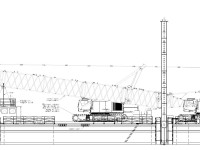
SAULT STE. MARIE, Mich., – The U.S. Army Corps of Engineers, Detroit District in concert with the Philadelphia District and the Marine Design Center awards a contract to Southwest Shipyard LP of Houston, Texas in the amount of $11.4 million for a new crane barge on the St. Marys River.
“The new crane barge will perform critical lock and hydropower facility maintenance at the Soo Project Office (Soo Locks),” said Justin Proulx, Chief of the St. Marys River Section. “Additionally, the new vessel will support channel maintenance and will be ready to respond to critical maritime incidents on the St Marys River, such as vessel groundings and anchor drags.”
Neebish Islander III departs shipyard for service in the Upper Peninusla
The new ferry Neebish Islander III departed the Burger Boat Co. shipyard in Manitowoc, WI, Thursday morning. She is expected to arrive at the island on Sunday. The 92-foot-long vessel is an ice breaking passenger and auto ferry that can carry 15 passenger vehicles. The ferry will be used year-round, carrying people on the St Marys River, in Michigan’s Upper Peninsula, between Barbeau and Neebish Island.
Canada’s shrinking St. Lawrence is the latest threat to shipping routes
A key Canadian shipping corridor is the latest waterway struggling with dwindling water levels.
Parts of the St. Lawrence River near Montreal have hit 10-year lows, said Bryce Carmichael, hydraulic engineer and U.S. section secretary for the International Lake Ontario-St. Lawrence River Board. Seaway managers in Canada and the U.S. are monitoring the conditions and considering boosting the flow of water from Lake Ontario to make conditions safer for commercial ships, according to Carmichael.
“Right now, we’re expecting two to three weeks of lower levels,” he said.
The shrinking water levels in Canada come as closures on the Mississippi River threaten exports of corn and soybeans just as farmers are in the thick of harvest, threatening to cause a buildup of supplies. The phenomenon has also hit Europe and China, where the Rhine River and Yangtze shrunk this year.
River levels on the St. Lawrence have “decreased considerably” and the latest forecasts by the Canadian Coast Guard call for further drops, according to a customer bulletin from global shipping line Hapag-Lloyd AG. The company has increased rates to move cargo to and through Montreal’s port until Nov. 1.
“It’s been very low for a while,” said Frank Seglenieks, Canadian co-chair of the International Lake Ontario-St. Lawrence River Board of Control, noting the basin has been dry this spring and summer, impacting water levels. “In general, when we have lower water levels ships do have to lighten their loads.”
Toronto Star
-
- Mark W. Barker load. Paul LaMarre photo
-
- New barge