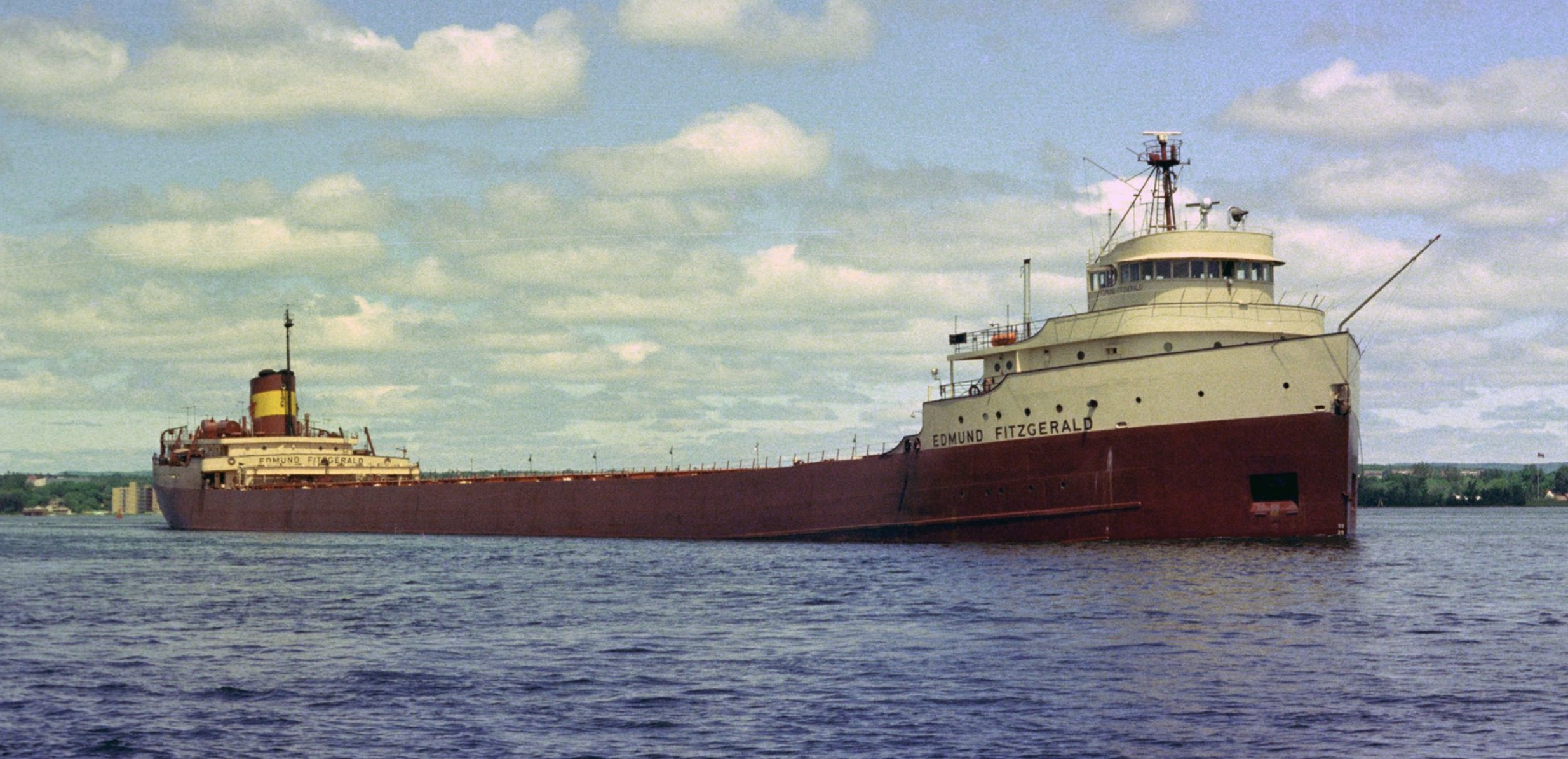
Edmund Fitzgerald search: Hear call to help after 29 men were lost in Lake Superior
LAKE SUPERIOR, MI – “Things look pretty bad. It looks like she may have split apart at the seams.”
In the hours after the 728-foot Edmund Fitzgerald abruptly vanished from the radar during a gale on Lake Superior the night of Nov. 10, 1975, the attitude of rescue crews quickly switched from incredulity that a freighter so large could just disappear, to asking nearby ships to help with the search.
Forty-seven years ago Thursday night, the search for the Mighty Fitz was just beginning. Its last radio contact with the Arthur M. Anderson was at 7:10 p.m. Minutes later, her crew could not be raised on the ship’s radio.
In these audio recordings, the U.S. Coast Guard at the Sault Ste. Marie station is talking to Capt. Jesse Bernie Cooper from the Arthur M. Anderson, a ship that had been trailing the Fitzgerald for much of that day in fierce seas and waves as high as 25 feet.
The Anderson had been the first to raise the alarm when the Fitzgerald vanished. Now the Anderson’s crew was being asked to go back out into the gale and look for the Fitzgerald and her crew of 29 men.
You can hear the Coast Guard saying it’s “very certain that the Fitzgerald went down,” and is asking nearby ships for assistance. The Coast Guard was hoping ships near Whitefish Point could look for lights in the water, lifeboats, debris – anything signaling there might be survivors.
Earlier in the day, the Edmund Fitzgerald had lost both it radars and the Anderson’s crew had been helping the Fitzgerald’s crew navigate through the storm.
“The last time I talked with him, he said he was ‘holding his own.’ I lost contact after that,” Cooper told the Coast Guard.
Cooper agreed to go back out to the area where he thinks the Fitzgerald disappeared, but you can tell by his voice that he was worried about his own crew, too.
“I’m afraid I’m going to take a hell of a beatin’ out there.”
MLive
Algoma Central Corporation and Furetank double investment in product tankers
ST. CATHARINES, ON – Algoma Central Corporation (TSX: ALC) today announced that it has doubled its investment in the FureBear joint venture, and will construct four additional dual-fuel ice class 1A 17,999 DWT climate-friendly product tankers with their partner Furetank AB (“Furetank”) of Sweden, bringing the total investment to eight vessels. Algoma owns 50% of the joint venture.
“In our strategic plan, we set out to find sustainable areas to grow our business and deploy capital in the highest and best uses,” said Gregg Ruhl, President and CEO of Algoma. “This investment enables us to further diversify Algoma’s asset base and geographic trading zones in a segment we know well and with partners that share our values,” concluded Mr. Ruhl.
“The expansion of our FureBear investment with Algoma is exciting news,” said Lars Höglund, CEO of Furetank. “This is yet another endorsement of the environmental benefits and innovative design of our Vinga Series. I look forward to delivering on these benefits with our partner and working together to fulfill the need for modern and efficient tonnage in the markets we serve,” concluded Mr. Höglund.
Like the initial four vessel order, the additional ships will be constructed at China Merchants Jinling Shipyard in Yangzhou, China, with delivery expected between 2023 and 2025. Two of the four vessels had previously been ordered by Furetank in September and will be transferred to FureBear, and the other two vessels have been placed as new orders bringing the total vessels in the Vinga series to 17. Upon completion, all eight FureBear vessels will be entered into the Gothia Tanker Alliance, and will be operated by Furetank out of Gothenburg, Sweden.
The Vinga ships are designed with FKAB Marine Design and all have dual-fuel capability and run on LNG/LBG or gasoil and are also fully equipped for shore power. They are designed with a battery hybrid solution and several innovative features that reduce fuel and energy consumption, resulting in extensively lower emissions of CO2, sulphur oxide, nitrogen oxide and hazardous particles. The ships have scored the best Energy Efficiency Design Index or EEDI value in their segment globally, meaning that they are the most energy efficient vessels according to the International Maritime Organization (IMO).
Algoma Central Corporation