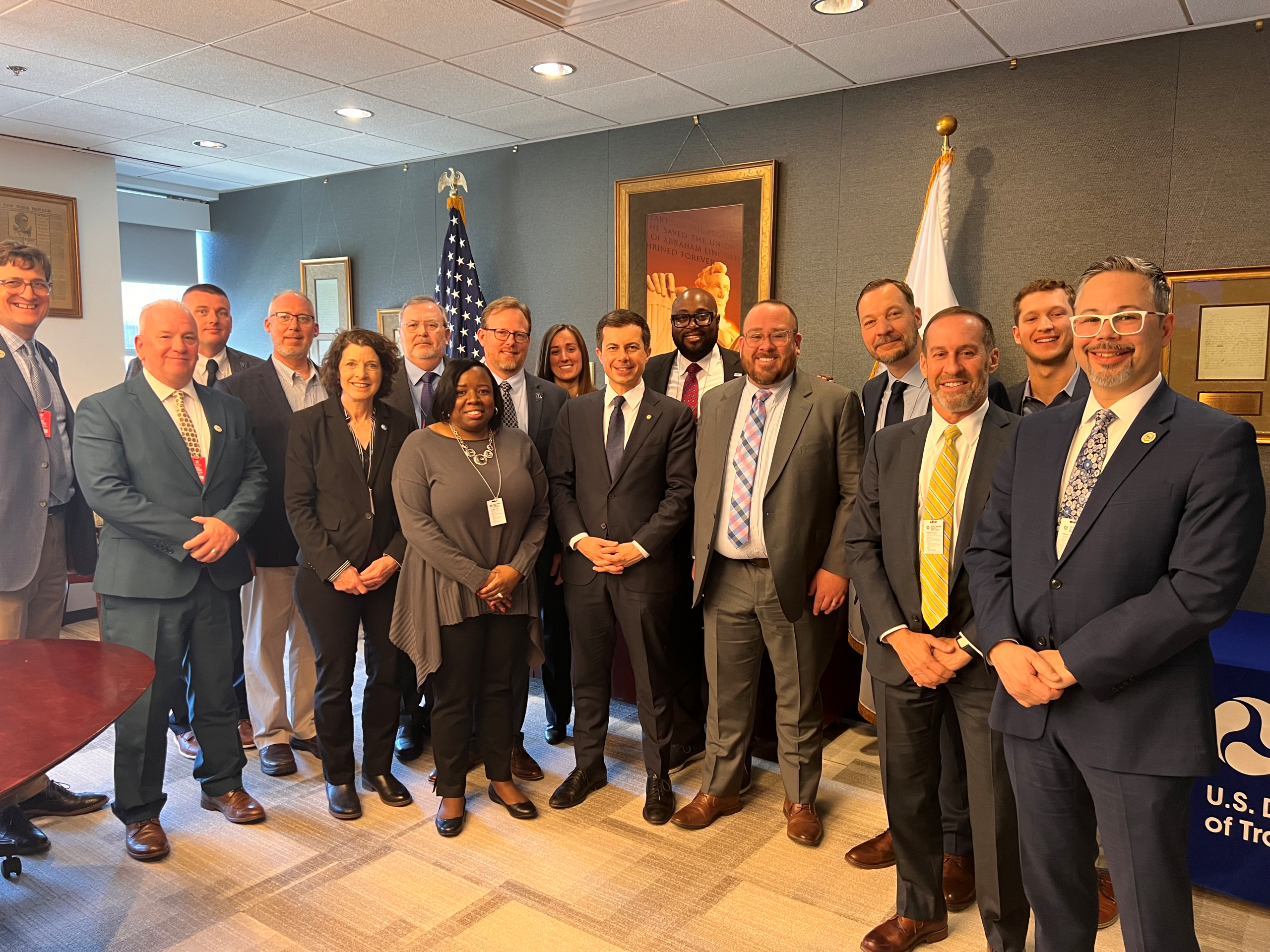
AGLPA Meetings in Washington DC
This week, members of the American Great Lakes Ports Association met with key leaders and legislators including Maritime Administrator Ann Phillips, Great Lakes St. Lawrence Seaway Development Corporation Administrator Adam Tindall-Schlicht, and Secretary of Transportation Pete Buttigieg as part of Great Lakes Day held in Washington DC.
Great Lakes ports are critical to the nation’s economy and are dependent on federal sources to fund important infrastructure improvements. The Port Infrastructure Development Program (PIDP) is the primary source of federal investment in the nation’s port infrastructure, and can fund components such as dock reconstruction, rail improvements, road access, storage expansion, and modernization of cargo handling equipment. Since the program’s first round of funding in 2019, over $154 million in PIDP grants have been awarded to Great Lakes ports.
The American Great Lakes Ports Association represents the interests of commercial ports and port users on the United States side of the Great Lakes. AGLPA works to influence public policies with the goal of fostering maritime commerce and related employment in the Great Lakes region.
Sam Hankinson
Mackinac Island Ferry Chippewa Set for Electric Transformation
Funds from the Michigan Department of Environment, Great Lakes, and Energy’s (EGLE) Fuel Transformation program will support the conversion of the Chippewa from diesel to electric propulsion.
The conversion will be the first of its kind thanks to the $3.06 million award, and it will bring the ferry to zero-emissions.
Star Line, now known as the Mackinac Island Ferry Company, will replace two 1988 diesel engines with two brand new electric propulsion motors on the Chippewa, reducing greenhouse gas emissions by 14,152 metric tons of carbon dioxide equivalents and 887 metric tons of nitrogen oxides over the boat’s lifetime. The project will begin immediately as part of a two- to three-year overhaul that will redesign and modernize the vessel’s hull and appearance.
Governor Gretchen Whitmer says, “converting a ferry in the Mackinac fleet to electric will build on our clean-energy leadership and help us achieve the goals of the MI Healthy Climate Plan to make our state carbon-neutral by 2050. The budget I put forward includes several investments in this space, and today’s ferry grant is another step forward as we build a brighter future for Michigan.”
The grant covers half the cost of the project, which includes installing 1.5 megawatts in shore power infrastructure at the Mackinaw City ferry dock, as electric power upgrades are also planned for the ports of St. Ignace and Mackinac Island.
“This project is a first critical step in the strategy to upgrade and modernize marine transportation in the Straits of Mackinac,” said Director Chris Byrnes of the Mackinac Economic Alliance. “Of course, Mackinac Island is famous for alternative modes of transportation, as cars are not allowed on the island. Everyone walks, rides bikes or horses and, of course, ferry boats, so the island is already a Michigan leader in alternative forms of transportation.”
“We actually have quite a few additional ferries and our plan would be to take that knowledge that we learn by converting to Chippewa and applying it to our other ferries as we go forward with eventually converting pretty much all of our ferries,” Jerry Fetty, CEO of Mackinac Island Ferry Company.
As the primary means of transportation to Mackinac Island, ferries serve about 500 year-round islanders and 750,000 visitors a year, with a summer peak of more than 16,500 a day. During peak months, ferries make up to 125 round trips daily. The 84-foot ferry Chippewa, built in 1962, is expected to carry 250-300 passengers after the electric conversion and MIFC’s concurrent redesign and modernization of the vessel.
The project is the first initiative from the Mackinac Island Transportation Master Plan, conducted by the Michigan Department of Transportation as the key piece of a larger initiative to modernize the ferry fleet and freight ships serving the region. That effort includes transition from fossil fuels, supported by creating local shipbuilding and servicing jobs and a marine industry training hub. The long-term goal is to transition all 138 Upper Great Lakes ships in the 50- to 200-ton range to electric or hybrid-electric power.
In a related move in January, plans to build a new, more efficient, reliable, and environmentally friendly Charlevoix-to-Beaver Island passenger ferry advanced with a $6.63 million federal grant added to a previous $14 million investment from the state.
9&10 News
Coast Guard news releases
The following announcements are all from the United States Coast Guard within the last few days:
SAULT STE. MARIE, Mich. – Captain of the Port Lake Michigan will open the Regulated Navigation Area encompassing southern Green Bay Tuesday, March 14 at 7 a.m. CST.
SAULT STE. MARIE, Mich. – Monday March 13, 2023 the Coast Guard starts breaking ice in the lower St Marys River in preparation for the 2023 Great Lakes commercial
shipping season.
Initially the icebreaking activity will focus on the lower St Marys River, south of Munuscong (Mud) Lake and the Middle Neebish Channel north and east of Neebish Island. As the week progresses, the Coast Guard will extend this icebreaking activity into the southern half of the West Neebish Channel, working from Mud Lake Junction Light north to Moon Island. The Coast Guard will not disturb the ice south of West Neebish Channel Light 45, above the Ferry crossing, or the ice north of Moon Island, below the Ferry crossing.
In the coming weeks, as the March 25th scheduled opening of the Sault Locks approaches, icebreaking activities will encompass all navigable waters of the St Marys River. Recreational users of the ice should plan their activities carefully, use caution near the ice, and stay away from charted navigation areas. If you have questions about local or regional icebreaking activities, you may contact the Vessel Traffic Service at (906) 635-3232 or via email at SOOTFC@USCG.MIL.