New administrator of Great Lakes/Seaway Development Corp. no stranger to NNY, shares vision
MASSENA, NEW YORK — The new administrator of the Great Lakes St. Lawrence Seaway Development Corp. found himself on old stomping grounds Wednesday morning.
“This is one of my favorite places on Earth,” Adam M. Tindall-Schlicht said during a visit to Massena, where two of the St. Lawrence Seaway’s 15 (13 Canadian) locks, Snell and Eisenhower, are operated. “Being here professionally is one of the gifts of being an administrator.”
Mr. Tindall-Schlicht, appointed in November as the 11th administrator of the Great Lakes St. Lawrence Seaway Development Corp.(GLS) by President Joseph R. Biden Jr., is atypical when it comes to the work experience of people previously appointed to that role. He has returned to GLS after working at the corporation from 2010 to 2018, focusing on marine transportation, international marketing and the Great Lakes Seaway System. In that role, he visited Massena frequently. At age 39, he is the youngest GLS administrator.
As administrator, Mr. Tindall-Schlicht oversees the federal corporation responsible for the operation and maintenance of the U.S. portion of the St. Lawrence Seaway between Montreal and Lake Erie. In timing with the opening of the Great Lakes St. Lawrence Seaway System’s 65th year of operation on Wednesday, the Watertown Daily Times requested a Zoom interview with the new administrator. It was expected that he’d be talking from the GLS’s Washington, D.C., headquarters, but on Wednesday morning, Mr. Tindall-Schlicht spoke from Massena where he was meeting with Seaway workers.
NNY360
Seafarers from Ukraine now working on Great Lakes Ships
Algoma, CSL, Groupe Desgagnés, and Hamilton’s McKeil Marine are among the Canadian ship owners that have welcomed qualified Ukrainian seafarers and other marine personnel after Russia invaded their homeland in February 2022.
Ruslan Butenko is eager to see his new work schedule as a Captain in Training on Algoma Central Corporation’s domestic vessels. He’s already sailed aboard the Algoma Intrepid, learning for the first time to operate the self-unloading eco-ship.
“No matter what my assignments, I’m grateful to be in Canada working for a company that has been supportive of this new start in my career and life,” says Capt. Butenko, who sought refuge for his young family from the war in Ukraine.
Butenko was aboard a German vessel when the Russian invasion started. “I had to work by phone and Internet to help my wife and daughter, who was just four months old, to find their way to safety,” he says.
That journey involved his family escaping to neighbouring Moldova, traveling next to Bulgaria, followed by Cyprus, then Italy to complete the necessary identity biometrics for Canada, and his wife and daughter returning again to Cyprus to stay with her sister while he made his way here to begin his new job and find a place for them to live.
“It was so wonderful when I arrived at Pearson International Airport on December 6th and the Customs officer said, ‘Welcome to Canada. You and your family will be safe now,’” he recalls.
Read the full article here: https://bayobserver.ca/seafarers-from-ukraine-now-working-on-great-lakes-ships/
The Bay Observer
How important was the Iron Range to winning World War II?
DULUTH — Minnesota nearly depleted its immense supply of high-grade iron ore to help the Allies win World War II, providing much of the crucial raw material behind America’s tanks, warships, guns and ammunition.
Reader Jim Herzog wanted to know just how much the Mesabi Range mines contributed to the “arsenal of democracy.” He sought answers from Curious Minnesota.
The short answer is that Minnesota’s rich iron deposits were a vital component of America’s war effort. About 70% of the iron ore that America devoted to the war came from Minnesota, amounting to more than 333 million tons, according to Pam Brunfelt, a retired Vermilion Community College faculty member and historian.
“Without the Iron Range, we would not have won the war,” said the Britt, Minn., native, who is writing a book about the phenomenon. “It was just the most astonishing accomplishment.”
Steel production in America tripled from 1938 to 1943. In 1942 alone, America produced about 8,000 warships, 24,000 tanks, 48,000 military airplanes and 667,000 machine guns, according to Marvin G. Lamppa’s “Minnesota’s Iron Country.” Much of the raw material to make those armaments came from the Iron Range.
The country’s need for all that natural iron ore during the war almost depleted Minnesota’s deposits and led to the mining of taconite, the lower-grade mineral produced on the Range today to make steel.
Read the rest of the article here: https://m.startribune.com/minnesota-iron-range-mesabi-world-war-2-ore-steel-mining/600259684/?fbclid=PAAaaFVZKkiKymvHRCNJGdf0tmGUV0rJ9QacT6CQIp3nXrFvQgU_pJKoIVbPk
The Star Tribune
St. Lawrence River hit with one of lowest ice cover seasons on record
There’s barely any ice to break on the St. Lawrence Seaway this year.
Scientists at the National Oceanic and Atmospheric Administration have confirmed that ice conditions across the Great Lakes during the 2022-2023 season were the third-lowest on record.
Although this is a widespread trend, it has had significant impacts on Lake Ontario and the St. Lawrence River.
“It was mid-December and January when we had those really deep freeze moments, but they were pretty quick this year,” Busler explained. “It was a short window when we had good ice cover between the islands.”
Without the typical thick ice, many winter recreational opportunities were too dangerous. Such as ice fishing, pond skating and snowmobiling out on the River and Lake Ontario.
This resulted in event cancellations throughout the region, Tyler Forger, the General Manager of Clayton Marina explained.
“Obviously we’ve missed all the ice fishing derbies, which are usually held right out in [our] bay. We missed events like that and some fundraisers,” he said. “So it has affected the community for sure.”
The low ice conditions also could have effects on native wildlife.
“Shorter winter and less ice cover could mean a shorter breeding and spawning season for fish and other wildlife,” Busler added. “Animals like the red fox and bobcat will use ice cover to travel amongst the islands.”
As of March 16, NOAA data confirmed that the total ice cover across the Great Lakes was 6.7%. On the same day in 2022, the total ice cover was 43.1%.
But as the winter season comes to a close, the low ice conditions may allow for an earlier season for water recreation.
Many marinas and public docks have already made preparations for early-season boaters.
“I think we’ll see an early spring. The sun’s out, people are itching to get ut of the house. That’s what we’re looking forward to at our marina,” Forger expressed. “So we’ll get phone calls from people that are trying to get to their island homes and we’ll see an earlier jump this year.”
WETM18
-
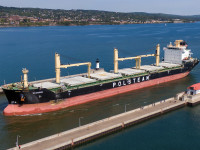
- Drawsko arriving to load wheat at Gavilon for Ravenna, Italy. Schauer photography photo
-

- Seaway Administrator Adam Tindall-Schlicht and Samuel Hankinson (Port of Monroe)