Algoberta name painted on hull of Algoma Central tanker
SARNIA, ON – While the former saltwater tanker Chiberta was moored at Sarnia this week, she received her new name, Algoberta. The naming of the latest Algoma Central tanker fleet acquisition began on April 1 or 2. The name is a nod to Algoma’s largest customer in the segment which calls Calgary, Alberta, home. Algoberta (and her sister whip Chantaco, now Algotitan), were built in 2007 at RMK Marine Shipyard, Istanbul, Turkey.
Port of Cleveland welcomes first freighter to open the 2023 Great Lakes shipping season
CLEVELAND — The beginning of April marks the opening of the 2023 Great Lakes shipping season with the first freighter arriving Tuesday night at the Port of Cleveland — the Isadora, a 652-foot-long bulk carrier cargo ship carrying steel coils from the Netherlands. It was smooth sailing for the ship as the mild winter weather has left the Great Lakes mostly ice-free.
The opening of the shipping season though dictated more by the maintenance done each winter to the locks that connect the lake than the weather itself.
“That is dictated by the St. Lawrence Seaway system, so the locks opened March 22 this year,” said David Gutheil, Chief Commercial Officer for the Port of Cleveland. “So the locks are drained every year, every winter for maintenance and they’re refilled when the system is ready to open and these vessels start to arrive.”
The Port is looking to welcome more ships this season, building on the job they’ve done in the wake of the nation’s supply chain struggles and positioning Cleveland as a viable alternative.
“Certainly, the congestion issues that have occurred over the last two years at coastal ports have helped us gain stature; we need to capitalize on that and continue to improve our infrastructure and give customers the opportunity to use the port more than ever,” he said. “We’re looking at another good year. We’re optimistic that [with] the steel that we bring in on an annual basis we’ll continue to stay strong.”
The port recently completed a $22 million project to overhaul one of its main docks and just received $27 million in part to modernize the warehouse. This is on top of improvements that will allow the port to begin handling, for the first-time, bulk liquids which will come into Cleveland this summer from Southeast Asia.
“So that will be our first direct partnership with the Southeast Asia origin cargo, so we’re excited about that,” Gutheil said.
Most of the cargo that comes through the port each year you never see but for one exception in recent years — the fast-growing area of cruise ship tourism. It turns out the port’s location at the doorstep of the Rock and Roll Hall of Fame, the Science Center and downtown as a whole is becoming a popular stop since the first ship stopped here in 2017. They had nine that summer; this year they’ll welcome 53.
“We’re really happy to welcome three new lines here this year, Viking, LeDumont and Pearl Seas, all will be in Cleveland for the first time and can’t wait to see those vessels start to arrive next month,” Gutheil said. The additional tourism dollars are dropped on top of the $3.5 billion in economic activity the Port generates through the 13 million tons of cargo that pass through it each year.
News 5 Cleveland
Ice conditions along St. Marys being monitored, board says
The International Lake Superior Board of Control says it is carefully monitoring ice conditions with the goal of raising gates at the Compensating Works on the St. Marys Rapids as soon as ice conditions permit.
In its monthly update, the board said it will issue another notice in advance of gate movements planned for later this month.
In the meantime, anglers and other users of the rapids are being reminded that a higher than customary gate setting continues to be maintained to minimize the impacts of ongoing maintenance at Evolugen’s Clergue hydropower facility on the Canadian side.
The gates of the Compensating Works at the head of the St. Marys Rapids will be maintained at an equivalent of two gates fully open for the start of April.
The board said that, at the beginning of April, the lake-wide water level of Lake Superior was 18 cm (7.1 in.) above the seasonal long-term average (1918-2021) and 24 cm (9.4 in.) above the level of a year ago.
The lake-wide level of Lake Michigan-Huron was 11 cm (4.3 in) above average and 14 cm (5.5 in.) below the level of a year ago.
Lake Superior declined by 4 cm (1.4 in.) last month, while the seasonal long-term average decline is 1 cm (0.4 in.) in March.
Lake Michigan-Huron rose by 4 cm (1.6 in) last month, which matches the seasonal long-term average rise in March.
What happens in Lake Superior will depend on weather and water supply conditions during the next month, the board said. Lake Superior may decline slightly in April, or it may rise by as much as 14 cm (5.5 in.).
Depending on the weather and water supply conditions, Lake Michigan-Huron is expected to continue its seasonal rise in April and may rise by as much as 20 cm (7.9 in), the board’s update states.
The International Lake Superior Board of Control is responsible for managing the control works on the St. Marys River and regulating the outflow from Lake Superior into Lake Michigan-Huron.
Under any outflow regulation plan, the ability to regulate the flow through the St. Marys River does not mean that full control of the water levels of Lake Superior and Lake Michigan-Huron is possible, the board noted.
This is because the major factors affecting water supply to the Great Lakes (i.e. precipitation, evaporation, and runoff) cannot be controlled, and are difficult to accurately predict.
Outflow management cannot eliminate the risk of extreme water levels from occurring during periods of severe weather and water supply conditions.
Additional information can be found at the board’s homepage.
Soo Leader
-
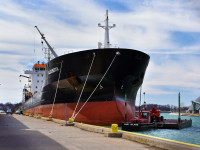
- New name has already been applied to the starboard bow. Roger LeLIevre image
-
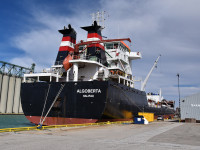
- Algoberta’s stern. Roger LeLIevre image
-
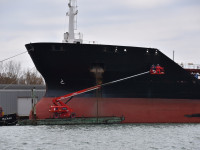
- Algoberta’s port bow was still awaiting the name Thursday afternoon. Roger LeLIevre image