Northern Venture leaves lay-up
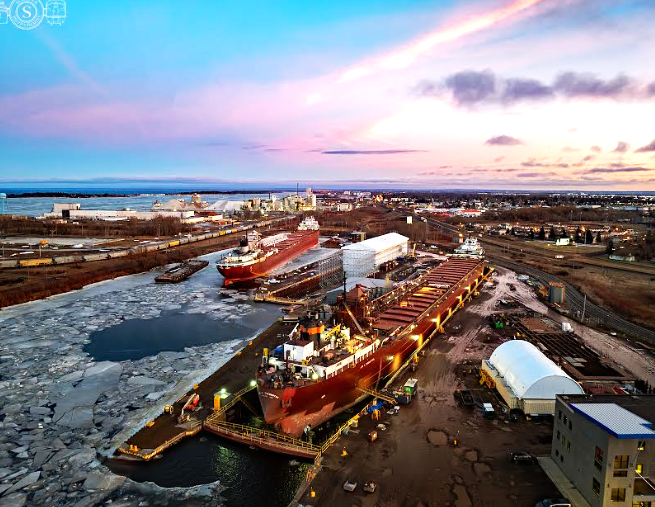
Northern Venture departed her lay-up berth at Ojibway, ON, headed for Ashtabula Friday morning.
U.S. shipping companies pour $120 million
into Great Lakes states
CLEVELAND, OH – The annual process of maintaining the U.S.-flagged fleet of “lakers” on the
Great Lakes began in mid-January after the navigational locks connecting Lake Superior to the
lower lakes closed for repairs. U.S. companies will invest more than $120 million into their
vessels bringing skilled labor to shipyards and repair facilities around the Great Lakes states. The
state receiving the largest sum was Wisconsin with $55 million followed by Ohio with $39
million, Pennsylvania at $19 million, and $7 million in Michigan.
“It is truly an amazing system where U.S. Lakers sail non-stop between March and January
delivering as much cargo as possible before entering a two-month repair period. The work is not
only vital to maintaining the U.S. fleet but also to the communities where it is performed
bringing excellent paying, hardworking jobs to everyday Americans,” stated Jim Weakley,
President of the Lake Carriers Association.
Engineers carefully inspect each vessel and execute any needed repairs while also upgrading
systems and crew quarters. Major investments have been made to improve habitability onboard
the vessels including wireless communications. State-of-the-art electronics will be refreshed
including navigational computers and propulsion control systems. Hull plating will be replaced
with steel made from iron ore that was shipped by the vessels to steel mills during the season.
Thanks to milder winter temperatures across the Great Lakes region the work will be a little less
daunting this year. The U.S.-flagged American shipping companies have the most talented
mariners in the world and Great Lakes shipyards and repair facilities have the absolute best
skilled workers to tackle any task to keep the vessels sailing another year.
Lake Carriers’ Association
The Great Lakes go digital as smart buoy
network launches in Lake Erie
LAKE ERIE – Lake Erie is the first of the Great Lakes getting connected to the internet with a
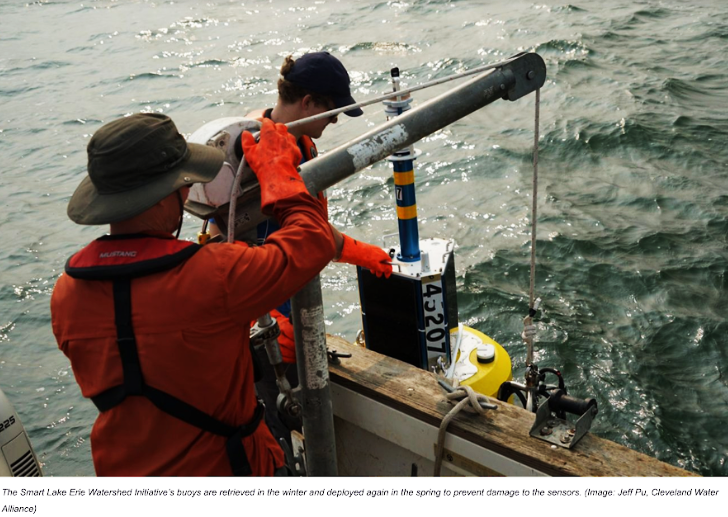
series of offshore “smart” buoys. And it’s not just for sending texts on the water. The buoy
project, called the Smart Lake Erie Watershed Initiative, is providing invaluable data to
researchers and anglers.
The initiative was created by the Cleveland Water Alliance, a group that protects and improves
how the Great Lakes are used in Ohio. The alliance works with a local engineering group,
Freeboard Technology, to develop and deploy the buoys.
Smart Lake Erie makes water conditions, contaminants and nutrients easily accessible, said Ed
Verhamme, Freeboard Technology’s president. Eventually it will be available across all of the
Great Lakes.
Smart Lake Erie is an infrastructure investment that will better prepare the region for harmful
algal blooms, oil spills and the consequences of climate change, experts say.
“We really take for granted how easy it is on land to provide (cellular) coverage,” Verhamme
said. “With the network, it’s going to be easier and cheaper to monitor the Great Lakes.”
Other methods of connecting to the internet on the water — cell modems and satellite telemetry
— are expensive and inconvenient, Verhamme said. But Smart Lake Erie allows users to directly
connect their devices through short-wave radio.
The goal is to have over 200 sensors in buoys and cell towers in the network to provide over
12,000 square miles of coverage, Verhamme said. Right now, about half of the area is covered,
with service available over 20 miles off the Ohio coast. That includes parts of Lake Erie and
nearby wetlands that drain into it.
132-foot silo part of $13.2 million port upgrade,
sent floating storage ship to scrapyard
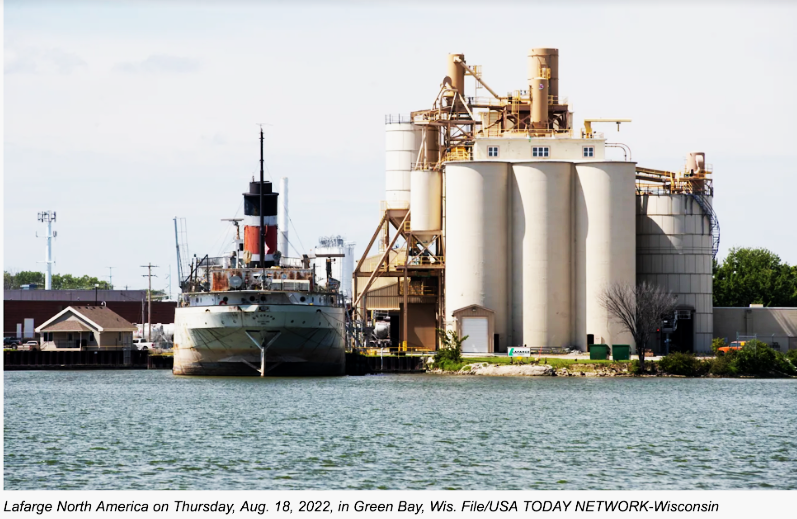
GREEN BAY, WI – Construction materials supplier Holcim US recently completed a 132-foot-
tall addition to the Green Bay shoreline. While Green Bay shed some smokestacks in recent
years, it’s now gained a storage silo for cement at Holcim’s port terminal site at 125 Ninth St.
The silo is the most visible element of a $13.2 million upgrade to Holcim’s port terminal facility,
which should enable the materials supplier to meet growing customer demand and deliver more
volume to the site with fewer ship trips, said Jared Stull, vice president of supply chain for
Holcim US.
Port of Green Bay Director Dean Haen said the project paired private and public dollars to help a
longtime port operator stay viable. It’s nice to see these companies making investments in Green
Bay. It means we’re part of their permanent future, Haen said.
The investments should translate into fewer bridge openings in downtown Green Bay, which
bring pedestrian and vehicular traffic to a halt periodically during the shipping season. It’s great
for customer service and allows us to bring in more-full vessels which means less trips," Stull
said.
The port terminal site was owned and operated by Lafarge North America for many years before
Holcim US and Lafarge merged in 2015.
The port facility upgrades will modernize a cement terminal site active in Green Bay since the
1930s and that still relied on storage tanks built in 1950. Stull said the investment will cut
operating costs, cut carbon emissions, expand products it can stock in Green Bay and enabled the
company to send the 97-year-old ship S. T. Crapo, docked at its port site for decades, on its final
voyage to the scrapyard.
We’re certainly excited about getting the extra volume, Stull said. The new silo means new
full-automated loading capabilities. It’s exciting for us to meet our customer needs there.
Holcim constructed the 10,000-metric-ton silo, added new technology to its facilities, improved
dock infrastructure and dredged the Fox River in the area around Holcim’s port terminal. Stull
said the dock improvements will also be safer and more efficient for workers and ships.
The key is the dredging of the Fox River. Holcim’s port terminal is located south of the Mason
Street bridge, so every cargo delivery likely meant all three downtown Green Bay bridges would
be raised, stopping vehicle and pedestrian traffic.
Before the upgrades, Holcim had to limit how much powdered cement it could load onto a ship
bound for Green Bay so the vessel did not sink too low into the water and risk getting stuck in
the riverbed. The dredging work will give cement freighters more clearance in the water, so they
can load more tonnage on, resulting in fewer trips down the river, Stull said.
Holcim has transitioned 12 of its 13 cement plants now to produce a lower-carbon formula of
cement that reduces carbon dioxide emissions by 5%-10% on average, Stull said. More storage
space also enables Holcim to deliver and store its newer, more-sustainable cement products in
Green Bay, such as NewCem cement that incorporates slag leftover from smelting metals.
HELP WANTED: S.S. Badger
Once again we are searching for some Navigational Deck/Navigational Engine crew for
our 2024 sailing season. Applications must be filled out on-line by visiting our website
at: www.ssbadger.com and click Join The Team.
Able-Seaman (AB): Performs navigational watch in and around the pilot house, assists
Mate on duty with supervising the deck crew, assists in loading and off-loading
passengers and cargo, proper use and care of deck equipment, supplies and material,
work alongside deck crew, undertaking tasks as necessary, learn fire and lifeboat
stations along with signals and procedures associated with an emergency to properly
carry out a fire and lifeboat drill to US Coast Guard standards, be prepared to live and
work aboard the vessel the duration of the sailing season, from mid-May to mid-Oct.
Room and board provided, employee will stand a 4-hour watch, twice a day, 7 days per
week and eligible for medical, dental, vision and 401K after completing 90-day
probationary period. APPLICANTS FOR THE AB POSITIONS MUST BE QUALIFIED
AND POSSES THE CREDENTIALS NEEDED FOR THIS POSITON.
QMED: Works under the direction of the watch Engineer, employee will stand a 4-hour
watch, twice a day, 7 days per week, be prepared to live and work aboard the vessel
the duration of the sailing season, from mid-May to mid-Oct. (room and board provided).
APPLICANTS FOR THE QMED POSITIONS MUST BE QUALIFIED AND POSSES
THE FIREMAN/OILER/WATERTENDER ENDORSEMENTS ON THEIR MMC. QMED –
Oiler: Assists with operating and maintaining all vessel equipment and systems, assists
with monitoring plant operation, assists with record-keeping, assigned a cleaning
station. QMED – Fireman: Manages the fires in the operating boilers, ensures an
adequate fuel supply to the boilers, assists the Coal passer on duty with ash removal
conveyors, assigned a cleaning station. Qualifications/Certifications required: Valid
Transportation Worker Identification Credential (TWIC), valid Merchant Mariners
Credential issued by the U.S. Coast Guard, endorsement as QMED
Fireman/Oiler/Watertender on MMC, current US Coast Guard Medical Certificate,
legally eligible to be employed in the United States (Proof of identity and eligibility will be
required upon employment.
LICENSED ENGINE OFFICER: Supervise a watch with the assistance and direction
from the Chief Engineer. Responsible for the safety of the personnel assigned to the
watch and their task performance in the operation of the vessel. Assists with the
operation and maintenance of all vessel operating equipment and systems. Maintains
the engine room records as required by various agencies. Conducts periodic safety
inspections of departmental tools and safety equipment as directed. Required to make
descriptive entries of all work performed in the Engineer log. Be prepared to live and
work aboard the vessel the duration of the sailing season, from mid-May to mid-Oct.
(room and board provided). Employee will stand a 4-hour watch, twice daily, 7 days per
week. Eligible for AMO medical, dental, vision and 401K after completing 60-day
probationary period. APPLICANTS FOR LICENSED ENGINEER POSITIONS MUST
BE QUALIFIED AND POSSESS LICENSED ENGINEER OF STEAM VESSELS OF
UNLIMITED ENDORSEMENT OF 4000 HP OR HIGHER. Qualifications/Certifications
Required: Valid Transportation Worker Identification Credential (TWIC), Valid Merchant
Mariners Credential issued by the U.S. Coast Guard with proper endorsements,
including at least Third Assistant Engineer of steam vessels of unlimited horsepower,
current US Coast Guard Medical Certificate and be legally eligible to be employed in the
United States (proof of identity will be required upon employment).
Interlake Steamship Co.