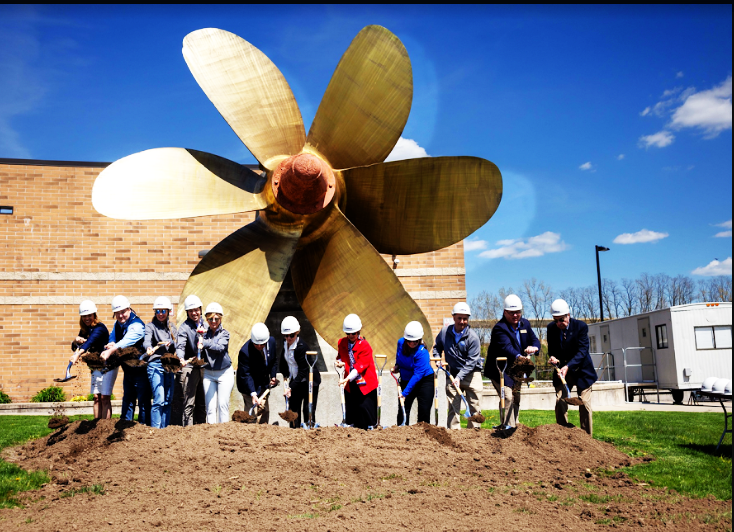
National Museum of the Great Lakes breaks ground on addition
TOLEDO, OH – Amid sunny skies and a brisk wind that occasionally carried a gull or two overhead, the National Museum of the Great Lakes broke ground on a 5,000-square-foot expansion Monday afternoon.
The museum’s capital campaign has already raised $4.5 million toward the Second Wave expansion project’s $6 million price tag, which includes construction and exhibit acquisition costs.
“Our fundraising efforts for this project are in full swing. We’ve had support from the State of Ohio, forward thinking businesses, generous donors, loyal museum members, and visitors,” said Paul LaMarre, vice chairman of the board of the museum, who was among the speakers at the groundbreaking ceremony.
The expansion of the museum, which is celebrating its 10-year anniversary on Front Street in East Toledo, will provide dedicated areas for temporary and traveling exhibits, new permanent exhibit spaces, and a community education center. “We’re expanding our horizons. We’re taking a pivotal step, breaking ground on the new addition to the museum,” Mr. LaMarre said.
The National Museum of the Great Lakes will become the place where all Great Lakes conversations happen, he added. “Imagine a space where the past, present, and future combine to create a dynamic hub for community education, cultural enrichment, and economic growth,” Mr. Lamarre said.
“Our mission at the National Museum of the Great Lakes is to educate and inspire visitors with the rich history of the Great Lakes. We’re embarking on an exciting new journey,” he said.
Dr. William Davis, a museum board member and the leader of the Second Wave campaign, agreed. “Education is going to be a big part of this expansion,” Dr. Davis said. “Because of this new development, we will be able to put on a lot more programs for the area, northwest Ohio and southern Michigan. It’s going to be great.”
He was hopeful the museum could soon team up with the Coast Guard and have programs on boat safety. “That’s an area that needs a lot of help,” he said.
Kate Fineske, executive director of the museum, said she was grateful for the support of the museum over the years. She noted how much the museum has grown since its first wave — moving to Toledo 10 years ago. The museum grew from just a few team members to its current 25.
“We have 11,000-square-feet of interior museum exhibit space, the maritime park, and a 617-foot lake freighter that you cannot miss, the museum tug Ohio, the St. Marys Challenger Pilot House, and now a 5,000-square-foot addition that we’re putting on to the back of the space. That space is going to be incredible for us,” Ms. Fineske said.
“Of the $4.5 million we raised, over 72 percent of that is derived from resources outside Lucas County. Over 70 percent of visitors who spend at least one hour on the museum grounds stay at least one night in a hotel. We are bringing visitors and revenue to Toledo. With this expansion, we are going to be the gathering place of all Great Lakes conversations,” she said.
Some in the small crowd who attended the groundbreaking ceremony were enthusiastic about the expansion. “I’m so excited that there is a community that wants to continue to educate so we can keep the Great Lakes at the forefront of everyone’s mind,” said Jackie Csiszar, senior vice president of World Shipping, agents for the ships of the Great Lakes.
“We have such a gem,” Lucas County Auditor Katie Moline said. “It really has a lot of room to grow in terms of its prominence in our community. And this is just one step in that direction. I love that the museum is always looking to the future, especially in this region. They have the foresight to expand so that the next generation can enjoy this.”
Toledo Blade
Toledo museum boats open for the season on May 1
TOLEDO – The National Museum of the Great Lakes has announced the reopening of the Col. James M. Schoonmaker Museum Ship and Museum Tug Ohio for the 2024 season on Wednesday, May 1st.
“Our entire team and community always looks forward to the seasonal opening of our museum boats,” said Ellen Kennedy, Director of Museum Operations at the National Museum of the Great Lakes. “Our visitors eagerly anticipate this time of year, and we can’t wait to immerse them in the living history that our vessels embody.”
The boats, which undergo seasonal closure over the winter, will be open for public tours between May 1st and October 31st. Visitors will have the opportunity to explore the 617-foot cargo ship and historic tug, gaining insight into life on the lakes through the 20th century. In addition to time aboard the vessels, guests are encouraged to explore the museum galleries, which showcase captivating stories through stunning photography, over 300 remarkable artifacts, immersive audiovisual displays, and interactive exhibits.
“During the summer season, we will have construction crews on site working on our 5,000 square foot expansion,” Kennedy added. “The museum and vessels will be fully open during construction with hopes of no interference with the guest experience. We just kindly ask that visitors pardon our dust during this exciting time of growth.”
In addition to the boats’ opening, beginning in May, the Museum’s open hours will also increase from 6 to 7 days a week, Monday through Saturday 10 a.m. to 5 p.m. and Sunday 12 p.m. to 5 p.m.
Tickets can be pre-purchased at nmglstore.org or purchased upon arrival inside the museum at the front desk. No tickets are sold on the vessels themselves and anyone boarding the ships needs a wristband.
National Museum of the Great Lakes
How low ice coverage is changing the future of Lake Michigan, the Great Lakes
CHICAGO – This past winter was one of the warmest on record. It led to record-low ice coverage on all five Great Lakes, a sign that the world’s largest freshwater system is not immune to climate change.
“We’re seeing the Great Lakes kind of as sentinels of climate change. They’re showing us what’s happening in this sort of global change that we’re experiencing,” said Joel Brammeier, president and CEO of the Alliance for the Great Lakes. The Alliance for the Great Lakes advocates for policies needed to protect the Great Lakes for the future.
“We’ve had the lowest ice cover year in about 50 years on the Great Lakes,” said Brammier. “And we know that the climate is changing around us. We see evidence of that in warming water, less ice, highly variable water levels”
The National Oceanic and Atmospheric Administration started keeping track of the Great Lakes’ ice cover in 1973. The Great Lakes typically see an average of 53 percent ice coverage in the winter. This year, it peaked in mid-January at just 16 percent, the fourth lowest on record.
Even more staggering, from January to March, total ice cover across all 5 Great Lakes measured a mere 4.4%, an all-time historic low.
“We started late, we never really got the cold air in place to let the ice catch up to where it needed to be. And so we trailed behind all season,” said Bryan Mroczka ,a physical scientist with the Great Lakes Environmental Research Laboratory.
“If the lake just goes up a few degrees, it can totally change the kind of habitat that’s available for that, for those fish and other wildlife, they might go somewhere else looking for a better place to live and we might see, for example, more invasive species coming into the Great Lakes,” said Brammeier.
The ice not only helps shelter marine wildlife, it also helps shield the beautiful beaches we all enjoy. The city’s prized shoreline is susceptible to extreme erosion, especially during the winter when there are strong storms and high waves.
“When you have frozen water at the shoreline that actually blocks some of those big winter storm waves from hitting the shoreline and can reduce erosion, it can reduce the loss of land and property,” said Brammeier.
Less ice cover could also mean more impactful lake effect snow events. When the Lakes freeze over, the fuel that drives these storms shuts off. Years that feature less ice have the greatest potential for snowier seasons. Year to year variability of ice cover will continue but less ice may be the new normal.
“We will see significant ice on the lakes again. That’s a guarantee, we will have colder winters, but the probability of any given year is increasing, that it will be a low ice year,” said Mroczka.
Climate change is already painting a different picture of the future of our fresh water source. Still, there are ways to preserve and protect the lakes.
“You’ll just see a lake that looks different, perhaps from the one that that I grew up with or my parents and grandparents grew up around,” said Brammeier. “And so that’s just going to be the reality that we face as well, is that we’re going to see a lake that is that is in its own way adapting to climate change and the unfortunate impacts of global warming. When you see that ice, you know, don’t just think of it as cubes in your freezer. Think of it as part of that living Great Lakes that we’re all part of and that we are privileged to live here and so protecting all those parts of the living Great Lakes is really important.”
WLS