Adella Shores shipwreck discovered 115 years after it sank near Whitefish Point
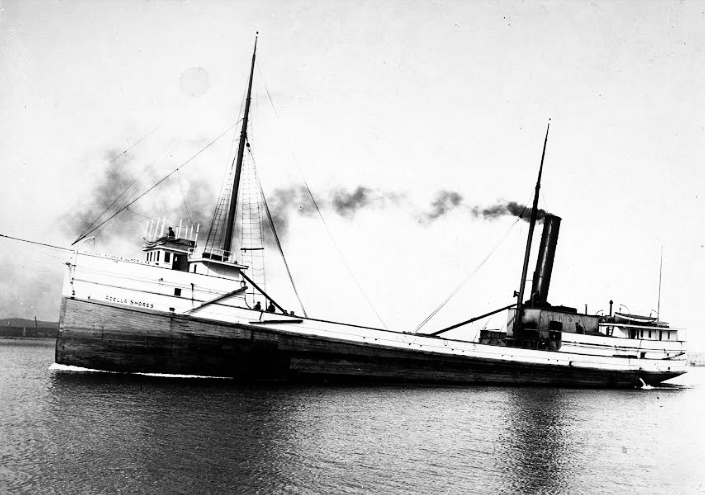
WHITEFISH POINT – The Great Lakes Shipwreck Historical Society this week announced the discovery of the wooden steamship Adella Shores, one of the many ships that “went missing” over the years in the vicinity of Whitefish Point. The Adella Shores went to the bottom of Lake Superior with no survivors on May 1, 1909.
In shipwreck parlance, the reference “went missing” is used to describe a vessel that left the dock and was never seen again. Such vessels vanish with no survivors, no witnesses, and are yet to be located. All of that changed when GLSHS found the Adella Shores more than 40 miles northwest of Whitefish Point in over 650 feet of water.
The Adella Shores had a storied career. Built in Gibraltar, Michigan, in 1894, the 195-foot, 735-ton wooden steamer was owned by the Shores Lumber Company and named after the owner’s daughter, Adella. Adella’s sister, Bessie, christened the new ship with a bottle of water (instead of Champagne or wine) as the family was strict about alcohol consumption. Old time sailors might have seen that as a bad luck omen. The Adella Shores had her share of trouble – she sank twice in 15 years in shallow waters, later being refloated each time and put back into service.
On April 29, 1909, the Adella Shores was upbound for Duluth with a load of salt. The Adella Shores was following the larger steel steamship, Daniel J. Morrell, through a thick ice flow, with the Morrell plowing a path through the ice as they went. As both ships rounded Whitefish Point, they were met by a fierce northeast gale. The Adella Shores was already two miles behind and out of sight of the Morrell. The Adella Shores was never seen again, disappearing with all 14 crew members. Some debris was found, but no bodies. Captain Millen of the Morrell thinks the smaller Shores might have struck a large ice flow, puncturing her hull, and quickly sinking.
In the summer of 2021, GLSHS Director of Marine Operations Darryl Ertel and his brother Dan were out running grids towing the society’s Marine Sonic Technology side-scan sonar system when they found a target.
“I pretty much knew that had to be the Adella Shores when I measured the length of it, because there were no other ships out there missing in that size range,” said Ertel. “As soon as I put the ROV down on it for the first time, I could see the design of the ship and I could match it right up to the Adella Shores.”
“She still tells a very poignant and fascinating story,” said maritime historian and author of “Went Missing,” Fred Stonehouse. “The folks that are out there actively hunting for shipwrecks like the Great Lakes Shipwreck Historical Society are helping to answer that story. And they keep looking for the ones that are not yet told and not yet found. For that, they deserve the highest commendation.”
Cleveland’s Nautica Queen relocates to the Soo
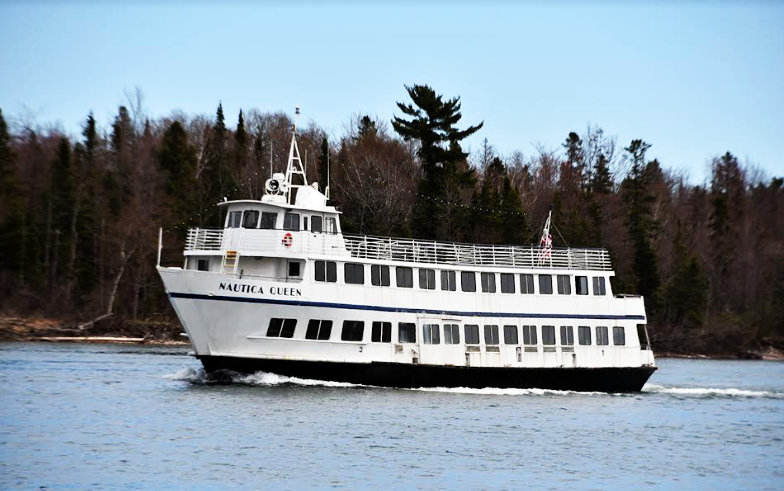
The Cleveland-based river cruise boat Nautica Queen was upbound at the Soo Thursday. Waterfront reports indicate that she is now owned by the Interlake Steamship Co. and she will take over the shuttling of workers to the new Soo Locks project that has been handled by the smaller tour boat Hiawatha, which is also owned by Interlake.
With ferry service facing cuts, an island in Northern Michigan fears for its future
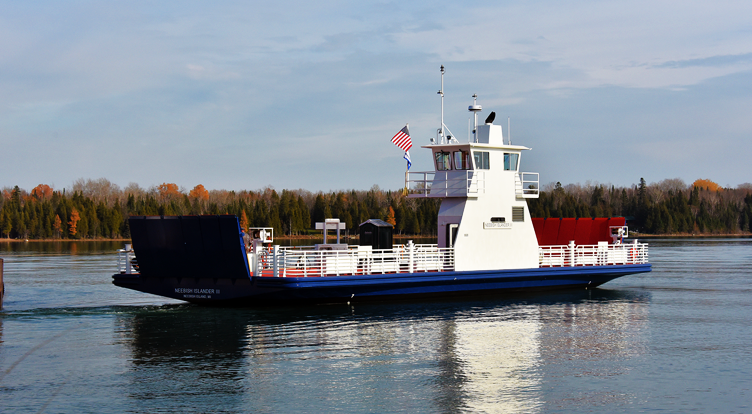
Neebish Island is separated from the Upper Peninsula mainland by a narrow channel of the St. Mary’s River. The ferry ride across takes a scant five minutes. But soon the ferry won’t run as late or as often as it used to, and the island’s few dozen permanent residents and the few hundred who come during the summer are worried that it will choke off Neebish Island’s lifeblood.
“Our very livelihood, the whole strength of our island, is being pulled back,” said Phylis Reed, president of the Neebish Island Improvement Association, “and we don’t have any reason to get people to move here or stay here, because we don’t support anything.”
The 21-square-mile island once supported two year-round stores, four schools and two churchesThe schools and most of the school-age children are gone. The one remaining church and one remaining store are seasonal.
Without ferry service after 7 p.m. in the summer, Reed said, it will be harder for summer residents to dart up to the island for weekend trips.
Without ferry service after 6 p.m. from December through April, it will be harder for everyone on the island to do the ordinary things of living: going to the doctor or out to eat or shopping for groceries.
“We can’t attract anybody to come to the island,” Reed said. “Why would people want to buy here and say this is like their second home? They can’t even come up here and get to it on a long weekend because there’s no late ferry.”
The reason for the changes in the ferry schedule is twofold, according to Pete Paramski, the executive director of the Eastern Upper Peninsula Transportation Authority, also called EUPTA, which has run ferry service to the island since 1981.
The ferry once operated during the summer until 10 p.m. on weekdays, but Paramski said the later runs weren’t used enough to make them worthwhile. EUPTA announced last fall that they would be eliminated.
“The bang just wasn’t worth the buck to make a 10 o’clock run that very, very few people were using,” he said.
The second set of changes, which will come before EUPTA’s board for approval next week, were set in motion by the U.S. Coast Guard, which regulates ferry operations.
Coast Guard regulations say crews shouldn’t work shifts more than 12 hours in a 24-hour period.
On the Neebish Island, the ferry crews been working more than 12 hours a day “for many, many years,” Paramski said.
“It’s a very rural Island. with not a lot of population,” he said. “There’s no businesses out there and whatnot, so we run a very limited schedule and there’s lots of breaks throughout the day. It doesn’t run like every hour on the hour like our ferry operations do at Drummond and Sugar Island.”
Because of the long breaks, they’d gotten an exemption, Paramski said, but the Coast Guard told EUPTA earlier this year that wasn’t going to work.
“Our primary concern is safety of passengers, crew members and the vessel,” said Lt. Phillip Gurtler, a spokesman for the Coast Guard’s 9th District, “and, when you’ve got a crew on board that’s operating for more than 12 hours in a single 24-hour period, frankly you’re kind of inviting an incident.”
He didn’t have an answer for why the ferry had been able to do so previously.
Paramski said hiring a third ferry crew would be prohibitively expensive, and EUPTA is now proposing a schedule that pushes what had been an 8 p.m. crossing on weekdays in the summer back to 7 p.m. and gets rid of 11 p.m. crossings on Friday and Saturday.
It would also expand the winter schedule, which is currently in effect from mid-January through March, to December through April. The last ferry run in the winter is at 6 p.m. When the channel to the mainland freezes, the ferry doesn’t run at all, though residents can then cross on foot or with snowmobiles.
Neebish Islanders are used to being self-sufficient, embracing a certain separation from the outside world.
But several residents said the changes already made in the ferry schedule and those proposed will create too great a distance.
To justify the changes, transit officials “keep saying, ‘Well, the population of Neebish Island keeps going down and down,’” said Helen Vogl, whose family has been coming to the island for more than a century. “Well, it goes down because people can’t live there and feel like they can get off the island (and) go to work.”
And for other reasons, too.Lori Miller moved to Neebish Island with her husband, Ed, a decade ago. Ed Miller and his siblings had spent years of their childhoods on the island. First a sister moved back. Others followed.
Ed Miller died in 2022 from COVID. Lori Miller moved from the island last year because her health was failing and she couldn’t get the help she needed.
“When we moved here, we knew what we were getting into, and we could make our life work around the schedule and around the lack of services and the lack of amenities,” she said, “but now they just keep taking away and taking away.
M Live