Great Lakes Limestone Trade Up 19.9 Percent in April
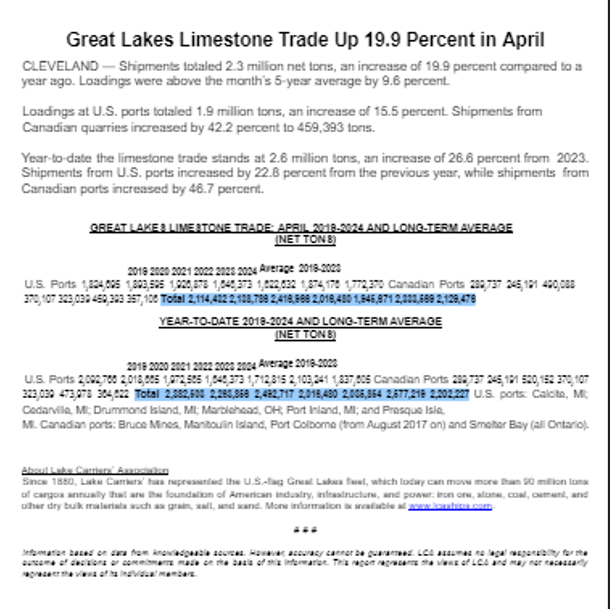
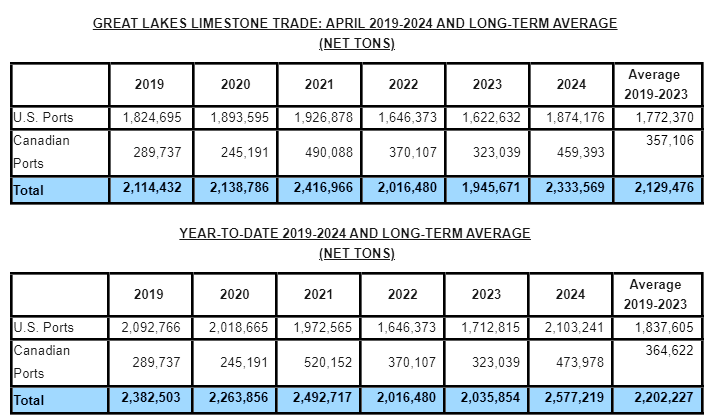
CLEVELAND — Shipments totaled 2.3 million net tons, an increase of 19.9 percent compared to a year ago. Loadings were above the month’s 5-year average by 9.6 percent.
Loadings at U.S. ports totaled 1.9 million tons, an increase of 15.5 percent. Shipments from Canadian quarries increased by 42.2 percent to 459,393 tons.
Year-to-date the limestone trade stands at 2.6 million tons, an increase of 26.6 percent from 2023. Shipments from U.S. ports increased by 22.8 percent from the previous year, while shipments from Canadian ports increased by 46.7 percent.
U.S. ports: Calcite, MI; Cedarville, MI; Drummond Island, MI; Marblehead, OH; Port Inland, MI; and Presque Isle, MI. Canadian ports: Bruce Mines, Manitoulin Island, Port Colborne (from August 2017 on) and Smelter Bay (all Ontario).
About Lake Carriers’ Association
Since 1880, Lake Carriers’ has represented the U.S.-flag Great Lakes fleet, which today can move more than 90 million tons of cargos annually that are the foundation of American industry, infrastructure, and power: iron ore, stone, coal, cement, and other dry bulk materials such as grain, salt, and sand. More information is available at www.lcaships.com.
Information based on data from knowledgeable sources. However, accuracy cannot be guaranteed. LCA assumes no legal responsibility for the outcome of decisions or commitments made on the basis of this information. This report represents the views of LCA and may not necessarily represent the views of its individual members.
Eric Peace
Vice President
Lake Carriers’ Association
25651 Detroit Road, Suite 102
Westlake, Ohio 44145
(440) 333-9996 (office) | (410) 703-8792 (mobile)
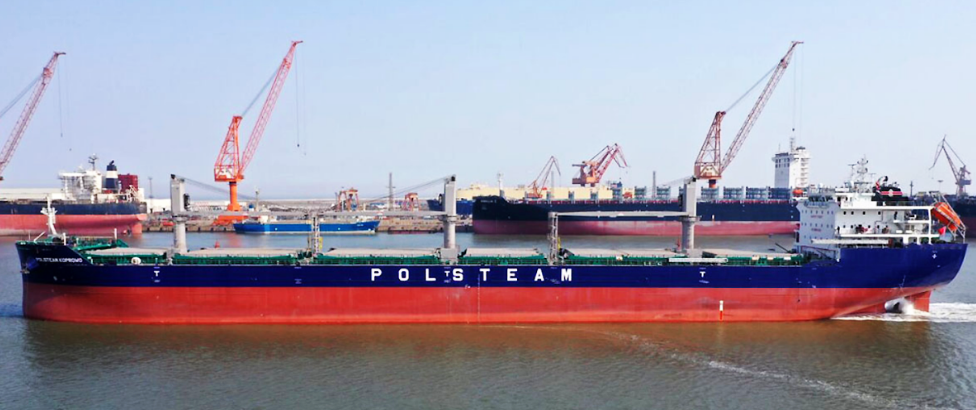
Polsteam Koprowo, a new ship in the Polsteam fleet, christened
A new ship has joined the fleet of the Polish Steamship Co. (Polsteam), and she is headed for the Great Lakes. She is the bulk carrier Polsteam Koprowo, named after a lake located on Wolin Island in Poland.
The delivery and christening ceremony occurred at the Chinese Shanhaiguan shipyard in Qinhungdao (Hebei province) of the Dalian Shipbuilding Industry Company (DSIC) group. Dorota Kubiak, head of the Technical Settlement Department at Polsteam, became the godmother.
The Polsteam Koprowo is the second in a series of twelve 37,000 dwt lake-type (laker-max) bulk carriers built by the Dalian Shipbuilding shipyard for the Polish Owner. The first of the series – the Polsteam Dabie – was handed over in mid-January 2024 and arrived in the Great Lakes at the beginning of April after a long voyage worldwide.
Subsequent vessels will be delivered every quarter. The first eight vessels will be equipped with engines running on low-sulphur fuel. The last four will already be able to burn emission-free ‘green’ methanol.
Polsteam Koprowo will sail on her first voyage on 26 April, commanded by experienced Capt. Andrzej Tłusty. The bulk carrier will load steel in the ports of Shanghai, Zhangjiagang (China) and Pohang (Korea) before crossing the Pacific Ocean and the Panama Canal, taking a course for the St Lawrence Seaway and the Great Lakes ports of Hamilton and Windsor.
On its fixed route to the American lakes, Polsteam carries high-grade steel from the Netherlands for the American automotive industry (about 300,000 tonnes per year) while on return voyages to Europe or North Africa, American and Canadian grain.
The Polsteam fleet comprises 56 vessels, including 52 bulk carriers and four ferries.
AI system to assist in St Lawrence Seaway and Great Lakes traffic management
St Lawrence Seaway Management Corporation (SLSMC) and Great Lakes St Lawrence Seaway (GLS) have agreed a deal to deploy a new Voyage Information System (VIS) from Global Spatial Technology Solutions (GSTS) to enhance joint management of the bi-national waterways between Canada and the US.
GSTS will provide predictions for the VIS through OCIANA, its AI-powered SaaS platform for ports, shipping lines, pilotage authorities, civil agencies and border security organisations.
The software will use information from the Seaway Traffic Management System and GSTS data streams to create a predictability model to forecast vessel ETAs, with the aim of assisting port operators in managing of voyages and optimising lockage schedules.
OCIANA is designed to incorporate the Locks System Rules, ensuring that all vessel movements adhere to safety and operational guidelines while adjusting for the impact of dynamic events stretching from the Atlantic approaches to the Great Lakes, to improve throughput and reduce delays.
Smart Maritime Network
Lake Ontario water levels expected to stay near or just below average into summer
by: Liam Healy
Updated: May 2, 2024 / 05:58 PM EDT
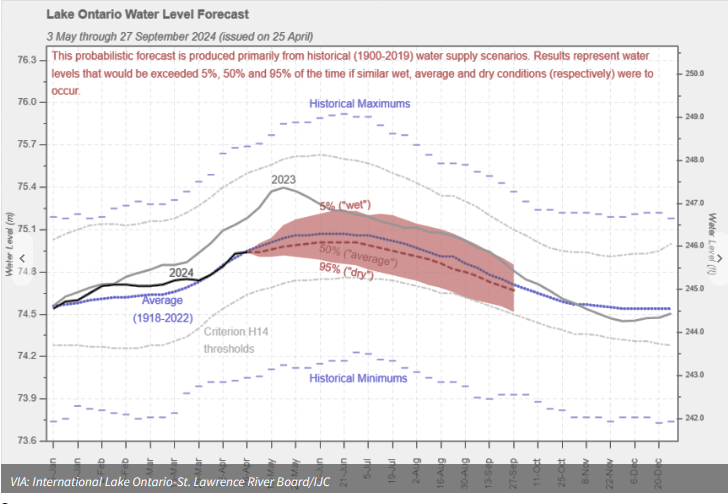
ROCHESTER, N.Y. (WROC) — While nothing is set in stone, early indications and forecasts from the International Lake Ontario – St. Lawrence River Board, which maintains outflow from Lake Ontario for the International Joint Commission, are that the normal mid-summer high point for Lake Ontario levels will remain slightly below average. That is according to Bryce Carmichael the US Section Secretary for the International Lake Ontario – St. Lawrence River Board.
“Lake Ontario itself this year is forecast to be a bit below average, but not to the extent where we see a drastic need for remediation or mitigation measures. The St Lawrence River, however, is already more below average than the lake is,” said Carmichael.
Lake Ontario is currently a few inches below 246 feet and expected to rise, which is normal through May and June, to just over 246 feet based on current forecasts. Which would leave Lake Ontario a few inches below its normal peak and much lower than the above-average levels seen around this time last year. Of more concern for the summer is levels along the St. Lawrence River near Massena.
“What we’re really looking at right now is really the impacts to the recreational boating community and tourism at large. We understand that under low water conditions, it causes people difficulties in access to Lake Saint Lawrence and the Saint Lawrence River and especially that section on Lake Saint Lawrence, which is just upstream of Moses Saunders Dam near Messina, New York,” said Carmichael.
Longer term where the levels on Lake Ontario and St. Lawrence River end up will be influenced greatly by the amount of rain we see through May and into June. Further considerations will be made by the Lake Ontario – St. Lawrence River Board on how to best manage levels if needed. Primarily though, outside of the already mentioned concerns for the St. Lawrence River, there isn’t much concern that levels on Lake Ontario in the coming months will pose much of an issue barring any short-duration changes that can’t be forecasted this far out.