Mackinac Island Ferry Co.’s new owner asks to suspend
summer, fall service amid huge repair issues
MACKINAC ISLAND, MI – Faced with a multi-million-dollar list of massive repairs for the fleet of boats it just purchased, the new owner of Mackinac Island Ferry Company Monday asked the Mackinac Island City Council to approve suspending their passenger ferry service schedule to and from the island for the rest of the summer and fall season.
This would mean their sister company, Shepler’s, would be the sole ferry service taking residents and visitors to and from Mackinac through December.
The city – which according to its charter must approve all schedule and fare changes for any island ferry service – has set another special meeting for Wednesday to vote on the request.
Hoffmann Marine, an arm of The Hoffmann Family of Companies private-equity firm based in Florida, purchased the Mackinac Island Ferry Company (MIFC) in late June. That ferry service, formerly known as Star Line, has passenger docks in both Mackinaw City and St. Ignace. It is one of two ferry services that handle all passenger boat traffic to the island.
Since the sale, all of MIFC’s fast boats, or Hydro-Jet ferries, have been pulled from service because of maintenance or safety issues. As of late last week, no MIFC ferries were leaving from the St. Ignace docks, and the MIFC ferries leaving from the Mackinaw City docks were down to three “classic” ferries, or slow boats.
Trying to pick up the slack has been Shepler’s ferry service, which Hoffmann purchased in 2022. Despite early assurances immediately after the MIFC sale that Hoffmann planned to run the competing ferry lines as two separate companies, the recent repair mess means it’s necessary to suspend the MIFC service for the remainder of the warm-weather tourism season and switch to making Shepler’s the sole ferry service to and from Mackinac, according to Chris Shepler, who has been overseeing daily operations of both fleets for the last few weeks.
In the 43 days since Hoffmann has taken over MIFC operations, it’s been discovered that deep pockets will be needed to turn around that fleet. Shepler, whom Hoffmann tapped to lead daily operations there after former CEO Jerry Fetty left his role, said initially every morning was a ritual of seeing what MIFC boats would start and which were safe for the water. By pulling all the fast boats and others off the schedule, Hoffmann was clear that no boats would go back on the water until they were 100% ready. The Band-Aid fixes that had been going on under the old company would not continue, Shepler said.
The Mac Express, Marquette II and Radisson need a combined $4 million in engine and power train work. The Joliet ran aground three weeks prior to the sale, the U.S. Coast Guard told Hoffmann. The prop and shaft were damaged, but the old company continued to run the boat. The Cadillac has 19 cracks in the hull and is taking on water. In the future, a repaired Cadillac and Joliet are only to be used in peak season on a minimal basis. These two boats also have a bilge oil waste water issue.
“The Band-Aid fixes led us to where we are today,” Shepler said of the repair list. He noted that MIFC ferries are inspected annually by the Coast Guard and that damage noted by the new owners are likely things that happened in the last four months and can be chalked up to a lack of regular maintenance.
The MIFC summer ferry boats are not the only pieces in the sale that required Hoffmann’s quick attention, Shepler said. Also on the big project list:
The much-needed repairs to the MIFC Main Dock on Mackinac Island. Of the 1,000+ pilings supporting that structure, more than 900 of them have to be restored. This will take a new set of engineering drawings, underwater divers and more planning. Shepler said it’s a priority, but no timetable has been set. He promised to keep in touch with island officials on this project.
A project to electrify MIFC’s Chippewa ferry, making it the first island ferry with electric motors, has been scrapped. While a $3 million grant from the state was announced, Shepler said no money was received and this project is no longer a priority, given all the other maintenance issues needing attention.
The Winter Boat: MIFC’s Mighty Huron is known as the “winter ferry,” the only ferry typically run between the island and the mainland in the winter. It has an ice-breaking hull and takes island residents, workers and visitors. Right now, the Huron needs a lot of work. A meeting with the U.S. Coast Guard is planned. As a backup, Hoffmann said it can invest $1 million in getting the Ottawa ferry ready by Dec. 1. They can use Shepler’s Missy Margy and Capt. Shepler ferries until the ice forms in the Straits. Hoffmann could also talk to Mackinac officials about a public-private partnership for winter ferry service, though details of that plan were not released.
M Live
Put-in-Bay’s unique Shiphouse a summer home that breaks all the rules
Stephen Zenner
The Blade
szenner@theblade.com
Aug 9, 2024 7:53 AM
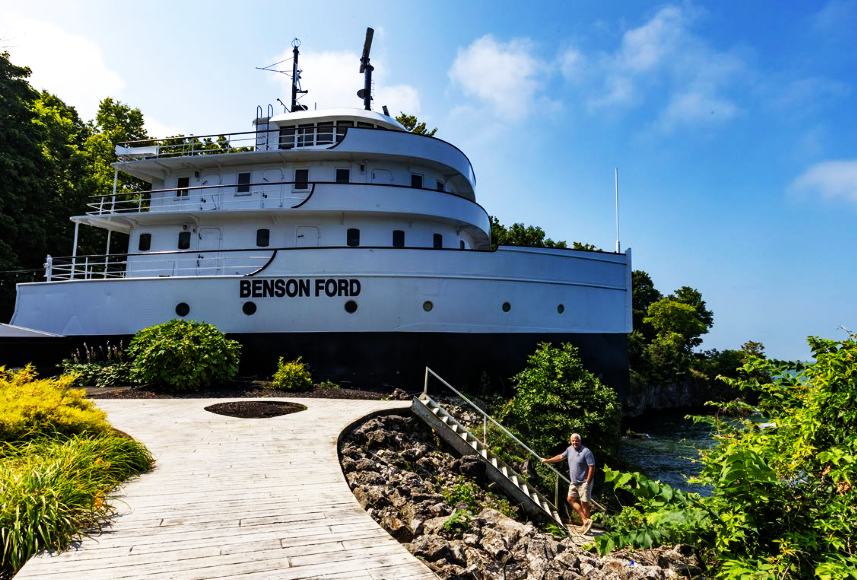
PUT-IN-BAY, Ohio — People don’t think of boats when they hear the name Ford or think of islands when they hear of Ohio or think of a steel freighter when they think of a summer home, but the Benson Ford Shiphouse in Put-in-Bay, Ohio, breaks all the rules.
“It is the one thing that people stand there and watch, you know, like, I mean, everybody wants to walk through this ship,” Paul Jeris said when talking about the home at 1191 Ashburn Ave. owned by his friend Bryan Kasper.
Most commonly the Shiphouse can be seen by people taking the Jet Express around the west side of South Bass Island, where the home appears as the front of a cargo ship perched on a rocky ledge.
“It’s the front 60 feet of a 600-foot freighter that the Ford family used to own and use for their transportation of raw materials around the Great Lakes,” Mr. Kasper said introducing the 100-year-old ship. Built in 1924, the ship was one of the first diesel engine freighters, hauling iron ore until it was retired in 1981 and given the new name John Dykstra II.
After different attempts to repurpose the freighter, the then owner, Frank J. Sullivan of Sullivan Marine in Cleveland, cut off the front end of the boat, shipped it from Cleveland to South Bass Island in 1986, and tried, unsuccessfully, to turn it into a bed and breakfast.
In 1999, Mr. Kasper bought the Shiphouse and began the gradual work of fixing up the steel freighter.
“All the carpets were green or orange or yellow, and some of the ceilings were falling down,” he said. “It’s kind of been the love of my life to refurbish all that you’ll see.”
Mr. Kasper can’t help showing off the early 20th century ship in all its steel glory and shared how Put-in-Bay started leading tours through the grounded forecastle of the ship, now his summer home.
“So my friend Paul Jeris said, ‘Hey Bryan, would you at all be interested in doing tours of your home?” Mr. Kasper said.
Mr. Jeris is also a member of the Put-in-Bay Chamber of Commerce and the Ottawa County Visitors Bureau.
“My involvement is, Bryan is a very generous guy,” Mr. Jeris said, and explained Mr. Kasper has given all the money from the tours to fund the Put-in-Bay community. “He volunteered that it all has to go to the island.”
More than $10,000 has gone to the Put-in-Bay sign, $10,000 went to bringing the Ohio State Marching Band to the island, and six live stream cameras were installed with the money from the tours.
The next tours of the Shiphouse are scheduled 10:30 a.m. to 3:30 p.m. Aug. 18. Tickets cost $40 and can be purchased through putinbay.com/tour/.
“I mean, the history of the ship is amazing,” Mr. Jeris said, adding that the tours are self guided, with he and Mr. Kasper on hand for questions.
The ship itself
Standing in front of the freighter fills visitors with the desire to explore the house — and to simultaneously learn how it works as a building.
“I finished off this lower level, put a pool table in there, dining area, put a bar and a kitchen in and a little sitting area and laundry room,” Mr. Kasper said. “The second, third, and fourth floors are still original.”
Plumbing and electricity was run to the Shiphouse by the previous owner. The tip of the ship seems precariously floating off the rock where the ship is placed, but Mr. Kasper assured “It’s anchored on bedrock, the majority of the boat, and then it’s tied in with a bunch of cement pillars and steel columns, so it’s not going anywhere.”
Entering on the ground floor, visitors may forget they’re in a ship, as it feels similar to a renovated basement. This first floor was changed the most from ship to home, but Mr. Kasper offered a glimpse of how the first floor looked before he made adaptations.
A door that could have been mistaken for a closet opens up into a high-ceilinged crosswork of steel beams with foam stuck between them. But heading just upstairs to the second floor leads back in time to a luxurious 1920s America.
“On the second floor, there’s two staterooms, one on the starboard side, one on the port side,” Mr. Kasper said.
“That would have been for Ford executives, or the rumors are that Henry Ford, Thomas Edison, Harvey Firestone, people like that have all traveled on this boat,” he said. “It’s all black walnut paneled. There’s serving call buttons near the doors and stuff.
“It’s a very ornate floor.”
Wooden stairs lead to an open common space on the third floor, a private study room, and two smaller bedrooms for crew staff.
“You can see where the wood turns from black walnut to white oak,” Mr. Kasper said. “On that floor, the black walnut would have been for Henry Ford and his guests, and then the white oak would be for the business side.”
One more set of stairs takes visitors to the wheel at the helm of the ship, where the view off the top of the ship gives the illusion of setting sail. “When you’re looking at the water, even though you’re on solid ground, you feel like you’re out on the water,” Mr. Kasper said.
Likewise the port and starboard sides of the ship have retained their slight tilts to help water run off the ship. The less-than-level floors mimic the feeling of being under way.
Altogether the ship is 7,000 square feet of steel that Mr. Kasper uses as a weekend novelty home in the summers for his family and friends and for private parties. Distinctively proud of the property, Mr. Kasper, launched Shiphouse Vodka, from one of his many companies, Noble Cut Distillery.
He proudly shows off his property and the work he put into it.
“I love when people see it, you know I put a lot of time and energy into this place, and it is very, very cool,” Mr. Kasper said.
Senator Gary Peters visits Soo Locks as new lock project continues
Peters recently secured $450 million for the project, which is estimated at a total cost of $3.2 billion.
By Jerry Tudor
Published: Aug. 8, 2024 at 7:50 PM CDT
SAULT STE. MARIE, Mich. (WLUC) – U.S. Senator Gary Peters visited Sault Ste. Marie Thursday afternoon as part of his annual motorcycle tour of the state.
Peters arrived in Sault Ste. Marie around 2:30 p.m., joined by 25 other riders.
This is Peters’ ninth year for his annual state-wide motorcycle tour. He visited the Soo Locks for a tour and update on the $3.2 billion project that would build a new Soo Lock. Peters, who is on the Senate Appropriations Committee, helped secure $450 million for that project.
If the budget is approved, the project can then begin phase three. Peters says there’s a strong chance the funding will come through.
“I was able to insert it into the appropriations language, certainly there was some give and take behind the scenes but, we basically put it in the package and it was passed unanimously out of committee, so that bodes very well for us to get it through the senate as well as to get it through the house and get it signed into law,” Sen. Gary Peters, (D) Michigan, said.
When trying to get funding for the Soo Locks project, Senator Peters explained there was a study done by the Department of Homeland Security that showed if the locks were shut down for any reason, it could negatively impact the entire U.S. economy.
“They did a study to look at what the impact would be if for some reason the Locks were shut down, perhaps a terrorist attack or some other event that shut it down, what would that mean for the whole economy, and as a result of that study, they said within a matter of two or three months the U.S. economy would be severely impacted and shortly thereafter you could actually see the economy go into a recession,” Peters said.
Peters began this year’s statewide tour in Kalamazoo.
Copyright 2024 WLUC. All rights reserved.
Lakes Limestone Trade Down in July
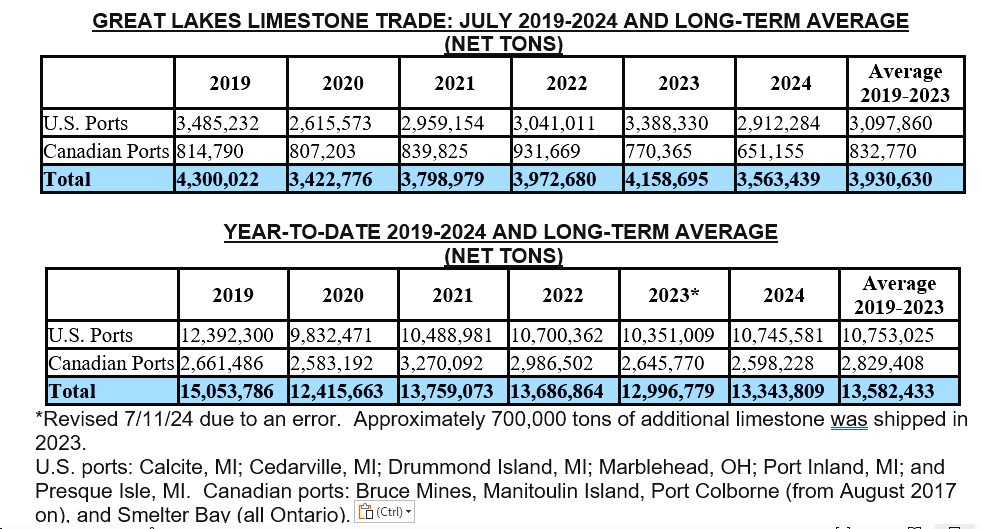
CLEVELAND — Shipments of limestone on the Great Lakes totaled 3.6 million tons in July, a decrease of 14.3 percent compared to a year ago. The trade was also below the month’s 5-year average by 9.3 percent.
Loadings from U.S. quarries totaled 2.9 million tons, a decrease of 14 percent compared to 2023. Shipments from Canadian quarries decreased by 15.5 percent to 651,155 tons.
Year-to-date the Lakes limestone trade stands at 13.3 million tons, an increase of 2.7 percent compared to a year ago. Loadings from Michigan and Ohio quarries total 10.7 million tons, an increase of 3.8 percent. Shipments from Ontario quarries total 2.6 million tons, a decrease of 1.8 percent compared to 2023.
[See Charts in Gallery Below]
U.S. ports: Calcite, MI; Cedarville, MI; Drummond Island, MI; Marblehead, OH; Port Inland, MI; and Presque Isle, MI. Canadian ports: Bruce Mines, Manitoulin Island, Port Colborne (from August 2017 on), and Smelter Bay (all Ontario).
About Lake Carriers’ Association
Since 1880, Lake Carriers’ has represented the U.S.-flag Great Lakes fleet, which today can move more than 90 million tons of cargos annually that are the foundation of American industry, infrastructure, and power: iron ore, stone, coal, cement, and other dry bulk materials such as grain, salt, and sand. More information is available at www.lcaships.com.
Information based on data from knowledgeable sources. However, accuracy cannot be guaranteed. LCA assumes no legal responsibility for the outcome of decisions or commitments made on the basis of this information. This report represents the views of LCA and may not necessarily represent the views of its individual members.
Eric Peace
Vice President
Lake Carriers’ Association
25651 Detroit Road, Suite 102
Westlake, Ohio 44145
(440) 333-9996 (office) | (410) 703-8792 (mobile)
www.lcaships.com
Detroit’s Detroit River Cruise tickets now on sale to public
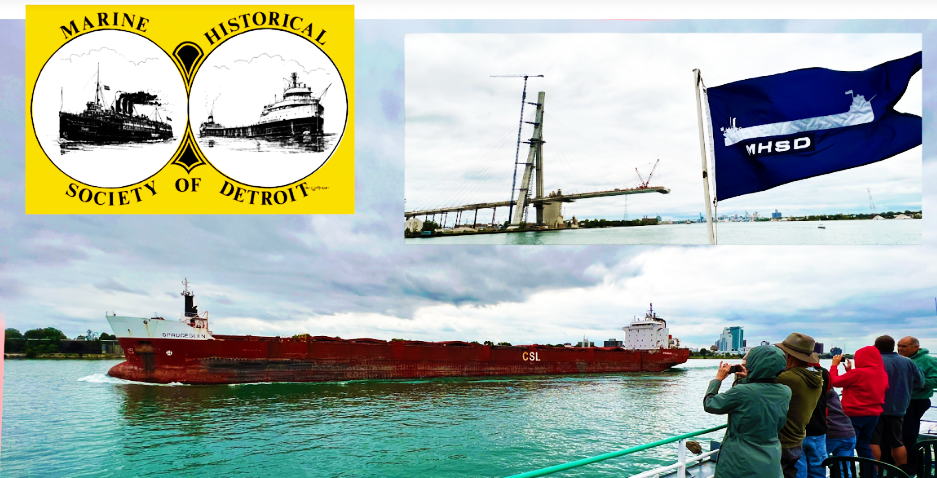
Ticket sales for the annual Marine Historical Society of Detroit’s Detroit River Cruise, scheduled for Saturday, September 7, from 1-4 p.m. aboard the the Diamond Jack River Tours boat DIAMOND QUEEN, are now open to the public.
Passengers will have the opportunity to photograph vessels and historic sites along the Detroit River and enjoy a narration by local history expert Ken Borg. The number of passengers will be limited to 100 so there will be lots of room to move about the boat. Tickets are now on sale at MHSD.org. Or pay by check to the Marine Historical Society of Detroit for $28.50 and mailed to MHSD Cruise,1020 Iroquois, Detroit, MI, 48214. If there are any tickets left the day of sailing, they will be sold at the dock for $30.
Marine Historical Society of Detroit