The St. Lawrence Seaway Unveils New Figures That Demonstrate Its Resilience, Predictability and Sustainability
CORNWALL, ON / WASHINGTON D.C. (Sept 16,2024) – Today, the St. Lawrence Seaway is releasing new figures on its performance. As of the end of August, 19.5 million metric tons of cargo have been shipped on the St. Lawrence Seaway so far this navigation season. The consistency and reliability of the binational system makes it a key supply chain link moving the goods that drive the North American economy.
The Great Lakes-St. Lawrence Seaway System supports over 350,000 jobs across the U.S. and Canada, in a region that if it were its own country, would be the third largest economy in the world. From the food we consume, highlighted by increasing shipments of grain and potash fertilizer, to the materials and fuels that support transportation and build infrastructure across North America, the Seaway keeps costs down.
“The Great Lakes-St. Lawrence Seaway System continues to provide shippers a reliable route for a diverse range of commodities flowing in and out of the U.S. heartland,” said Adam Tindall-Schlicht, Administrator, Great Lakes St. Lawrence Seaway Development Corporation. “Cargo numbers continue to improve thanks to the dedicated workers at U.S. and Canadian ports and on the vessels who are keeping vital products like grain and steel moving efficiently through the Great Lakes maritime supply chain.”
Cargos which showed significant increases compared to the same period in 2023 are:
- Grain 5.2 million metric tons of Canadian and U.S. grain, up by 277,000 mt or 5.6%
. Potash 849 thousand metric tons of Potash, a product mined in the prairies and used in agricultural fertilizers, up by 145,000 mt. or 21%
, Petroleum 1.8 million metric tons of petroleum products, up by 385, 000 mt or 27%
, Iron and steel 1.3 million metric tons of iron and steel, up by 347,000 mt or 35%
“The St. Lawrence Seaway is a vital link in the supply chain that keeps our economies moving,” said Jim Athanasiou, President and CEO of the St. Lawrence Seaway Management Corporation. “Marine shipping on the Seaway is an environmentally-friendly method for transporting goods. That’s why we’re actively working with the Great Lakes St. Lawrence Seaway Development Corporation (GLS) on initiatives like the Green Shipping Corridor to further increase our sustainability.”
As the season progresses, we expect tonnage levels to remain on trend demonstrating the Seaway as a resilient, predictable and sustainable binational system for global shipping.
About the St. Lawrence Seaway Management Corporation (SLSMC):
The St. Lawrence Seaway Management Corporation, on behalf of the Government of Canada, manages the Canadian portion of the waterway system and its associated lands. The binational St. Lawrence Seaway system serves as a key corridor and vital supply chain link for North America, driving significant economic activity.
About the Great Lakes St. Lawrence Seaway Development Corporation (GLS): The GLS is a wholly owned U.S. government corporation created by statute to construct, operate, and maintain that part of the St. Lawrence Seaway between the Port of Montreal and Lake Erie, within the territorial limits of the United States. Its mission is to serve the U.S. intermodal and international transportation system by improving the operation and maintenance of a safe, reliable, efficient, and environmentally responsible deep-draft waterway, in cooperation with its Canadian counterpart. The GLS also encourages the development of trade through the Great Lakes-Seaway System, which contributes to the comprehensive economic and environmental development of the entire Great Lakes region. Some 241,286 jobs and $36 billion in economic activity are supported by the movement of goods within the Great Lakes-Seaway System. For more information on the St. Lawrence Seaway, please consult the websites.
Quick Fact
The Great Lakes- St. Lawrence region is the industrial and agricultural heartland of both the United States and Canada – with a combined GDP of more than $6 trillion U.S. dollars. This output would represent the third-largest economy in the world – behind the U.S. and China – if it were a country.
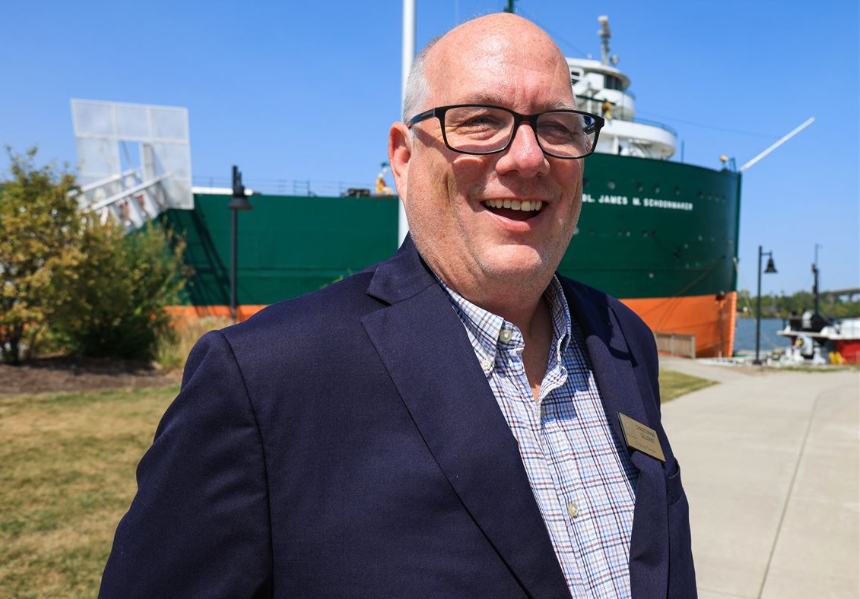
Director emeritus of Great Lakes museum reflects on national award
Eric Taunton
The Blade
etaunton@theblade.com
Sep 15, 2024 5:08 PM
He only dreamed of what the National Museum of the Great Lakes could be when he started as executive director in 1999.
Chris Gillcrist, now director emeritus of the museum, remembers thinking, along with the rest of the staff at the museum’s former location in Vermilion, “If only.”
“If only we had space for that,” he said. “If only we could get involved in that. It’s things that you want for the organization because your organization will then be serving more people.”
Mr. Gillcrist’s efforts to preserve Great Lakes history over the past 25 years earned him the 2024 C. Patrick Labadie Award for Historic Preservation from the Association for Great Lakes Maritime History, a conglomerate of institutions and individuals in the United States and Canada who work to preserve Great Lakes history.
Community members and friends of the National Museum of the Great Lakes attend a groundbreaking ceremony for the museum’s expansion on Monday in Toledo.
The national award, which he received in Buffalo on Sept. 7, was named after Great Lakes preservationist C. Patrick Labadie and is presented to individuals who have contributed to the education and preservation of the Great Lakes.
“It was a great honor but, as I said in my acceptance speech, it’s an honor for the organization because I don’t think there are a lot of times where one person is solely responsible for everything,” Mr. Gillcrist said. “I used to call them my staff, now I call them my colleagues. I have had a great staff. … I’m energized by their skills and enthusiasm. It’s really an award for the organization.”
Before he became the executive director of the museum in 1999, he worked as a teacher for small Catholic colleges on the east side of Cleveland and then for museums and other historical organizations before he came across the job listing for executive director at the National Museum of the Great Lakes.
“My background in history wasn’t in Great Lakes history, it was in American museum history and in early 20th century history,” he said. “I just said, ‘It sounds interesting.’ I applied and 25 years later [I’m still here]. It’s been a crazy ride because we were a small organization that did a lot because we had a little museum in Vermilion.”
For the first decade during his time as executive director, they had a “tiny” staff of three people before moving to Toledo, which is the seed that led the museum to sprout to success, he said.