National Museum of the Great Lakes Announces
Winners of the 2024 Luck of the Lakes Raffle
The National Museum of the Great Lakes has announced the winners of its 2024 Luck of the Lakes Raffle, which raised over $122,000 to support the museum’s mission to preserve and share the history of the Great Lakes. The fundraiser’s grand prize offers a once-in-a-lifetime Great Lakes experience: a multi-day trip for two aboard a working Interlake Steamship Co. freighter.
“Our community’s tremendous support this year is inspiring, and we’re incredibly grateful to everyone who participated in the Luck of the Lakes Raffle,” said Kate Fineske, Executive Director of the National Museum of the Great Lakes. “This raffle is not only our biggest fundraiser, but also a reminder of how deeply people care about preserving and sharing Great Lakes history. Every ticket sold helps bring our mission to life and makes a lasting impact.”
2024 Raffle Winners:
Grand Prize (Great Lakes Freighter Trip of a Lifetime): Paula K. from Waterville, OH. She will embark on an exclusive journey aboard a classic Interlake freighter, with scenic views of the Great Lakes, unique meals, and a glimpse into the life of professional mariners.
Second Prize (Ultimate Put-in-Bay Experience): Charles and Mary Alice A. from Elma, NY. Charles and Mary Alice A. won a fun-filled getaway to Put-in-Bay, including round-trip transportation, dining vouchers, attraction tickets, and a stay on the Benson Ford Shiphouse.
Third Prize (10 tickets for the 2025 Raffle): Cindy and John K. from Monclova, OH. Tey will receive ten entries for the 2025 Luck of the Lakes Raffle drawing.
For those interested in supporting the National Museum of the Great Lakes, please visit nmgl.org/donate to learn how to contribute. Details for the 2025 Luck of the Lakes Raffle will be announced in the spring of 2025.
Mayor moves to shore up trust in Toronto’s aging island ferry service
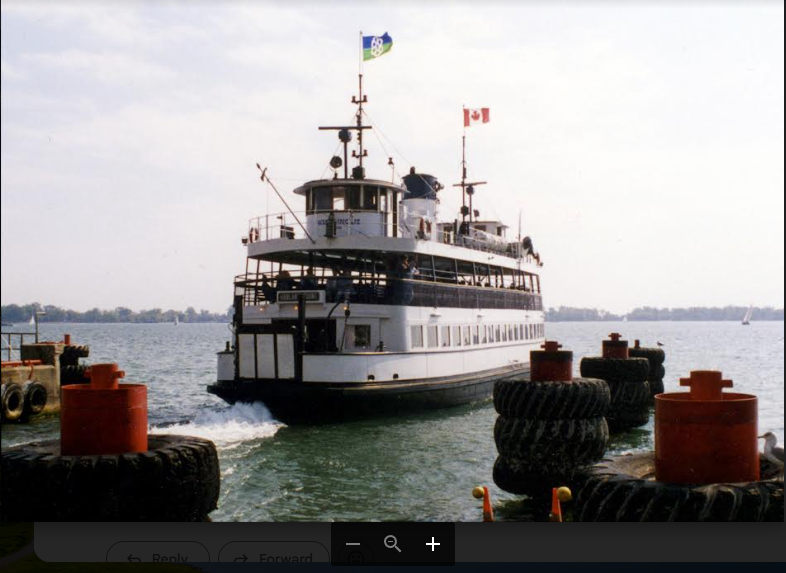
Toronto ON – Mayor Olivia Chow says Toronto’s aging island ferry fleet is safe, despite a number of problems with the boats in recent months.
Chow said Friday that she has taken a more active role in managing the file and is concerned that a number of high-profile safety incidents and maintenance issues “risk shaking people’s faith in the ferries.” Those comments come days after the head of the department that oversees the fleet appeared before a city committee, at the mayor’s request, to publicly explain safety enhancements made to the fleet.
“I want to assure the public that the ferries are safe,” Chow said. “As soon as I saw the situation I said, ‘Hang on, we need to have better support. We need more people. We need new ferries. I’m glad that the electric ferries have been ordered.”
The city’s ferry fleet serves 1.4 million passengers annually and has been under increasing scrutiny after several safety incidents. The four aging vessel’s reliability has also been questioned after lengthy outages have taken some of the boats out of service earlier this year.
Last month, the crew of the William Inglis ferry had to perform an emergency stop after what the city describes as a “mechanical issue,” resulting in the ferry hitting the dock. No one was injured, but the ferry was taken out of service. The city said Friday the vessel remains offline as it continues to investigate the incident.
In June, two of the ferries, the Thomas Rennie and the Trillium, were out of service because they were in need of repairs, resulting in the city warning travelers to expect delays and advising them to make alternate arrangements or postpone trips to the island.
The most high-profile incident occurred in August 2022, when the Sam McBride collided with the dock, injuring 20 people and sending six to hospital. A Transportation Safety Board (TSB) inquiry found that “several safety deficiencies” contributed to the incident.
The acting general manager of the city’s parks, forestry and recreation department told the city’s executive committee this week that staff have worked to address concerns raised after the 2022 incident and responded to the TSB’s recommendations. That includes hiring 63 more staff to crew the vessels, adding more life jackets on the boats and increasing lighting and safety signage.
“The city’s priorities remain operating a safe and reliable service, which includes meeting Transport Canada’s regulatory requirements around safety,” Howie Dayton told the committee.
CBC
This is what 12,000 metric tons of road salt looks like
Crew of the ‘Calumet’ spent part of Sunday unloading salt
Jim Lehocky
about 16 hours ago
It’s a sign that winter is not too far away.
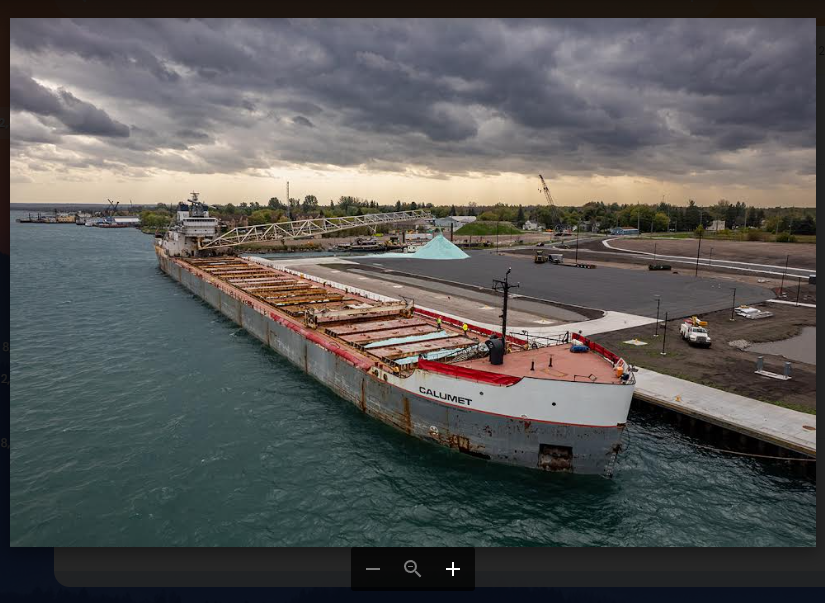
A batch of road salt was unloaded off the Calumet onto the old Carbide Dock on Portage Avenue on Sunday.
Around 12,000 metric tons (13,228 U.S. tons) was unloaded in a matter of hours before the Calumet departed to Muskegon.
According the Rand Logisitics website, the Calumet is a 630-foot self-unloading bulk freighter designed to carry a variety of cargo types including grain, iron ore, coal, aggregates, salt and other bulk commodities. The River Class vessel has a 260 foot unloading boom and has an unloading rate of 5,000 tons per hour.
The salt will be distributed to area road commissions.
New EPA standards exempt most Great Lakes ships from installing new treatment systems
New standards adopted by the U.S. Environmental Protection Agency exempt the existing fleet of ships on the Great Lakes — including in the Duluth-Superior harbor — from installing new ballast water treatment systems to control the spread of invasive species.
The standards require ocean-going vessels, known as “salties,” as well as new ships built that travel only within the Great Lakes, known as “lakers,” to install new onboard treatment systems.
But they don’t apply to the current fleet of lakers.
Federal regulators agreed with industry representatives who argued there are technological constraints, as well as economic challenges, in adding the systems to treat ballast water.
Ballast is used to balance the giant ships, up to 1,000 feet long, when they load and unload cargo. However the ballast water scooped up in one place may contain plants, shellfish and other life forms which cause problems when they are dumped in a distant post.
A host of environmental groups, along with some officials from Great Lakes states, argued for a stricter standard.
“It’s woefully inadequate,” said Steve Morse, executive director of the Minnesota Environmental Partnership. “It really doesn’t do anything to regulate the ballast water in the current fleet of lakers, many of which will be with us for half a century or more yet, in that these ships last for a long time.”
But Jeff Udd, director of government and environmental affairs at the Duluth Seaway Port Authority, said the port is supportive of how the EPA approached the new rulemaking.
“We think it’s a reasonable conclusion that they came to,” said Udd.
A significant number of the nonnative aquatic species that have invaded the Great Lakes, critters such as zebra and quagga mussels, hitched rides from Europe and Asia, hidden in ballast water tanks deep in the bowels of ocean-going freighters.
When those ships flushed their ballast tanks in Great Lakes ports, they inadvertently dumped those organisms into the lakes.
Without natural predators, many of those species have wreaked havoc in the Great Lakes, where they can outcompete native species, degrade habitat and alter the food web, in addition to causing tens of millions of dollars in economic damages.
Starting in 2006, U.S. and Canadian officials began to require salties to flush their ballast tanks with saltwater before entering the Great Lakes — a process known as “swish and spit.” The saltwater kills the freshwater organisms left in the tanks.
Since then, there have been no new documented introductions of invasive species in the Great Lakes.
But environmental groups say lakers can still move invasive species around within the Great Lakes — especially to the Duluth Superior Harbor, where 85 percent of all the ballast water dumping in the Great Lakes occurs, said Morse.
A 2018 study found lakers had transported several species of nonnative zooplankton in their ballast tanks, including a species called the Bloody Red Shrimp, to western Lake Superior.
Minnesota and Wisconsin officials had asked the EPA for stricter requirements in comments leading up to the development of the new standards.
In 2022, Minnesota Pollution Control Agency commissioner Katrina Kessler wrote to the EPA that its proposed rule, as it applies to lakers, “is a significant step back backward in controlling AIS [aquatic invasive species].”
Minnesota Public Radio
U-M team selected to lead maritime strategy development for Michigan
Ann Arbor, MI – The state of Michigan has picked a team from the University of Michigan’s Naval Architecture & Marine Engineering department for nearly $200,000, yearlong project to develop a maritime strategy for the state.
The project awarded by the Department of Environment, Great Lakes, and Energy is part of moving toward Michigan’s goal of being 100% carbon neutral by 2050 under the MI Healthy Climate Plan.
The university’s team will produce a strategy document at the end of a year, along with a proposed implementation plan targeted at stakeholder groups who will be involved in the process.
Transportation accounts for 28% of carbon emissions in the U.S., with 3% coming from boats and ships, according to Gregory Keoleian, co-director of UM’s Center for Sustainable Systems. Keoleian is a professor in the School for Environment and Sustainability, which is partnering with the Naval Architecture and Marine Engineering Department for the maritime strategy development.
“The Healthy Climate Plan focuses a lot on ground-based transportation. This effort is really to also address opportunities in with ships and boats. So it’s really exciting that way,” he said.
Thomas McKenney, a UM associate engineering professor leading the project, said decarbonization is a key way to reduce damage done to the planet by climate change, but while sustainability is rooted in environmental stewardship, it has social and economic impacts as its other main pillars of consideration.
“You can’t have sustainability if there’s not economic viability, right?” McKenney said. “So we can’t decarbonize the Michigan maritime industry at the cost of … losing jobs and and tanking the industry.”
He said one goal of the strategy is to bring together initiatives into a holistic approach to decarbonization in Michigan’s maritime industry.
The Great Lakes-St. Lawrence Governors and Premiers, an intergovernmental organization of Great Lakes states and Canadian provinces, has looked at the possibility of electric battery-powered ferries as a way to reduce pollution from the region’s maritime industry. A leader for the group has said ferries are good candidates for electric power because of their short, predictable routes and frequent stops.
Use of biodiesel to power ships and trucks in the shipping industry has been suggested by the Detroit/Wayne County Port Authority and Southwest Detroit Environmental Vision, which aim to get the port’s carbon emissions to zero by 2040. Proponents say it can be used in existing engines, an advantage over other renewable energy sources. But plant-based fuel comes with its own divisions, because of the environmental footprint of the field crops needed to produce it.
The Detroit News
Marine Mart planned for Oct. 12
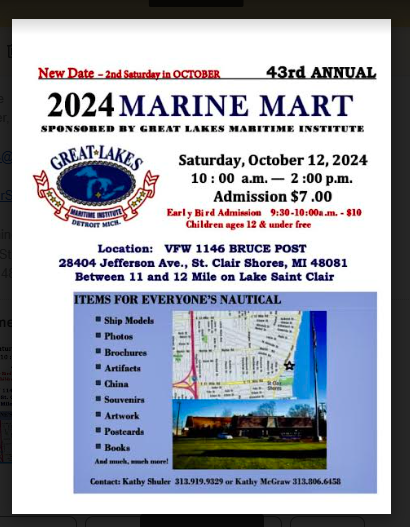
The Great Lakes Maritime Institute will host its 43rd annual Marine Mart Oct, 12 in St. Clair Shores, MI. See the flier in the photo gallery for details.