Ships taking extra caution after recent seiche
exposes parts of the Detroit River’s bank
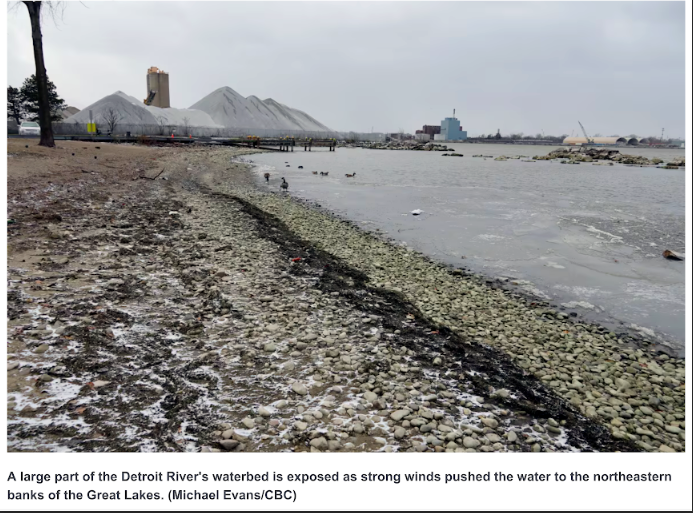
When Windsor Harbour Master Peter Berry looked at the Detroit River earlier Friday, he saw things he hadn’t seen in more than a decade. “We haven’t seen the bottom of the river since 2010, 2011. They’re now exposed,” Berry told CBC Windsor.
“Fish habitats we installed years ago that were under water are now exposed. The root balls and root wads, we can now see them.”
The culprit is a seiche that has taken the river and Lake Erie by storm. It’s a natural phenomenon that happens when strong winds push water from one end of a basin to another.
In this case, water in Lake Erie and the Detroit River are being forced into the northeastern basin by a strong, sustained southwest wind — all in a very short amount of time.
Berry says they lost about three-and-a-half to four feet of water in roughly a 24-hour period, which is why the water level is so low and parts of the riverbank are exposed.
That water loss, coupled with the strong winds, is a concern for shippers, according to Berry.
“Certainly, it’s something that mariners are keeping watch of,” said the chief operating officer of the Windsor Port Authority. “They’ve got to go look at those depths, those approaches to the docks.”
“Three, four feet, you know, a metre coming into a dock when you’re fully loaded could be a problem.”
Although three to four feet of water may not seem like much, Berry says navigating that difference in water levels takes extra effort.
“The depth on your vessels, your draft is everything,” he said, adding that mariners also have to consider where their load line is, where they’re sitting in the water, and the attitude of the vessel itself.
Prior to the seiche, Berry said the Detroit River was experiencing low water levels, especially when compared to previous years. “We’re still slightly above the mean average, but we’re [lower] than we were this time last year by 20, 30 centimetres,” he said.
The water decline isn’t necessarily a bad thing — Berry says it’s part of “a natural cycle of the Great Lakes” due to evaporation, water temperatures and climate change.
“[But] what we saw this season of decline, it went rather quickly,” he said. “We didn’t get a lot of rain in the later part of the summer and the fall, what normally would replenish those water stocks and keep us higher.”
“So we went down rather quickly from where we thought we would be.”
These lower levels mean vessels can’t carry as much cargo on board, according to Berry. And if the ships aren’t carrying a lot of cargo, the vessels are “basically a scrap of paper floating down the road.”
That makes it risky to put a ship out in anchorage, as the strong winds turn them into “mylar balloons.”
“We don’t want those anchors dragging as well because we do have fuel lines, we do have natural gas lines and liquid propane lines that travel underneath the river,” he said.
“As much as they’re buried, an anchor … being dragged starts to dig in deeper, and we definitely don’t want that.”
Nevertheless, Berry says they have to keep the economy going, so they can’t stop moving cargo to and from the port. They just do it with extra caution.
“We sail every day of the week, 365 [days]. We’ve got to move that cargo,” he said. “The only thing that stops a ship early is heavy ice, which we’ve not seen in the Great Lakes for several years.”
Berry says it’s uncommon for these strong winds to last weeks. He hopes the seiche will have slowed down by Sunday, though he knows Mother Nature sometimes has her own plans. “I’ve been here for 15 years and I’ve watched the river. She has her own attitude and her own response to things,” he said.
He says a seiche like this one can “absolutely” happen again — maybe more often due to climate change.
CBC
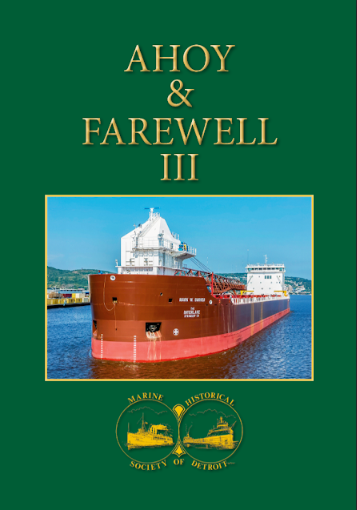
MHSD’s Ahoy & Farewell III book documents 30 years of laker history
Ahoy & Farewell III, the third installment of the Marine Historical Society of Detroit’s long-running series marking the MHSD’s 80th anniversary, is now available. The book documents the vessels we welcomed, and those to which we had to bid farewell, during the last 30 years. This 308-page, hardcover book features many color photos, with multiple images of each vessel referenced.
In a departure from the MHSD’s previous volumes, the nearly 308-page, hardcover book includes color photos, with multiple images of every vessel. The book’s authors are marine historians William Moran and Viktor Kaczkowski, and Know Your Ships publisher Roger LeLievre.
“Putting the book together has been a much greater challenge than any of us had expected,” Kaczkowski said. “With the influx of foreign-built new and used tonnage, writing the histories required a lot more research to ensure the information was correct, particularly due to the wide variety of languages that came into play.”
Order Ahoy & Farewell III now at MHSD.org.