St. Lawrence Seaway to close Jan. 10
The St. Lawrence Seaway has begun the process of shutting down for the 2024 shipping season. The Seaway system, which includes the Welland Canal and its eight locks in Port Colborne, Thorold and St. Catharines, began the shutdown process on Dec. 1 with the Canal set to close on January 10. Some ships may be allowed to transit after that date with special permission to do so.
A notice issued by The Great Lakes-St. Lawrence Seaway System said that ships that can apply for the special permits include those which report to designated call-in points (CIP 15 and 16) or any and all ships that are “at a port, dock or wharf in the Port Colborne to Port Weller section of the Seaway” and are reporting for transit after the designated closure time with all ships being clear of the canal by Jan. 10, 2025.
According to the system, more than 2.5 billion tonnes of cargo worth an estimated $375 billion has moved through the seaway to and from Canada and the United States as well as other parts of the world since opening in 1959. Almost 25 per cent of Seaway traffic comes from overseas ports, including Europe, the Middle East and Africa.
CORRECTION: While transits after 11:59 p.m. on December 26, 2024, are subject to prior written agreement, the canal remains operational. The canal is officially closing on January 10.
Thorold Today
Davie Undertaking Major Shipyard Transformation to Build Canada’s Most Advanced Icebreakers
Mike Schuler
December 10, 2024
Canada’s Chantier Davie Canada Inc. (Davie Shipbuilding) has announced strategic partnerships with Pearlson & Pearlson Inc. and Construction Dinamo Inc. to transform its Lévis facility in Québec into North America’s largest and most versatile shipbuilding center.
The facility modernization, backed by CAD $519 million in Québec government financing as part of an CAD $840 million expansion budget, will be crucial for delivering seven heavy icebreakers and two hybrid ferries under Canada’s National Shipbuilding Strategy.
The ambitious redevelopment plan includes six new state-of-the-art buildings, modernization of five existing structures, waterfront upgrades, and a new assembly hall and launch pad. The facility will also receive comprehensive utility infrastructure upgrades, including all-new plant equipment and machinery, and advanced overhead traveling cranes for ship module construction.
Based in Florida, Pearlson is known for its expertise in shipyard design and program management, having designed and and developed facilities for several of the world’s leading shipbuilding and ship repair companies, including BAE Systems, Austal USA, and Fincantieri Marine Group.
“Partnering with Pearlson will ensure our facility is more than ready to meet the high demands of building the most powerful and advanced icebreakers in Canadian history,” said James Davies, President and CEO of Davie.
The collaboration with Dinamo addresses the delivery of construction and supervision services for key sub-projects within the larger upgrade of the Lévis shipyard. “Dinamo’s expertise in construction will play an integral role in realizing our vision for the future of shipbuilding in Québec and Canada,” added Davies.
The modernization project, which align with the recently announced ICE Pact between the U.S., Canada, and Finland, is expected to create hundreds of jobs during construction and expand Davie’s workforce to 1,800 direct employees upon completion.
Operating since 1825, Davie has built over 720 specialized vessels, including many of the world’s icebreakers. The company currently holds the world’s largest orderbook of heavy icebreakers for Canada and owns Helsinki Shipyard in Finland, which has built more than half of the global icebreaker fleet.
Davie was named the third official partner to Canada’s National Shipbuilding Strategy in April 2023, joining Irving Shipbuilding Inc. in Nova Scotia and Seaspan Shipyards in Vancouver, British Columbia. The NSS is a long-term, multi-billion-dollar program to modernize Canada’s naval and coast guard fleets while revitalizing the domestic shipbuilding industry. The strategy focuses on two vessel categories: non-combatant vessels (icebreakers, offshore science vessels, and support ships) and combatant vessels (frigates and Arctic offshore patrol ships). Davie’s initial CAD $8.5 billion package of work includes seven heavy icebreakers and two large hybrid-powered ferries.
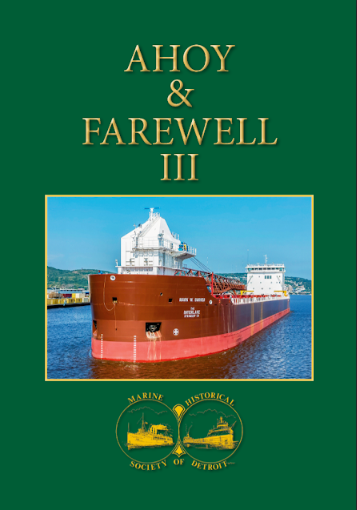
MHSD’s Ahoy & Farewell III book
documents 30 years of laker history
Ahoy & Farewell III, the third installment of the Marine Historical Society of Detroit’s long-running series marking the MHSD’s 80th anniversary, is now available. The book documents the vessels we welcomed, and those to which we had to bid farewell, during the last 30 years. This 308-page, hardcover book features many color photos, with multiple images of each vessel referenced.
In a departure from the MHSD’s previous volumes, the nearly 308-page, hardcover book includes color photos, with multiple images of every vessel. The book’s authors are marine historians William Moran and Viktor Kaczkowski, and Know Your Ships publisher Roger LeLievre.
“Putting the book together has been a much greater challenge than any of us had expected,” Kaczkowski said. “With the influx of foreign-built new and used tonnage, writing the histories required a lot more research to ensure the information was correct, particularly due to the wide variety of languages that came into play.”
Order Ahoy & Farewell III now at MHSD.org.