Damaged Wolfe Island ferry moved to Hamilton for repairs
The damaged Wolfe Islander IV ferry was towed to Hamilton for repairs on Saturday.
In a series of tweets, the Ontario Ministry of Transportation said it would move the Wolfe Islander IV to a Hamilton dry dock for further inspection and repairs on Saturday. The new zero-emission ferry, which began service this summer, was damaged earlier this during a trip from the Marysville dock. While the damage to the hull was described as “minor,” the Wolfe Islander III was brought in to replace ferry service.
The tow was handled by tugs Molly M 1 and Sheri Lynn S.
CTV, Janey Anderson (Ship Junkies)
Bipartisan SHIPS Act Aims to Revitalize U.S. Maritime Industry
In a landmark move to restore America’s maritime leadership, a bipartisan group of lawmakers has introduced comprehensive legislation aimed at rebuilding the nation’s declining shipbuilding and commercial maritime industries.
The Shipbuilding and Harbor Infrastructure for Prosperity and Security (SHIPS) for America Act, introduced by Senators Mark Kelly (D-AZ) and Todd Young (R-IN), along with Representatives John Garamendi (D-CA-8) and Trent Kelly (R-MS-1), comes at a critical time when U.S. shipbuilding capacity has weakened and China dominates international shipping.
The United States, once a dominant maritime power, now faces a stark reality: fewer than 200 oceangoing ships fly the American flag, while China has surged ahead in shipbuilding and commercial shipping.
“We’ve always been a maritime nation, but the truth is we’ve lost ground to China, who now dominates international shipping and can build merchant and military ships much more quickly than we can,” said Senator Kelly, notably the first U.S. Merchant Marine Academy graduate to serve in Congress.
The legislation sets ambitious goals, including expanding the U.S.-flag international fleet by 250 ships within a decade. It establishes a Maritime Security Advisor position within the White House and creates a Maritime Security Trust Fund to reinvest industry fees into maritime security programs.
Representative Garamendi, a long-time advocate for maritime revitalization, underscored its importance: “This bill represents the most substantial and comprehensive approach to have America compete and lead globally.”
The Act addresses critical national security concerns, particularly regarding military sealift capabilities. Currently, less than 200 oceangoing ships fly the American flag, a situation that the legislation aims to remedy through various incentives, including a 25% investment tax credit for shipyard investments.
Industry leaders have praised the initiative. David Heindel, President of Seafarers International Union, called it “an extraordinary piece of legislation” and the most comprehensive and impactful maritime policy he’s seen in his 51-year industry career.
The Act addresses critical national security concerns, particularly regarding military sealift capabilities. Currently, less than 200 oceangoing ships fly the American flag, a situation that the legislation aims to remedy through various incentives, including a 25% investment tax credit for shipyard investments.
With endorsements from over 80 maritime organizations and industry stakeholders, the SHIPS Act represents what many consider the most substantial effort in years to revitalize America’s maritime sector and counter China’s growing influence in global shipping.
“It will ensure our country has the U.S.-flag shipping capability and American mariners needed to support both national security and economic stability,” said R. Christian Johnsen, Chair of USA Maritime.
Philly Shipyard, one of the nation’s key shipbuilders, praised the act as a “major recapitalization of shipbuilding infrastructure” that would “provide substantial incentives for U.S.-built vessels.”
Key Provisions of the SHIPS for America Act
- National Maritime Strategy: Coordinate U.S. maritime policy by establishing the position of Maritime Security Advisor within the White House, who would lead an interagency Maritime Security Board tasked with making whole-of-government strategic decisions for how to implement a National Maritime Strategy. The bill also establishes a Maritime Security Trust Fund that would reinvest duties and fees paid by the maritime industry into maritime security programs and infrastructure supporting maritime commerce.
- Fleet Expansion: Establish a national goal of expanding the U.S.-flag international fleet by 250 ships in 10 years by creating the Strategic Commercial Fleet Program, which would facilitate the development of a fleet of commercially operated, U.S.-flagged, American crewed, and domestically built merchant vessels that can operate competitively in international commerce.
- Boost Competitiveness: Enhance the competitiveness of U.S.-flagged vessels in international commerce by establishing a Rulemaking Committee on Commercial Maritime Regulations and Standards to cut through the U.S. Coast Guard’s bureaucracy and red tape that limits the international competitiveness of U.S.-flagged vessels, requiring that government-funded cargo move aboard U.S.-flag vessels, and requiring a portion of commercial goods imported from China to move aboard U.S.-flag vessels starting in 2029.
- Shipyard Investments: Expand the U.S. shipyard industrial base, for both military and commercial oceangoing vessels, by establishing a 25 percent investment tax credit for shipyard investments, transforming the Title XI Federal Ship Financing Program into a revolving fund, and establishing a Shipbuilding Financial Incentives program to support innovative approaches to domestic ship building and ship repair.
- Next-Generation Innovation: Accelerate U.S. leadership in next-generation ship design, manufacturing processes, and ship energy systems by establishing the U.S. Center for Maritime Innovation, which would create regional hubs across the country.
- Workforce Development: Make historic investments in maritime workforce by establishing a Maritime and Shipbuilding Recruiting Campaign, allowing mariners to retain their credentials through a newly established Merchant Marine Career Retention Program, investing in long-overdue infrastructure needs for the U.S. Merchant Marine Academy, and supporting State Maritime Academies and Centers for Excellence for Domestic Maritime Workforce Training and Education. The bill also makes long-overdue changes to streamline and modernize the U.S. Coast Guard’s Merchant Mariner Credentialing system.
As the U.S. faces escalating geopolitical challenges, particularly in the Indo-Pacific region, the timing of this legislation is critical.
With bipartisan backing and endorsements from across the maritime spectrum, the SHIPS for America Act is poised to make waves in Congress. If successful, it promises to not only rebuild America’s shipbuilding and shipping capabilities but also reaffirm its status as a maritime leader on the global stage.
gCaptain
Share your boat-themed Christmas and holiday cards
Continuing a Boatnerd tradition, we invite you to share your boat-themed Christmas and holiday cards on our discussion board at https://newsearch.boatnerd.com/viewforum.php?f=6 (attachments must be under 2 MB. Please add to the existing thread.
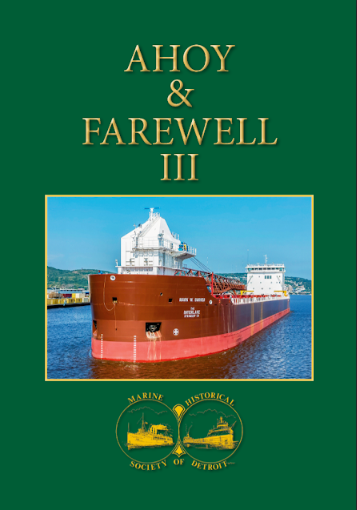
MHSD’s Ahoy & Farewell III book
documents 30 years of laker history
Ahoy & Farewell III, the third installment of the Marine Historical Society of Detroit’s long-running series marking the MHSD’s 80th anniversary, is now available. The book documents the vessels we welcomed, and those to which we had to bid farewell, during the last 30 years. This 308-page, hardcover book features many color photos, with multiple images of each vessel referenced.
In a departure from the MHSD’s previous volumes, the nearly 308-page, hardcover book includes color photos, with multiple images of every vessel. The book’s authors are marine historians William Moran and Viktor Kaczkowski, and Know Your Ships publisher Roger LeLievre.
“Putting the book together has been a much greater challenge than any of us had expected,” Kaczkowski said. “With the influx of foreign-built new and used tonnage, writing the histories required a lot more research to ensure the information was correct, particularly due to the wide variety of languages that came into play.”
Order Ahoy & Farewell III now at MHSD.org.