Will the money come to finish the Soo Lock expansion in Michigan?
May 15, 2025
Lester Graham, Michigan Public
One of the Great Lakes region’s most critical pieces of infrastructure is in Sault Ste. Marie, Michigan on the St. Mary’s River which connects Lake Superior to Lake Huron and eventually to the rest of the lakes. The Soo Locks (the colloquial name) on the river handle up to 1,000-foot-long ships carrying bulk freight from Minnesota, Wisconsin, and Michigan to ports throughout the Great Lakes region. The product many of those ships carry is taconite.
Taconite is low-grade iron ore that’s mined and processed into pellets. It is the
most important source of iron ore in the U.S.
The only lock capable of handling those long freighters is the Poe Lock.
“The Poe came online in 1969, [so it’s] well over its 50-year design life,” explained Carrie Fox, Public Affairs Specialist for the U.S. Army Corps of Engineers (USACE), which operates the locks.
Much of the taconite that is hauled through the Poe Lock at Sault Ste. Mariecomes from the Mesabi Range in Minnesota. The low-grade iron ore is processed into pellets at plants like this one in Silver Bay, Minnesota. (Lester Graham/Michigan Public)
A new lock is under construction.
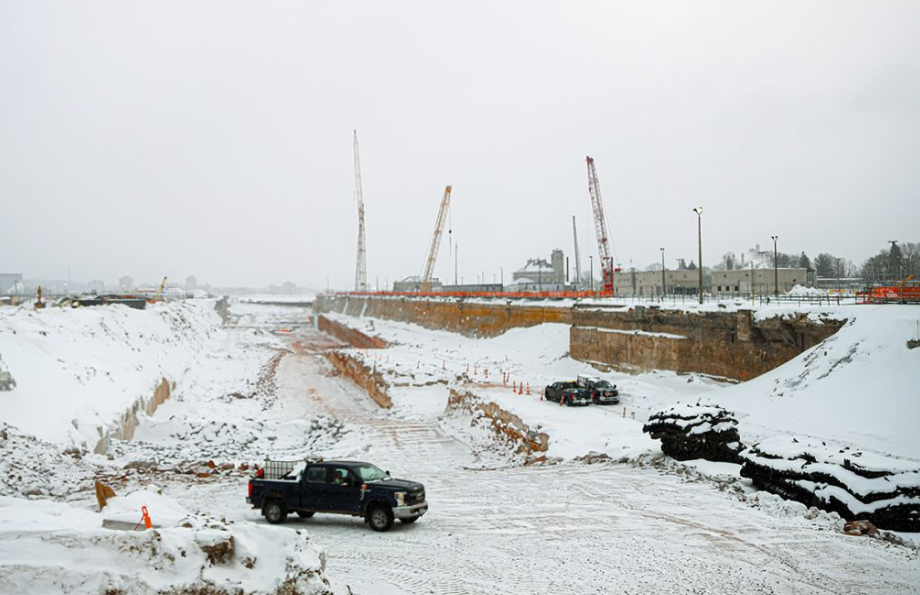
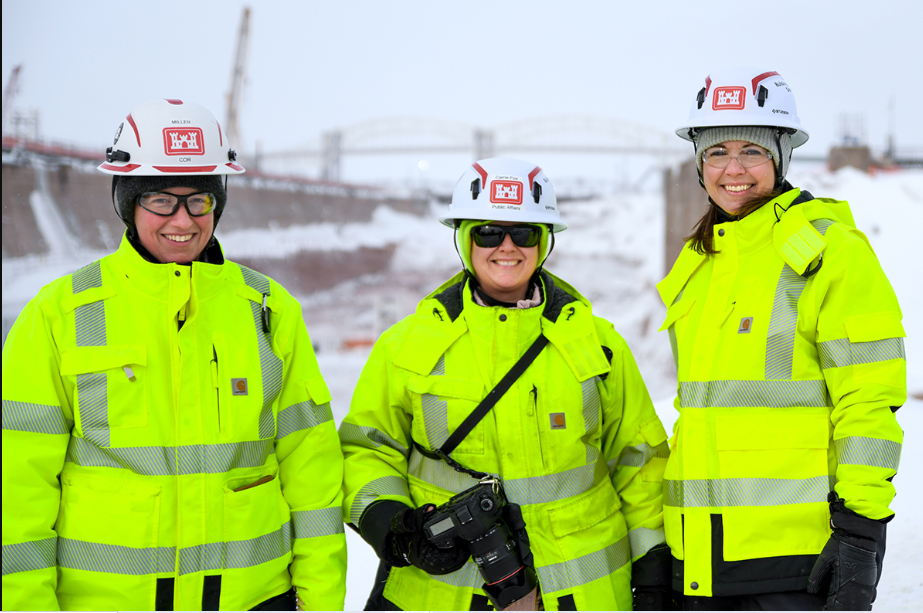
In February, I was given a tour of the site by Corps personnel.
“It’s around negative 10 [degrees F] with the wind chill today, but we’ve still got crews out there,” said Rachel Miller, supervisory engineer of the new lock project.
We headed out the door into the brisk wind off of Lake Superior and into one of the biggest federal construction efforts in the Midwest right now.
Cash Flows: Industry, Ecology, and the Future of the Great Lakes Blue Economy
It almost was not funded.
Despite knowing that each year, 80 million tons of goods go through the Sault Ste. Marie locks, including that critical iron ore, updating them did not seem to be a priority in Washington.
In 1986, Congress first authorized construction of a new lock at Sault Ste. Marie. Some preparatory work was funded in 2009. But, Congress seemed in no hurry to commit serious money to the project.
That changed after the Department of Homeland Security issued a report in 2015. It found:
One (of) the Nation’s most economically vital systems, the iron mining –integrated steel production – manufacturing supply chain, is also potentially the least resilient.
A disruption of the Poe Lock likely will cause an almost complete shutdown of Great Lakes steel production.
A shutdown of Great Lakes steel production likely will cause almost all of North American appliances, automobile, construction equipment, farm equipment, mining equipment, and railcar production to cease within weeks.
The disruption would likely result in widespread bankruptcies and dislocations throughout the economy. Almost 11 million people would likely be unemployed because of the impact and the North American economies would likely enter a severe recession.
The economic impact of the loss of the Soo Locks (the colloquial name for the structure) would not be limited to Michigan, Illinois, Indiana, and Ohio, where most of the steel mills are located.
There likely would be a $100 billion hit to the economy in Texas because of the loss of the major source of steel for products. Pennsylvania and New York would face roughly $50 billion in damage to each state’s economy. Unemployment in Michigan would reach 20%. Ohio, Kentucky, and Tennessee would experience unemployment rates of about 15%. States as far away as California would be affected.
Canada would also be hurt financially because its ships, as well as ocean-going international ships, depend on the Sault Ste. Marie locks to move goods to and from the ports in Lake Superior.
It would be bad for the U.S. It would be bad for Canada. And, it would have some impact on trade beyond the Great Lakes.
“So basically, the Soo Locks meet the definition of critical infrastructure in probably the most robust way you can imagine,” said Michigan U.S. Senator Gary Peters, a Democrat, and one of the leading proponents of building a new additional lock.
Congress approved funds for building the new lock eight years ago. Construction began in 2020.
The USACE hired contractors, Kokosing Alberici Traylor, which now have completed phase two of the three-phase project.
The construction of the new lock faced a lot of challenges. Sault Ste. Marie is remote. The major population centers in the region, Detroit, Chicago, and Cleveland, are hundreds of miles away. Finding construction workers, getting the massive amount of materials and equipment to the job site, and coordinating work without interrupting a major shipping channel were just the beginning of the hurdles for the megaproject.
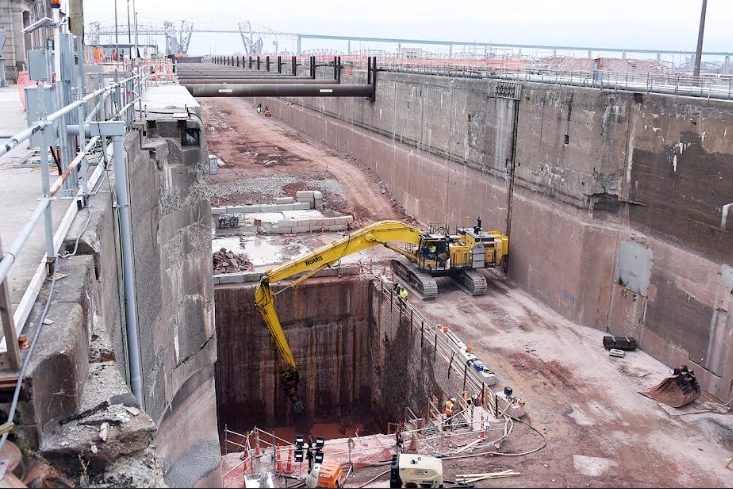
“We’re building under the level of the river in the middle of the river. So, we’re essentially creating a bathtub in order to work inside and it’s a massive one,” said Miller.
The 500 construction workers must be ferried to and from the new lock job site that’s in the middle of the river each work day.
To complicate things, there’s a hydro power plant that provides electricity for about 20% of the eastern Upper Peninsula of Michigan. A new bridge to carry the large power lines had to be constructed without causing unscheduled outages.
Workers also had to remove an old lock while not disturbing the Poe Lock next to it.
Digging and blasting a long, wide, and deep trench out of the red Jacobsville sandstone and other material in the exposed St. Mary’s River channel was another major challenge.
Complicating things further was the economy.
“Record inflation in our nation … an extreme nationwide labor shortage, a robust nationwide construction workload really stretched contractors thin,” said Mollie Mahoney, the senior project manager.
Those unexpected cost increases have driven up the price for the lock more than three times the original cost. The approved authorization in 2018 was just over $1 billion.
“The last authorization was in 2022. And at that point, the project was authorized at $3.219 billion,” Mahoney said.
The lock construction is facing an upcoming financial deadline. Under the current Continuing Resolution budget in Washington, the money for the new lock needs to be allocated before September 25th of this year.
“If those contracts aren’t executed by then, you have to be in the next appropriations bill,” said Senator Peters, adding, “It is really challenging right now to know what the Trump administration will or will not do.”
Peters said he will be working with congressional colleagues in a bipartisan way to ensure the money is there. Although, a House Republican budget plan severely restricts the funding for the project, which could delay completion. The Detroit News reported that one Michigan Republican Member of Congress suggested the USACE could reallocate funds for the project.
It’s presumptive to say what Congress and the White House will do about paying for the completion of the new Sault Ste. Marie lock. It’s anyone’s guess.
Given the amount of money spent on the nation’s highway system, there are arguments that this new lock is a bargain.
“Just the efficiency of moving goods via our maritime transportation system and the location of the Great Lakes, we’re at a great point to connect to the rest of the country,” said Erika Jensen, executive director of the Great Lakes Commission, an agency representing the eight Great Lakes states and two
Canadian provinces. She added that the Great Lakes ships use less fuel per ton of cargo than a train and much less than a truck would use.
The Great Lakes shipping industry say a ship can carry one ton of cargo 607 miles on one gallon of fuel. The rail industry’s numbers indicate a train can carry one ton of cargo more than 480 miles on one gallon of fuel. Trucks vary widely in efficiency, but a figure often cited is one gallon of fuel will carry a ton of cargo 134 miles.
Ask the captains.
In designing the new lock, the USACE invited some of the U.S.-flagged Great Lakes ships’ captains to a research facility with navigation simulators to get feedback on different approaches to the lock entrances and the different configuration of the lock under consideration.
Guiding a 1,000-foot-long ship, carrying 80,000 tons of bulk cargo into a narrow entryway to the lock is not as easy as the people in the pilot house make it look Design features of the lock matter.
“And our captain made some recommendations on how to deal with the wind conditions and the approach wall,” said Jim Weakley, president of the Laken Carriers’ Association.
He said once the lock is completed, the system will pick up some efficiencies because it’s quicker to move ships through two locks than using just one lock, but that’s just a marginal gain.
“The real big importance of this project is system resiliency,” because of having a backup lock if one fails.
The irony is, that won’t happen immediately. After the new lock is in service, the old Poe Lock will go out of service for a few years for a major overhaul to ensure its reliability in the future.
Mollie Mahoney, the USACE project manager, said the Corps engaged the shippers at every major design step. Taking five freighter captains to the Engineering Research and Design Center in Vicksburg, Mississippi, to use the simulator was helpful.
“It actually led to us changing the length of our upstream approach wall based on the feedback we got from that ship simulation study.”
Mahoney said the ship captains seem to be looking forward to the new lock. With a grin, she added, “I think they’re already fighting over who gets to go through the new lock first.”
New Book Tells Lake Michigan Shipwreck Stories
After chronicling dozens of Great Lakes shipwrecks over the years, maritime historian Michael Schumacher turned his focus to the lake just outside his window – Lake Michigan, the most shipwreck-laden of all the Great Lakes.
In the recently published book Along Lake Michigan: Shipwreck Stories of Life and Loss, Schumacher tells the stories of ships lost to fire, storm and human error across more than a century of maritime history.
From the fiery wreck of the Phoenix in 1847 to the catastrophic Armistice Day storm of 1940, Schumacher’s storytelling reveals how Lake Michigan’s shallow waters and busy commercial corridors made it both a vital artery and a deadly trap.
Door County Pulse
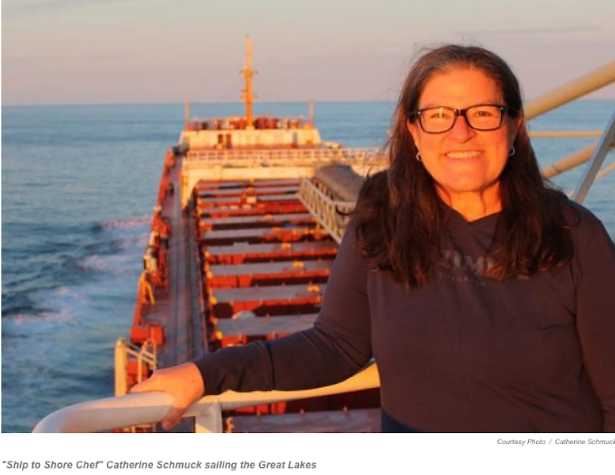
INTERVIEW: Cargo ship chef dishes about her adventures on the Great Lakes
Some cooking students dream to one day land their dream job as chef in a fancy restaurant. But one chef has made a decades-long career cooking aboard ships on the Great Lakes. I recently talked with Katherine Schmuck who started the conversation explaining how a chance meeting in a bar got her culinary career started.
Read the story, listen to it and view images here: https://radio.wcmu.org/local-regional-news/2025-05-14/cargo-ship-chef-dishes-about-her-adventures-on-the-great-lakes?fbclid=IwY2xjawKUq5NleHRuA2FlbQIxMABicmlkETFieTY4MThPNHJJREduMXF0AR7Ui0i7zxjLxds4fFlb5GLYEBkbNELLgBw2m1f9_ZobcnVO7H9WR_Wu9zoNFQ_aem_6JROikfRoQDtqY3RD7wqlg
=================================================================================================================
Registration Now Open for Annual Soo Boatnerd Cruise
Join us for the Annual Boatnerd Freighter Chasing Cruise on the St. Marys River!
- When: Friday, June 27, 6-9 pm, rain or shine
- Where: Soo Locks Boat Tours, Dock #2 (next to the Valley Camp)
- Limit: 100 passengers
- Food: Pizza and salad included with paid passage
- General Adult Admission:
-Early Bird Adult $35.00 each (through May 31)
-Regular Adult $40.00 each (June 1-June 20)
-Procrastinator Adult $45 each (after June 20)
- Youth Admission, age 5-17: $15 flat rate
- Youth Admission, age 4 and under: FREE
- Students (age 18+) with a current, valid i.d. get a $5 discount off an adult ticket. The student must present their student i.d. when boarding.
This year’s St. Mary’s River cruise will be aboard a Famous Soo Locks Boat Tours boat on Friday, June 27. Boarding begins at 5:30 pm, and we cast off at 6pm. The cruise is three hours long. We plan to travel through the U.S. Locks, but that may change in order to chase freighters.
Pizza and salad are included in paid passage. There will be a cash bar on board. You can bring your own food and beverages (you cannot bring alcohol).
Reservations are a must, as the group is limited to 100 passengers. Mailed checks must be received no later than Friday, June 20.
If the cruise is not sold out by June 20, we will take online or cash (US funds only) reservations at the Procrastinator Price of $45.00 per General Admission ticket. Youth ticket rates stay the same as listed above.
Contact Angie at griffinclawangie@gmail.com or 734-386-0899 if you have questions or to request any refunds. No refunds will be issued after June 19.
Click link below to buy your ticket(s) online.