Saginaw River Report
There was a total of 23 commercial vessel passages on the Saginaw River for the month of October 2025, with 13 different docks receiving 33 separate deliveries of product. This accounts for split cargo loads, delivered by one vessel to more than one dock during a visit. These 23 vessel passages represent one more load than recorded during October 2024.
Looking at long-term averages, October 2025, was higher than all of them, with the 5-year average at 21 passages, the 10-year average at 20 passages, the 15-year average at 18 passages, and the 20-year average at 20 commercial vessel passages for the month of October.
The total number of commercial vessel passages for the year-to-date is 161, which is one fewer passage than last year at this point. Looking at the averages, the 161 passages for the year to date are again higher than all the long-terms with the 5-year average at 149, the 10-year average at 140, the 15-year average at 129, and the 20-year average at 141 vessel passages through the end of October.
During the month of October, there were 17 deliveries to the docks on the lower half of the Saginaw River, located in Essexville and Bay City, and 16 deliveries to upper river docks, located in Zilwaukee, Carrollton, and Saginaw. 10 vessels carried split loads with cargo unloaded at more than one dock. These numbers for October are exactly the same as for September. For the year-to-date, there have been 110 lower river deliveries and 84 upper river deliveries, with 54 split loads.
Vessels making deliveries to the Saginaw River in October were Olive L Moore/Menominee with 4, Defiance/Ashtabula, Alpena, American Courage, and Algoma Compass with 3 each, Northern Venture and Algoma Buffalo with 2, American Mariner, Algoma Innovator, and Iver Bright each with 1.
Todd Shorkey, Saginaw River Images
Another New Polsteam Bulker On the Way
Another new Polsteam ship is on her way into the Seaway. She’s the Polsteam Insko, a dry bulk/Handysize ship built in 2025 and is sailing under the flag of Portugal. She has an overall length (LOA) of 200 meters and a width (beam) of 24 meters. Her summer deadweight capacity is 36,880 tonnes. Her destination is Trois-Rivières, QC, ETA Nov.7, from Inchon, Korea.
[Janey Anderson, Rene Beauchamp]
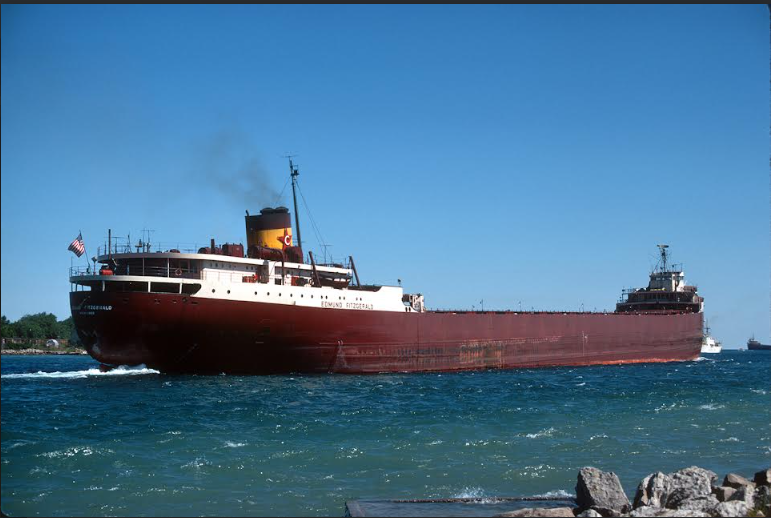
Why disasters like the Edmund Fitzgerald are far less likely on the Great Lakes today
Keith Matheny
Detroit Free Press
So long as bulk carrier freighters move goods through the Great Lakes — and through the severe storms that can pop up in November and other months — the risk of an Edmund Fitzgerald-type disaster is never zero. But improvements in weather forecasting, Great Lakes bottom mapping and other safety technology make such a disaster far less likely, experts said.
In the 1970s, Great Lakes freighters primarily received weather information through voice radio broadcasts from the U.S. Coast Guard and other marine reports by radio. Mariners would use this information to manually create their own weather charts. Observation technology at the time was much less sophisticated than it is today, relying on reports from shore stations and other vessels.
With the weather forecasting capabilities of today, better knowing the storm that was coming, the crew of the Edmund Fitzgerald may not have even embarked from port in Superior, Wisconsin, on the far western shore of Lake Superior, as they did on Nov. 9, 1975, said Thomas Hultquist, technical program lead for the analysis and forecast branch for the National Weather Service in Minneapolis.
“The biggest difference now is even before leaving Superior, they would have had a pretty good forecast a good 24 hours before even their planned departure,” he said.
Such a forecast today would have predicted a storm warning — a step above a gale warning in maritime weather forecasting, with winds between 48 and 63 knots, or 55 to 72 mph, Hultquist said, and wave heights of 20 feet or more.
“They would have had information well in advance that they probably would have made a different decision, obviously, if it were to happen today,” he said.
According to the National Weather Service, in 1975, there were no data buoys on the Great Lakes, nor any data from automated stations. The only real-time observations available to the mariner were shore and ship reports. As a direct result of the Edmund Fitzgerald disaster, eight data buoys measuring the direction and speed of winds, as well as wave heights, were dispersed on Lake Superior in 1979.
The number of buoys reporting real-time weather observations on the Great Lakes more than tripled, from 20 in 2009 to nearly 60 in 2019, with about a dozen universities, government researchers and specialized water technology companies facilitating the increase, the International Joint Commission reported.
In addition to the buoys, the tremendous expansion of shoreline weather observations and the use of satellites to track storms and their severity have also transformed the information that’s available to freighter captains and crew, Hultquist said.
“So it’s both forecast and observational data now that have really advanced and hopefully will keep these kinds of things from happening again,” he said.
Robert Thibaudeau spent 45 years as a mariner on the Great Lakes, the last 18 years as a captain of freighters. His last ship was the MV Paul R. Tregurtha, the longest bulk carrier freighter on the Great Lakes at more than 1,013 feet. He retired as a captain in 2021. Thibaudeau concurred that modern weather forecasting and observation technology of today could have made a difference on that ill-fated Edmund Fitzgerald voyage in November 1975.
“You could certainly see a lot of things coming at you that they couldn’t have seen back then,” he said.
Redundant location systems now show exactly where ships are
At about 3:30 p.m. on the fateful day of Nov. 10, 1975, as the Edmund Fitzgerald and other ships on Lake Superior battled the raging storm, the Fitz radioed two other nearby ships, the Arthur M. Anderson and the Avafors, that, among other problems, both of the Fitzgerald’s radars were out. The Anderson was asked to keep plotting the Fitzgerald’s position and help steer it to expected safe harbor in Lake Superior’s Whitefish Bay northwest of Sault Ste. Marie.
After 7:10 p.m., all radar and radio contact was lost with the Edmund Fitzgerald. By 9 p.m., the Coast Guard radioed Anderson Capt. Bernie Cooper, asking that he leave the relative safety of Whitefish Bay to go back out and look for survivors of the suspected sinking of the Edmund Fitzgerald. Cooper searched in the area where he’d last seen the Fitz on radar, and eventually found a life raft, life vests and other debris from the sunken vessel.
The National Transportation Safety Board, in its 1978 report from its investigation of the Edmund Fitzgerald sinking, noted that large Great Lakes ships at the time were not required to have onboard emergency position-indicating radio beacons, or EPIRBs, battery-operated radio transmitters that send an emergency signal when manually turned on or through automatic activation when floating. The Edmund Fitzgerald did not have these devices.
“Although the Anderson lost visual and radar contact with the Fitzgerald around (7:15 p.m.), the Anderson was not convinced that the Fitzgerald had sunk for more than an hour,” the NTSB report states. “When the Anderson became convinced that the Fitzgerald was lost, she advised the U.S. Coast Guard by VHF-FM radio-telephone of her concern. The reason for this delay was that there was no distress call from the Fitzgerald. If the Fitzgerald had been fitted with an EPIRB, a distress signal would have been transmitted immediately when the Fitzgerald sank. The EPIRB would have alerted rescue units sooner and reduced the search area.”
The report noted that as with many catastrophic maritime accidents, the crew of the Edmund Fitzgerald had no time to radio a distress call.
“Had the Anderson not been in contact with the Fitzgerald by radio and radar, the loss of the Fitzgerald and a good estimate of her position would not have been known for many hours, and the search area for possible survivors would have been greatly expanded,” the report stated.
Under a law passed by Congress in 1988, EPIRBs were mandated for Great Lakes bulk carriers and other commercial vessels operating more than 3 miles from shore.
Other technological advancements have also improved Great Lakes shipping safety, said Lt. Joseph Snyder, public affairs officer and incident management division chief at Coast Guard Sector Northern Great Lakes in Sault Ste. Marie.
With the VHF radio systems on Great Lakes ships in the mid-1970s, no direction-finding technologies existed off shoreline radio towers, Snyder said. So if a ship didn’t know or couldn’t broadcast where it was, “the Coast Guard wouldn’t really have any way of being able to try and triangulate where that call was coming from,” he said.
That changed with the installation of the Coast Guard’s Rescue 21 system on the Great Lakes, completed over the years by 2015. Radio towers now include direction-finding capabilities for radio signals that allow emergency responders to much more quickly and accurately triangulate the location of a ship in distress, Snyder said.
An augmentation to marine radar, automatic identification systems, or AIS, became commonly used by the early 2000s, continually broadcasting a ship’s identification, position, course, and speed to maritime officials and other ships. Many ship enthusiast websites use these signals to track the journeys of their ships of interest. The AIS systems most often today are coordinated with satellite GPS systems.
“This just transmits the ship’s live position at all times, and that’s publicly available information,” Snyder said.
Between EPIRB and AIS systems, there are now multiple ways of locating a ship in distress, he said.
“Back in 1975, you were relying pretty much completely on the vessel telling you where they are, on them to broadcast their own position or communicate with other ships; or have another ship tell you, ‘I see them on my radar; this is where they are,’ ” Snyder said. “And now we just have a lot more redundancy in terms of a vessel’s ability to broadcast their location and also issue a distress notification in the event they find themselves in trouble.”
Better mapping, maintenance and more safety measures
An enduring possible factor in the sinking of the Edmund Fitzgerald was that it may have grounded and caused hull damage on shoals as it passed Michipicoten and Caribou islands in Lake Superior. The 1977 U.S. Coast Guard Marine Board of Inquiry investigation report on the sinking noted that mariners at the time of the Fitzgerald disaster were using bathymetric maps of the Lake Superior bottom features in those areas, created in 1916.
Such mapping in that time would have been done by “soundings,” dropping a weight on a measured piece of rope from a drifting boat and measuring at what point the weight touched bottom — a far from comprehensive method. In light of the Edmund Fitzgerald tragedy, the U.S. Coast Guard asked Canadian counterparts to conduct updated hydrographic studies of the Lake Superior bottom between Michipicoten and Caribou islands, work that was completed in 1977.
The understanding of underwater terrain features is much more accurately understood now, with the extensive technology involved today, Snyder said.
“You’re definitely going to have a much higher fidelity in terms of charting the subsurface, the terrain at the bottom of the lake, the depths, and it’s just much easier for mariners to access as well,” he said.
Even at the time the Edmund Fitzgerald sank, many ships still relied on a library of paper charts carried on board, Snyder said. Now it’s all electronic, and can be updated automatically or via CD-ROM or other inputs every month or so, Snyder said.
“So they are always using the most up-to-date charts, and you’re no longer having to go and manually pencil in any changes if a new survey is done and new information comes in,” he said.
The Coast Guard in the immediate years after the Fitzgerald sank rescinded a 1973 amendment to Great Lakes bulk carrier load lines that was allowing the ships to carry more cargo in their holds, with the effect of riding lower in the water. This change was part of broader safety improvements, including mandatory inspections of hatch and vent closures.
Although it didn’t contribute to the loss of life in the very rapid sinking of the Edmund Fitzgerald, the NTSB report noted that the Coast Guard’s search and rescue capability was “extremely limited” on Nov. 10, 1975.
“The only Coast Guard surface unit that was large enough to cope with the weather and sea conditions, that was not under repair, and that was close enough to respond within a reasonable time was the Woodrush,” a Coast Guard buoy tender and icebreaker at port in Duluth, Minnesota, 300 miles west of Whitefish Bay.
“The small craft designed for coastal operations, which were available in Lake Superior, were unsuitable for searching 15 miles offshore under the prevailing sea conditions,” the NTSB report states. “Additional surface search and rescue units on the Great Lakes that are capable of operation in severe weather conditions are needed.”
That has changed in the years since, Snyder said. On Lake Superior, the Coast Guard has boat stations in Duluth, Bayfield, Wisconsin, Houghton-Hancock, Marquette, and Sault Ste. Marie. “All of those stations are equipped with our 45-foot response boats, which are capable of going out in some pretty snotty weather,” he said.
The Coast Guard uses MH-60T Jayhawk helicopters from Air Station Traverse City to cover Lake Superior for search and rescue operations. These long-range, all-weather helicopters are capable of extended flight times and can fly in gale-force winds.
Thibaudeau said self-inspections of Great Lakes bulk carriers by the crews and companies, as well as by the Coast Guard, increased and improved in the 50 years since the sinking of the Edmund Fitzgerald. Onboard survival suits became mandatory on bulk carriers after the ship sank, as well.
“Thank God we haven’t had another tragedy like that,” Thibaudeau said. “We’ve had fires and so on, but we haven’t had a ship go down, which is amazing when you are going back 50 years.”
What caused the Edmund Fitzgerald to sink 50 years ago is still a mystery
Keith Matheny
Detroit Free Press
What caused the SS Edmund Fitzgerald freighter to sink amid a violent storm on Lake Superior on Nov. 10, 1975, killing its 29 crew members, remains a point of debate and mystery a half-century later.
Theories range from the Edmund Fitzgerald striking a shoal and suffering bottom damage to flooding through the freighter’s hatch covers, which filled the ship with water and sank it, to rogue waves, to structural flaws in the ship that the 1975 storm made deadly.
Fed investigations: Ship likely sank due to faulty, failing hatch covers
Two major federal investigations were conducted after the Fitzgerald’s 1975 sinking: the U.S. Coast Guard’s Marine Board of Investigation, which released its report in July 1977; and the National Transportation Safety Board, whose findings and recommendations were released in May 1978.
The Coast Guard Marine Board of Investigation, in its conclusions, noted that the lack of survivors and witnesses, and the incomplete information on all that the Edmund Fitzgerald was facing on Lake Superior that day and evening, meant “the proximate cause of the loss of the SS Edmund Fitzgerald cannot be determined.”
But the board goes on to list a suspected cause: flooding through the ship’s topside hatches.
“The most probable cause of the sinking of the SS Edmund Fitzgerald was the loss of buoyancy and stability which resulted from massive flooding of the cargo hold,” its report states. “The flooding of the cargo hold took place through ineffective hatch closures as boarding seas rolled along the Spar Deck,” the deck that covers a ship’s cargo holds.
The report states that the Edmund Fitzgerald’s flooding began early on Nov. 10 and worsened throughout the day and evening as the violent storm on Lake Superior gained strength. The taking on of water reduced the ship’s freeboard, making it ride lower and lower in the raging water. The Coast Guard report notes that Edmund Fitzgerald Capt. Ernest McSorley reported being in some of the worst seas he had ever seen.
“It is probable that, at the time he reported this, Fitzgerald had lost so much freeboard from the flooding of the cargo hold that the effect of the sea was much greater than he would have ordinarily experienced,” the report states.
The Coast Guard report noted that the sinking of the Edmund Fitzgerald happened so quickly, no deployment of lifeboats occurred, nor a mayday distress call sent over the ship’s radio — despite the ship’s crew having been on the radio with the nearby freighter Arthur M. Anderson just minutes before on the evening of Nov. 10.
The report further noted that the Fitzgerald’s positioning on the Lake Superior bottom — its front section upright and looking as if it collided with the muddy bottom at speed; the middle section of the ship disintegrated and the rear section capsized and nearly perpendicular but less than 200 feet from the front section on the lake bottom — tend to indicate the ship didn’t suffer a structural breaking apart on the lake surface, as the ship halves would have likely remained buoyant for at least a brief time and the raging, 50-knot winds would have taken the two ship halves farther from one another.
The marine board walked through how a loss of buoyancy due to severe topside flooding through the ship’s faulty or failing hatches potentially unfolded on the fateful night of Nov. 10, 1975.
“Finally, as the storm reached its peak intensity, so much freeboard was lost that the bow pitched down and dove into a wall of water, and the vessel was unable to recover,” the report states. “Within a matter of seconds, the cargo (26,000 tons of iron ore taconite pellets) rushed forward, the bow plowed into the bottom of the lake, and the midships structure disintegrated, allowing the submerged stern section, now emptied of cargo, to roll over and override the other structure, finally coming to rest upside-down atop the disintegrated middle portion of the ship.”
The NTSB final report from its investigation reached a similar conclusion.
“The probable cause of this accident was the sudden massive flooding of the cargo hold due to the collapse of one or more hatch covers,” its report stated.
George “Red” Burgner was a Great Lakes mariner for decades and served as a steward or cook on the Edmund Fitzgerald for 10 years. Burgner left the Fitzgerald earlier in 1975 to have surgery on chronic bone spurs in his feet — and turned down a company invite to return to the ship just days before its fateful voyage.
In a January 1978 deposition, Burgner stated that the Fitzgerald frequently left port without yet fully securing the approximately 68 clamps that went around the ship’s hatch covers. It has contributed to some speculating that the ship’s hatches may not have been perfectly secured when the fierce storm hammered the boat.
Could the Fitzgerald have bottomed out on a shoal?
The captain of a Great Lakes freighter that also endured the storm of Nov. 10, 1975, on Lake Superior, and was the nearest ship to the Edmund Fitzgerald at the time it sank, speculated that the Fitz may have sunk from damage to its hull from bottoming out on a shoal, a shallower area in the lake due to rocks and sandbars.
“(T)he Fitz was to the west of our course line. Maybe too close to Caribou Island,” said Capt. Jesse “Bernie” Cooper of the bulk carrier Arthur M. Anderson, in a handwritten recounting of the Fitzgerald’s sinking about 10 years after the event.
“(The time was) 15:20 — 3:20 p.m. The Fitzgerald called with the information that she had a fence rail down, two vents damaged, plus a starboard list. He (Fitzgerald Captain McSorley) also had his pumps going, so that means that the Fitz had to have water in one or two of her side tanks. Probably a stress fracture of the hull.
“At this time the Fitz was mortally wounded. How bad we wouldn’t know until later. My own opinion is that she bottomed out on a shoal. This area had not been surveyed since the 1915 era.”
Robert Thibaudeau spent 45 years as a mariner on the Great Lakes, the last 18 years as a captain of freighters. His last ship was the MV Paul R. Tregurtha, the longest bulk carrier freighter on the Great Lakes at more than 1,013 feet. He retired as a captain in 2021.
He, too, speculates that the Fitz grounded on a shoal, and suspects it’s one known as Six Fathom Shoal, on the north end of Caribou Island in northeastern Lake Superior. Bedrock ridges there take lake levels to 36 feet or even shallower in places, a potential problem for a deep-drafting vessel like a Great Lakes bulk carrier. In the aftermath of the Fitzgerald sinking, the Canadian government in 1976 updated its bathymetric maps near Caribou Island from those created in the early 1900s, and mapped the shoal about a mile farther east from the island than had been previously mapped.
“If you look at where they went, the track line, there is a 36-foot (deep) shoal area they potentially could have got close to just off Caribou in that area,” Thibaudeau said. “I believe they could have gotten close to that 36-foot (shoal) spot.”
The captain added that even if the ship was in navigable water near the shoal, the heavy seas from the storm could have thrusted the ship’s bottom into the bedrock.
Officials with the Lake Carriers Association, a Westlake, Ohio-based trade organization representing the Great Lakes freighter shipping industry, also concluded that the Edmund Fitzgerald bottomed out on a shoal in the immediate years after the sinking.
But some dispute the possibility.
Sean Kery, a senior principal engineer and naval architect for CACI, a Virginia-based government contractor that works with the U.S. Navy and other clients; and Ben Fisher, with Bremerton, Washington-based SAFE Boats International, a company that designs boats for military, law enforcement and first responders, in a 2012 presentation of a forensic examination of the Edmund Fitzgerald’s sinking, rejected the shoal damage theory.
“There is no sign of grounding damage to the exposed stern section, which would be the deepest in the water under normal conditions,” Kerry and Fisher’s research paper stated.
Ric Mixter agrees. The Wixom resident is a diver, documentary filmmaker, Great Lakes shipwreck historian and author of the 2022 book “Tattletale Sounds: The Edmund Fitzgerald investigations.” He is among the few who have dived the Edmund Fitzgerald shipwreck, in a submersible in 1994.
“I’ve totally ruled out running aground,” he said. “I’ve got lots of people who tell me that Six Fathom Shoal doesn’t exist.”
In addition to McSorley, three other crew members on the Fitzgerald that fateful night — First Mate John H. McCarthy, Second Mate James A. Pratt, and Third Mate Michael E. Armagost — had attained the designation of Master from the U.S. Coast Guard, meaning they had passed through a rigorous licensing and endorsement process showing their experience and proficiency to safely and efficiently operate a ship such as a Great Lakes bulk carrier.
“They had made that turn (by Michipicoten and Caribou islands) more than a hundred times,” said Mixter. “John Simmons, the wheelsman, had been on the Fitzgerald since 1959. He was the longest-serving employee on board that ship.
“To insult those guys to say … they cut that corner and ran aground, it’s absolutely silly.”
A faulty ‘backbone’ and rogue waves could have doomed the Fitz
In addition to serving as a cook on the Edmund Fitzgerald for a decade, Red Burgner was also the ship’s winter “keeper” for seven years, an employee who stays on the ship at dock or drydock overwinter, helping coordinate maintenance and keeping the ship operational, and serving as a point of contact with contractors coming to the ship.
In his January 1978 deposition, Burgner stated that the Edmund Fitzgerald had recurring problems with a loose keel, the steel backbone of the ship along its bottom, from which the hull is constructed. Burgner said he observed the loose keel, with sections receiving only spots of “tack welds” instead of solid welds along the length of the keel to reattach it to the ship, as recently as overwinter 1973-74.
Burgner also testified that the ship would move and heave with large waves in a way that he didn’t experience on other boats, and take longer to straighten out after such waves. The Fitzgerald also made “groaning” noises that Burgner said he’d never heard on any other boat he’d served on.
Burgner stated he was present for a conversation where maintenance men working on the lower decks of the boat told McSorley the problem had arisen again earlier in 1975, as the Edmund Fitzgerald was being prepared for the upcoming shipping season.
“They came in the mess room door, had coffee, sat down and started talking,” Burgner stated. “And they said, ‘Captain, the keel’s loose on this son of a bitch again.’ “Burgner said McSorley replied, “‘I don’t give a (expletive). All this son of a bitch has got to do is stay together one more year. After that, I don’t give a shit what happens to it.'”
Burgner’s account of keel problems on the Edmund Fitzgerald is corroborated by marine engineer and naval architect Joseph E. Fischer, then president of Bay Engineering Inc., who, in a recollection years after the Fitzgerald sank, recalled that a company he was with in 1969, R.A. Steam in Sturgeon Bay, Wisconsin, “was asked to investigate the continuing failure of the longitudinal keelsons attachment to the bottom shell plate” of the Edmund Fitzgerald.
“Each year, a survey would show cracks in the weld of the center vertical keel to the bottom shell,” Fischer said. “These cracks would be gouged out and rewelded only to show the same cracks in the following years.”
Mixter thinks it’s a key to the Fitzgerald’s demise. With Burgner’s testimony, “there is a clear indication (McSorley) knew there was an issue, but he still pushed through five gale-force winds in that season, one on Lake Huron and the rest on Superior,” Mixter said. “So each time that keel was getting loose.”
Cooper, the captain aboard the Anderson on the same Nov. 10, only miles away from the Fitzgerald, recalled seas of “25 to 35 feet” that evening on eastern Lake Superior.
“Sometime before 7 p.m. we took two of the largest seas of the trip,” Cooper recounted in his handwritten retelling of that night. “The first one flooded our boat deck. It had enough force to come down on the starboard lifeboat, pushing it into the saddles with a force strong enough to damage the bottom of the lifeboat … the second large sea put green water on our bridge deck! This is about 35 feet above the waterline!
“Did these two large seas reach the Fitzgerald at 7:10 p.m.?”
The Fitzgerald had already reported a fence rail down, vents damaged and a starboard list, with two pumps activated — signs the ship was already taking on water. The ship was riding lower above the waterline. The large waves might have meant its death knell.
“It collapsed Hatches 1 and 5, and the ship couldn’t recover,” Mixter speculated. “It broke its back on the surface. It dove underneath the water, and the stern section ripped off and flipped upside-down.”
That more or less coincides with the conclusions of the 2012 analysis by Kery and Fisher: a cascading disaster of two smashed vents, flooding ballast tanks, the Fitzgerald’s forward house flooding, the forward two hatch covers blown in, allowing yet more water to rush in and weigh down the ship, and a hull girder failure.
Mixter believes what exactly caused the Edmund Fitzgerald to sink on the night of Nov. 10, 1975, leaving its crew of 29 dead, is possible to know. But it would take more dives and further research on the ship’s remains on the Lake Superior bottom to understand. It’s time to overcome reservations about it, he said.
“There are so many questions that could be solved with a quick sonar scan with the newest technology we have,” Mixter said. “Many of the voices that were so vocally opposed to us (shipwreck divers) have faded since they have passed away.
“Fifty years later now, we are sitting at the point where there is better technology, and we could figure it out.”
Gales of November Conference Honors Fitzgerald 50th
DULUTH, MN – Lake Superior Marine Museum Association presents Gales of November 2025, a two-day conference Nov 7-8 commemorating the 50th anniversary of the SS Edmund Fitzgerald. This special event brings together maritime historians, lighthouse preservationists, and Great Lakes experts for a weekend of reflection, education, and storytelling
Attendees can look forward to in-depth presentations on shipwreck research, lighthouse restoration, and the evolution of theories surrounding the Fitzgerald disaster. The conference also includes updates from the Duluth Seaway Port Authority and the Lake Superior Maritime Visitor Center, buffet luncheons and a silent auction.
Gales of November offers an opportunity to honor the men lost aboard the Fitzgerald and celebrate those who continue to preserve the legacy of Great Lakes shipping and maritime history.
LEARN MORE & REGISTER AT: destinationduluth.co/GalesOfNovConf
Great Lakes Maritime Institute Marks Fitzgerald Anniversary
Great Lakes Shipwreck Museum Offers 2
Special Edmund Fitzgerald Events
WHITEFISH POINT, MI – Great Lakes Shipwreck Museum has two special events happening before the Fitzgerald memorial on November 10th. One on November 7th and one on the 9th. All our events this fall are free to the public…please read below.
NOVEMBER 7th
The Great Lakes Shipwreck Museum will host an Edmund Fitzgerald speaker panel to take place on Friday, November 7, 2025 (6:30pm) at the Whitefish Township Community Center in Paradise, MI. Panelists will range from historians and surviving Fitzgerald family members…to Shipwreck Society staff and a former engineer on the Fitzgerald. This is a free event and seating will be on a first-come, first serve basis. The event will last approximately 1.5 hours. The Whitefish Township Community Center is located at: 7052 M-123, Paradise, MI 49768.
ON NOVEMBER 9th
The Great Lakes Shipwreck Historical Society will soon release the second edition of its popular Edmund Fitzgerald publication, The Legend Lives On. With an additional 48-pages of content, this richly illustrated book features historic imagery and artwork of “Big Fitz” during its working life and of this ship’s ongoing story across the years since November 10, 1975. The GLSHS official release and book signing of The Legend Lives On will take place at the Shipwreck Coast Museum Store on the Shipwreck Museum campus (Whitefish Point) on Sunday, November 9, 2025 from 1pm-3pm. Authors Bruce Lynn and Christopher Winters will be signing copies of the book at this time
National Museum of the Great Lakes Remembers the Fitzgerald
Fifty years after the Edmund Fitzgerald tragically met its demise in Lake Superior, the National Museum of the Great Lakes invites you to Toledo for four powerful days of stories, music and reflection remembering the ship’s 29-man crew-many of whom called Toledo home.
[See the two-page flyer in the gallery.]
Mark 50 years since Edmund Fitzgerald sinking with historic cuisine, wreath laying
DETROIT, MI – From dining on authentic cuisine served on the ill-fated freighter to a solemn laying of wreaths on the water, the Detroit Historical Society is hosting a weekend of events to honor the 29 mariners who died in the sinking of the Edmund Fitzgerald nearly 50 years ago.
The museum is planning several opportunities, paid and free, to honor the Fitzgerald, which went down in a violent storm on Nov. 10, 1975, and is remembered in the Gordon Lightfoot ballad.
Rebecca Salminen-Witt, a spokeswoman for the Detroit Historical Society, said tickets are expected to sell out fast for a special brunch set for Sunday, Nov. 9, and the solemn wreath-laying ceremony on Nov. 10. Free events also are scheduled at the museum throughout the weekend.
“It’s important for people to learn about this history ― there’s a lot of it. And Detroit played a huge role in the maritime history of the state and in the whole country,” Salminen-Witt said.
Friday Nov. 7
The commemorative weekend kicks off at 11 a.m. with a book talk featuring Thomas Nelson, the author of “Wrecked: the Edmund Fitzgerald and the Sinking of the American Economy.”
Salminen-Witt said Nelson’s book takes a unique perspective on the ship’s sinking and how the loss of thousands of pounds of ore affected Michigan’s manufacturing economy, ultimately impacting the nation’s economy.
Register for the book talk here: https://www.detroithistorical.org/events/book-talk-wrecked
Detroit Free Press
Detroit Historical Society hosts several events for 50th anniversary of Edmund Fitzgerald sinking
By: Max White
(WXYZ) — The Detroit Historical Society is hosting a full weekend of activities to mark the 50th anniversary of the sinking of the Edmund Fitzgerald.
According to the society, the activities all take place at the Dossin Great Lakes Museum on Belle Isle, and will kick off on Friday, Nov. 7, with a talk by author Thomas Nelson, who wrote the book “WRECKED: the Edmund Fitzgerald and the Sinking of the American Economy.”
On Saturday, Nov. 8, curators and docents will host drop-in tours of the Edmund Fitzgerald exhibit on the lower level of the Dossin Great Lakes Museum. Also, the Great Lakes Maritime Institute will be there for information and merchandise.
Also on Saturday, the Livonia Amateur Radio Club will be in DeRoy Hall for the Edmund Fitzgerald radio broadcast, and a new pop-up exhibit will debut.
Sunday morning, the museum will host its first-ever Maritime Brunch, which will feature a chef-prepared meal directly from the Edmund Fitzgerald’s on-ship menu, along with a video presentation from Ship-to-Shore Chef Catherine Schmuck.
During the brunch, a new film will premiere about the Edmund Fitzgerald with experts from around the Great Lakes. Tickets for the brunch are available now.
Finally, on Monday, the society will host its 26th annual Lost Mariner’s Remembrance, which is a tribute to the sailors who were lost on the Great Lakes. The event takes place from 6 p.m. to 8 p.m. and begins with a lantern vigil at the Fitzgerald’s bow setting. Officials say the event sells out every year, and tickets are available now.
Click to see Full story and videos: https://www.wxyz.com/news/detroit-historical-society-hosts-several-events-for-50th-anniversary-of-edmund-fitzgerald-sinking?sfnsn=mo&fbclid=IwY2xjawMsZ1VleHRuA2FlbQIxMQABHi7V_IMl1KDLaV2aLwAgHT9l68-iG1GT4NPz0DBD_7FrGRv3vNimb9LJi74Q_aem_jJq4jLDiDZj4tCbMK3qspw
Split Rock lighthouse on Lake Superior to shine
beacon for Edmund Fitzgerald memorial ceremony
TWO HARBORS, MN – One of the most famous lighthouses on the Great Lakes will again be hosting an Edmund Fitzgerald memorial service this year, and the gathering marking the 50th anniversary of the freighter’s tragic loss is expected to draw thousands to the clifftop site.
Split Rock Lighthouse will host its annual event on Nov. 10, a half-century after the Fitzgerald sank in a violent storm off Whitefish Point at the southern end of Lake Superior.
At the service, all 29 names will be read aloud to the tolling of a bell. Then Split Rock’s beacon will be lit in tribute to those lost.
The Minnesota Historical Society will be hosting the event. The lighthouse, perched atop a high, rocky cliff, sits more than 130 feet above Lake Superior. It is one of the most photographed lighthouses in the United States.
“We’re just trying to provide a little place for memory and for remembrance and to really put into perspective the power of the lake,” site manager Hayes Scriven told Minnesota Public Radio recently. “So that’s why we think it’s very important for us to keep doing this.”
The Split Rock Lighthouse event is one of many taking place across the Great Lakes to honor the memory of the Edmund Fitzgerald’s crew. In Michigan, the Great Lakes Shipwreck Museum at Whitefish Point will be holding a public remembrance event on Nov. 10, as well as a private ceremony for the relatives of the Fitzgerald’s crew.
The Mariners’ Church of Detroit also has memorial events planned for November. You can see the lineup here: https://marinerschurchofdetroit.org/edmund-fitzgerald/
[M Live]
Fitzgerald Memorial Plans Announced By
Great Lakes Shipwreck Historical Society
The Great Lakes Shipwreck Historical Society will hold an outdoor public remembrance service for the 50th Edmund Fitzgerald Memorial at Whitefish Point on Monday, November 10th, 2025 at 2 p.m.
PLAN AHEAD – WHAT TO EXPECT:
Outdoor Shelter: NO tent or seating will be setup for the outdoor public ceremony, as November can have volatile weather that would cause more harm than good. Check the weather forecast prior to traveling to Whitefish Point, and know your limits.
*(Seating will be provided for speakers and individuals ringing the bell.)
Parking: LIMITED parking is available at Whitefish Point. No RVs, Campers, or trailers will be allowed to park in the PAVED parking areas. Once paved parking areas are filled, be prepared to park along the shoulder of the road prior to reaching Whitefish Point.
No Shuttle Services: Be prepared to walk the distance from where you parked to get to Whitefish Point. Know your limits!
Museum Closed: The Museum will be closed to the public. Restrooms will be open.
Grounds Cleared: In order to make room (and parking available) for Fitzgerald families driving-in for the evening ceremony, daytime visitors will be asked to leave the grounds by 5PM.
A ceremony for family members only will take place at 7:00 PM, which will be livestreamed for the public. Under no circumstances will the evening ceremony for the family members of the Edmund Fitzgerald be open to the public.
The live stream link of the evening ceremony will be made available prior to the ceremony via our website and social media channels.
[Great Lakes Shipwreck Historical Society]
Huge crowd expected for 50th anniversary
memorial of sinking of the Edmund Fitzgerald
A crowd of about 2,000 people is expected to turn out next month when Split Rock Lighthouse and the Minnesota Historical Society host a memorial to commemorate the 50th anniversary of the sinking of the Edmund Fitzgerald on Nov. 10.
The ship left port in Superior, Wis., in 1975 “With a load of iron ore, 26,000 tons more, than the Edmund Fitzgerald weighed empty,” as immortalized in Gordon Lightfoot’s famous song about the wreck. The Fitz would have passed just a few miles off shore from Split Rock.
For the past 40 years, the lighthouse has observed the anniversary with a ceremony in which the names of the 29 crew members who perished in Lake Superior are read aloud to the tolling of a ship’s bell. Then Split Rock’s beacon is lit in their honor.
This year’s event will continue that tradition. In addition, former Split Rock Lighthouse Site Manager Lee Radzak will discuss why he started the annual memorial 40 years ago.
“My first one that I attended was actually the first day I was here on site, back in 2019, and the emotional response that I had was just very striking to me,” recalls current site manager Hayes Scriven.
“Listening to the names and the bell being rung, and all of sudden the light comes on, it’s very moving.”
Scriven said they’ve already sold more tickets in advance this year than they ever have for past events. He advises those interested in attending to arrive a few hours before it starts at 4 pm. Free shuttles will also be available from Silver Bay.
He believes there are a few reasons why the tragedy still resonates so deeply with people today. Many know it through the iconic song “The Wreck of the Edmund Fitzgerald.” There’s also the enduring mystery of what precisely led to the ship and crew’s demise.
Thousands of tourists flock to Duluth and the North Shore of Lake Superior to see up close the giant 1,000-foot freighters that carry iron ore and other materials across the Great Lakes. Scriven says many people have a hard time fathoming how one of those enormous ships could disappear.
“We’re just trying to provide a little place for memory and for remembrance and to really put into perspective the power of the lake,” Scriven says. “So that’s why we think it’s very important for us to keep doing this.”
MPR News
ISMA Milwaukee Lodge, Wisconsin Marine Historical Society
Will Host 50th Anniversary Fitzgerald Commemoration
International Ship Masters Association Milwaukee Lodge and the
Wisconsin Marine Historical Society have partnered to commemorate
the SS Edmund Fitzgerald and her Crew on the 50th anniversary of
her sinking.
Join us on Monday, November 10th, from 5-8 PM, at The
Cooperage (822 S. Water St., Milwaukee). The event will feature a
solemn bell ringing ceremony at 6:10 PM in memory of the 29 lost
crew members, followed by speakers sharing their personal
connections to this historic event.
Admission includes heavy hors d’oeuvres and a cash bar. Tickets
are $20 presale, or $40 at the door if space allows. Secure your spot
early – the first 200 tickets sold will receive a commemorative
challenge coin and gift bag. Presale ends November 5, 2025.
Don’t miss this unique opportunity to reflect on a solemn and
significant event in Great Lakes history. Space is limited, so purchase
your tickets today at:
http://www.shipmaster.org/lodge-6
This event is a commemoration, not a fund raiser.