U.S. Shipping Companies Invest
$150 Million in Great Lakes Region
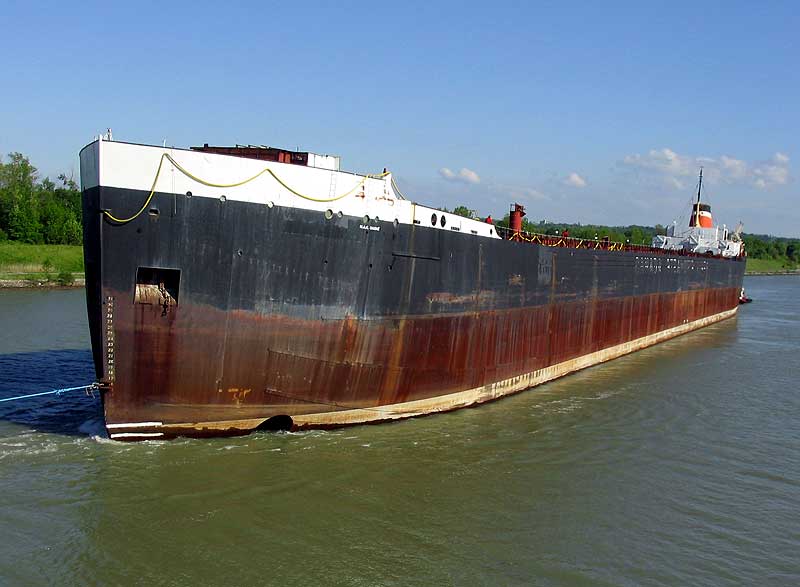
CLEVELAND – With winter in full swing, the U.S.-flagged fleet of Lakers have tied up in ports across the Great Lakes region to perform critical maintenance before the navigational locks in Sault Ste Marie, Michigan reopen on March 25th. Hundreds of skilled shipyard workers will flock to the area to support the nearly $150 million maintenance investment being made on these massive ships. The state receiving the largest amount of work is Ohio with $51.5 million, followed closely by Wisconsin at $51 million, Pennsylvania at $25 million, Minnesota and Michigan both getting $9 million, and another $3 million will go to facilities in New York and Illinois.
“This level of investment is a testament to the strength of the U.S. shipping industry on the Great Lakes. Domestically produced steel will be installed on many ships by U.S welders and electronic equipment will be upgraded by American electricians. It is good for the ships, good for local jobs, and great for the Great Lakes region,” stated Jim Weakley, President of the Lake Carriers Association.
After nine and a half months of continuous operations loading and unloading various bulk cargo, the ships get a short rest period. Most of the crew that sailed will get a prolonged vacation while engineers and other support staff work over the winter to make sure the vessels are in top shape when the season begins again in March. Propulsion equipment will be tuned and, in some cases, replaced, steel hull plating and welds will get refreshed, and crew comforts will be added or upgraded.
Since most of the U.S.-flagged fleet of lakers are too large to exit the Great Lakes due to the limiting size of the Seaway locks, they will remain comfortably accommodated at some of the world’s best ship repair facilities right here in Great Lakes states. Investment in the current Great Lakes ships is an investment in the future of the North American economy and the continued strength of our nation.
Lake Carriers’ Association
Algoma Sault enters winter layup in Port Colborne
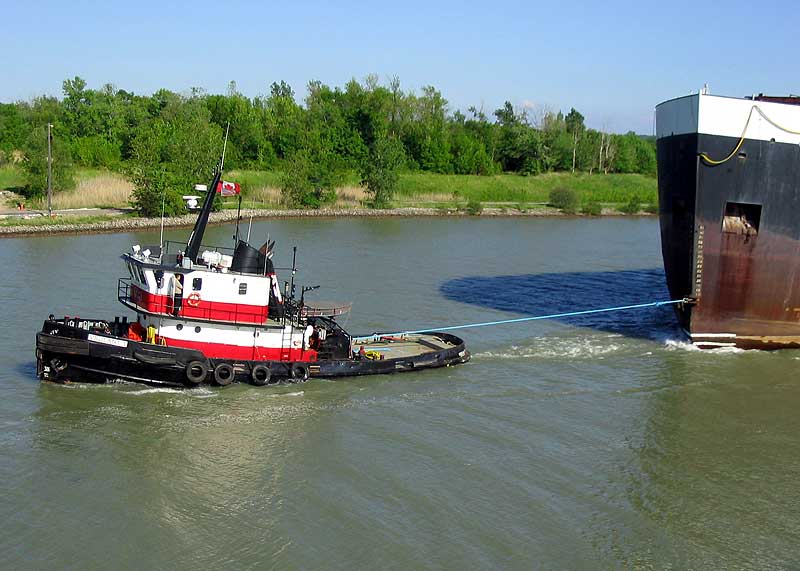
Its engine laboring at times, McKeil Marine’s tug John D surged up the Welland Canal Thursday at Lake Erie, its bow rising and crashing through the ice, opening a path on the waterway.
The 21-metre-long work tug left its berth on the west side of the canal wall in Port Colborne, heading down the middle before turning toward Wharf 16 on the east side, just in front of the already docked CSL Thunder Bay.
It was clearing the canal and wall of ice for the incoming 255.55-metre-long Algoma Sault, a self-unloading bulk carrier of St. Catharines-based Algoma Central Corp.’s domestic fleet, on its way for winter layup.
The Algoma vessel headed down the lake from Long Point Bay off Port Dover.
As Algoma Sault sat offshore of the breakwall, the Canadian Coast Guard’s 70-metre-long icebreaker and buoy tender Samuel Risley headed out onto Lake Erie, clearing a path in the canal and passing the cargo vessel before heading east down the lake.
On the Marine Traffic website, the Samuel Risley was later spotted off Buffalo, working with the U.S. Coast Guard’s 42-metre-long icebreaking tug Bristol Bay. By late afternoon, the two were headed west up the lake past Port Colborne.
Along with the Neah Bay, another American icebreaker, the two worked together last week to free Lower Lakes Towing Ltd.’s 202-metre-long Manitoulin from the lake’s icy grip. The bulk carrier became stuck for four days after delivering a load of wheat to the Queen City more than a week ago.
The three vessels freed the cargo ship last Saturday and escorted it 32 kilometres up the lake to open waters off Port Colborne, where it continued on unescorted to meet the 73-metre-long heavy U.S. icebreaker Mackinaw near Pelee Island. The Mackinaw escorted the vessel to Sarnia, at the mouth of the St. Clair River and Lake Huron, for winter layup.
With CSL Thunder Bay just south of it, Algoma Sault is the third cargo vessel to layover in the city for the winter before the canal opens sometime in March.
Also docked in Port Colborne is Algoma Buffalo, north of Main Street Bridge near Wharf 12, and McKeil Marine barge-pushing tug Sharon M I.
Welland Tribune
Vezhen Operator Claims Proof
Subsea Cable Damage Was Accidental
Bulgarian shipping company Navibulgar has released images of the anchoring system aboard the bulker Vezhen, which has been boarded and detained on suspicion of dragging its anchor and damaging a subsea cable between Gotland and Latvia last weekend. According to Navibulgar CEO Capt. Alexander Kalchev, the photos show that the chain stopper failed in a gradual way that allowed the chain to “leak” out slowly under tension, without a runaway.
The Vezhen was seized by Sweden on Sunday on suspicion of aggravated sabotage after a cable outage between Gotland and Latvia. Sweden’s coast guard intercepted the vessel as soon as the cable breach was identified, and a police boarding team deployed to the ship by military helicopter. The crew agreed to divert to Swedish territorial seas, where the ship was detained. A senior Swedish prosecutor and a senior police official have both declined questions about whether the diversion was voluntary.
Navibulgar’s Kalchev insists that the incident was an accident, and has opened an internal investigation. He told Bulgarian business outlet Economic that as Vezhen approached Gotland on Saturday, weather conditions were rough, with waves of 10 feet and winds of 40 knots. Surveillance footage from the bridge shows that the Vezhen’s bow took a pounding. In these conditions, the wave action worked the port anchor back and forth until the wire stopper on the chain failed, he said. After that, all the weight of the chain and anchor hung on the guillotine stopper. The stopper failed gradually under tension, letting a few links slip underneath the bar at a time, he said.
“[The guillotine stopper] bore the blows of every wave that crashed into the axis of the ship, which little by little led to its wear and tear and the gradual ‘leakage’ of the chain into the sea,” explained Kalchev. He said that such incidents had happened before, but never causing subsea cable damage. (Guillotine stopper failures have been reported previously in the near-miss literature.)
According to Kalchev, the wear on the stopper bar proved that the anchor drop was accidental, even if expensive and politically ill-timed. “There is no way to calculate at what point the wire and guillotine would give way and drop the anchor at the exact moment when the ship is next to the cable in order to deliberately cause an incident,” he said.
For now, the ship’s crew have been neither detained nor questioned, Kalchev said. “The investigation is probably ongoing, but there are no investigators on board the ship and no interviews have been conducted with the crew,” he told the outlet.
The Maritime Executive