Wreck of the Western Reserve
found in Lake Superior
SAULT STE. MARIE, MI – The shipwreck of the Western Reserve, lost in 1892, has been found. After 132 years, the final resting place of the 300-foot steel steamer has been discovered roughly 60 miles northwest of Whitefish Point in Lake Superior.
According to the Great Lakes Shipwreck Historical Society, the shipwreck was discovered by Director of Marine Operations Darryl Ertel and his brother and First Mate, Dan Ertel, who have been looking for the Western Reserve for over two years. The brothers were piloting the David Boyd, a research vessel, during the search.
Using marine sonic technology within the Boyd, the duo made the initial discovery of the shipwreck during the summer of 2024. Subsequent trips with remotely operated vehicles revealed a ship broken in two with the bow section resting on top of the stern in approximately 600 feet of water.
“We side-scan looking out a half mile per side and we caught an image on our port side. It was very small looking out that far, but I measured the shadow, and it came up about 40 feet,” said Darryl Ertel. “So we went back over the top of the ship and saw that it had cargo hatches, and it looked like it was broken in two, one half on top of the other and each half measured with the side scan 150 feet long and then we measured the width. It was right on so we knew that we’d found the Western Reserve.”
The Western Reserve was a well-known ship in its time, and was one of the first vessels on the Great Lakes made entirely of steel. The ship was built to break record speeds of cargo ships on the lakes, it was even referred to as “the inland greyhound” because of its speed.
Owned by millionaire and shipping magnate Captain Peter G. Minch, the ship was considered one of the safest in the water at the time. That was part of the reason why Minch took a large portion of his family on board the ship, under the command of Captain Albert Myer, for a late summer cruise through Lake Huron in August of 1892. They were on their way to the port of Two Harbors, Minnesota.
According to the Great Lakes Shipwreck Historical Society, after the ship passed through Whitefish Bay, the previously calm weather turned rough, leading to the crew dropping anchor to wait out the storm. Soon after, they picked up the anchor to make their way into Lake Superior and the ship was overtaken by a strong wind. At 9 p.m. on Aug. 30, 1892, the Western Reserve began to break apart and sink.
“Knowing how the 300-foot Western Reserve was caught in a storm this far from shore made an uneasy feeling in the back of my neck. A squall can come up unexpectedly … anywhere, and anytime,” said Ertel.
The crew and passengers tried to make their way to safety in two lifeboats. One lifeboat overturned quickly, and only two crewmen from that lifeboat were able to be recovered by the second lifeboat.
The Western Reserve sank within 10 minutes.
The remaining crew and members of the Minch family floated in their lifeboat for around 10 hours before they passed by a steamship. Unfortunately, they were unable to attract the attention of the ship by shouting and they had no flares.
By the next morning, the lifeboat had made it within one mile of the shoreline near the Deer Park Life-Saving Station, but the lifeboat overturned. Only one survivor, Wheelsman Harry W. Stewart of Algonac, Michigan, lived to tell the tale. In total, 27 people were killed in the tragedy.
“Every shipwreck has its own story, but some are just that much more tragic,” said Great Lakes Shipwreck Historical Society Executive Director Bruce Lynn. “It is hard to imagine that Peter Minch would have foreseen any trouble when he invited his wife, two young children and sister-in-law with her daughter aboard the Western Reserve for a summer cruise up the lakes. It just reinforces how dangerous the Great Lakes can be any time of year.”
Brendan Wiesner, Sault Ste. Marie News
Canada Awards Polar Icebreaker Contract to Davie Shipbuilding
Davie Shipbuilding, the Quebec-based shipbuilder, has secured a CAD $3.25 billion contract from the Government of Canada to construct a new polar icebreaker, with delivery expected by 2030.
The project, which will begin construction in 2025, marks a significant development in Canada’s Arctic maritime capabilities, following another heavy polar shipbuilding contract to Seaspan Shipyards.
The Davie vessel, dubbed the Polar Max, will leverage expertise from Helsinki Shipyard, which Davie acquired in 2023. Helsinki Shipyard brings considerable experience to the project, having constructed over half of the world’s icebreakers.
The Polar Max will be 22,800 tonnes with a length of 138.5 meters. It will be the first newbuild project at the Helsinki Shipyard under Davie’s ownership, and carried out in collaboration between Finnish and Canadian maritime industry experts. The work will begin in Helsinki and be completed at Davie’s shipyard in Canada.
“When we acquired Helsinki Shipyard, we pledged to rebuild this historic business. The Polar Max project is evidence that we are delivering on our promise,” said James Davies, President & CEO, Davie Shipbuilding. “The Canadian government deserves immense credit for partnering with Davie on this groundbreaking procurement.”
The Honourable Jean-Yves Duclos, Minister of Public Services and Procurement and Quebec Lieutenant, emphasized the strategic importance of the project: “This state-of-the-art vessel will not only strengthen our icebreaking fleet but will also support critical scientific research and environmental protection efforts, and ensure national security in the Arctic.”
The project represents a milestone in the ICE Pact, a trilateral partnership established in 2024 between the United States, Canada, and Finland to develop Arctic and polar icebreakers. The collaboration comes at a crucial time, as Arctic regions become increasingly accessible due to climate change.
This announcement is part of a broader Canadian shipbuilding initiative. Notably, Seaspan Shipyards in North Vancouver on Friday announced it has also secured a contract for a heavy polar icebreaker for the Canadian Coast Guard. Their vessel will be a Polar Class 2 ship designed to operate year-round in the high Arctic at temperatures as low as -50°C.
The Seaspan icebreaker will feature advanced capabilities, including more than 40MW of installed power, an ice-classed azimuthing propulsion system, and comprehensive research facilities. The vessel will be equipped with scientific laboratories, a moon pool for equipment deployment, helicopter facilities, and capability for future remotely piloted aircraft systems.
The timing of the contracts coincide with growing cooperation between Russia and China in the Arctic. Moscow is working to increase oil and gas deliveries to China in response to Western sanctions, while Beijing seeks alternative shipping routes to reduce dependence on traditional maritime corridors.
Davie’s President & CEO, James Davies, highlighted the transformative nature of the agreement: “Delivering such a special ship in a timely manner is in the best interests of all Canadians. It will accelerate economic benefits for Quebecers and strengthen the skills of our talented Lévis’ shipbuilders.”
The project will involve significant workforce development, with Davie implementing an exchange program enabling Quebec employees to learn icebreaker construction expertise directly from their Finnish colleagues. The company plans to invest more than $200 million in local small- and medium-sized businesses, reinforcing Quebec’s position as a naval construction hub.
These projects mark a historic moment in Canadian shipbuilding, representing the first polar icebreakers to be built in Canada in over 60 years. The contracts come as the U.S. Coast Guard faces challenges with its own icebreaker fleet replacement program, with the first Polar Security Cutter now unlikely to arrive before 2030.
Davie was named the third official partner to Canada’s National Shipbuilding Strategy in April 2023, joining Irving Shipbuilding Inc. in Nova Scotia and Seaspan Shipyards in Vancouver, British Columbia. The NSS is a long-term, multi-billion-dollar program to modernize Canada’s naval and coast guard fleets while revitalizing the domestic shipbuilding industry. The strategy focuses on two vessel categories: non-combatant vessels (icebreakers, offshore science vessels, and support ships) and combatant vessels (frigates and Arctic offshore patrol ships).
Davie has secured an initial $8.5 billion package that includes seven heavy icebreakers and two large hybrid-powered ferries.
gCaptain
Great Lakes water levels have dropped
to their lowest point in the last decade.
PLEASANT, MI – Lakes Michigan and Huron were nine inches lower and Lake Superior is six inches lower than the historical average, according to March data from the U.S. Army Corps of Engineers.
The levels are expected to rise during the spring thaw, but low water levels can cause shipping vessels to run aground, limit recreational access and increase erosion.
Richard Rood is a professor emeritus of climate and space sciences and engineering with the University of Michigan. He said Great Lakes ice cover was moderately low this winter, allowing more water to evaporate.
“Some of that evaporation is going to be immediately turned into snow and lake-effect precipitation, but that’s not going to feed back into the lake until you get in the melting season,” he said.
Rood said some variability year-to-year is normal, but climate change is contributing to sharper shifts between extremely high and low lake levels in a “tug-of-war” trend.
“Climate change has the potential to amplify both the flood and the drought cycles,” he said. “And this pendulum swing makes climate resilience and mitigation planning difficult.”
WCMU
2025 “Know Your Ships” launches
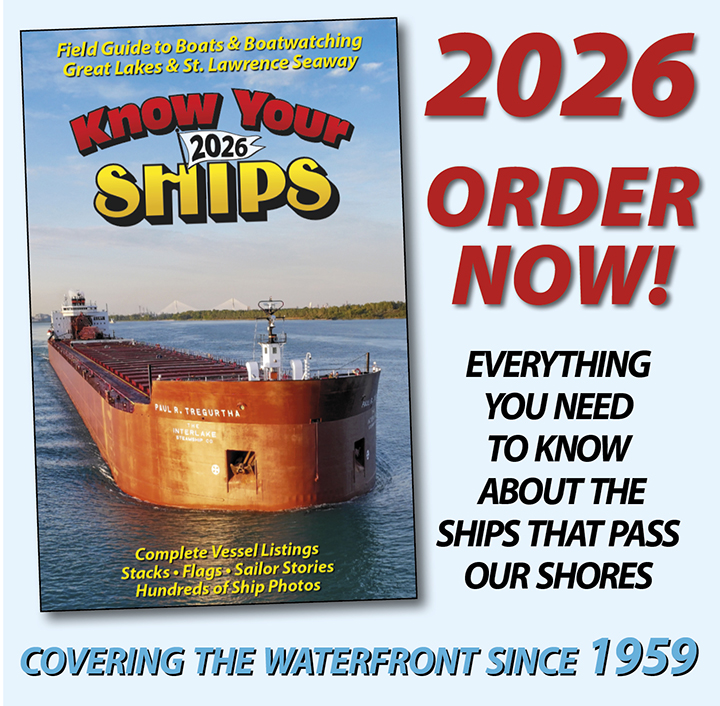
The new shipping season is at hand, and so is the release of the 2025 edition of Know Your Ships, the popular annual field guide to boats and boatwatching on the Great Lakes & St. Lawrence Seaway, now in its 66th year.
Preorders are now being taken. As usual, standard and spiral bindings are available. Preorders will be the first to mail out when the book arrives from the printer around March 23.
New this year is the ability to preorder the midsummer EXTRA magazine, which will feature a 50th anniversary tribute to the Edmund Fitzgerald and her crew, when you preorder the book.
To mark the opening of the Soo Locks, Editor & Publisher Roger LeLievre will be at the Soo Locks Visitor Center Saturday, March 26, from 11 a.m.-3 p.m., to sign copies of the new edition. Buy them right from him, or from Das Gift Haus and Island Books and Crafts in the Soo, bring them to the Visitor Center and he will sign them.
Preorder at this link: www.knowyourships.com
Enter Duluth’s 42nd Annual First Ship Contest
Birds chirping. Snow thawing. Groundhogs emerging. There are many signs of spring across the country. In Duluth, it’s when the season’s first oceangoing vessel, known as a “saltie,” enters the city’s harbor. Begone ice! The ships are coming in.
To celebrate the occasion, the Duluth Seaway Port Authority and Visit Duluth are partnering for the 42nd Annual First Ship Contest. Correctly guess when the season’s first saltie sails into our seaport and you could win an epic prize package of Duluth goods and experiences. The second-place winner will also receive a prize package.
Here’s the link: https://visitduluth.com/first-ship/
Help Wanted: Interlake Logistics
Solutions Seeks Chief Engineer
The Interlake Logistics Solutions team has an immediate need for an experienced Chief Engineer Limited. More details about the position, pay and schedule can be found via the link below. You can apply directly through ADP and if you have additional questions and genuine interest, you can reach directly to General Manager Chuck Leonard at 231-590-8695 or cleonard@interlakems.com