Alpena changes docks in Cleveland
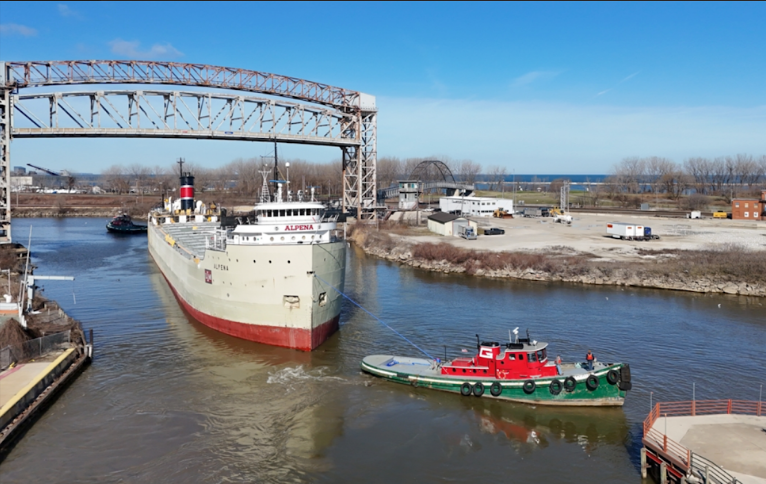
Alpena was moved from her winter slip over to the Port of Cleveland Friday to make room for incoming cement boats. G tugs Massachusetts and Minnesota handled the move, with the William C Gaynor assisting once they were over at the port. Winter work is continuing on the Alpena.
Sunken AuSable River Queen back on dry
land, owners hope to return it to service
Published: Mar. 20, 2025, 1:00 p.m.
By Ron Fonger | rfonger1@mlive.com
River Queen pulled from AuSable River. Owners hope to return paddleboat to service
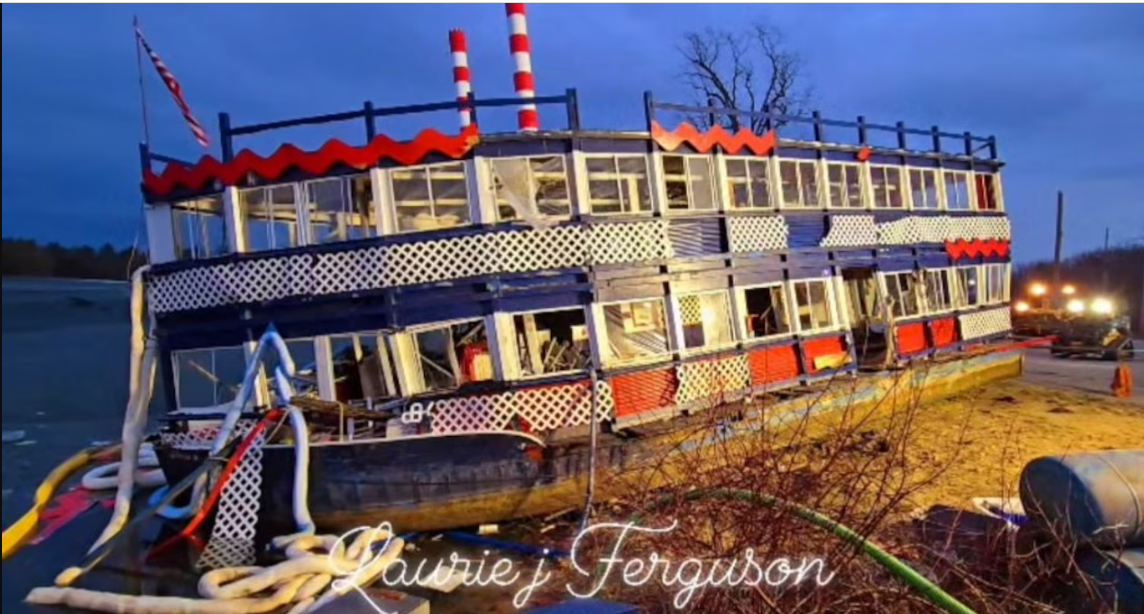
OSCODA TWP, MI — An AuSable River paddleboat that’s offered scenic tours for decades has been rescued from the water eight days after it started sinking.
Oscoda Township Superintendent Thomas Chatel said the AuSable River Queen was towed to dry land on Wednesday, March 19.
“We’re pleased with the high level of cooperation” from agencies that responded to the incident, Chatel said on Thursday, March 20. “The township is looking forward to the vessel being removed as soon as possible.”
Agencies including the Michigan Department of Environment, Great Lakes, and Energy and the U.S. Environmental Protection Agency responded to the area where the River Queen had been partially submerged since March 11.
Absorbent booms were used to surround the paddleboat in an effort to protect the surrounding water from any leaks of oils and gas, an EGLE spokesman told MLive-The Flint Journal last week.
Laurie Rice Bell, one of the paddleboat’s owners, wrote in a Facebook post on Thursday that Michigan State Police divers and area towing and excavating companies protected the River Queen through a difficult rescue.
“We found no obvious reason for her sinking,” Rice Bell wrote. “No damage to the hull so now we are baffled as to why she sank.”
Earlier this week, Rice Bell wrote in another post that owners of the riverboat are still hopeful it can be returned to service.
“For now I’m going to remain steadfast to the idea that we will succeed in pulling her up safely and (bringing) her back to her pride and glory …,” she said. “Please pray for the queen of the Ausable River.”
Rice Bell said in a GoFundMe post in November that her aim was to remove the paddleboat this spring for an inspection of its bottom — a process she expected to cost more than $15,000.
The fundraising effort had raised $9,657 from 66 donors as of Thursday morning, March 20.
A story published by the Associated Press in 2003 said the River Queen was designed after a Mississippi paddle boat, stretching 65 feet in length and 24 feet wide.
The boat is approximately 58 years old and initially featured an enclosed top with no windows on the lower level. It was modified more than 20 years ago to have an open top and windows on the sides for all-weather outings.
Duluth EPA lab’s future uncertain
under plan to cut research arm
DULUTH – The U.S. Environmental Protection Agency has proposed eliminating its scientific and research arm and up to 75% of its staff, leaving the future of the agency’s Duluth freshwater laboratory and its more than 100 employees uncertain.
The proposal for the EPA to eliminate its Office of Research and Development, first reported Monday by the New York Times, is part of the “reduction in force” plans required throughout the federal government by the Trump administration. The potential cuts were outlined in documents reviewed by Democrats on the House Committee on Science, Space and Technology.
The ORD includes the Great Lakes Toxicology and Ecology Division laboratory, 6201 Congdon Boulevard in Duluth, which is world-renowned among aquatic scientists for developing scientific protocols used worldwide to measure how toxic chemicals affect the environment.
What these cuts would mean for the Duluth lab is unclear.
A portion of the reduction plan shared with the News Tribune by Science Committee Democratic staff said the EPA planned to “eliminate” the ORD and expected 50-75% of its more than 1,540 positions “will not be retained.”
As of 2021, the Duluth lab employed 136 people, according to the agency.
Reached by phone Wednesday, Dale Hoff, director of the Great Lakes Toxicology and Ecology Division in Duluth, said he couldn’t discuss the future of the Duluth lab. “Anybody who’s read that article knows as much as I do,” Hoff said, referring to Monday’s New York Times article.
During a virtual town hall meeting Tuesday, ORD officials told the EPA’s science and research employees, including those at the Duluth lab, that dismantling the ORD would likely require an act of Congress, according to two people at the meeting.
Political appointees left career ORD officials out of the reduction-in-force discussions, the ORD officials told attendees.
At a separate town hall Tuesday for Center for Computational Toxicology and Exposure sites, which includes labs in Duluth and Durham, North Carolina, employees were told to download and save personnel files, writing samples and anything else they might want from their EPA computer, the two people said.
U.S. Rep. Zoe Lofgren, D-Calif., the ranking member on the science committee, said in a statement that the Trump administration was trying to kill the EPA and the ORD, but that doing so would violate the law.
“EPA’s Office of Research and Development is in statute,” Lofgren said. “Eliminating it is illegal. … EPA cannot meet its legal obligation to use the best available science without ORD, and that’s the point. Donald Trump and Elon Musk are putting their polluter buddies’ bottom lines over the health and safety of Americans.”
U.S. Rep. Pete Stauber, a Hermantown Republican whose district includes the Duluth lab, did not respond to the News Tribune’s request for comment on whether he supports the plan to eliminate ORD or if he is concerned about the potential loss of EPA jobs in his district.
Asked what the plan meant for the Duluth lab, EPA spokesperson Molly Vaseliou said the agency was “taking exciting steps as we enter the next phase of organizational improvements” and that it was “committed to enhancing our ability to deliver clean air, water, and land for all Americans.”
“While no decisions have been made yet, we are actively listening to employees at all levels to gather ideas on how to better fulfill agency statutory obligations, increase efficiency, and ensure the EPA is as up-to-date and effective as ever,” Vaseliou said.
Jack Kelly, who worked as chief of the ecology branch at the Duluth lab from 1998 to 2015, told the News Tribune that EPA’s reduction in force plan targeting the ORD was “really, really upsetting.”
“The country has invested in the training, schooling and development of these people to serve a purpose — protecting humans and the environment,” Kelly said. “There’s been a great amount of money invested in this … to throw that away is beyond ridiculous in my mind.
To him, the lab is a place where methods were developed to track the quality of the Great Lakes, standards were established on pollutants, and new chemicals that come along were evaluated, like PFAS (per- and polyfluoroalkyl substances), commonly known as “forever chemicals.”
“On a personal level, just right away, I object to the not-very-subtle and, frankly, quite ignorant characterization that comes with this,” Kelly said. “My entire life’s pursuit in environmental research and protection is pretty useless and just wasteful spending?”
Kelly said the employees at the Duluth lab work there because they are committed to protecting the environment, even though they could probably make more money elsewhere.
“It’s hard to swallow the idea that you just toss this out with the garbage,” he said.
John Morrice, of Duluth, worked at the EPA lab in Duluth for 15 years as a research biologist studying Great Lakes ecosystems. He retired 12 years ago but worked under both Republican and Democratic administrations.
While Republicans often targeted EPA’s regulatory enforcement side, Morrice said the agency’s science and research arms were largely left alone.
“There is a need to have better science to underpin the establishment and enforcement of chemicals in our waters as part of the Clean Water Act … the (Duluth) lab has set up teams to try to address that need,” Morrice told the News Tribune. “These are ongoing projects that I don’t think universities and academia are really in a position to pick up the slack if the lab were to disappear.”
He cited evaluating and assessing St. Louis River Estuary restoration efforts, creating water criteria for Great Lakes coastal regions, and studying the responses of fish and other organisms to different chemicals among the lab’s “huge successes” over its nearly 60-year history.
Established in 1967, the lab predates the EPA by three years. Its roots go back a few more years.
In 1961, U.S. Rep. John Blatnik, D-Minn., sponsored an amendment to the new Federal Water Pollution Act to create federal water quality labs in key areas of the United States. Blatnik picked Duluth (in his home district) as the Great Lakes site.
Legend has it that a new congressional aide named Jim Oberstar helped pick the site. Oberstar worked for Blatnik and the powerful House Public Works Committee that Blatnik headed. Later, after he was elected to Congress and served on the same committee, Oberstar returned to visit the lab often, extolling its work.
Construction began in 1965 when the lab was under the Federal Public Health Service. By the time it was dedicated two years later, it was part of the Water Pollution Control Administration. It joined the EPA when President Richard Nixon established the agency in 1970.
Most recently, its work focused on developing baseline scientific data/protocol for testing chemical impacts on organisms.
Without the lab, Kelly said, “We’re talking about not just a loss to the scientific community. We’re talking a loss to the population of the United States … they (the Duluth lab) speak to all kinds of issues of how we need to live and protect the environment so that we protect ourselves.”
Duluth News Tribune
Baldwin, other Great Lakes senators
send letter about effects of NOAA cuts
By: Henry Redman – March 20, 2025 12:46 pm
U.S. Sen. Tammy Baldwin and a group of six other Democratic senators representing Great Lakes states sent a letter this week to the National Oceanic and Atmospheric Administration (NOAA) pressing for more information about how staff cuts at the agency will affect programs on the lakes.
The letter, addressed to NOAA Vice Admiral Nancy Hann, asked her to detail the number of people fired at NOAA since she became the agency’s acting administrator, the number of people fired at each Great Lakes-focused NOAA program, the services that will be terminated and her plan to preserve those services.
Baldwin was joined in sending the letter by Sens. Amy Klobuchar (D-MN), Chuck Schumer (D-NY), Dick Durbin (D-IL), Elissa Slotkin (D-MI), Tina Smith (D-MN), Kirsten Gillibrand (D-NY), and Gary Peters (D-MI).
“We write to express our deep concern over the firing of probationary staff at the National Oceanic and Atmospheric Administration (NOAA) and the potential impact these firings will have on the Great Lakes,” the senators wrote. “The Great Lakes are among the United States’ greatest natural treasures, strengthening our economy and attracting millions of visitors each year. The Lakes provide drinking water to over 30 million people, generate clean hydropower, and generate $3.1 trillion in gross domestic product. National and regional NOAA programs help protect these lakes and support our constituents who call the Great Lakes home.”
Among the NOAA programs that the group is seeking information about are the National Weather Service, National Estuarine Research Reserve System, Great Lakes Environmental Research Laboratory, Cooperative Institute for Great Lakes Research and Midwestern Regional Climate Center.
In Wisconsin, Lakes Michigan and Superior support 50,000 jobs and provide nearly $3 billion to the state’s gross domestic product, according to a 2024 NOAA report. Last month, Baldwin told the Wisconsin Examiner she’d fight to protect the Great Lakes.
“Wisconsin communities, farmers, and businesses rely on our Great Lakes, and I’ll stand up to any efforts that will hurt them and their way of life,” she said.
2025 “Know Your Ships” launches
The new shipping season is at hand, and so is the release of the 2025 edition of Know Your Ships, the popular annual field guide to boats and boatwatching on the Great Lakes & St. Lawrence Seaway, now in its 66th year.
Preorders are now being taken. As usual, standard and spiral bindings are available. Preorders will be the first to mail out when the book arrives from the printer around March 23.
New this year is the ability to preorder the midsummer EXTRA magazine, which will feature a 50th anniversary tribute to the Edmund Fitzgerald and her crew, when you preorder the book.
To mark the opening of the Soo Locks, Editor & Publisher Roger LeLievre will be at the Soo Locks Visitor Center Saturday, March 26, from 11 a.m.-3 p.m., to sign copies of the new edition. Buy them right from him, or from Das Gift Haus and Island Books and Crafts in the Soo, bring them to the Visitor Center and he will sign them.
Preorder at this link: www.knowyourships.com