American proposal could devastate Canadian Great
Lakes shipping industry, says union and marine chamber
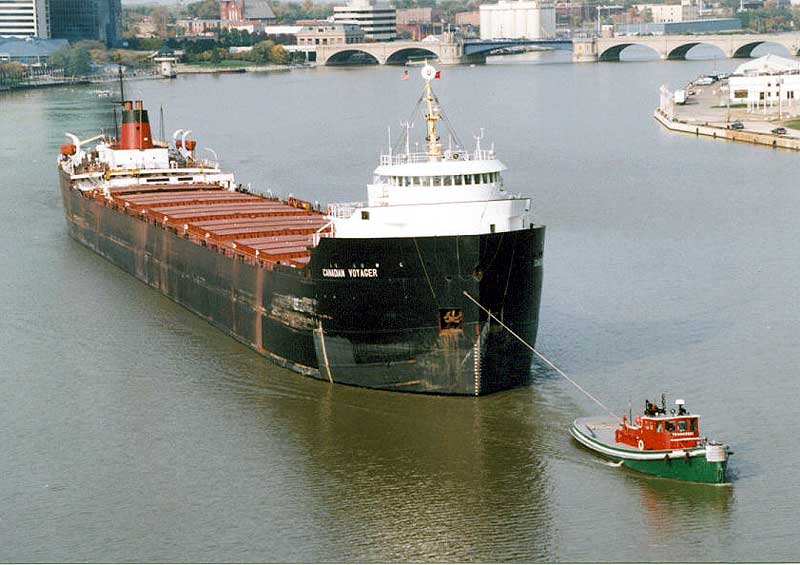
A measure intended to strengthen America’s shipbuilding industry could devastate Canadian shipping companies, say both the union representing Canadian seafarers and Chamber of Marine Commerce.
The United States Trade Representative (USTR) has proposed up to a $1.5-million duty on Chinese-made vessels arriving at U.S. ports, as it looks into China’s dominance in the maritime, logistics and shipbuilding sectors.
USTR is an agency of the American government responsible for developing and promoting foreign trade policies. Its proposal started under U.S. President Joe Biden’s administration and has continued under President Donald Trump. Hearings on the proposal were to get underway this week in Washington, D.C.
“It’s devastating for the whole integrated North American supply chain. That’s the point we made when we were (recently) in Washington,” said Chamber of Marine Commerce president and chief executive officer Bruce Burrows.
The chamber is a binational, private sector, not-for-profit association representing marine industry stakeholders — ship operators, ports and terminals, shippers of vital commodities — on both sides of the Great Lakes-St. Lawrence Seaway System.
The Great Lakes region accounts for more than 50 per cent of bilateral trade. A 2022 study by Martin Associates showed marine shipping contributes $66.1 billion to the Canadian and U.S. economies and supports nearly 360,000 jobs.
If the Great Lakes region stood on its own, it would have a gross domestic product (GDP) of $6 trillion (U.S.), making it the third-largest economy in the world. GDP is a monetary measure of the market value of all the final goods and services produced in a specific period by a country.
Burrows said the goal should be to strengthen the supply chain between the two nations and having more vessels available, not fewer.
“It should all be about reducing costs to U.S. consumers, not increasing. We suggest the integrated supply chain across the Great Lakes and coastal markets be protected. Any movement under 3,200 kilometres shouldn’t be subjected to these onerous fees.”
He said one problem with the proposal is just about every global fleet has Chinese-built vessels, and the port fee would be another tariff on top of other Trump-imposed tariffs.
“One of the options (in the proposal) is to extend the fee to almost any fleet by association with Chinese ships in it. Any ship arriving from Canada to a U.S. port would be subject to a $1 million to $1.5 million, in some cases, extra costs per vessel transit, which would knock out many, if not all, Canadian goods going across the border by ship into the U.S.,” said Burrows.
Seafarers’ International Union of Canada (SIU Canada) president Michael Given said the USTR proposal doesn’t just punish Chinese-flagged vessels.
SIU Canada represents thousands of qualified seafarers working aboard vessels on the Great Lakes, the St. Lawrence River, and the East and West coasts through affiliated unions.
“Even if it has a Canadian flag on it, or any other nation’s because it was built in China, they’re going to put a fee on it. It would cripple the Canadian industry, and affect the supply chain,” said Given.
Burrows said part of the proposal is geared toward older vessels built in China and delivered to customers years ago. St. Catharines-based Algoma Central Corp. and Montreal-based Canada Steamship Lines (CSL) have Chinese-built vessels in their fleets.
“China has no interest in those ships once sold to other owners worldwide, including Canada,” said Burrows. “It doesn’t achieve the objective of trying to target China, quite frankly. They’re older ships that shouldn’t even be affected anymore.”
He said Canadian fleets are the dominant player in the cross-border market on the Great Lakes. Those players include Algoma, CSL, Lower Lakes Towing Ltd. and McKeil Marine, among others.
“American fleets (on the Great Lakes) are primarily trading internally. Their ships, generally, are far too large to fit through the Welland Canal and St. Lawrence Seaway,” said Burrows.
The most recent purpose-built American laker to carry cargo through the canal was Interlake Steamship Company’s 195-metre-long River-Class M/V Mark W. Barker, launched three years ago.
Built at Fincantieri Bay Shipbuilding in Sturgeon Bay, Wisc., it was the first new build for Interlake since 1981 and the first American bulk carrier to be built on the lakes in more than 35 years.
Before the hearing date, Given wondered if the Americans would start to look beyond Chinese-built vessels.
“It starts with China. What’s the next thing?”
Canadian fleets have taken delivery of ships built in places such as Turkey, Croatia and Korea.
Given said the union is in favour of North American shipbuilding, but not by doing it through the port fee. Building vessels on the Great Lakes would take infrastructure, investment and training. “We don’t have the expertise right now on the lakes to do it on either side of the border,” said Given.
Burrows said North America is not competitive in the commercial shipbuilding space and hasn’t been for decades. “We have been going to the offshore markets, not just China. It’s different in the defence, security, coast guard space. Those vessels are constructed domestically and they’re much more expensive ships,” he said.
When it comes to Canadian fleets on the lakes, whether the vessels were built in China or not, they carry needed raw materials such as stone, iron ore, cement, steel, coal, road salt and more to the American market.
Burrows said with the proposed port fee and tariffs imposed by the Trump administration, Americans who rely on imports could see increased prices and possible supply chain shortages.
He said American municipalities and ports are concerned about the proposal.
The fee could drive up the price of road salt for cities that depend on the Canadian supply for the winter. Increased steel and cement costs would drive up public project costs, for things like roads, bridges and buildings.
Burrows said the auto industry has expressed its concerns at the highest levels, and parts shipped back and forth across the border would see tariffs slapped on every time, including the port fee.
“I don’t think people are aware of what crosses the border.”
American ports rely on Canadian and other foreign vessels to take their products out of the country, he said.
Foreign fleets — ocean-going ships colloquially called salties — carry cargo to and from American and Canadian Great Lakes ports.
The union is in close contact with the shipping companies on the issue, said Given.
“We’re working with stakeholders, and as many government officials as we can get to listen to us. We need to have a united front on this one to make sure we survive four years of Donald Trump.”
He said if the proposal goes through it would be devastating for union members. There are up to a thousand on the lakes.
“Our members are concerned. We receive dozens of calls every day wanting to know what’s going on. This is the time of year when most are coming back to work. It’s a short season, nine or 10 months, and that’s when they make their money.”
The shipping season on the Welland Canal and Montreal-Lake Ontario sections of the St. Lawrence System usually runs late March through to early January the following year. Most vessels tie up for the winter season and undergo maintenance with seafarers off work until the shipping season starts.
The 2025 shipping got underway Saturday with vessels moving through the canal.
Seafarers’ International Union of Canada (SIU) is affiliated with Seafarers’ International Union of North America, serving unlicensed sailors since 1938. It has been representing the majority of seafarers working aboard vessels on the Great Lakes, St. Lawrence River, East Coast, West Coast and Arctic since 1954. It represents thousands of qualified seafarers across Canada.
Dave Johnson, Welland Tribune
2025 “Know Your Ships” available now
The new shipping season is at hand, and so is the release of the 2025 edition of Know Your Ships, the popular annual field guide to boats and boatwatching on the Great Lakes & St. Lawrence Seaway, now in its 66th year.
New this year is the ability to preorder the midsummer EXTRA magazine, which will feature a 50th anniversary tribute to the Edmund Fitzgerald and her crew, when you preorder the book.
Order at this link: www.knowyourships.com