1884
1884: On 31 December 1884, ADMIRAL (wooden propeller steam tug, 49 gross tons, built in 1883, at Chicago, Ill.) had her boiler explode in Chicago harbor. All four of the crew was killed.
1884: The PERE MARQUETTE NO 1 ran aground at Ludington, Mich.
1889
1889: On 31 December 1889, H. M. Loud of Oscoda, Mich., sold the 551-ton wooden schooner ANGUS SMITH to Mitchell Brothers of Marine City, Mich., for $16,000. The vessel was built in 1871.
1895
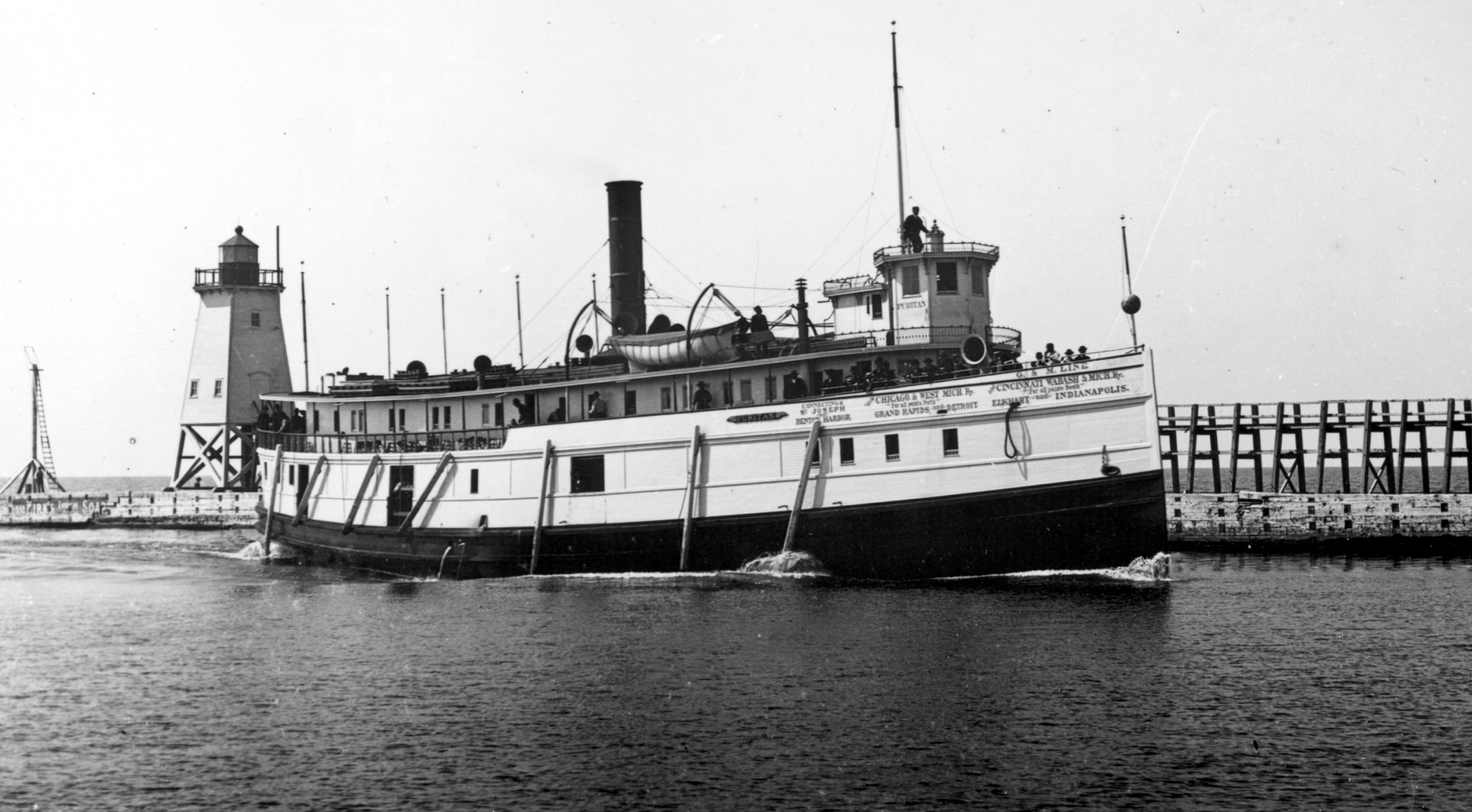
1895: At 4:00 p.m., 31 December 1895, the PURITAN (wooden propeller passenger/package freight steamer, 172 foot, 289 gross tons, built in 1887, at Benton Harbor, Michigan) burned at the dock in Oak Hill (Manistee), Michigan. She was a total loss.
1905
1905: B. F. JONES (Hull#15), 530 x 56 x 31 with a capacity of 10,000 tons, slid down the ways at Great Lakes Engineering Works, Ecorse, Mich. The JONES was built at a cost of $400,000 for Jones and Laughlin Steel. She was declared a constructive total loss after a collision with the CASON J. CALLAWAY in the St. Marys River on August 21, 1955. Most of the hull was scrapped at Superior, Wis., in 1956. Part of the hull became the crane barge SSC-1. Her forward cabins and hatch crane and covers were installed on the SPARKMAN D. FOSTER.
1905: The whaleback Barge 126 had left the Great Lakes earlier in the year and was renamed b) BADEN. It stranded at Buzzard’s Bay, Mass., enroute from Newport News, Va., to New Bedford, Mass., with coal and was a total loss. The crew of six was also lost.
1919
1919: December 31, 1919 – The entire Ann Arbor carferry fleet was tied up in Frankfort, Mich., due to bad weather
1941
1941: At the close of the shipping season, the Great Lakes fleet consisted of 513 boats of U.S. Registry and 279 boats of Canadian Registry.
1951
1951: Upon suggestion from the U.S. Maritime Commission, surplus World War II cargo vessels, many of which had laid up on the James River, were made available for sale under the Great Lakes Vessel Sales Act of 1950 (enacted September 28, 1950) to be converted for Great Lakes use. The act allowed Great Lakes fleets to purchase up to 10 surplus ships by December 31, 1951, and receive a 90% cost subsidy to convert and refurbish them for lakes use. The first such conversion occurred when the Cleveland-Cliffs Iron Co. of Cleveland, Ohio bought the NOTRE DAME VICTORY (later CLIFFS VICTORY) on December 10, 1950.
1952
1952: A total of 35 boats were laid up for the season at Cleveland. The WILLIAM FAIRBAIRN, GEORGE STEPHENSON, and ANDREW S. UPSON had storage cargoes of flax, the MICHAEL GALLAGHER had a storage cargo of wheat, and the remaining 31 vessels were empty.
1983
1983: GEORGE M. HUMPHREY of 1953 was laid up for the last time at the old Great Lakes Engineering Works slip at River Rouge, Mich., beginning December 31, 1983.
1984
1984: The QUEDOC, a.) NEW QUEDOC, was laid up for the last time on December 31, 1984, at Toronto, Ont., alongside the SENATOR OF CANADA.
1996
On Dec. 31, 1996, the tug John Purves departed Duluth with the J. L. Mauthe in tow, proceeding to Sturgeon Bay for the Mauthe’s conversion to a barge
Data from: Skip Gillham, Joe Barr, Dave Swayze, Russ Plumb, Father Dowling Collection, Max Hanley, Ahoy & Farewell II and the Great Lakes Ships We Remember series.