The 2025-2026 winter layup list is now up and running at https://boatnerd3.jasonbowlerdesign.com/winter-lay-up-list-2025-2026
Rand Logistics gets a rebrand; now called Mainstay Marine
The following statement was posted New Years Eve on the internet web site LinkedIn for Mainstay Marine:
“We are excited to announce that Rand Logistics has been rebranded to Mainstay Maritime.
Along with a new name, we are introducing a clear mission, vision, and set of values that reflect who we are today and how we operate—grounded in reliability, accountability, and continuous improvement. We’ll be sharing more details in the weeks ahead.
The name Mainstay comes from maritime tradition. On a sailing ship, the mainstay provides the critical support that stabilizes the mast and enables propulsion. In the same way, Mainstay Maritime provides the strength, reliability, and forward momentum that support our customers’ supply chains.
Our new logo has five sides, representing the five Great Lakes we operate on. Its form also evokes the bow of a ship cutting forward and an upward arrow—symbolizing progress, resilience, and our direction as a company.
As Mainstay Maritime, we operate as a meritocracy—where the best ideas, best practices, and best people rise and drive continuous improvement across our fleet.
Proud of our legacy. Focused on the future. One Fleet. One Future
Grand River Navigation Company is the U.S. operating subsidiary of Mainstay Maritime, Inc. Together with our Canadian sister company, Lower Lakes Towing Ltd., we are one of the largest marine transportation service providers operating on the Great Lakes today with a combined fleet of 15 bulk freight vessel is service to over 50 customers across the Great Lakes and St. Lawrence Seaway.”
Visit Mainstay Maritime here: https://www.linkedin.com/company/randlogisticsinc./
Saltie Alicia G stuck in Seaway lock due to ice
The saltwater vessel Alicia G spent the first day of 2026 stuck in the ice at Beauharnois Lock 4 on the St. Lawrence Seaway. There are two 20 ships currently upstream including one in Lake Erie and four downstream still to transit Seaway locks.
[Pat English]
Atlantic Huron now headed for the recycling yard
Atlantic Huron is now completing its journey to the R.J. MacIsaac Construction ship recycling yard in Sheet Harbour, Nova Scotia, where it is expected to arrive on Friday. It departed Quebec City Tuesday night after unloading taconite, which was loaded at Superior, WI.
[Rene Beauchamp]
St. Marys River reopened after buoy issue is resolved
The St. Marys River was closed from the Soo Locks to the Mud Lake Junction Buoy early Wednesday morning due a buoy that ice dragged out of position and into the downbound shipping channel.
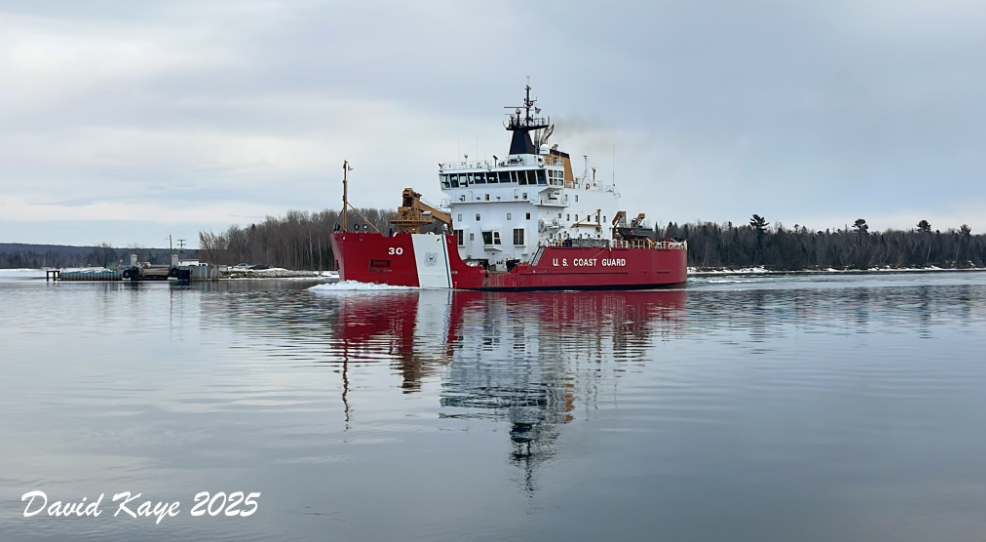
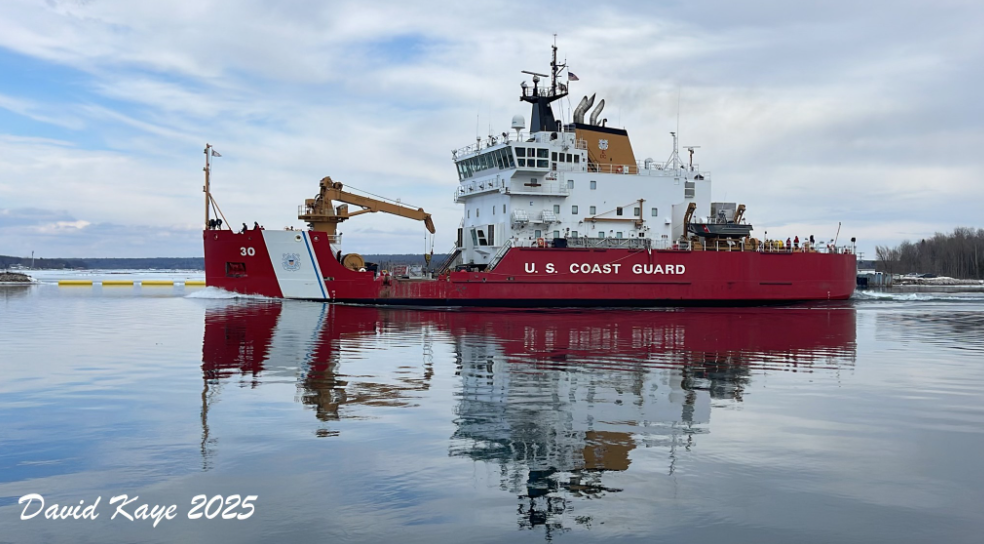
By midafternoon, the USCG Katmai Bay managed to move the buoy, located in Munuscong Lake between Nine Mile Point and the Rock Cut, so that vessel traffic could pass, and the USCG reopened the river at 2 p.m., allowing eight vessels that were either at anchor above the locks or being held at the piers to get underway. They were the James R. Barker, Algoma Strongfield, Presque Isle, American Integrity, Hon. James L. Oberstar, G3 Marquis, H. Lee White and Manitoulin, which had been delayed on Lake Superior by the intense storm earlier this week.
Stewart J. Cort, showing a destination of Silver Bay and which anchored above DeTour Monday for weather and then became stuck in the ice, was freed Wednesday afternoon by USCG Biscayne Bay. She headed upbound, but went to anchor in the Hay Lake Anchorage to await her turn at the locks.
Other upbound traffic Wednesday included the barge PML 2501/tugs Wilfred M. Cohen and W.I Scott Purvis, American Spirit and, late, Kathy McKeil.
[Know Your Ships]
Algoma Guardian has close call near Brockville
The bulk carrier Algoma Guardian has mechanical issues near Brockville, ON, Wednesday due to a possible engine/blower issue, causing significant smoke and causing it to drift towards the shoreline. Fortunately power was quickly restored and she continued on her way without incident. At 10 p.m. Wednesday, AIS showed her anchored waiting for traffic to clear due to ice delays in the Seaway.
[From local reports]
America Turns to Finland for Icebreakers It Struggles to Build at Home
U.S. admits decades of neglect with unprecedented foreign shipyard deal as Arctic rivalry intensifies.
By Paul Morgan (gCaptain) – The United States just signed contracts for Finland to build American warships, a stark admission that the world’s most powerful navy can no longer construct the specialized vessels it desperately needs.
On December 27, the Coast Guard awarded contracts to Finland’s Rauma Marine Constructions and Louisiana’s Bollinger Shipyards for six new Arctic Security Cutter icebreakers. Finland gets the first two, with delivery in 2028. The U.S. will build four more domestically by 2029, using a Finnish-Canadian design, Finnish expertise, and Finnish hand-holding.
It’s an unprecedented arrangement that exposes how far American shipbuilding has fallen behind. President Trump personally waived the legal requirement that Coast Guard vessels must be U.S.-built, citing national security grounds. The reason? America simply lacks the experience to design and build modern icebreakers quickly enough.
“Nothing like the PSC has been built in the United States in 50 years,” a Government Accountability Office report concluded about the troubled Polar Security Cutter program. American yards have no recent experience with large icebreakers, and it shows.
A Shipyard Gap That Can’t Be Hidden
The U.S. currently operates three Arctic-capable icebreakers. Russia fields 40-50, including eight nuclear-powered behemoths. China now has four to five polar research vessels actively operating in Arctic waters, with more under construction.
The 49-year-old Polar Star, America’s only heavy icebreaker, is 18 years past its designed service life and held together by constant emergency repairs. The 25-year-old Healy caught fire last year and had to abort its Arctic patrol. The newly commissioned Storis is a converted commercial oil rig support ship rushed into service as a stopgap.
This is America’s polar fleet at a moment when the Arctic has become a front-line security theatre.
The contrast with the domestic heavy icebreaker program is brutal. The first Polar Security Cutter was supposed to be operational in 2024. It’s now unlikely to enter service before 2030, six years late. The original 2019 contract was for $746 million. Current estimates put the first ship alone at $1.9 billion, with total program costs exceeding $5 billion for three vessels.
Design completion sits at 67% after five years of work. Full construction hasn’t actually begun. Congressional committees have held multiple hearings demanding answers. “It’s been six years since this program was authorized, and we still don’t have a final design,” Representative Carlos Giménez complained. “It only took us nine years to get to the moon.”
Why Finland Wins?
Finnish yards have built much of the world’s modern icebreaker fleet. Rauma Marine Constructions sits at the center of a mature Arctic technology cluster with decades of specialized experience. They can deliver a medium icebreaker in 36 months from contract signing, roughly half the time U.S. estimates suggest for domestic construction.
Finland’s expertise runs deep. Even Russia’s shallow-draft nuclear icebreakers Taymyr and Vaygach were built at Finnish yards (though their reactors were installed in Russia). China’s most capable icebreaker, Xue Long 2, was designed by Finnish firm Aker Arctic.
The Arctic Security Cutter design itself comes from a consortium led by Finland’s Aker Arctic Technology and Canada’s Seaspan Shipyards, a production-ready design that already exists rather than something American yards need to figure out from scratch.
By turning to Finland, Washington is essentially buying time. The first two Finnish-built cutters arrive in 2028, giving U.S. crews operational platforms while domestic yards learn how to build them. The partnership includes explicit technology transfer: Finnish engineers will work alongside American builders to train them in icebreaker construction.
Strategic Implications
The deal reveals competing pressures in U.S. defense policy. On one hand, relying on foreign construction for national security vessels would have been unthinkable a generation ago. On the other, the Arctic gap with Russia and China has become too dangerous to ignore while waiting for domestic shipyards to figure it out.
The arrangement fits within the broader “friend-shoring” strategy—partnering with trusted allies for strategic manufacturing when domestic capacity falls short. Finland joined NATO in 2023 and brings deep Arctic expertise without the geopolitical concerns of Chinese yards.
For Finland, the contracts represent a major industrial victory. RMC gains a prestigious reference customer in the U.S. government and long-term design support revenue. Finnish officials called it a “historic milestone” that cements Finland’s role in NATO’s Arctic strategy.
For U.S. shipbuilding, the message is uncomfortable but unavoidable: decades of underinvestment have consequences. The U.S. commercial shipbuilding share sits at 0.1-0.13% of global output. Costs run three to four times higher than East Asian yards. When specialized capabilities are needed quickly, America now has to look abroad.
The $6.1 billion Arctic Security Cutter program won’t reverse that decline overnight. But it represents a pragmatic acknowledgment that in the new era of great power competition, national security sometimes requires admitting what you can’t do and finding partners who can.
The question is whether this serves as a wake-up call for broader shipbuilding reform, or it’s simply another temporary fix while underlying capacity continues to erode. With nearly $9 billion now allocated for Coast Guard icebreakers and cutters, the industry has its chance. Whether it can deliver remains to be seen.