Boatnerd News

Boatnerd News – August 2, 2023

S.S. Badger’s 2023 sailing season ending early due to ramp damage

LUDINGTON, MI – The S.S. Badger is done for the season.

Lake Michigan Carferry, which owns and operates the 70-year-old vessel on Lake Michigan, said Tuesday that damage to its ramp system will force an early end to its 2023 sailing season.

The ramp, which is used to load and unload the ship malfunctioned when one of the lifting structures collapsed into the water on July 21. LMC says a failure of the counterweight structure on the port side of the Badger’s ramp system occurred.

Underwater divers, marine construction contractors and an engineering firm were quickly engaged but over the last week, but the company said “it became clear that the necessary repairs were extensive and would take months to clear the collapsed structure and erect a new one.”

Cross-lake service from Ludington to Manitowoc, Wisconsin was suspended with the goal of returning in a few weeks, but that won’t be the case.

“We have made the difficult, and unfortunately unavoidable, decision to suspend our daily crossings for the remainder of the season,” says Mark W. Barker, President of Interlake Maritime Services, parent company of the Lake Michigan Carferry.

“This is not how we hoped our 70th season would end but we are fully committed to making the extensive repairs – and doing it the right way – so that we will be back better and stronger in 2024 to serve our loyal passengers and port communities.”

The 70th season had included the return of overnight sailings known as doubles for the first time in three years. The overnight trips offer passengers a chance to view the night sky, stars, and sunsets as a part of the route to their destination.

Passengers with reservations will receive full refunds. They will be contacted individually in order of their reservation date.

LMC also said it’s working to keep as many of its seasonal staff working as possible in Ludington and through other employment opportunities in the Interlake family of companies.

“While an amazing amount of work has been done in last 11 days and an incredible effort has been made by all of our employees and key partners on the Lakes, this is a very complicated process and one that will not be complete in time to resume service this season,” said Sara Spore, General Manager of Lake Michigan Carferry.

“We sincerely apologize for any inconvenience and disruption in plans. We know that our passengers and our port communities of Ludington and Manitowoc rely on the Badger. We thank them for their support, patience and understanding as we tackle this unexpected and disappointing end to our season.”

She also asked that people respect the fencing around the dock area in Ludington as an active work site.

In addition to being a unique experience, the S.S. Badger provides a significant economic boon to Ludington and Manitowoc due to passengers that arrive in both coastal cities.

The vessel, which was the last coal-powered passenger steamer operating in the United States, is a designated National Historic Landmark built in 1953 by Christy Corp. in Sturgeon Bay, Wis., for C&O Railway Co.

It once carried railcars between Ludington and Manitowoc on an extension of US-10 across the lake and can now accommodate 600 passengers and 180 vehicles, including RVs, motorcycles, motorcoaches, commercial trucks and oversized vehicles.

MLive


LaMarre elected president of AGLPA, Port receives another Pacesetter Award

Port of Monroe director Captain Paul C. LaMarre III was elected president of the American Great Lakes Ports Association at the organization’s annual conference in Chicago last week. AGLPA represents the interests of commercial ports and port users on the U.S. side of the Great Lakes. Its members include 16 public agency port authorities and more than 30 associate members representing allied companies and organizations.

“As a lifelong student of the Great Lakes maritime industry, I am humbled by the opportunity to serve our Great Lakes ports as the President of AGLPA, but most importantly to lead our association as ‘one port’ sustaining our region through relationships and relevance,” said LaMarre.

Also at this event, the Port of Monroe received a Robert J. Lewis Pacesetter award for the 2022 shipping season this week. The award was presented to LaMarre by Great Lakes Seaway Administrator Adam Tindall-Schlicht. It is the seventh Pacesetter award the Port of Monroe has received since 2013.

The Robert J. Lewis Pacesetter Award is an award presented to Great Lakes ports by the U. S. Saint Lawrence Seaway Development Corporation (SLSDC) that report increases in international tonnage during a shipping season. It was established in 1992 to recognize the achievements of U.S. ports whose activities resulted in increasing international tonnage shipped through the St. Lawrence Seaway, excluding Canada, in comparison to the previous year.

Port of Monroe


Click here for recent drone footage of the scene in Ludington, MI, courtesy of Daniel Anderson from the Ludington Ship Watch Facebook page.

Boatnerd News – August 1, 2023

Report shows Great Lakes-Seaway benefits Indiana the most

According to a report, Indiana is the state with the greatest economic impact from cargo handling by ports and terminals along the Great Lakes-Seaway system.

Ohio and Michigan landed a distant second and third, according to the “Economic Impacts of Maritime Shipping in the Great Lakes-St. Lawrence Region” report.

In Indiana, 75,498 people were directly or indirectly employed because of the system. Business revenue topped $11 million. And more than $2 million in taxes were collected because of activity on the seaway.

The port at Burns Harbor specifically was mentioned as one that has steel mills and other operations that create a larger concentration of direct jobs.

The Burns Harbor port handled 3.45 million tons of cargo on Lake Michigan in 2022, a 2% increase from 2021, according to the Ports of Indiana. For the second consecutive year, the port exceeded its highest annual shipping total since its inception in 1970.

“As governor of Indiana, my mission is to increase Indiana’s global competitiveness and our ports play a critical role by bringing the world to Indiana and connecting Indiana to the world,” said Gov. Eric Holcomb in a press release.

Martin Associates, which has headquarters in Lancaster, Pennsylvania, performed the analysis for the study. The study sponsors were the Great Lakes St. Lawrence Seaway Development Corp. (U.S.), the St. Lawrence Seaway Management Corp. (Canada), the American Great Lakes Ports Association, the Chamber of Marine Commerce, the Lake Carriers’ Association and the Shipping Federation of Canada.

Read the full report here.

Northwest Indiana Business


Obituary: Robert D. Perlewitz

Robert Donald Perlewitz 85, of Sturgeon Bay, died on July 24, 2023, at Door County Medical Center. He was born on December 31, 1937, in Algoma to Raymond and Martha (Karrer) Perlewitz. In 1958, he married Mary Johnson in Algoma.

For over 40 years, Robert (better known as “Bob” or “Perly” to friends and family) worked on the John Purves, an immaculately restored 1919 tugboat that is now docked at the Door County Maritime Museum. He was awarded several Naval Preservation Awards, a President’s Lifetime Achievement Award for his volunteer efforts, and many other write-ups and acknowledgments for his work and service. Bob had a lifelong passion for all things automotive, which included his cherished Thunderbird and an incredible collection of gas and oil memorabilia that brought in buyers and admirers from all over the country.

When he wasn’t working or collecting treasures, you could find him watching television with his beloved German Shepherds or telling outlandish stories about narrowly escaping from bears and surviving the Ice Bowl. Bob seemed to own his status as a grouch. He pushed people’s buttons and enjoyed riling people up; just ask his wife Mary or his three children, Jeff, Scott, and Chris. That being said, he was also a sentimental man who held onto as many family keepsakes and heirlooms as he could and always had a warm and loving smile for his great-grandson when he visited. He will be dearly missed by those who loved him.

Survivors include his wife; three children, Jeffrey (Heidi) Perlewitz, Sturgeon Bay; Scott (Chip) Perlewitz, Chattanooga, TN; Christine (Jeffrey) Heard, Brussels; one grandson, Timothy (Kari) Perlewitz, Green Bay; one great-grandson, Atlas Perlewitz; and several nieces and nephews. He was preceded by his parents; three brothers, Harold, Raymond, and Gordon; one sister, Patricia; and a brother-in-law, James.

Funeral services will be at 11:00 a.m. Monday, July 31, 2023, at Forbes Funeral Home in Sturgeon Bay with Rev. Paul Graf officiating. Burial will be in Clay Banks Cemetery. Visitation will be from 9:00 a.m. until the time of services at the funeral home on Monday.

Door County Pulse


Boatnerd News – July 31, 2023

Farms resident flips freighters into homes

Tony Gatliff, a 42-year Grosse Pointe Farms resident, has taken on the unique project of creating cottages out of the pilot house of a freighter.

The former ship’s officer and pilot aboard the Ford Motor Co. Fleet said a pilot house is the control room of a freighter

“That’s where all the navigation takes place,” Gatliff said. “That’s where the steering takes place. That’s where the charting, plotting takes place. That’s where the radar is. That’s where the engine room controls are, where the steering is. It is the brain center, if you will.”

After hearing about a freighter that was being taken out of use, Gatliff jumped on the opportunity to give the ship a new use, with plans to create two separate cottages on Beaver Island. Gatliff’s parents were born and raised on Beaver Island and he spent summers working there during high school and college building his own cottage. The pilot house will be a component of that home.

He said the project began when he went to see the freighter in December at Marine Recycling in Ontario, Canada. He has since purchased another pilot house off a French-Canadian ferry that ran across the St. Lawrence, which he will use as guest quarters.

“I had seen on a website that the ship was being pulled up to be cut up into scrap,” Gatliff said. “I inquired, ‘How would I get a hold of the recycling company to speak to somebody about possibly getting to own the pilot house?’ I asked if I could come down there.”

The ship was at Port Colborne, which is at the eastern end of Lake Erie. Gatliff wanted to transport the pilot house to Beaver Island, located about 32 miles northwest of Charlevoix, where he would flip it into cottages. The pilot house and the captain’s quarters together are about 1,100 square feet, with the pilot house alone measuring 650 square feet.

“We have a property that I put it on, but it was too shallow out front to get the barge there,” Gatliff said. “We had to cut the pilot house and strategically cut the captain’s quarters off the pilot house so that we could get it down the road.”

The project requires much more than just building a house. It takes bigger equipment and extensive planning and transportation. Once the pieces were loaded onto a barge at Port Colborne, Gatliff began the four-and-a-half-day round-the-clock journey to Beaver Island.

Still working a full-time job as a 34-year partner at Great Lakes Woodworking, Gatliff set a reasonable goal to have the cottages completed within two years.

“I’ve got about five phases completed,” he said. “Purchasing it, getting it cut, getting it onto the barge, getting it across Lake Erie and Lake Huron to Lake Michigan, and then getting it off the barge and getting it to the property. There’s already a lot of work that has gone into it.”

Gatliff is no stranger to the freighter he is flipping, which is one of the many reasons the project is special to him.

“I spent approximately five years on this ship in various capacities,” he said. “We’ll keep it as our family cottage.”

He is working with local architect Keith Owen on the transformation and plans to keep the pilot house cottages for himself and his family to enjoy in the years to come.

Grosse Point News


Boatnerd News – July 30, 2023

New G-tugs christened in the Windy City

The Great Lakes Towing Company christened its two newest tugs, Illinois and Indiana, during the American Great Lakes Ports Association annual conference in Chicago, IL. The Illinois was christened by Illinois State Representative Eva-Dina Delgado, Illinois House 3rd district. The Indiana was christened by Dr. Orla Hart, Clinical Teaching Associate Professor, Purdue University. The Damen Stan 1907 ICE harbor tugs are part of GLT’s fleet renewal program.

Sam Hankinson


Nukumi crew comes to aid of fishing boat in distress

On July 22, a fishing vessel sent a distress signal to the Coast Guard as it was taking on water in the Gulf of St. Lawrence. The Coast Guard quickly responded by dispatching the closest vessel, MV Nukumi, to assist. A Coast Guard Hercules aircraft dropped portable pumps and life rafts near the distressed fishing vessel.

Captain Kevin Crouse and the Nukumi crew launched the ship’s rescue boat and towed the pumps to the sinking fishing vessel. They also towed the life raft with all four crew members on board to the Coast Guard vessel.

Once everyone from the distressed fishing vessel was safely on board the Coast Guard vessel, MV Nukumi resumed her transit to the Magdalen Islands.

Thanks to the brave and quick actions of the Nukumi crew, the four fishing boat crew members were safely rescued.

We extend our heartfelt gratitude to the Nukumi crew for their courage, quick thinking, and unwavering dedication to the rescue operation.

Canada Steamship Lines


Boatnerd News – July 29, 2023

Fire-damaged bulker Tecumseh going to scrap this fall

Nearly four years after an engine room fire sent her to the wall, Lower Lakes Towing’s 50-year-old bulker Tecumseh has officially reached the end of the line.

Marine Recycling Corporation owner Wayne Elliott broke the news in a Facebook post late Friday night, announcing that the fire-damaged vessel will be towed from her berth at Ashtabula, Ohio, to nearby Port Colborne, Ontario, before the end of September. There, like fleetmates Ojibway and Manistee just before her, Tecumseh will be torn apart by the torch, shredded with the shear, and fed to the furnaces for a fiery rebirth.

The 1973-built bulker was launched in Seattle, Washington, as the oceangoing Sugar Islander. Later sailing under the names Islander, Judy Litrico, and Tina Litrico, the vessel was sold to Lower Lakes Towing in 2010 and renamed Tecumseh, officially entering Great Lakes service in April 2012. She would serve the Canadian grain trade for the better part of the decade.

While sailing down the Detroit River with canola on December 15, 2019, Tecumseh suffered a severe fire originating in her engine room. No injuries were reported, but damage to the engine control room was extensive. The stricken vessel was laid-up for the winter at Windsor, Ontario, and later brought to Ashtabula, Ohio, under tow the following April.

Tecumseh has remained motionless since with her fate uncertain… and now sealed.

Joshua Hebeisen


New stone breakwater to be installed at Buffalo’s Outer Harbor

The US. Army Corps of Engineers is taking a step toward protecting the wetland ecosystem of Lake Erie.

The agency says more than $5 million will cover construction costs of a new stone breakwater at Buffalo’s Outer Harbor.

“This is just the first visible step of a project that will revive the natural aquatic habitat on Buffalo’s Outer Harbor,” said Lt. Col. Colby Krug, commander of the USACE Buffalo District. “I hope all fellow Buffalonians and visitors to the waterfront will join us in envisioning the positive impact this project will have on generations of people, plants, and wildlife.”

The plans for the project look to reverse decades of industrial development and hardening of the Outer Harbor shorelines, which have been harmful to fish and other species in the area.

The breakwater, which will be installed near the now-abandoned ship slip three, will connect to Lake Erie and create a new habitat.

“Under the leadership of the Army Corps Buffalo District, this project brings new life to the slip next to Wilkeson Pointe and continues to build on Buffalo’s waterfront revival,” said Congressman Brian Higgins. “This is yet another example of how the Great Lakes Restoration Initiative, which saw funding boosted through the Bipartisan Infrastructure Law, is directly benefiting Western New York.”

The Army Corps of Engineers says it will not only be beneficial for aquatic species, but also birds.

Construction is slated to start early this fall and will be finished in November.

Spectrum News


U.S. House passes James bill requiring Soo Locks security study

Washington ― The U.S. House on Wednesday passed a bill directing completion of a new study of potential security shortfalls at the Soo Locks, as well as the supply chain and economic impacts of a potential failure at the Great Lakes shipping lock complex at Sault Ste. Marie.

The legislation, passed by voice vote, is the first by freshman U.S. Rep. John James, R-Shelby Township, to pass the chamber. The bill’s co-sponsors include U.S. Reps. Jack Bergman, R-Watersmeet; Dan Kildee, D-Flint Township; and Hillary Scholten, D-Grand Rapids.

The bill directs the secretaries of transportation and defense, in coordination with the commandant of the Coast Guard, to present the study to Congress within a year of enactment, asking the agencies to also recommend measures to strengthen security at the shipping lock complex and to reduce impacts to supply chains in the event of a Soo Locks failure or attack.

Previous studies of the potential economic consequences of a Soo Locks failure have been conducted by the Department of Homeland Security and the U.S. Army Corps of Engineers. The corps in 2018 concluded that unexpected outage of the 1,200-foot-long Poe lock would create a “bottleneck,” disrupting the supply chain for steel production and thus manufacturing in North America — particularly the auto industry.

A 2015 Department of Homeland Security report that found no alternative transportation mode exists for getting iron ore from Minnesota mines to steel mills on the lower Great Lakes.

“A six-month shutdown would be disastrous. It would cause recessions, close factories, shutter mines,” James told reporters on a Tuesday phone call. “Around 11 million jobs could be lost nationwide. That’s massive. That’s more than the entirety of Michigan’s population. … This is why we must pass this legislation.”

He emphasized how the security landscape, especially in terms of cyber and drone threats, has changed in the eight years since the Homeland Security study was conducted. “The world’s a completely different place,” James said.

Among the recommendations that James is hoping to see from the report is assigning next-generation fighter aircraft and a hypersonic mission to Selfridge Air National Guard Base in his district in Harrison Township “to cover our vital infrastructure” at the Soo Locks.

Bergman, whose district includes the Soo Locks, anticipated a “lop-sided” House vote in favor of the bill. He urged his Senate colleagues to pass it, as well.

“Although a lack of investment by the Biden administration has pushed back project completion, we still have the requirement to ensure the locks are secure and identify any critical, vulnerable areas where improvement may be needed, now even during the construction phase,” Bergman said.

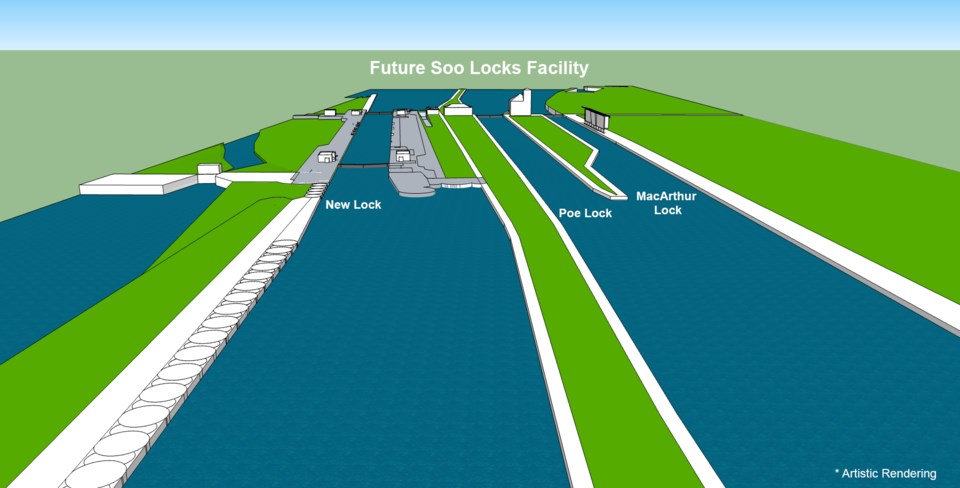
Bergman was referring to the massive $3 billion project underway at the shipping lock complex on the St. Mary’s River that connects Lake Superior to the lower Great Lakes. Plans call for a new 1,200-foot-long lock to mirror the aging Poe lock, which is the only one at the shipping complex big enough to handle the largest Great Lakes freighters that carry 71% of the tonnage that traverses the corridor.

The new lock under construction would provide redundancy, so cargo could keep moving in the case of an unexpected outage of the aging Poe, built in 1968.

The Congressional Budget Office estimated the study and report would cost less than $500,000, though a separate appropriation would still be needed.

The Detroit News


New Great Lakes maritime facility could change export game for ag producers in northern states

Officials of Port Milwaukee and The DeLong Co., Inc. recently celebrated the grand opening of the $40-million Agricultural Maritime Export Facility. They were joined by Wisconsin Gov. Tony Evers, Milwaukee Mayor Cavalier Johnson, and federal, state, and local officials to welcome the single largest investment in the port since the 1950s.

The facility, located on the west side of Jones Island, will be one of the first on the Great Lakes-St. Lawrence Seaway system to handle various agricultural commodities via truck, rail and international vessel, including dried distillers grains with solubles, a high-nutrient animal feed supplement derived as a byproduct of ethanol refining.

The new transload facility has a storage capacity of 30,000 metric tons of DDGs or 45,000 tons of soybeans and can serve outbound vessels with a capacity between 7,000 and 22,000 metric tons. It can load 1,000 metric tons an hour. It includes rail and truck gravity dump hoppers connected to a conveyer system to transport the material into a fabric storage building.

Inside the fabric building, a reclaim system conveys product to be loaded into bulk material cargo vessels or barges. The facility is fully operational and in June 2023 successfully loaded its first vessel of Wisconsin-produced DDGs, made with corn from Wisconsin. The first vessel, the Ebroborg, was loaded with 7,250 metric tons—the equivalent of 330 trucks or 92 rail cars—of Wisconsin-produced DDGs during the end of June and arrived in Belfast, United Kingdom, in mid-July.

No other facilities on the Great Lakes can load entire vessels of DDGs or other feed ingredients. Future service at the facility may include the export of Wisconsin-grown soybeans, corn and grain. The agricultural “draw area” will depend on the product, but will include Wisconsin, Minnesota, Iowa, North Dakota, South Dakota and possibly Illinois. Currently most DDGs produced in Wisconsin, Minnesota, or Iowa are shipped by container to southeast Asia or by barge down the Mississippi to be loaded into bulk vessels for export.

Thanks to a public-private partnership, this development is the largest one-time investment in Port Milwaukee since the 1950s. Port Milwaukee was one of the first nationwide grant recipients of the Port Infrastructure Development Program through the U.S. Department of Transportation. Additional facility funding was provided by the Wisconsin Department of Transportation, Port Milwaukee, and The DeLong Co., Inc.

“Milwaukee is the economic engine for our state and region. This addition to the port’s operations will expand a strong partnership that includes The DeLong Co., the City of Milwaukee, our state and federal partners, Wisconsin agriculture, and world markets,” said Johnson. “Thank you to our many partners for advancing this continued growth at Port Milwaukee.”

“We want to thank the City of Milwaukee for their partnership on this project. We look forward to being part of the community,” said Bo DeLong, vice president of grain, The DeLong Co., Inc.

“Port Milwaukee is an integral link in the Wisconsin economy. In this case, we are connecting Wisconsin farmers, growers, and producers with new international markets,” said Jackie Q. Carter, director of Port Milwaukee.

The Wisconsin Department of Transportation has estimated the DeLong terminal will generate $63 million in new statewide economic impact annually, increasing exports through Port Milwaukee by as much as 400,000 metric tons per year.

“This new facility will have a tremendous impact here in the local Milwaukee community and around the state and will help ensure more of our farmers’ best-in-class, Wisconsin-made goods will be shared with folks all over the world,” said Gov. Evers. “I want to congratulate the DeLong Company, Port Milwaukee, and everyone that played a role in getting this project over the finish line.”

“The facility is among the first on the Great Lakes-St. Lawrence Seaway system that can handle a variety of agricultural commodities via truck, rail and international vessels,” said Wisconsin Transportation Secretary Craig Thompson. “It’s an important new resource for both shipping and agriculture, and its impact will be felt statewide.”

Port Milwaukee is governed by a seven-member Board of Harbor Commissioners, a panel appointed by the mayor and confirmed by the Common Council. It administers operations on the 467 acres that make up the Port.

The DeLong Co., Inc. is a sixth-generation family-owned business headquartered in Clinton, Wisconsin, operating 37 locations around the United States and comprising six divisions of agricultural and logistical sales and services: grain, exports, agronomy, seed, transportation and wholesale feed. Over the last 20 years, DeLong has grown to become a leader in containerized agricultural exports. With transload facilities around the country, it is the largest U.S. exporter of containerized agricultural products and the fifth largest container exporter overall of products originating from the U.S.

High Plains Journal


Boatnerd News – July 28, 2023

Sault’s “Uber boatnerd” Mason Harris turned six years old on Thursday

Know Your Ships? “Well, you should,” birthday boy Mason Charles Harris said, holding a toy freighter with his name written all over it in gold letters.

Mason’s birthday wish is to become a boat captain one day.

Interlake Steamship Company coined Mason, “one of the biggest & littlest fans of Great Lakes shipping” when he was just four years old. Today, he turns six and enjoys a James R. Barker vanilla birthday cake.

“James R. Barker is my favorite freighter,” he said. “It gives me master salutes.”

Mason even knows all about its captain, Capt. Brad Newland, whom he called a friend.

“It is 1004 feet, and Captain Brad always waves,” Mason said. “Mom follows him on Facebook.”

Mason only hopes for more Great Lakes freighter toys and books on his sixth birthday, such as those from his favorite series, Know Your Ships, written by local author Roger LeLievre.

“He is an uber Boatnerd,” LeLeivre said about one of the littlest, biggest freighter fans he knows in the Sault.

Mason also wants an iPad, since his fell into the water while shooting pictures of ships.

“His whole day revolves around boats,” Mason’s mother, Lori Mason, added. “We always go up on the Soo Locks Visitor’s Deck. He likes going into the Soo Locks Visitor’s Center to play. We go to Valley Camp, and up on the Tower of History (Sault Historic Sites). He watches the boats from the top of the tower. We have to go catch freighters every day. He has friends at Rotary Park: Jordan, Carson, and Mr. Don. They take pictures of the freighters. We even go out there in the winter, March, when the Soo Locks open. I have pictures of him waving in snow and ice.”

The other day, he spent the night at Grandma JoAnn Mason’s house.

“Mason woke her up at 4 a.m. to go see the Mark W. Barker,” Lori said, giggling. “He has the MarineTraffic app, and saw it coming.”

Mason was named after his grandfather, Vietnam Veteran Charles Mason, who worked for the U.S. Corps of Engineers as a Soo Lock and dam operator for approximately 30 years. He retired in 2009 and passed away on Sept. 23, 2016.

Mason also has two cousins aboard the Mesabi Miner, Sissy and Gary Payment.

“I love my cousins,” he said. “Sissy cooks and Gary works on the unloading boom.”

But Mason said his love for ships on the Great Lakes was inspired by early memories aboard Famous Soo Locks Boat Tours aka “The yellow ones.”

“He was either two or three at the time,” Lori said.

Mason is also a big fan of Original Soo Locks Boat Tours aka “The white ones”  because its fleet was recently acquired by Interlake Maritime Services.
Both yellow and white tour boats carry out narrated cruises along the St. Marys River through the Soo Locks.

But Mason mainly wanted to talk about the James R. Barker, referencing a fire that occurred in its engine room in 1987.

Eventually, he moved into conversation about the 858-foot Roger Blough, built in 1972 by American Ship Building Company in Lorain, Ohio. The ship is owned by Great Lakes Fleet.

During winter layup on February 1, 2021, a fire broke out at Fincantieri Bay Shipbuilding in Sturgeon Bay, WI. More than one year later, the Blough was towed to Conneaut, OH. Mason was unsure as to whether or not it had been scrapped yet.

Lori pulled a credit card out of her purse. The card had a freighter printed on the front of it.

“That is the Hon. Paul J. Martin,” he said at a glance, wanting to talk about Paul R. Tregurtha instead. “The Paul R. Tregurtha is the largest freighter on the lakes at 1,013 feet, 6 inches.”

“How does he know this?” Lori asked, rhetorically. “He can name all of them. He is so smart. In preschool, they had a boat week just for him. They made a big cardboard boat toward the end of the year.”

Ms. Amie Lawson was his Sault Tribe Head Start teacher that year.

Mason just finished up kindergarten, and is excited to start first grade. This school year, he just hopes to meet like-minded friends, whose lives also revolve around the ships of the Great Lakes.

Happy sixth birthday, Mason Charles Harris!

Soo Leader


Four new methanol-ready vessels to be built to ABS class for Algoma

Algoma Central Corporation (Algoma) has ordered two, methanol-ready, 37,000-DWT, ice class product tanker vessels to be built to ABS Class. This CAN$127m investment followed an order for two, new, 72,250-DWT, methanol-ready, Kamsarmax-based ocean belt self-unloading vessels that will also be built to ABS Class from Algoma.

The new product tankers will be entered on long-term time charters under Canadian flag, trading primarily from Saint John, New Brunswick, with deliveries to ports in Atlantic Canada and the U.S. East Coast.

The methanol-ready Kamsarmax vessels will support Algoma’s decarbonization efforts with the new ships designed to exceed EEDI Level III requirements and to include Tier 3 engines. The vessels are expected to be 40 percent more efficient than the ships they will replace, owing to a combination of fuel efficiency and optimized cargo lift.

“ABS is proud to help Algoma modernize their fleets and support their sustainability strategy. Methanol is a promising fuel source to reduce shipping emissions, and these vessels will be ready to adopt this as bunkering infrastructure matures,” said John McDonald, ABS President and Chief Operating Officer.

“These vessels have been designed with safety and optimization at the top of mind and will be a model for the next generation of vessels. ABS has worked with Algoma for over 25 years providing technical expertise and services to help us achieve quality vessel performance, and we look forward to continuing to work together to maximize safety and accelerate efficiency,” said Gregg Ruhl, President and CEO of Algoma.

Source: ABS

Helenic Shipping News


Boat crew responsible for saving man after Ambassador Bridge fall saves another man over the weekend

DETROIT (WXYZ) — A crew of boaters typically known for helping to deliver mail to mariners on the Detroit River is being hailed as heroes once again after helping to save a fisherman over the weekend.

The J.W. Westcott has been delivering mail and other items to mariners crossing the Detroit River since 1874.

Because a boat captain and deckhand are on the boat for 24 hours per day, seven days a week for around 250 days each year, they say they often are the first to see when boaters or swimmers get into trouble on the water.

On July 12, the crew on board the vessel helped to save a worker who fell off the Ambassador Bridge. Surveillance video captured bystanders banging on the office door of J.W. Westcott to alert the crew that someone had fallen 150 feet into the river. The crew immediately jumped into action, getting to the critically injured worker within two minutes and pulling him to safety.

“Usually, it’s something that happens spur of the moment. We usually train with man overboard drills,” Capt. James Hogan of the rescue said.

Hogan says while it’s not a part of their job description, many people may be surprised to learn how often the crew helps pull straggling swimmers or boaters to safety on the river.

The crew says tools that are meant to be used in case of an emergency with one of their crew members like life jackets, life preservers and a tool called “Jacob’s Cradle” come in handy when disaster strikes for others on the river.

“Every now and then, you’ll get dogs in the water, bodies that just kind of float up, sadly, and, you know, other people that have had unfortunate accidents happen,” Hogan said.

Hogan says last Tuesday, the crew was able to help the Detroit Fire Department pull a floating body from the water. Then this past weekend, the crew pulled a fisherman to safety after he went overboard.

The crew says although they’re not expected to take the place of first responders, they’re happy to lend a helping hand.

“You just start to notice things in the water and you’re like that’s not normal. You go to check it out because sometimes it isn’t. Just like the head of a person that’s trying to keep afloat,” Hogan said. “We do what we can with what we got.”

WXYZ Detroit


Boatnerd News – July 27, 2023

Research vessels are on the Great Lakes, but there’s no crew on board

The government is using three uncrewed research vessels in the Great Lakes.

These autonomous vessels are gathering data on fish. One vehicle is on the surface on northern Lake Michigan. Another is on Lake Erie.

There’s also a long-range autonomous underwater vehicle (LRAUV) that’s mapping fish distribution. It’s being deployed out of harbors from Frankfort down to Benton Harbor.

The U.S. Geological Survey along with conservation agencies from Michigan, Wisconsin, and Ontario are partners in these experimental uses of the uncrewed vessels.

The USGS said in a release that diesel-powered conventional research vessels are relatively loud and that might have an impact on the data collected because fish could be scared away by the noise.

The surface vehicles, called saildrones, are wind-powered and can stay out on the water 24 hours a day for months, gathering data.

Having more data always makes scientists happy. It can be used to determine the validity of other research where data was gathered by crews on conventional boats.

The operators say notices about the autonomous vessels have been sent to the U.S. Coast Guard to provide to mariners.

Michigan Radio


Brig Niagara sailing season to end early due to propellor repairs

The remainder of the U.S. Brig Niagara’s 2023 sailing schedule has been officially canceled due to mechanical issues.

The Flagship Niagara League will offer refunds to anyone who has already registered to sail on the ship, according to a statement Monday from the Flagship Niagara League and the Pennsylvania Historical & Museum Commission.

What kind of mechanical issues?

The cancellation was due to the loss of the Niagara’s starboard propeller.

Flagship Niagara League Executive Director and Fleet Captain Billy Sabatini said the propeller had been attached to the Niagara for 30 years without incident and that he doesn’t know what led to its sudden failure, which was discovered earlier this month and led to a temporary suspension of sails.

“We didn’t hit anything. We didn’t get it caught up in fishing gear. We didn’t hit a dock. Nothing happened. There wasn’t any event that precipitated the prop falling off because if that was the case I would have noticed,” he told the Erie Times-News.

Sabatini said he looked into getting temporary propellers. But after considering the time this would take — a minimum of 55 days — and the fact the Niagara would ultimately get permanent propellers this fall in Cleveland, that option seemed less attractive.

“The temporary ones would be great spares to have, but the timetable being a minimum of 55 days, it didn’t make sense to go through all that just for one week of sailing at the end of the year,” Sabatini said.

The Niagara will be fitted with in-kind custom-fabricated propellers, which, according to the statement, will save money on repairs in the long run and allow the ship to operate without undue stress to the engines.

The variable-pitch propellers will take a minimum of 76 days to fabricate and install at a cost of roughly $120,000.

“Our next step will be to sail the Niagara to shipyard (in Cleveland) to replace the propellers and install new generators as previously planned,” said Melissa Mann, PHMC’s director of Historic Sites and Museum, in the statement.

“While at the shipyard, a full survey of the ship’s mechanical and maintenance needs will be conducted in order to develop a long-term maintenance and preservation plan to ensure many successful future sailing seasons.”

Niagara still open for deck tours

Before the ship travels to Cleveland in the fall, the Niagara will be open for deck tours at the Erie Maritime Museum Wednesday through Saturday, 9:30 a.m. to 5 p.m., and Sundays, 1 p.m. to 5 p.m.

Day sails, sunset sails and occasional full-moon sails are available aboard the schooner Lettie G. Howard as scheduled, weather permitting.

Sabatini said the canceled Niagara sailing schedule was a “hard hit” but that the Flagship Niagara League and PHMC are committed to Niagara sailing in the future.

“The public-private partnership between the Flagship Niagara League and the Pennsylvania Historical & Museum Commission is strong and as long as we work together, and this community is still in support of what we’re doing, we’re going to make this happen.”

The PHMC administers the Erie Maritime Museum. The Flagship Niagara League is a nonprofit organization that facilitates public participation aboard the reconstructed Battle of Lake Erie warship.

Erie Times-News


Boatnerd News – July 26, 2023

Great Lakes are once again a hot destination for cruise ships

DULUTH, Minn. — The Viking Polaris sliced through the dawn June fog, entering the harbor without fanfare. No horn blasts to this Midwestern port city’s landmark lift bridge. Onboard, all but a handful of cabins were dark as the 666-foot cruise ship ended its maiden Great Lakes voyage.

Cruise ships, which once thrived on these lakes before all but disappearing in the 1970s, are making a remarkable comeback on this inland sea, wooed by competing states. Marketed as “expedition cruising,” the ships deliver tourists and their spending money to ports that for decades primarily served global markets with iron ore and wheat.

“The [global] cruise industry is fairly mature,’’ said Dave Gutheil, chief commercial officer of the Port of Cleveland. “There aren’t a lot of new places to go.”

States and Canadian provinces worked together to change that. After drawing major industry players to the world’s largest freshwater ecosystem in recent years, states now must balance that cooperation with competition as they seek port calls and the economic benefits they bring. But for some ports, especially the small ones, even the smaller expedition ships may be too big to handle.

For cruise fans these have been, if not uncharted, at least long neglected waters. In the heart of North America and separated from the Atlantic Ocean by the St. Lawrence Seaway, more than a dozen Great Lakes ports in five U.S. states and a similar number in the Canadian province of Ontario offer expeditions as wild as kayaking sea caves along Minnesota’s rugged North Shore or as urban as touring the Rock & Roll Hall of Fame in Cleveland.

Attracting the cruise industry took regional and international coordination, Gutheil said. “This really has been a Great Lakes team effort.”

Now some states along the lakes — Illinois, Michigan, Minnesota, Ohio and Wisconsin — are competing for a tourism bounty by making their ports more attractive and accessible to cruise lines. In 2022, the cruises drew nearly 150,000 passenger visits to Great Lakes ports in the United States and Canada, a record, according to the industry group Cruise the Great Lakes. It forecasts nearly 170,000 visits in 2023 with an economic impact of $180 million.

Passenger cruises were once a major industry of the Great Lakes, with more than 30 lines operating in the upper lakes alone, according to a 2011 study by Richard Stewart of the University of Wisconsin-Superior. With the growth of the U.S. highway system and regional airlines, all were gone by 1970.

For decades, ventures to revive the industry struggled, hindered by regulations such as the 1896 Passenger Vessel Services Act, which limited access to U.S. ports. Gambling restrictions also discouraged cruise lines from offering service.

Combining U.S. and Canada stops allowed foreign-built ships to avoid the port restrictions, however. The current surge started in the 2015 season, including the arrival of the Pearl Mist, a 210-passenger ship.

These new ships are not the 6,000-passenger floating resorts that ply the Caribbean. With fewer than 400 passengers, most serve a more affluent and adventurous clientele. Viking entered the region in 2022, bringing a global reputation and two new ships designed specifically for the Great Lakes. Yet those ships, the Polaris and Octantis, are clearly ocean-capable vessels. Strengthened to withstand polar ice, they serve Viking’s Antarctic routes during the North American offseason.

Ponant, a French line, offers a seven-night cruise from Milwaukee to Toronto that starts at $5,790 per person, about $800 per night. A typical Caribbean cruise often can be booked for $100 per person per night. Other major players in the Great Lakes are Hapag-Lloyd, a German line that challenges Viking with state-of-the-art polar expedition ships, and Pearl Seas, which runs routes from deep in the Great Lakes to the Canadian Maritimes. Ten ships are working the lakes this season.

On shore, cruise passengers spend an average of $111 per port stop, according to a 2021 report by the University of Minnesota Duluth. That number increases to $188 in “turnaround” ports, where one tour ends and another begins.

State tourism agencies and port cities tout each port’s unique attractions. In Duluth, it’s the mix of outdoor activities and urban amenities. Michigan’s Mackinac Island boasts the car-less charm of its old-time seafront resorts, while Cleveland’s cultural attractions and strategic location in the middle of the lakes offers cruise options to the east and west.

For cruise lines, though, infrastructure matters. Cruise ships require docks and handling facilities in ports for decades dominated by cargo ships. That’s where state support matters.

“What keeps me up at night is if we don’t build South Shore correctly, Duluth is building a fantastic dock that will include all of these features,” Adam Tindall-Schlicht, the Port of Milwaukee director at the time, told the city’s harbor commissioners in 2022, according to Urban Milwaukee.

“Chicago coming online at Navy Pier keeps me up. Duluth and their investment in their downtown dock keeps me up,” said Tindall-Schlicht, who is now administrator of the Great Lakes St. Lawrence Seaway Development Corporation, a leading federal advocate for the cruise industry.

Milwaukee is meeting that challenge with a $7.3 million cruise facility. Wisconsin Gov. Tony Evers, a Democrat, allocated $3.5 million of federal American Rescue Plan Act funds to the project.

Similar projects are underway up and down the lakes.

Duluth, which is more than 2,000 nautical miles from the Atlantic, is the world’s most inland port with access to the world’s oceans. The city, with 11 scheduled cruise stops this season and 15 expected in 2024, is rebuilding a seawall, expanding dredging and adding Lake Superior’s only U.S. Customs and Border Protection facility at its downtown convention center. When completed in 2025, the projects will allow passengers to disembark steps from the Great Lakes Aquarium, a former ore carrier-turned-museum, and the lively Canal Park tourist district. Currently some ships dock at an industrial area or use tenders to ferry passengers to shore.

Tourism officials hope the projects will help the port land more turnaround stops, which can double the number of visitors.

“With the day stops, they have around eight hours to spend in Duluth, and they have already pre-booked tours and so they get off, they get on a bus and they go to a tour, which is phenomenal for our tourist locations, but our active restaurants and hotels don’t get the use out of that,” said Belle Wanke of the Duluth Entertainment Convention Center.

“But when we have these turnarounds, they’re able to come in,” Wanke said. “Honestly, most of them come in the night before and stay in our hotels, and then they’ll come down later this morning and get on the ship, and then a good number of the people that get off today will spend the night in Duluth and fly out tomorrow.”

Michigan, which has multiple ports with cruise stops, has supported cruise ships through the Michigan Strategic Fund, a business development resource. The former Upper Peninsula copper mining town of Houghton has attracted visits with a new $5 million pier built with $4 million from the state fund.

In New York, Buffalo wants a piece of the market: The state’s Erie Canal Harbor Development Corporation has commissioned a feasibility study, scheduled to be finished later this year, on making the city a cruise ship destination.

In Cleveland, state funds and the city’s central lakes location have helped make the city a regular stop for cruise lines, according to Gutheil. Ohio’s Maritime Assistance Program provides $10 million annually for the state’s lake and river ports. Cleveland expects 49 port calls this season, up from 37 in 2022. The aid is vital because the industry is growing and competitive, he said.

“Some of our neighboring states have more of a bucket to pull from,” Gutheil said.

Some markets have had less success. A cruise boat terminal built in 2002 in Erie County, Pennsylvania, has never hosted a visit. County Executive Brenton Davis is pushing to change that, GoErie.com reported.

Not all port cities are so eager to see a cruise ship at their docks.

Traverse City, Michigan, a popular tourist town of 15,000 people on Lake Michigan, had been scheduled for Viking stops. But in 2020, two years before the first stop, the Discovery Center & Pier announced it would no longer accept Viking or other small cruise lines it had served.

Three years later, the city has reversed course. In 2024, the Pearl Mist, which carries 168 fewer passengers than the Viking ships, is scheduled for at least two visits. It will anchor offshore and use tenders to shuttle passengers ashore. The process will reduce some of the congestion caused by an onshore docking.

For Discovery Center CEO Matt McDonough, concerns from the community were a driving force. Traverse City, which promotes itself as the “Cherry Capital of the World,” already has a bustling tourism industry that overfills the town during the cruise season. Plus, he said, the town is looking to diversify its economic base beyond tourism.

“It was something a lot of folks around the community were not supportive of,” McDonough said.

For the center, which looks to connect people with all the Great Lakes, the cruises did not mesh with its mission, he said. Viking, he said, was more interested in having a place to disembark passengers to buses.

In the wake of its decision, the Discovery Center has developed features more true to its mission, including a new freshwater research center, McDonough said.

Even larger cities now say there is a limit to the number of boats they can handle. Duluth senior economic developer Tricia Hobbs, for example, told Minnesota Public Radio that the city would like to see just 10-20 visits per season.

Environmental opposition has been limited. In part that’s because the cruise companies tout the expedition ships’ environmental records. The U.S. Coast Guard and Canadian regulators enforce rules that are stricter than on the open seas.

According to Coast Guard Lt. Phillip Gurtler, graywater from baths, kitchen prep and laundry uses, is treated the same as sewage, which is banned from Great Lakes waters. A 2006 agreement on ballast water, which is used to stabilize ships, has substantially reduced the transfer of invasive species from outside the ecosystem.

Some states require additional permits. Michigan, for example, requires ocean-going ships to obtain a ballast permit before they “begin port operations,” according to Jeff Johnson, a spokesperson for the Michigan Department of Environment, Great Lakes, and Energy.

Tourism officials say they see a young market evolving, and more expedition-style ships are under production.

“Right now there aren’t a ton of ships that are small enough to fit all the way through [the St. Lawrence Seaway], but expedition cruising is becoming a thing and being more promoted by the smaller cruise lines. Expedition and luxury cruising is growing,” Duluth’s Wanke said. “And when those [demands] grow and they build more ships, there’ll be more opportunities.”

Stateline


SS Badger expected to return in few weeks after ramp equipment failure

MANITOWOC, Wis. (WBAY) – The S.S. Badger revealed more information Monday on why it had to suspend service last week and why it may not return to service for the next few weeks.

In a statement, Lake Michigan Carferry says one of its two lifting structures for the ramp used to load and unload the Badger collapsed into the water. No one was hurt and the ramp itself wasn’t damaged.

Now, the S.S. Badger is working on removing and replacing the old equipment. Lake Michigan Carferry says it’s hopeful the S.S. Badger will be back in service in the next few weeks. The company didn’t have an exact timeframe.

Ticketed passengers can call 1-800-841-4243 to either issue a refund or change their reservation.

WBAY


Boatnerd News – July 25, 2023

LMC provides update on SS Badger operations

A mechanical failure at the Ludington, MI, dock ramp early Friday morning has canceled SS Badger’s daily cruises across Lake Michigan until further notice. See the full statement from LMC in the gallery at the bottom of the page.


U.S. Great Lakes shipping is a massive economic driver

CLEVELAND, OHIO (February 23, 2021) – “The Great Lakes Navigation System is the backbone of our Nation’s manufacturing, industrial, building, and agricultural economies.” That statement, included in the Fiscal Year 2024 Senate Energy and Water Appropriations Bill, was reinforced with the release of a new economic impact study of maritime shipping on the Great Lakes and St. Lawrence River Friday, July 21, 2023.

The report titled; “Economic Impacts of Maritime Shipping in the Great Lakes” highlights the crucial role maritime shipping plays in the economic success of the nation. The industry drives $36 billion in annual economic activity and generates more than $6 billion in tax revenue. 147,350 U.S. jobs are tied to the maritime industry in the region and more than $17.8 billion in family sustaining wages are paid every year.

“The Great Lakes Navigation System is vital to our national economic security.  We as a nation must continue to invest in the system to ensure it remains sustainable and resilient.  The new large navigational lock in Sault Ste Marie, Michigan, reliable Coast Guard icebreaking, and dollars for dredging and navigational structure maintenance are all examples of an investment in our security,” stated James Weakley, President of the Lake Carriers’ Association.

U.S. Transportation Secretary Pete Buttigieg opened the announcement of the report highlighting that the Great Lakes region is the third largest economy in the world behind the U.S. and China.

Read the full report here.

Lake Carriers’ Association


Boats set sail from Monroe Harbor for annual Race to Mackinac

CHICAGO (WLS) — Boats set sail Saturday morning from Monroe Harbor for the annual Chicago Yacht Club Race to Mackinac.

“This is super exciting,” said John Desmond, a sailor in the race. “I don’t think there’s a lot of places in the world where you can have this kind of a view of the city.”

230 boats are traveling well over 300 miles to Michigan’s Mackinac Island in Lake Huron.

This year is the 114th running of the famed regatta, known by many as ‘the Mac.’

“When you leave, you always look at the skyline to see how far away you’re getting,” said Michael Schultes, a sailor in the race. “And when it’s gone, you say my goodness, we’re in the race.”

2,100 sailors from around the world and across the country set sail.

“Year-after-year, I keep saying, this is the last one, but I keep coming back,” said Jamal Alwattar, a sailor in the race. “It’s really challenging. It’s an endurance race.”

This year is Alwattar’s 31st time in the regatta.

Boat crews range in size from just two members to as many as 22 people, depending on the size of the boat.

“There is a lot more communication going on, as opposed to just like two people, you have to talk to everybody so everybody understands what’s going on,” said Luci Ramirez, a sailor in the race.

For 15-year-old Ramirez and 16-year-old Lauren Gullo, this is their first time in ‘the Mac,’ and they were eager to get sailing.

“I’m very excited about getting there and celebrating with my family once I get there,” Gullo said.


Boatnerd News – July 22, 2023

Senate committee approves funding for new Soo Lock

The Senate Appropriations Committee on Thursday voted to provide the Army Corps of Engineers the full $235 million it had asked for to continue construction on a new supersize navigation lock at Sault Ste. Marie in the Upper Peninsula as part of its annual energy and water development budget.

While the federal appropriations process is far from complete, the vote Thursday, along with earlier passage of $257.4 million for the new Soo Lock in the House Appropriations Committee, makes it likely that Corps will receive at least the amount it requested to set aside for the project.

U.S. Sen. Gary Peters, D-Mich., who is a member of the Senate Appropriations Committee and helped secure the funding, noted that when Biden’s budget first came in it did not specifically earmark money for the new Soo Lock. He and U.S. Sen. Debbie Stabenow, also D-Mich., had to go to the administration and urge it to dedicate specific funding for the project, he said.

“The Soo Locks are critical to Michigan’s economy and to our entire country,” Peters said Thursday. “There’s no question that continuing to modernize the Soo Locks is long overdue — and even a temporary shutdown of one lock would have incredibly harmful impacts on Great Lakes commerce, jobs, national supply chains and our national security.”

The new lock under construction will be the same size as the 55-year-old Poe Lock, the only one at Sault Ste. Marie capable of handling the biggest lake vessels that carry the majority of cargo — including iron ore pellets used to make steel for autos and appliances — between Lake Superior ports and those in the lower Great Lakes. Reports have indicated if the Poe Lock were to suffer a long closure for any reason it could lead to a national recession.

In recent years, however, the estimated cost of the new lock has ballooned from what had been expected to be $922 million to more than $3 billion. While much of that was due to inflation, a Free Press investigation found that there also were design changes and incorrect initial assumptions about the project that drove up the cost.

In the House Appropriations Committee, U.S. Rep. John Moolenaar, R-Caledonia, helped secure the $235 million requested for the project, while U.S. Reps. Jack Bergman, R-Watersmeet, and John James, R-Shelby Township, won approval of an additional $22.4 million for the new lock. Ultimately, both chambers will compromise on the final funding amount for the year, but Thursday’s vote means it should be at least the $235 million requested.

Detroit Free Press


Independent study confirms Great Lakes-St. Lawrence Seaway shipping vital to economic strength and development

A comprehensive independent study of the economic impacts of the entire Great Lakes-St. Lawrence Seaway navigation system for the 2022 shipping season was released today, detailing the billions in economic activity and hundreds of thousands of jobs supported by the industry. Titled “Economic Impacts of Maritime Shipping in the Great Lakes-St. Lawrence Region,” the study reviews the industry’s economic impacts from multiple perspectives, and showed that even in a year in which the world was gripped with pandemic challenges, global unrest, and supply chain concerns, marine shipping drove the North American economy forward.

The binational study presents results from both a U.S. and Canadian perspective.

An analysis of the “Great Lakes-St. Lawrence Seaway System” is most relevant to American stakeholders because it focuses on cargo traffic to and from Great Lakes ports. The study showed that from this perspective, 2022 maritime commerce supported:

  • $36 billion (USD) in economic activity;
  • more than 240,000 jobs, which generated almost $18 billion (USD) in wages;
  • the movement of 135.7 million metric tons of raw materials and finished goods; and
  • $6.3 billion (USD) in state and federal taxes.

An analysis of the “Great Lakes-St. Lawrence River Waterway” is most relevant to Canadian stakeholders in that all Quebec impacts along the St. Lawrence are considered – including those outside the Great Lakes. The study showed that from this perspective, 2022 maritime commerce supported:

  • $66.1 billion (CDN) in economic activity;
  • more than 355,000 jobs that generated more than $30 billion (CDN) in wages;
  • the movement of 252.1 million metric tons of raw materials and finished goods; and
  • $12.8 billion (CDN) in taxes.

The English language version of the study can be accessed at https://greatlakes-seaway.com/wp-content/uploads/2023/07/eco_impact_full_2023_en.pdf

The French language version of the study can be accessed at https:///grandslacs-voiemaritime.com/wp-content/uploads/2023/07/eco_impact_full_2023_fr.pdf

The study was requested by a public/private sector committee of American and Canadian maritime organizations, with the intent of providing the navigation community, transportation planners, government policy makers, and the public with a credible, independent assessment of the economic contributions made by commercial maritime shipping in the Great Lakes and St. Lawrence region throughout North America.  The industry’s vital contributions to jobs and wages, supply chain strength, business competitiveness across key commodities, and tax revenues provide strong rationale for major governmental initiatives aimed at enhancing infrastructure and improving supply chains. This includes the U.S. Government’s Bipartisan Infrastructure Law and Inflation Reduction Act, which were aimed in part at investing in green technologies and infrastructure enhancement, the Canadian Government’s Green Shipping Corridor Program, which will support increased sustainability within the marine sector, and the Canadian Government’s commitment to establish a dedicated Transportation Supply Chain Office to enhance supply chain effectiveness.

In addition to the information presented in “Economic Impacts of Maritime Shipping in the Great Lakes-St. Lawrence Region,” an additional study detailing the public and private investments made in the Great Lakes -St. Lawerence Seaway System will be released this fall.

Chamber of Marine Commerce


Boat with cool history arrives in Petosky’s Little Traverse Bay for sunset cruises

PETOSKEY, MI – When big boats motor into Petoskey’s beautiful Little Traverse Bay, they tend to attract attention. The neighborhood’s newest double-decker arrival is inviting people to step aboard.

The Harbor Princess – a boat with a storied history on two Great Lakes – has settled into its new home here and is now offering sunset cruises on the bay. It’s the new big sister in the Little Traverse Bay Ferry Company fleet. The ferry service for the last few years has been port-hopping around Little Traverse Bay with stops to pick up and drop off passengers in Petoskey and neighboring Bay Harbor and Harbor Springs.

For now, the Harbor Princess will be used mainly for sunset cruises. These evening trips will be offered several days each week. Each cruise departs from the Petoskey Clocktower Pier at 7:30 p.m. The cruises motor around the bay for about an hour and a half, then return to the pier at 9 p.m.

Tickets are $35 per person. A cash bar is available on board. The boat has two decks and covered seating areas.

You can book your tickets in advance on the company’s website here.

“We take pride in bringing Harbor Princess back to her rightful home,” said Capt. Chris Chamberlain, owner of Little Traverse Bay Ferry Company. “Given our success with our ferry on the Little Traverse Bay, it was a natural choice to introduce another vessel to the Greater Petoskey Area. Northern Michigan holds a special place in our hearts, and we couldn’t be more excited to extend a warm welcome to everyone aboard.”

Upcoming sunset cruise dates include:

  • Thursday, July 20
  • July 26 through July 29
  • Aug. 1-5
  • Aug. 9-12

For additional dates or information about private charters, see the details on the company’s website, www.littletraversebayferry.org.

Cruise With History

People familiar with tour boats that ply the Great Lakes know that vessels can change hands and change names several times over the decades they are on the water. The same is true of the newly-christened Harbor Princess. This boat has a pretty cool history that includes two well-known islands and Michigan’s biggest city.

It was launched in 1955 and first known as the Emerald Isle, built for the Beaver Island Boat Company. The 65-foot boat could carry up to 125 passengers and nine vehicles between that remote island in northern Lake Michigan and Charlevoix, its mainland port. It was later bought by the Arnold Transit line to ferry people, horses and other cargo between Mackinac Island and mainland docks in the Straits of Mackinac. Its most recent incarnation under Chamberlain and his team was as the Diamond Jack, a dinner and river cruise boat in Detroit.

After heading north to St. Ignace, where it spent a stint in dry dock for a little refurbishing, the boat left as the Harbor Princess and joined the ferry company in Petoskey for its next chapter on the water.

“The Harbor Princess carries a rich history that unfolds with every voyage,” Chamberlain said. “From her beginnings as the legendary Emerald Isle, tailored specifically for the Charlevoix to Beaver Island route, to a Mackinac Island ferry for Arnold Line, then as the beloved Diamond Jack touring the heart of Detroit. Her journey is a special testament of maritime history around the state of Michigan.”

Stay tuned for other fresh plans for the Harbor Princess, which could include narrated history tours and other special event cruises.

For more information on the sunset cruises or the company’s daily ferry service between the three ports, check the website here.

MLive


#gallery-10 { margin: auto; } #gallery-10 .gallery-item { float: left; margin-top: 10px; text-align: center; width: 33%; } #gallery-10 img { border: 2px solid #cfcfcf; } #gallery-10 .gallery-caption { margin-left: 0; } /* see gallery_shortcode() in wp-includes/media.php */

Jump to a Date:

Archives