Boatnerd News

Boatnerd News – July 11, 2023

Traffic moving again in Welland Canal

UPDATE: Traffic has resumed in the Welland Canal as of 22:30 on July 10th, 2023. Please be advised that until further notice, ships at Lock 7 will be secured in the lock with mooring lines as Hands-free Morring is not operational. SLSMC

WELLAND, ON – A power outage on the Welland Canal has damaged hands-free-mooring systems in locks 1 and 7, stranding vessels between Lake Erie and Lake Ontario, says the St. Lawrence Seaway Management Corp. and it remains uncertain when traffic will resume.

The Seaway said the outage occurred at 5:50 p.m. Sunday, and immediate steps were taken to ensure the safety of the public, personnel, vessels, infrastructure and the environment. Unofficial reports indicate that when the power went out, it caused two of the hands-free moorings, which were not locked, to crash down to the bottom of locks 1 and 7 which were empty, which damaged them.

Sunday, at least 11 vessels were between lakes Erie and Ontario and by Monday, three more were anchored off Port Colborne and another three west of Port Weller. Two vessels stranded in Port Colborne include American Queen Voyages’ cruise ships Ocean Navigator and Ocean Voyager.

Sunday evening, Ocean Navigator reversed up the canal after sitting just south of Bridge 19A, and then docked at the Snider Dock on the east side. One of the delayed vessels off Port Colborne is the U.S. Coast Guard’s Hollyhock, a buoy tender and icebreaker that also carries out search and rescue on the Great Lakes.

Another unique vessel caught up by the power failure and lock issue is the U.S. Environmental Protection Agency’s R/V Lake Explorer II, docked at the end of Sugarloaf Street at West Street. It specializes in environmental assessment of coastal conditions and samples aquatic life, water quality and sediments on the lakes.

The commercial vessels stranded include a mix of lakers from Algoma Central Corp. and Canada Steamship Lines and two ocean-going cargo ships.

A release from the corporation, which oversees the 3,700-kilometre-long St. Lawrence Seaway system and eight-lock, 43-kilometre-long Welland Canal in Niagara, said recovery operations are proceeding. It also said updates “regarding the resumption of marine traffic will be provided when available.”

It’s unknown what any of the vessels are carrying, but cargo on the lakes includes wheat, corn, soybeans, barley, oats, and flaxseed; steel slabs, scrap iron, bars, rods, and manufactured iron and steel; iron ore, coal, coke, salt, gypsum, and stone; fuel oil, petroleum products, chemicals, forest products, and animal products; and other items like wind turbine parts and yachts.

It’s unknown what impact the delay will have on the shipping industry, and local, provincial, state, and federal economies.

Editor’s note: Vessels were able to transit Lock One as of early Monday evening, using linehandlers.

Toronto Star


Oswego County honors deep history of Lake Ontario

OSWEGO COUNTY – Oswego County’s rich marine history is on display – from events to exhibits. The H. Lee White Maritime Museum in Oswego hosts a new display for the 2023 season, “Shipwrecks of Upstate NY.” The exhibit offers a detailed look at the shipwrecks below Lake Ontario using 3D printed and hand-painted scale models of shipwreck sites.

“Shipwrecks of Upstate NY” includes 25 models and was developed by local divers Tim Caza and Dennis Gerber. The two shipwreck enthusiasts have spent several years researching, diving and locating Lake Ontario shipwrecks in order to provide the public with a diver’s view of these wrecks.

Caza holds a U.S. Coast Guard captain’s license and has more than 45 years of experience in shipwreck diving in search and discovery of lost ships. He has worked with archeologists on his discoveries and has over 127 discoveries to date. Gerber has been a scuba diver for 37 years and is the designer and builder of the side scan sonar that has assisted in finding many of the exhibit’s featured discoveries. For more information on Caza and Gerber and their work, visit their website at https://sonarguy.com/.

“Shipwrecks of Upstate NY” can be viewed at the H. Lee White Maritime Museum daily from 10 a.m. to 5 p.m. in July and August and from 1 to 5 p.m. in the fall and winter. The museum is located at 1 W. First St. Pier, Oswego. For more information about the museum, visit its website at https://hlwmm.org/.

Oswego County Today


State senator calls for Coast Guard station to return to Grand Marais

DULUTH — Weeks after two teenaged boys drowned while cliff diving in Silver Bay, state Sen. Grant Hauschild is calling for the return of the U.S. Coast Guard Station in Grand Marais that closed after Labor Day in 2022.

Hauschild, DFL-Hermantown, took to Twitter in late June with a plea to reinvest in water rescue resources as the search-and-rescue mission for Austin Henning, of South St. Paul, and Max Williams, of Inver Grove Heights, drew help from the Bayfield, Wis.-based U.S. Coast Guard, in addition to local agencies.

“There is no reason we should rely on Coast Guard from as far away as Michigan and Wisconsin for our safety on the North Shore,” Hauschild tweeted.

He has since made a formal written request to state lawmakers for the return of Station (Small) North Superior — which covered Lake Superior between Two Harbors and the international border. It originally was established in 1929, but shifted to a seasonal schedule in 1998. The station was staffed by a rotating crew from Duluth and averaged one water emergency a season in its final decade.

Hauschild, elected in 2022, said he has been hearing about safety concerns from constituents.

“The response to this has been probably one of the biggest responses I’ve had as a senator so far,” he said.

Lt. Phillip Gurtler, public affairs officer for the Great Lakes, said he has been working closely with Hauschild’s office. In the case of the two teenagers , the Coast Guard would’ve pulled a boat from Bayfield even if Grand Marais had been open, Gurtler said. The large waves that day called for a 45-foot boat — whereas the stations in Grand Marais had only 29-foot boats when it was active. The Coast Guard also had a helicopter on the scene.

Between bases in Duluth and Bayfield, airfields and relationships with local law enforcement, Gurtler said the U.S. Coast Guard maintains several layers of coverage in the Grand Marais area.

Hauschild secured funding from the Judiciary and Public Safety Omnibus bill for emergency equipment including boats, additional staff and training. The Cook County Sheriff’s Office and Grand Portage Band of Lake Superior Chippewa will receive more than $3 million to upgrade its response to water emergencies.

Cook County Sheriff Pat Eliasen said in addition to water rescues, a lack of water patrol means no one is watching the boaters. The county extends 35 miles into Lake Superior, but much of that is inaccessible to his department.

“Our biggest fears are that when people know they won’t be checked on Lake Superior, it’s kind of a free-for-all out there,” he said. “They don’t need specific safety equipment. They don’t need to keep up on sobriety.”

The long winter has meant fewer anglers so far this season but the numbers should increase in upcoming weeks.

“This is a huge liability to us,” he said.

Eliasen said the project to create a joint marine rescue with Grand Portage — the first collaboration of its kind between a county and a local tribal nation — will include boats similar to what the U.S. Coast Guard uses. A call to the tribe was not returned Friday.

Eliasen said he expects to start shopping for boats with tribal chair Robert Deschampe as soon as next week.


Boatnerd News – July 10, 2023

Power outage closes Welland Canal locks

CORNWALL, ON – The Welland Canal Section of the St. Lawrence Seaway experienced a power outage at 17:50 on July 9th, 2023. The St. Lawrence Seaway Management Corporation (SLSMC) took immediate steps to ensure the safety of the public, personnel, vessels, infrastructure and the environment.

Traffic remains halted until the issue is resolved. There is no word on when that might be.

Preliminary assessments have determined that as a result of the power outage, Hands-Free-Mooring equipment was damaged in Lock 7 and Lock 1. Recovery operations are proceeding. Updates regarding the resumption of marine traffic will be provided when available.

SLSMC


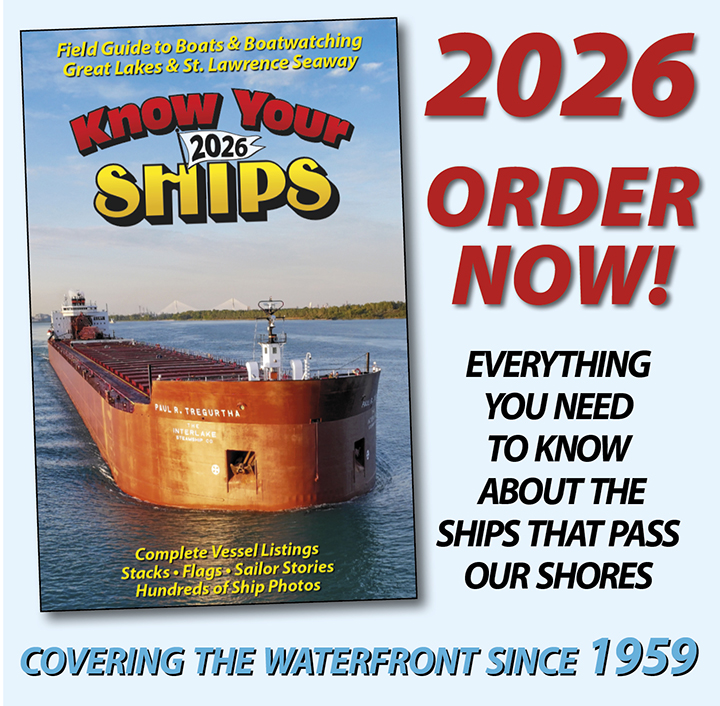
Know Your Ships expands crew, launches mid-summer edition

Know Your Ships, the annual field guide for boats and boat watching on the Great Lakes and St. Lawrence Seaway, is expanding its crew and its publication lineup.

“I have realized the captain needs a bigger crew, so please welcome aboard Sam Hankinson and Nick Stenstrup,” said Roger LeLievre, who has been editor and publisher of the book since 1994, following the death of founder Tom Manse.

“Sam and Nick have a deep passion for the ships and the people who make them go,” LeLievre added. “Nick brings experience in sales and marketing to the table. Sam is not only Port Development Coordinator at the Port of Monroe, MI, he is also a skilled writer and researcher. Since last year, both have been busy learning what they need to know about managing the behind-the-scenes details involved with the book and will now take a more active role in its publication.”

Nick found his love for Great Lakes shipping at a young age. He graduated from St. Scholastica in Duluth with a B.A. in Communication in 2020 (yes, he chose Scholastica because of the boats). He works in sales for Burnett Dairy in Wisconsin, but is a shipwatcher at heart. You can find him taking more boat photos with a film camera rather than digital, though he admits to having a drone.

"I got my first copy of Know Your Ships July 3, 2012 at the Two Harbors Lighthouse gift shop after watching the Roger Blough arrive,” Stenstrup said. “I wore that book out to the point where it was held together by tape before receiving a permanent spot on my KYS book shelf. I think back on that memory and feeling of excitement flipping through the book for the first time to now, working on the production of the book with people I consider my family. The book created a spark in me, and now I get to help create the same book that could someday create a spark for new shipping fans, the way it did for me. I'm very honored."

Sam grew up watching freighters in his hometown of Grand Haven, MI. He is a 2021 graduate of Central Michigan University. Currently he works at the Port of Monroe. In addition to his KYS responsibilities, he is secretary of Marine Historical Society of Detroit, serves on the board of boatnerd3.jasonbowlerdesign.com/, and writes the weekly Ship’s Log column in the Grand Haven Tribune.

“Know Your Ships has given me the gift of lifelong friends and family,” said Hankinson. “As part of this team, I look forward to creating a platform for our fans to share their stories and expose new fans to the legacy of Great Lakes shipping.”

Their arrival means Know Your Ships can now explore other areas, including a new EXTRA! edition coming out Sept 1. The EXTRA will offer even more ship and sailor stories, touch on industry-related subjects, provide a digest of recent shipping news and include many more of the stunning photos for which KYS has become known. This booklet, at 48 pages, is not meant to replace the regular Know Your Ships, but to complement it. “Think of it as an update to the main book, which comes out in March,” LeLievre said. Now folks won’t have to wait a whole year for more of the KYS stories and photos they love so much.”

Other KYS crew members, including Matt Miner, Jack Hurt, Brendan Falkowski, Isaac Pennock and advertising director Kathryn Lau will continue to be involved with Know Your Ships. If the EXTRA! proves successful, it will become an annual mid-summer publication in 2024.

There are more exciting things in the works for 2024, Know Your Ships’ 65th season, but those will be announced later. Consider yourself teased!

Pre-order it here and get free postage! Pre-order EXTRA here and get free postage to the U.S. and Canada! https://knowyourships.com/kys-extrapreorder.html?fbclid=IwAR1pqOKCeRuJtIwqXTEIGjPBQR0WR_b6EnGTEYM7trqWeUBM7mrBivFUCt4


Boatnerd News – July 9, 2023

St. Lawrence Seaway reaches tentative agreement with union

Cornwall, Ontario (June 30, 2023) – The St. Lawrence Seaway Management Corporation (SLSMC) announced today that it has reached a tentative agreement with UNIFOR locals 4211 and 4319 representing the Supervisory Group, as of June 30th, 2023.

The agreement is for a 4-year period, April 1, 2023 – March 31, 2027. A ratification vote will take place in the next few weeks. Further details will be made available at that time.

The SLSMC thanks all the parties for their commitment in bringing this process to a positive conclusion.

The St. Lawrence Seaway Management Corporation


Algoma Transport descends the Twin Flight Locks in the Welland Canal. Bill Salton Jr. (Thorold, ON – March 2023)

Boatnerd News – July 8, 2023

Great Lakes iron ore trade up 47.8 percent in June

CLEVELAND – Shipments of iron ore on the Great Lakes totaled 5.8 million tons in June, an increase of 47.8 percent from 2022.  Shipments were 12.7 percent above the month’s 5-year average.

Year-to-date the iron ore trade stands at 19.9 million tons, 44 percent below the previous year’s total of 13.8 million tons.  Iron shipments are above their 5-year average by 7.9 percent for the first half of the year.

Lake Carriers’ Association


Limestone trade down in June

CLEVELAND — Shipments of limestone on the Great Lakes totaled 3.1 million tons in June, a decrease of 17.6 percent from a year ago.  This June’s loadings were also below the month’s 5-year average by 17.4 percent.

Loadings out of U.S. quarries totaled 2.5 million tons, a decrease of 15.2 percent compared to last year.  Shipments from Canadian quarries totaled 610,702 tons, a decrease of 26.4 percent.

Year-to-date the Lakes limestone trade stands at nearly 8.1 million tons, a decrease of 16.9 percent compared to 2022.  Loadings from Michigan and Ohio quarries decreased by 15.8 percent from a year ago.  Shipments from Ontario quarries total 1.6 million tons, a decrease of 21.2 percent.

U.S. ports: Calcite, MI; Cedarville, MI; Drummond Island, MI; Marblehead, OH; Port Inland, MI; and Presque Isle, MI. Canadian ports: Bruce Mines, Manitoulin Island, Port Colborne (from August 2017 on) and Smelter Bay (all Ontario).

Lake Carriers’ Association


Obituary: Chief Engineer James Stitt

It is with deep sadness we announce the passing of James Royal Stitt of Kemble, Ontario, on July 5, 2023 at the age of 88. Born in Chapleau, Ontario, on March 12th 1935. Loving husband to Claire for 65 years. Survived by his children, Jim (Ene), Ken, Ron (Mary); his grandchildren Ellen, Lauren, Amanda, Bayley and Trevor; great granddaughter Isla; and many nieces and nephews.

James lived a life sailing on the Great Lakes, finishing his career as Chief Engineer on the ferry Chi-Cheemaun. His kindness, humor and stories will be missed by family, neighbors and life-long friends.

Jim was a remarkable character to every soul he encountered. He passed down strong values of work ethic, honesty, and togetherness to his family. He inspired each generation to strive for their best and did everything he could to provide a good life for his family.

His good friend, retired Captain Graham Grattan, offers these memories: “Before the 1970s Jim worked on the Q&O ships and may have been chief engineer with them. He worked for Cooper Bessemer diesel and for that reason, about 1975, he was hired by Algoma Steel Marine as shore engineer. Yankcanuck had a eight cylinder Cooper Bessemer diesel of 1860 hp.

When Capt. Leith Davis left Algoma Steel to oversee the expansion of his old employer HALCO, Jim Stitt moved into the position of Manager Algoma Steel Marine and Algoma Steel Marine Services (Algoma Steel’s stevedoring services).

In March 1977 he hired me as captain on Yankcanuck; this was over the concerns of senior Algoma Steel executives who couldn’t understand how he could hand over the ship to a 26-year-old when the previous captain was 62.

When Algoma Steel sold Yankcanuck in 1991 Jim was hired by Owen Sound Transportation as the alternate chief engineer on Chi-Cheemaun. Jim was again working with his old friend Leith Davis who was now manager at Owen Sound Transportation.

There were two captains for Chi-Cheemaun but only one chief and he was getting up in years. Jim ended his sailing career on Chi-Cheemaun. Of interest, in 1985 Jim agreed to help out his good friend Jack Purvis and bring Jack’s newly purchased tug Avenger IV from the U.K. to Canada. Jim would be ‘chief’ and he brought his son Jim along to help.”

Online condolences may be left at www.funeraloptions.ca.


Joseph L. Block unloads stone into the hopper at CN Dock 6. (Duluth, MN – May 4, 2008)

Boatnerd News – July 6, 2023

Slideshow: Great Lakes Maritime Academy shows off State Of Michigan

The training Ship State Of Michigan was docked at Sault Ste. Marie, Mich. in celebration of Engineers Day last Friday to educate visitors and draw interest to the Great Lakes Maritime Academy (GLMA) at Northwestern Michigan College in Traverse City, MI.

Cadet Jason Glass is a licensed third mate officer in charge of navicular duties and responsibilities aboard the training ship. He heard a call to the Great Lakes at a rather early age.

“My dad was a Great Lakes captain,” he said. “I grew up hearing all of his stories. Many of them came with a moral lesson, even if they were funny. I saw how being a captain shaped my dad’s character. When I got older, I decided to look for opportunities myself.”

GLMA is designed to prepare its students to operate commercial vessels as merchant marine officers who on the Great Lakes and oceans.

“My goal is to serve as a navigation officer on a Great Lakes commercial freighter,” Glass said. “I’m an Eagle Scout, and I have grown up learning about leadership. I see becoming the captain of a Great Lakes freighter as the pinnacle of my leadership career.”

According to the GLMA website, its deck officer program prepares students to operate commercial ships of unlimited tonnage on the Great Lakes and oceans as merchant marine officer. Deck officers manage deck department, as well as oversee the loading and discharging of cargo. They are responsible for the ship’s business operations. Deck Officer cadets must complete three sea project internships during their academic program. Deck officers may train to become pilots and crew mates.

Glass, who has already learned a lot in his time aboard the State Of Michigan, offered informative public tours on Friday.

“This ship used to be a ship owned by the US Navy,” he said. “It would hunt for submarines. Now, operated by GLMA as a ‘floating classroom.’ The instructors are all retired sailors who teach cadets about ship navigation, operations, and etiquette.”

The training ship’s crew consists of approximately 15 officers, two Instructors, and an average of 50 cadets. It was built in 1985 with a carrying capacity of 910 deadweight (DWT), overall length of 68.28 meters, and width of 13.11 meters.

Soo Leader


New Lock at Soo to host public meeting for blasting activities

The U.S. Army Corps of Engineers and the New Lock at the Soo contractor will host an in-person and virtual public meeting at 6 p.m. on July 10 to inform the public of blasting activities needed for project construction.

The Corps of Engineers, Detroit District, contracted Kokosing Alberici Traylor, LLC (KAT) to complete Phase 3 construction of the New Lock at the Soo. This work includes excavation and installation of a shaft and tunnel scheduled for this year, the Corps of Engineers said in a news release.

Marine traffic on the St. Marys River will not be allowed within 1,000 feet at the time of blast detonations for recreational boats, fishermen, swimmers, and general waterborne public. Red Flag Vessels, transporting bulk fuel or other hazardous materials, will not be allowed within 2,000 feet during blasts.

The Corps of Engineers said it did not anticipate blasting to be conducted on any Sundays at this time. “For 2023 blasting activities, the Corps of Engineers does not anticipate impacts to any public roadways or land areas outside of the Soo Locks facility,” Mick Awbrey, New Lock chief said.

“However, each blast will be evaluated to ensure the safety of the public. During blasting, guards will be posted at all access points to ensure no persons will be allowed within 300 feet of the blast radius.”

Marine traffic on the St. Marys River will not be allowed within 1,000 feet at the time of any blast detonations for recreational boats, fishermen, swimmers, and the “general waterborne public.” Red Flag Vessels, transporting bulk fuel or other hazardous materials, will not be allowed within 2,000 feet during blasts.

All exclusion zones are coordinated with the Soo Locks Lockmaster as well as the United States Coast Guard.

“Prior to blasting, an airhorn will be sounded five long times indicating that the blast will occur in five minutes. At one minute before a blast, an airhorn will be sounded five short times. Then the blast will be detonated.”

After the detonation the master blaster will confirm the completion of the blast and give the ‘all clear’ consisting of one long sound from an airhorn or siren.

“The New Lock at the Soo construction contract includes measures to monitor and control vibrations due to blasting,” Hal Harrington, Detroit District Biologist said.

“Two fish species use the tailrace area directly north of the blasting location for spawning – Atlantic Salmon and Lake Sturgeon. The vibration monitoring locations and limitations on peak particle vibrations for the contract have been restricted to account for these spawning areas. The contractor is required to design and control all blasts to meet a maximum PPV of 1 inch per second at both spawning locations. This limitation is specifically in place to prevent negative impacts to fish.”

The Corps of Engineers said the goal during New Lock at the Soo construction is to “minimize or eliminate negative impacts to the community and other affected parties”.

The safety measures being enacted to clear marine vessels within the affected areas will be applied immediately preceding and during blasts. Additionally, there will be no permanent explosive storage or overnight explosive storage on site at the Soo Locks facility, the release states, adding that, “The safety of all accessing the waterways is a priority”.

The public meeting will be held in the Superior Room of Lake Superior State University, 650 W. Easterday Ave., Sault Ste. Marie. The public meeting is scheduled from 6 to 7 p.m. Monday, July 10.

A slideshow presentation will be briefed by the Corps of Engineers as well as KAT’s blasting specialist, blasting consultant, and vibration specialist. The presentation slides will be made available after the public meeting at this link.

After the presentation, the public will have the opportunity to ask general questions about their concerns dealing with the blasting operations, “magnitude of seismic motion, airblast overpressure, and potential for flyrock debris.

Additional blasting activities in the chamber of the existing decommissioned Sabin Lock are scheduled for the 2024 spring-summer-fall construction season. These blasting activities will differ in scope and location from the shaft and tunnel blasting but will implement many of the same mitigating measures.

Soo Leader


Ship & Shore Days Allow Visitors to Explore Great Lakes History on Land and Water

Toledo, OH – The National Museum of the Great Lakes (NMGL) and The Sandpiper passenger tour boat are teaming up again to offer the “Ultimate Great Lakes History Day.”

This summer, on Saturday, July 8 and Saturday, August 12, a special ticket will be available combining full access to the National Museum of the Great Lakes and a trip along the Maumee River aboard The Sandpiper.“The Ship & Shore experience provides a way to explore Great Lakes history all day long,” says Ellen Kennedy, the museum’s spokesperson. “Guests receive full-day access to the National Museum of the Great Lakes including our museum’s world-class, family-friendly exhibits, a 617-foot iron ore freighter and a lake class tugboat—along with a mid-day trip aboard The Sandpiper departing and returning from the museum docks.”

While touring the Maumee River aboard The Sandpiper, visitors will have access to the award-winning Port of Toledo: Then and Now exhibit. This exhibit uses QR codes onboard the vessel to allow cruisers to interact with Great Lakes history along the Maumee River.

The codes provide additional images and information about the rich history behind various spots along the river’s banks—giving visitors the opportunity to visually compare and contrast the old Maumee River with the new.

It is recommended that tickets for “Ship & Shore: The Ultimate Great Lakes History Day” be purchased in advance at nmgl.org or by calling 419-214-5000. Day of tickets will only be available if space exists. For additional information please visit nmgl.org/event.

Boatnerd News – July 4, 2023

Overnight trips are back on the Badger

LUDINGTON, MI – The crew of the S.S. Badger is bringing back overnight voyages. Lake Michigan Carferry, which owns and operates the 70-year-old vessel on Lake Michigan, announced Monday that its overnight sailings known as doubles will return after a three-year absence on July 6.

The overnight sailings offer passengers a unique opportunity to travel and view the night sky, stars, and sunsets as a part of the route to their destination. The S.S. Badger travels between Ludington and Manitowoc, Wisconsin. It wisas the last coal-powered passenger steamer operating in the United States.

“We have seen a continued increase in traffic and demand for the additional crossing. Many passengers have expressed how much they missed being able to sail at night and we are ecstatic to service our passengers in this capacity again,” said Shelby Soberalski, Director of Marketing and Sales for Lake Michigan Carferry.

The overnight trips will continue through August 6, but will only be available on evenings Thursday through Sunday. In addition to the scheduled day crossings, a second trip will leave Ludington at 8:45 p.m. eastern time and depart Manitowoc at 1:30 a.m. central time.

On the 8:45 p.m. departure, passengers can expect the same amenities as they do during the day, such as Badger Bingo and dining and bar service.

Passengers with tickets for a day crossing who wish to change to an evening crossing can call 800-841-4243 to request a change at no additional fee.

Read more here: https://www.mlive.com/news/2023/07/historic-lake-michigan-car-ferry-bringing-back-overnight-sailings-with-views-of-sunset-night-sky.html?utm_campaign=mlivedotcom_sf&utm_medium=social&utm_source=facebook&fbclid=IwAR2OAFU6NmHzhD7bdIJKRvCNf77RbCbcIggRbrswANBXSEITF3ueCDJusko


Viking cruise ships pair science with adventure

ALPENA, MI – This is one radical partnership. Viking Octantis and Viking Polaris, named for the southern and northern stars, are touring the Great Lakes this year, with stops in Alpena and in various other ports along the way. These are a different kind of cruise ship, with multiple goals, including scientific research and education.

Last Wednesday, Viking Head of Science and Sustainability, Dr. Damon Stanwell-Smith, talked about the vision and purpose of Viking’s research, which aligns with its goal of providing an educational, unique Great Lakes cruise experience for its guests.

Viking is a Norwegian company owned by Torstein Hagen and his daughter, Karine Hagen. They wanted to create a different type of expedition-style cruise targeted toward the curious traveler seeking knowledge and adventure.

“The market we aim for is what we refer to as ‘the intellectually curious,’” Stanwell-Smith noted. “People who are interested in culture, and history, and geography, and destination, and place.”

He said over the past 25 years, the company has grown, and continues to grow and expand its offerings. The first Great Lakes cruise launched in May 2022, with a stop in Alpena. This summer, the two ships will take turns touring Alpena.

“We have over 100 ships,” Stanwell-Smith explained. “Most of them are river ships. We take a lot of Americans to Europe and around the world, on rivers. We have a fleet of ocean ships, they’re what is described as small ocean ships ­– they still have 900 guests on board.”

The Polaris and Octantis each carry 378 guests for the Great Lakes cruises, with 260 crew members. “A subset of that crew are a team of expedition specialists and scientists,” Stanwell-Smith said. “We also have two submarines on each ship, so we have a submarine team.”

While the guests are cruising, scientists are conducting research at the same time on the ship. “Four years ago, Viking decided that we should build expedition vessels,” Stanwell-Smith said. “But the market that we’re looking at is to do sincere, credible, rigorous science while guests are on board. So, we built, during the pandemic lockdown, two expedition ships.”

He said the partnership is mutually beneficial, not just to NOAA and Viking, but to advancing Great Lakes research at a faster pace while also providing an expedition-style cruise experience to guests, many of whom have never visited the Great Lakes.

“We are very well aligned,” Stanwell-Smith said. “We can mutually help one another. The vessels are great platforms for science.”

Read more here: https://www.thealpenanews.com/news/local-news/2023/06/viking-cruise-ships-pair-science-with-adventure/?fbclid=IwAR3aKI4KrvlOd0ziUXH0-44H5_UKtgNLgloSyuFSTKMElJEV4pp5-gt9MoQ


Obituary: Boatnerd George Robert Zock

Passed in peace at the age of 92. Predeceased by his parents Elsa (nee Cameron) and George Sr. Zock, brother William Zock, sisters Eleanor Moore and Audrey St. Pierre. Loving father of Tina Robitaille. He will be missed by his son-in-law Andrew Robitaille, grandchildren Connor Ball and Caleb Robitaille, nephew Gordon Zock (Kim), and Bill Peterkin (Tanis). Dad was forever on the road. He loved to travel all over Canada in the summer and enjoyed his winters in Texas. He had daily “meetings” with all his friends at McDonalds and enjoyed watching people coming and going. He loved big ships and belonged to a group called Boatnerds. He would frequently go on trips to Michigan to meet up with the other enthusiasts. He will be missed by his friends, especially Phil Nash, a fellow Boatnerd. Special thanks to all the wonderful staff at the Villa Care Centre. Their loving and exceptional care kept dad very happy and healthy for the last few years. There will be no funeral.

Boatnerd News – July 3, 2023

PRESS RELEASE: CSL Offers 2022 Corporate Sustainability Report

Thursday, June 29, 2023

We’re pleased to announce the release of our 2022 Corporate Sustainability Report. Published annually, the report highlights CSL’s achievements in key areas such as decarbonization, marine pollution prevention, employee well-being, community engagement, and corporate governance. 

“Our report aims to inform and empower our customers, employees, suppliers, and communities by openly sharing our actions in promoting a sustainable future for marine transportation and the world at large,” said Louis Martel, President and CEO. “Every year, we have steadily enhanced our report to align with what matters most to our stakeholders and with the highest reporting standards.”

Key Highlights from the 2022 Report

Environmental
  • 80% reduction in life-cycle emissions using B100 biofuel on eight vessels
  • 8% of the total energy consumed by our ships is renewable
  • 15% increase in recycling as a percentage of total waste on our ships
  • 90% reduction in plastic water bottle use in our Americas fleet
Social
  • 0.5 lost-time injury frequency rate
  • 47% of new hires at shore were women
  • 1% of net profit was donated to charity and disaster relief
  • Recognized as one of Canada’s Top Employers for Young People and of Montreal’s Top Employers
Governance
  • 100% of employees completed compliance training.

The 2022 Report provides transparent data-driven insights into CSL’s progress towards its sustainability goals and its alignment with the United Nations Sustainable Development Goals. Performance results are disclosed in an ESG scorecard against the Sustainability Accounting Standards Board (SASB) Marine Transportation Industry Standard.

“As CSL expands into exciting new horizons within the marine sector, our unwavering commitment to people and the environment will always remain at the core of our business,” Mr. Martel continued. “We will always prioritize decisions and practices that have a positive and meaningful impact on people and our planet.”

Click here to read or download the 2022 CSL Corporate Sustainability Report or click here to consult past reports.

Photo: Windsor Aerial Drone Photography

Boatnerd News – July 30, 2023

‘Boatnerds’ gather for freighters and frankfurters at the Soo Locks

Boat watchers gathered for the annual Boatnerd picnic at Sherman Park near the Soo Locks, a day before the U.S. Army Corps of Engineers’ annual Engineer’s Day.

Around 75 people attended the event, some coming from as far away as Utah. Great Lakes freighter enthusiasts bonded over hot dogs, brats and burgers.

“It’s all about the people we meet. The boats are great but the people…is the core reason why we are here. Plus the free food. That is what this weekend is all about, boats. Boats and people,” said Roger LeLievre, author of the Know Your Ships annual field guide.

The Boatnerds will attend Engineers Day on Friday before heading out for a boat-chasing cruise on a tour boat. LIsten to the story here: https://www.9and10news.com/2023/06/29/boatnerds-gather-for-freighters-and-frankfurters-at-the-soo-locks/

Boatnerd News – June 29, 2023

Mesabi Miner is home for experienced Great Lakes captain

GREAT LAKES—Captain Paul Berger Jr., of the Interlake Steamship Company, said he is “at home” this shipping season aboard the M/V Mesabi Miner—an iron ore freighter dedicated to the Men and Women of Minnesota’s Mesabi Iron Range.

In 2022 Berger captained the 639 foot M/V Mark W. Barker—the newest ship in the Interlake Steamship Company Fleet during its inaugural season.

“It’s a nice ship,” Berger said, but that he prefers the Mesabi Miner, a 1,004 foot freighter that he’d captained for four and a half years prior to last year.

Berger, of Ohio, started with the Interlake Steamship Company in 1997 and has captained in one form or another since 1985.

The Mesabi Miner has always been part of the Interlake Fleet and was built by the American Ship Building Company in Lorain Ohio, and christened in 1977. Its name is the original name given to the ship, according to information on the company’s website.

On June 8 the Mesabi Miner with its 29-person crew aboard pulled into the Duluth Harbor at 5:30 a.m. on its way to the CN Docks in Duluth to pick up a load of iron ore, and was met with onlookers as it pulled into the harbor that morning, Berger said.

As the Mesabi Miner made its way through the canal, Berger sounded off a salute consisting of one long and two short toots of the horn, which he said is typical unless it’s in the middle of the night when he refrains from blowing the signal.

In the case of master salute in honor of someone, or a special occasion, “it’s three long and two shorts,” Berger said.

Berger provided the Mesabi Tribune a behind-the-scenes look at the Mesabi Miner that day, with sunny skies overhead and little to no wind.

The tour started with a climb up a ladder on the exterior of the ship to an area on deck where the ore was being loaded into the cargo hold.

Berger noted that the hatches are each 6 feet tall are spaced 6 feet apart. The odd number hatches are loaded first, and “once they’re full, there are about 40,000 tons,” Berger explained, adding then the ship is turned around, and the odd numbered hatches are loaded and will hold about 18,000 tons.

While walking on the deck of the ship, Berger said he captained the Mesabi Miner since 2017 consistently up until last year, and had also captained its sister ship the James R. Barker. Even though the two ships were designed to be identical, he said they handle differently.

Once the Mesabi Miner is full of ore, Berger said it holds roughly 55,000 long tons, or 62,000 short tons of ore.

The Mesabi Miner also carries coal on occasion, Berger said.

Berger pointed out the lines for the self-unloading system on the Mesabi Miner that includes a 265-foot boom, and three conveyor belts that run the entire length of the ship.

“It’s an ingenious design, and works well” Berger said.

Prior to this current system, Berger said chains and buckets were used for unloading.

“It’s a vast improvement,” he said.

Berger noted there is one maintenance engineer dedicated to the loading system, ensuring that there are no rollers clanking, or other issues.

Should there be a problem, he said other deckhands are available to help the engineer change rollers and perform other maintenance.

Berger said he and his crew take pride in their ship, and there’s typically daily maintenance they perform. They are also in the process of freshening up the deck with a new coat of paint, a project that is in its second year due to the size of the vessel.

The seasoned captain downplayed the skill and attention to detail required to maneuver the 1,004 foot ship, while giving a tour of the wheelhouse.

“It’s just like operating a 22 foot fishing boat,” Berger said as he showed the controls he uses to steer the ship.

The Mesabi Miner is equipped with state-of-the-art technology, but when it comes to navigation, Berger prefers “old school” paper maps when charting out a course. The new paper maps continue to be updated with stickers issued for each update, and a meticulous record keeping system that documents each change made in a bound book.

In the massive control room in the center of the ship, Berger showed where five engineers, the Chief, First Assistant, a second assistant and two third assistants operate the controls. The First Assistant is a day worker, he noted.

The control room engineers start up the engine, and get the propeller running until the captain gives his signal that he is ready, Berger explained.

Once he’s ready, the captain gives the signal and with a push of a button, takes over in the wheelhouse.

Berger talked about the importance of water levels in the ship. While still filling with cargo, the ship retains water so it’s not sitting too high at the loading dock, he explained.

At a check of the controls during the tour, the ship had 12 feet of water.

While traveling empty Berger said the Mesabi Miner typically has 40 feet of ballast water in each of its 18 tanks, and it travels at about 105 RPM’s.

With a lighter ballast, he said the speed would increase, but there tends to be rattling and vibration, which can cause things to break. With 40 feet of ballast water in the tanks, it also conserves fuel, which in turn saves on costs at roughly 12,000 gallons of fuel per day on a 380-mile run, he noted.

Berger said the safety and health of his crew are essential.

The open bow lifeboat currently on the deck, he said, is being replaced with 40-person capacity fast rescue boat, which is enclosed providing essential protection from the elements in rough seas, and only requires one person to launch.

“It’s a much better system,” Berger said as he told how every moment counts in an emergency situation, especially in the icy, fresh water Great Lakes.

In the cold weather the crew de-ices the deck, scattering sand that is mixed with some water and then also salt, Berger said.

A workout space on the ship, complete with a treadmill, elliptical, rowing machine, etc. is set up in a space originally designed as a visitor’s lounge, and offers the crew an area to work out with a view of the outside weather.

Once loaded with ore in Duluth, it takes the Mesabi Miner roughly 2.5 days on a route across Lake Superior, a section of Lake Michigan, onto the St. Mary’s River on its way to the Indiana Harbor steel making facility in East Chicago, Indiana.

Berger said he pays close attention to the wind conditions when determining whether to ship out.

“If it’s under 25, I don’t worry,” Berger said, adding if wind conditions are mid to upper 30 miles per hour sustained, he waits for more favorable conditions before departing.

Captain Paul Berger is an Ohio native and graduate of the Massachusetts Maritime academy.

Prior to being hired to the Interlake Steamship Company in 1997, he has captained in one form or another since 1985 and began his shipping career on the ferry boats servicing Lake Erie.

Inspired by his uncle who was a ferry captain and wheelman for Bethlehem Steel, Berger spent time on the ferry boats with his uncle.

“He pretty much got me involved in it, got the passion going for it,” Berger said in an earlier interview. “I was actually steering the ferries by the time I was five years old and making the dock with him by the time I was 10.”

A highlight of Berger’s career was when on a trip into Sandusky, Ohio, his uncle was able to witness him captaining the Herbert C. Jackson from the city pier.

Mesabi Tribune


Coast Guard warns smaller boats to steer clear of big ships on Detroit River

(WXYZ) — During the warmer weather, the Detroit River transforms into the go-to spot for fishermen, recreational vessels, the usual freighters, and cruise ships resulting in a lot of traffic. That may sound good, but it comes with a huge challenge because everyone is fighting to use the same small body of water safely and freely.

The Detroit River only runs 28 miles long and serves as the international border between Canada and the United States. It is also one of the busiest waterways in the world.

From freighters to cruise ships and little fishing boats, many vessels that maneuver on the river for the most part tend to be between 0.5 and 2 miles wide.

“But with the summertime coming up, obviously, the boating public is a lot heavier now. And so we are trying to get out there, educate and keep everyone safe,” said U.S. Coast Guard’s Senior Chief Casey McDonugh.

McDonugh says one of the biggest concerns is when fishermen and recreational boats come too close to bigger ships.

This fishing season, the U.S. Coast Guard addressed 400 marine alerts that include vessels coming in close proximity to each other. This time last year, that number was 46.

Captain George Haynes has been navigating these waters for 37 years, and says there have been times he has come across several heart stopping close calls. Over the years, he says it’s only gotten worse.

“Everybody has the right to enjoy the waterways. Big ships can only navigate in certain parts of the channel cause they are loaded deep, and they can’t maneuver as well. So recreational boaters, as much as they want to enjoy it they still have to move,” Captain Haynes said.

He added that people should be aware of where they are.

“If you are inside the channel, that boat can only safely navigate inside the channel. So if you hear the 5 short blasts … obviously, that’s them telling you we need you to move,” said Captain Haynes.

To identify the channel is simple. Along the Detroit River, you will see red and green buoys and anytime you are operating between the buoys that means you are inside the channel.

“Another thing they can do is never converge on the path of a vessel. We may be watching them, that makes us nervous because we don’t know if they are paying attention to us, especially at night,” said Captain Haynes.

But since every story has two sides, we met up with a proud Detroiter, Captain Eric Zwierzchowski, also known as Captain Z, who has been fishing in these waters for over 35 years. An art he learned from his dad.

“In the Springtime, you get a walleye migration of an estimated of about 11 million. It’s their spawning habitat and that is why everyone from around the country comes here. That makes matters worse,” Captain Zwierzchowski said.

Captain Zwierzchowski says fishermen unfamiliar with the area may need more knowledge or experience to operate on the river.

“The way it always works for me is, I catch a fish as the freighter is coming closer and closer, so I’m doing a couple of things, I cant get to my motor right away, I got to bring up 3 lines, if there are multiple people there are multiple lines, so it’s not exactly easy, but again I see both sides of the story,” he said.

But then again, why be in their path in the first place?

“Well, that’s where the fish are. As for the law, big vessels like freighters, cruise and naval ships have the right of way. And obstructing their paths may result in fines,” said Captain Zwierzchowski.

Now remember, safety comes first, and the best way to be safe is to be aware of all the rules and regulations. So anytime you come to the river make sure you learn all the dos and don’ts.

WXYZ Detroit


How healthy is Lake Ontario? EPA wants to know more

NIAGARA COUNTY (WIVB) — We’ve seen it look blue, green, brown and all sorts of colors in between. But what’s going on below the surface? The United States and Canada are working together to protect Lake Ontario and learn more about the potential threats it faces.

As part of the 2023 Cooperative Science and Monitoring Initiative (CSMI), the Environmental Protection Agency (EPA) has been utilizing two research vessels as to collect data on the lake, in order to properly address issues of nutrient pollution, chemical contaminants, habitats and invasive species.

“Our action to collect this data on Lake Ontario will help us identify the most pressing challenges and opportunities and further support our efforts to protect and restore this great lake for current and future generations,” Regional Administrator Lisa Garcia said.

The two vessels, Lake Guardian and Lake Explorer II, are being funded by the Great Lakes Restoration Initiative (GLRI).

“Since 2010, the multi-agency GLRI has provided funding to 16 federal organizations to strategically target the biggest threats to the Great Lakes ecosystem and to accelerate progress toward achieving long-term goals,” the GLRI’s website says.

According to the binational State of the Great Lakes 2022 Report, things haven’t been looking bad, with the immense body of water being assessed as “fair” and “unchanging to improving.”

Boatnerd News – June 28, 2023

Mayflies swarm Great Lakes freighter as they begin showing up in metro Detroit

It’s officially Mayfly season. A photo posted by the Interlake Steamship Company shows mayflies swarming a freighter in Toledo.

It happened on the M/V Hon. James L. Oberstar in Toledo, according to the post.

Mayflies have a brief adult life, according to Michigan State University, but will lay 4,000 to 8,000 eggs on the water’s surface. Those eggs drop to the bottom of the water where they hatch into larvae called naiads.

MSU said the naiads will live underwater for a year or two, and then become wingless in their final immature life stage called subimago. Those subimagos fly toward the shore and within 24 hours, morph into an adult.

Mayfly hatches occur in June or July, but mayflies only thrive in lakes and rivers with good water quality, meaning seeing them is a good thing.

WXYZ Detroit


Great Lakes Seaway Announces Port Winners of 2022 Season “Pacesetter Award”

WASHINGTON – The U.S. Great Lakes St. Lawrence Seaway Development Corporation (GLS) announced today that nine U.S. ports in the Great Lakes St. Lawrence Seaway System received its Robert J. Lewis Pacesetter Award for recording increases in international cargo tonnage shipped through their ports during the 2022 navigation season.

“Every year, more than 36 million metric tons of cargo pass through the St. Lawrence Seaway, supporting nearly a quarter of a million jobs and made possible by ports throughout the Great Lakes region,” said U.S. Transportation Secretary Pete Buttigieg. “We are proud to announce this year’s winners of the Robert J. Lewis Pacesetter Award, which honors Great Lakes ports that have made significant strides in moving goods through the supply chain so they can reach the communities that need them.”

More than 237,000 jobs and $35 billion in economic activity are supported annually by the movement of cargoes on the Great Lakes St. Lawrence Seaway System. The nine ports earning the Robert J. Lewis Pacesetter Award for 2022 are: Port of Buffalo (N.Y.); Port of Chicago (Ill.); Port of Cleveland (Ohio); Port of Manitowoc, (Wis.); Port Milwaukee (Wis.); Port of Monroe (Mich.); Port of Oswego (N.Y.); Ogdensburg Bridge and Port Authority (N.Y.); and Toledo-Lucas County Port Authority (Ohio).

“Congratulations to the nine Great Lakes/Seaway ports being recognized as GLS Pacesetter Award recipients for their achievements during the 2022 Seaway navigation season,” said GLS Administrator Adam Tindall-Schlicht. “The sustained level of high performance is a testament not only to the Seaway System’s importance as a maritime supply chain, but also to the hard work and resiliency of the dedicated men and women throughout the Great Lakes/Seaway port community.”

The Robert J. Lewis Pacesetter Award was established in 1992 to recognize the achievements of U.S. ports whose activities result in increasing international tonnage shipped through the St. Lawrence Seaway, excluding Canada, in comparison with the previous year. The Pacesetter Award name was officially changed in 2001 to posthumously honor the noteworthy career of former GLS Logistics Director Robert J. Lewis, who was instrumental in developing and implementing the GLS’s trade development program.

U.S. Department of Transportation


Mayflies swarm the deck of Hon. James L. Oberstar. Interlake Steamship Company (Toledo, OH – June)

Jump to a Date:

Archives