Boatnerd News

Boatnerd News – February 26, 2023

Great Lakes record low ice coverage; warmer than average winter

A decline of ice cover on the five Great Lakes is becoming a normal occurrence over the years. NOAA has been documenting this since 1973.

Studies showed between 1973 and 2017, there has been a significant drop in average ice cover during the winter months from Dec. 1 through April 30. The decline is approximately 70%.

This winter, up to Feb. 13, 2023, there is only 7% ice coverage on the Great Lakes. This marks an all-time record low amount!

Around this time of year, the Great Lakes should have 35% to 40% ice coverage. A warmer than average winter season is one of the reasons why ice has not been able for stay and form over the bodies of water.

On average, maximum ice coverage occurs from mid-February through early March. Warming effects caused by humans is only one factor in the equation of ice loss. Others include “long-term patterns of climate variability over the Pacific and Atlantic oceans,” according to NASA.

Speaking of warming, check out the temperatures in December, January, and February this winter season in Milwaukee. Unseasonably warm temperatures are a factor showing why ice cover isn’t as high this season.

Extended forecasts are hinting at additional days above average mixed with some below average days wrapping up the end of the month.

– FOX6 News Milwaukee (February 24, 2023)


Obituary: Capt. Robert J. Libby Jr.

Robert J. Libby Jr., 90, of French River, MN, died Monday, January 30, 2023 at Waterview Shores in Two Harbors.

On June 11, 1950, he signed on the Interlake Steamship Co. bulk freighter Jay C. Morse as an ordinary seaman/deckhand. Little did he realize this would start a maritime career spanning 42 years. In 1958 he received his unlimited tonnage 1st Class Pilot license. He sailed for many of Great Lakes steamship companies including, Republic Steel Lake Fleet, Reiss S.S. Co., Cleveland Cliffs, Medusa, and Columbia before retiring in 1992 as master of the S.S. Charles M. Beeghly, Interlake S.S. Co.

In February 1952 he enlisted in the US Navy, serving during the Korean War as QMSN aboard the USS Andromeda, aka 15, in the West Pacific area: Korea, Japan, China. In April 1954 Bob returned to the States to attend submarine school in New London, CT. Upon graduation, he was assigned to the USS Batfish 310 Squadron in Key West, FL where he completed his enlistment and was honorably discharged on February 26, 1956 as QM2SS.

Bob was born April 15, 1932 to Robert J. and Florence (Swanson) Libby at Miners Hospital in Crosby. Growing up on the north shore of Serpent Lake, he attended Franklin Elementary School and graduated in the Class of 1950 from Crosby-Ironton High School. In 1952 he married his high school sweetheart, Naomi Ringhand, and in 1959 they purchased land in the French River area on the North Shore of Lake Superior. They built their home in 1960 and filled it with 5 children.

He was a Life Member of the VFW Post 132 Duluth, American Legion Post 557 Deerwood, U.S. Submarine Veterans, Lake Superior Base- Duluth, Korean War Veteran’s Assoc., 60 year member of French River Lutheran Church, where he served on the church council, International Shipmaster Assoc- Twin Ports Lodge 12, serving as Chaplain for over a decade, Pequaywan Area Trailblazers snowmobile club where he served terms as trustee, the St. Louis County Historical Society, Great Lakes Historical Society, American Truck Historical Society, and taught snowmobile safety courses for over a decade in the French River area.

In lieu of flowers, memorials are preferred to the French River Lutheran Church or the Seafarers Ministry, 2024 W 3rd St, Duluth, 55806.

The Great Lakes aren’t quite as frosty this season. FOX6 News Milwaukee image, February 24

Boatnerd News – February 25, 2023

Soo Locks Engineers Day is June 30

The U.S. Army Corps of Engineers in conjunction with the City of Sault Ste. Marie, the Sault Ste. Marie Convention & Visitors Bureau, the United States Coast Guard, the Lake Superior State University Center for Freshwater Research and Education and the Craft Show are planning the 2023 Soo Locks Engineers Day for June 30.

Visitors are welcome into the Soo Locks facility and across the MacArthur Lock 9 a.m. to 3:30 p.m., Friday, June 30. Visitors will not be able to cross the Poe Lock this year due to ongoing New Lock at the Soo construction. Visitors will be able to tour the first floor of the Administration Building and gates at the east and west ends of the MacArthur lock will be open for access.

The MacArthur Lock gate at the east end (downstream) of the facility will be available for visitors to enter, the MacArthur Lock gate at the west end (upstream) of the facility will be available for visitors exiting. Exceptions will be made for those with difficulty walking the distance of the lock.

The City of Sault Ste. Marie is closing a portion of Portage Avenue to focus on downtown city merchants and vendors. Downtown Portage Avenue will close to vehicle traffic and open for pedestrians and vendors from Ferris Street to Osborn Boulevard from 6 a.m. to 6 p.m., June 30.

Along with allowing visitors into the Soo Locks facility, several other events will take place:
• United States Coast Guard open house from 9 a.m. to 4 p.m.
• Craft Show at the City Hall grounds from 10 a.m. to 5 p.m.
• Lake Superior State University Center for Freshwater Research and Education will be open from 10 a.m. to 4 p.m.To register to be a vendor (no-cost) on Portage Avenue, please contact the Sault Area Convention and Visitors Bureau at 906.632.3366, admin@saultstemarie.com

– City of Sault Ste. Marie (February 24, 2023)

Join the crowd on June 30, 2023! City of Sault Ste. Marie image, n.d.

Boatnerd News – February 24, 2023

Interested in learning how to sail a 19th century tall ship?

SOUTH HAVEN, MI — For anyone who has ever dreamed of what it would have been like to navigate the Great Lakes on a tall ship in the age of sail, the Michigan Maritime Museum is offering a special training.

Registration is now open for the museum’s 2023 basic seamanship training, which will take place over the weekends of April 22-23 and May 20-21 in South Haven.

The training is free with museum membership and participants who complete both weekends are eligible to join the crew of the museum’s own tall ship, “Friends Good Will,” a news release from the museum states.

Whether a seasoned sailor or a complete novice, the basic seamanship training will prepare participants for sailing aboard a replica Great Lakes tall ship. The training consists of both classroom and on-water instruction aboard Friends Good Will.

The museum-owned ship is a replica of a square topsail sloop built in 1811 for a Detroit merchant, which was captured by both British and American forces during the War of 1812, the release states.

Volunteers who have taken the seaman training can choose to sail on the ship as often as they’d like from the end of May through September. A limited number of staff crew positions are also available; completion of the basic seamanship training course is required for those positions as well.

“The skill-building, the camaraderie, it’s a total package that lets our volunteers learn something new while having a great time,” said Capt. Bob Harnish, commander of the fleet. “It’s amazing how many people we have had over the years that never dreamed they would be doing this and love it!”

Basic seamanship training is free to participants but museum membership is required and space is limited. To register, please contact Harnish at captain@mimaritime.org or call 269-637-8078, ext. 105.

Training will take place April 22-23 and May 20-21 at 260 Dyckman Ave., South Haven. Participants must be able to attend both weekends. For more information on memberships, which start at $25 for seniors and $30 for adults, michiganmaritimemuseum.org/get-involved/membership/.

For more information about Friends Good Will, click here.

– MLive (February 21, 2023)


More than 36 million metric tons transited system in 2022

More than 36 million metric tons (mmt) of cargo transited the Great Lakes/St. Lawrence Seaway System during the 2022 navigation season, according to the St. Lawrence Seaway Management Corporation (SLSMC) and the Great Lakes St. Lawrence Seaway Development Corporation (GLS). The total is down 5.03 percent compared to 2021. Several obstacles, including continued disruptions in the global supply chain and the ongoing war in Ukraine, contributed to the decrease.  

General cargo saw the steepest decline at 21.5 percent. Iron ore decreased 9.6 percent, while coal cargo fell 6.9 percent. Grain shipments were also down due to the 2021 drought that affected western Canadian farmers.  

Overall, dry bulk was the leading commodity of the season, with 11.70 million metric tons, a 2.84 percent increase over 2021. Liquid bulk, including refined petroleum products, increased 9.85 percent over last year, with 3.55 million metric tons. General cargo shipments, which rose 72.98 percent in 2021, fell off 21.52 percent this past season. Iron ore, coal and grain shipments were also down in 2022. 

“Seaway traffic results show positive trends amongst certain commodities, which demonstrates our system’s ability to quickly adapt to changes in the market,” said Terence Bowles, president and CEO of the SLSMC. “It’s this agility that enables the Seaway to respond to changes and act on emerging opportunities, such as shifting trade patterns resulting from global events. In addition, we are working closely with partners to develop lands along the Seaway, which will benefit both the economy and local communities.” 

Adam Tindall-Schlicht, administrator of the GLS, said the Great Lakes can handle upheavals in the global supply chain thanks to decades of investment and reliability. “The Seaway System is a leading example of a worldwide economically resilient and environmentally sustainable shipping corridor, and optimism is high for expansion of trade on the Great Lakes in 2023,” he said. 

The last commercial transit of the 2022 navigation season through the Montreal-Lake Ontario (MLO) section of the Seaway occurred on January 1. Commercial traffic ceased on January 9 at the Welland Canal and January 15 at the Soo Locks. 

Highlights from the Season 

Despite the decrease in some cargoes in 2022, the navigation season did experience several highlights: 

  • U.S. and Canadian producers helped mitigate global issues affecting fertilizer supplies, which drove significant growth in potash, up over 100 percent compared to 2021.  
  • Dry bulk commodities, including coke, salt and potash, contributed over 11 million metric tons of the 2022 total.  
  • Petroleum products were up nearly 28 percent over last year, due to increased passenger travel.  
  • U.S. grain exports increased, and although month-over-month Canadian grain performed well, it did not match last year’s results. The effects of the 2021 drought in the Canadian prairies impacted export movements at the beginning of the 2022 season. That said, the improved 2022 grain harvest is expected to result in a strong start for 2023.  
  • An increase of vessel transits, including expanded cruise ship activity in the Great Lakes helped contribute to tourism and economic development in Canada and the United States. 

Planning for the Future 

While there is some uncertainty about economic growth in 2023, the SLSMC and GLS plan to work on key initiatives to further support expanding trade on the Great Lakes. These include facilitating the establishment of green shipping corridors, expanding land development along SLSMC-owned canals and developing innovative technologies, such as the Vessel Information System. 

– Great Lakes Seaway Review (January 27, 2023)

Friends Good Will approaches the South Haven, MI, piers on a summer afternoon. Garret Ellison image, July 23, 2022

Boatnerd News – February 23, 2023

It’s the end of an era for the Kinnickinnic Grain Elevator

On Jan. 23, JOHN J. BOLAND arrived light at Milwaukee and headed up the Kinnickinnic River to COFCO. All grain (soybeans) remaining in the elevator was loaded onto the BOLAND and taken to COFCO’s Chicago terminal. COFCO then closed the Kinnickinnic elevator and sold the property.

This move comes as no surprise. Operating a museum of mechanical engineering is expensive. There is barely enough grain traffic out of Milwaukee to support a single facility. And the century-old Kinnickinnic elevator could not compete with the new Agricultural Export Facility, financed primarily by taxpayer dollars, scheduled to open later this year.

Built by the Chicago & North Western Railway, the Kinnickinnic elevator, which stands near the mouth of the Kinnickinnic River, began accepting grain in fall 1916.

This original section included a workhouse and 72 circular concrete bins (six rows of 12), each 15 feet in diameter and 90 feet high. Its storage capacity was 1.5 million bushels.

When the Kinnickinnic elevator opened in 1916, grain arrived almost exclusively by rail in 40-foot boxcars. These could typically carry between 1,500 and 2,000 bushels. Today grain is transported by rail in covered hoppers capable of carrying 3,500 bushels. Modern grain trucks can usually haul about 1,000 bushels.

Updike Grain of Omaha operated the facility until 1921 when Donahue-Stratton, a Milwaukee grain dealer, acquired Updike’s lease. Donahue-Stratton would become Stratton Grain in 1935.

An annex was completed in 1930 just north of the existing structure. 48 concrete tanks (four rows of twelve) were added, each 25 feet in diameter and 90 feet high. This increased capacity to 3.5 million bushels. New railcar handling equipment allowed a 40-foot boxcar, which typically carried about 1,500 bushels of grain, to be unloaded in six minutes.

In 1938, officials at Stratton Grain would declare the Kinnickinnic elevator to be one of the fastest at handling grain in the United States. They claimed 700,000 bushels could be spouted into boats in an eight-hour day. That equates to a rate of 87,500 bushels per hour. By comparison, Milwaukee’s new Agricultural Export Facility will load 40,000 bushels per hour.

The next major improvement was the installation of a marine leg in 1940. This device extracts grain from vessels and could unload 15,000 bushels per hour. The Kinnickinnic elevator was now able to handle incoming shipments by water. In its first test, 250,000 bushels of wheat originating in Duluth bound for Chicago was transferred from water to rail at the Kinnickinnic elevator.

Lake-rail shipping costs were competitive with those of an all water route to Chicago. In future years, the elevator would receive a substantial amount of Canadian malting barley for Milwaukee’s brewing industry.

In 1960, New York based Continental Grain replaced Stratton as operator. By then more grain was arriving by truck, so Continental invested in a “new high speed truck dump” that could empty ten trucks per hour. This would not be enough. In 1979, a second dump was added that allowed the Kinnickinnic elevator to handle up to 30 trucks per hour.

Milwaukee received an interesting offer in early 1970. The Chicago & North Western would sell the Kinnickinnic elevator to the city for one dollar. It was the only elevator in Milwaukee accessible to oceangoing vessels and had handled 217,000 tons of grain in 1969.

According to Port Director John Seefeldt: “Unless something is done, the elevator will close.” City leaders did not accept this offer. Continental would ultimately acquire the property and keep it open.

By 1979, the Kinnickinnic elevator’s loading rate had been downgraded to 30,000 bushels per hour when loading vessels, and its storage capacity was now listed as 3.1 million bushels. The elevator would typically operate 24 hours a day for a month at the beginning of the shipping season, and then again for a month during fall harvest. Other times, it was generally open eight hours per day.

Minneapolis based food giant Cargill acquired Continental’s commodity marketing business in 1999. (NOTE: From 1958 to 1989, Cargill owned and operated Elevator E built by the Milwaukee Road along the South Menomonee ship canal. Because this channel was narrow and shallow, larger oceangoing vessels could not access the Cargill elevator.)

Concerned with market concentration, the Justice Department approved the deal only after Cargill agreed not to buy several facilities, including Continental’s Milwaukee terminal.

So in late 1999, the Kinnickinnic elevator was sold to Chicago & Illinois River Marketing, a subsidiary of Dutch grain trader Nidera.

The last inbound cargo received by water at the Kinnickinnic elevator was 14,097 metric tons of barley from Asnaes, Denmark. It came to Milwaukee in late October 2014 aboard Polsteam’s SKAWA. Because the elevator’s marine leg was no longer working, SKAWA tied up south of the elevator. Barley was then scooped out using clamshell buckets attached to her onboard cranes, dropped into trucks, and then hauled about 800 feet to the elevator. This was a time consuming project requiring over 400 truck trips from vessel to elevator (load limits did not apply).

The Kinnickinnic elevator became known as the COFCO elevator after the China Oil and Foodstuffs Corporation completed its takeover of Nidera in 2017. COFCO Group is China’s largest food processor, manufacturer, and trader. It is a state-owned enterprise based in Beijing. In January 2023, COFCO closed the elevator and sold the 10-acre parcel to Ozinga, a concrete supplier, for a reported $4 million. No plans for the property have been announced, but it no longer will be used to handle grain.

On Tuesday, a Port Milwaukee spokesman said, “The Port is looking forward to the future of this property in Milwaukee Harbor becoming fully realized. The Port is also looking forward to the export of agricultural products continuing on Jones Island with the opening of The DeLong Company’s Agricultural Maritime Export Facility later this year.

“Thanks to a robust public-private partnership, the DeLong development is the largest one-time investment in Port Milwaukee since the 1950s that will create jobs, support Wisconsin’s agriculture industry, and grow the regional economy.”

– OnMilwaukee (February 21, 2023)


Great Lakes Seaway reports increased grain movement

The Administrator for the Great Lakes St. Lawrence Seaway says the trade route is becoming more important to the agricultural industry as exports increase.

“U.S. and Canadian Great Lakes ports are eager, hungry, ready, and capable to support increased export of agricultural goods.”

Adam Tindall-Schlicht tells Brownfield the war in Ukraine and drought conditions on the Mississippi River system were likely factors behind increased movement in 2022.

“U.S. grain exports have been one of the success stories of Great Lakes trade last year, we saw a four percent year over year increase in the amount of tonnage that was exported,” he shares.

He says an incentive partnership with Soybean Transportation Coalition, which offers a 50 percent reduction on shipping tolls for new shipments of soybeans and ag freight, has also helped move more goods

Tindall-Schlicht says he’s impressed by the amount of investment ports are making into agricultural commodity handling.

“Toledo; Cleveland; Duluth, Minnesota; Oswego, New York; Monroe, Michigan; Milwaukee, Wisconsin—these are some of the places and Great Lakes ports that are making investments now to help sustain really robust agricultural activity,” he says.

The Seaway will open to international traffic March 22 and Tindall-Schlicht expects an even more robust year in 2023.

– Brownfield Ag News (February 17, 2023)

John J. Boland loads the last cargo from COFCO’s Kinnickinnic elevator in Milwaukee, WI. MKE Marine Reports image, January 24

Boatnerd News – February 21, 2023

Cleveland-Cliffs to restart Northshore Mining in April

It’s the news that Northshore Mining has been waiting to hear. Cleveland-Cliffs has told area lawmakers that they plan on restarting the mine in Babbitt and the plant in Silver Bay in early April.

The operation has been idle since last May, putting over 450 people on layoff.

The mayor of Silver Bay, Wade LeBlanc, said they couldn’t ask for better news.

“I’m encouraged that Cleveland-Cliffs is beginning the process to reopen their facilities in Babbitt and Silver Bay,” said Sen. Hauschild. “In recent months, I’ve held several meetings with Cleveland-Cliffs to discuss the importance of reopening these plants as soon as possible. These mines and jobs are critical to our regional economy. I heard from numerous miners who were impacted by this closure who said they wanted to get back to work. While we were able to get them a bridge in unemployment insurance benefits until April with my recent bill, my primary goal has always been to reopen these two plants. I’m glad to say that we’re one step closer to making that happen.”

Earlier this year, the Legislature passed a bill authored by Sens. Grant Hauschild, Jen McEwen, Rob Farnsworth, Justin Eichorn, and Kari Dziedzic and Reps. Dave Lislegard, Roger Skraba, and Spencer Igo which extended unemployment insurance benefits for miners who had been laid off. Reps. Dan Wolgamott, Emma Greenman, Cedrick Frazier, Jeff Brand, Ben Davis, Brad Tabke, and Melissa Hortman also signed on.

Sen. Hauschild said this bill went a long way in helping those workers, but he stayed focused on the ultimate goal of supporting Cleveland-Cliffs’ efforts to reopen their mining operations.

– WDIO (February 20, 2023)


Furetank and Algoma Central Corporation extend joint venture through tanker acquisition with Larsson Shipping

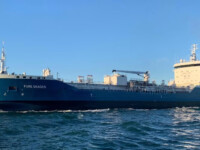
The Furetank/Algoma joint venture FureBear, together with Larsson Shipping, takes over the ownership of Algoma’s product tanker Algonorth. It has arrived from Canada to trade in Northern Europe under the new name Fure Skagen.

– We are strengthening our collaboration with Algoma, with a high standard vessel of its generation. The addition of Fure Skagen will improve the services we can offer our customers and give us a well-timed overlap while waiting for the new Vinga series vessels to arrive from the shipyard in China in the coming years, says Lars Höglund, CEO of Furetank.

Fure Skagen is a 16,958 dwt double hull product oil tanker built in 2008. Her twelve epoxy coated cargo tank capacity is 19,594 cubic metres. Her ice class and super strip system makes her well designed for the intense Northern European trade.

– This is another example of how great partnerships lead to further collaborations that optimize organizational strength and enable us to deploy assets to the best and highest use for our customers. We look forward to having Fure Skagen joined by eight newbuilds, to be owned by FureBear, with the first vessel expected to be delivered later this year, says Gregg Ruhl, President and CEO of Algoma Central Corporation.

Furetank’s customers have previous experience with Fure Skagen, as Algoma acquired the vessel from Furetank’s Gothia Tanker Alliance partner Rederi AB Älvtank in 2018.

Fure Skagen will be flying the Faroe Island flag and is owned by FureBear and Larsson Shipping. She will be commercially managed by Furetank Chartering in the Gothia Tanker Alliance.

– Furetank (February 20, 2023)

#gallery-1 { margin: auto; } #gallery-1 .gallery-item { float: left; margin-top: 10px; text-align: center; width: 33%; } #gallery-1 img { border: 2px solid #cfcfcf; } #gallery-1 .gallery-caption { margin-left: 0; } /* see gallery_shortcode() in wp-includes/media.php */

Boatnerd News – February 19, 2023

The CSL Group and Algoma Central Corporation order a new generation of Kamsarmax-based ocean belt self-unloading ships

The CSL Group and Algoma Central Corporation, who together form the CSL International Pool, today announced a newbuild order with Jiangsu Yangzi-Mitsui Shipbuilding Co., Ltd., to construct four new methanol-ready Kamsarmax-based ocean belt self-unloading vessels. These new ships will replace the Pool’s oldest vessels and become the model for its next generation of ocean self-unloaders.
Two of the four jointly designed, 72,250 DWT newbuild ships have been ordered by Algoma and the two others by CSL. The commercial partners have an option to build an additional two vessels.

“We are reinvesting with confidence in a business segment that has performed well for us for many years, alongside our long-term partner, and with YAMIC, a shipyard having a proven track record for quality construction and on-time delivery of these specialized assets,” said Gregg Ruhl, President and CEO of Algoma. “The teams at Algoma and CSL combined their decades of experience in this space to design the optimum ship for the Pool trades, while simultaneously taking yet another leap forward in reducing our carbon footprint.”

In line with Algoma and CSL’s decarbonization efforts, the new ship design exceeds EEDI Level III requirements and includes Tier 3 engines. The vessels are expected to be 40% more efficient than the ships they will replace owing to a combination of fuel efficiency and optimized cargo lift.

“This joint order represents our long-term commitment to serving our customers safely and sustainably with our ocean-going Pool of ships,” said Louis Martel, President and CEO of CSL. “Designed with efficiency and versatility in mind, these new vessels will have the advantage of being interchangeable and able to adapt to any trade and operating condition.”

The new vessel order will replace the three oldest ships in the Pool and see its fleet size increase to 19. The first vessel delivery is scheduled for July 2025, beginning with an Algoma ship. The subsequent deliveries are expected every three months.

New Vessel Highlights

  • Designed based on fourth generation Kamsarmax hull form with a cargo capacity of 72,250 metric tonnes
  • Equipped with methanol-ready engines
  • Exceeds EEDI Level III requirements and includes Tier 3 engines
  • Capable of unloading at a rate of 5,000 MT per hour

– The CSL Group (February 17, 2023)

A look at the design of the newest self-unloading ocean bulk carriers joining the CSL International Pool. The CSL Group image, February 17

Boatnerd News – February 18, 2023

Tallest lighthouse on Great Lakes to offer overnight stays this summer

EMMET COUNTY, MICH. — White Shoal Lighthouse, the tallest lighthouse on the Great Lakes, will be welcoming overnight guests for multi-day stays beginning later this year.

Organizers from White Shoal Lighthouse Preservation Society said bookings for the candy-striped lighthouse’s overnight adventures will open March 1 for a short season, running mid-July through mid-August for lighthouse volunteers and mid-August through mid-September for the general public.

White Shoal is perched in the waters of the Mackinac Straits some 20 miles west of the Mackinac Bridge. As one of a handful of historic Great Lakes “crib” lighthouses, which sit offshore on reefs or shoals, the lighthouse offers a rare travel opportunity for lighthouse lovers and adventure seekers alike.

This summer will mark the return of the lighthouse’s overnight guest programming, which had only just launched in 2019 but was suspended the past two years due to the pandemic.

“I think we’re ready to get our feet wet again,” said lighthouse co-owner Brent Tompkins.

All of the proceeds from the overnight stays will go toward a long list of restoration projects, Tompkins said. Current top-priority projects include repainting the light’s iconic red and white stripes, and eventually adding solar technology to reduce reliance on generators for the lighthouse’s electricty.

An escape to White Shoal isn’t necessarily for everyone: For starters, guests must be prepared to climb a ladder to reach the lighthouse from its concrete base, and Tompkins urges people to have some schedule flexibility in case incliment weather unexpectedly extends their stay by a night or longer.

But for those who can brave the isolation, the rewards include unrivaled sunrises and sunsets, breathtaking stargazing, the potential to experience a storm from inside an off-shore lighthouse, and much more.

Stays will be sold in three-night packages with accommodations for up to five guests across two queen rooms and one single room, Tompkins said. Transportation to and from the lighthouse is included, and will feature a ride under the Mackinac Bridge and a close look at the neighboring historic Waugoshance Lighthouse.

Further updates and booking announcements will be posted in the coming weeks on preservewhiteshoal.org and facebook.com/whiteshoallight.

– MLive (February 17, 2023)

The remote White Shoal Lighthouse sits 20 miles west of the Mackinac Bridge. Photic.Zone image, n.d.

Boatnerd News – February 17, 2023

Great Lakes iron ore trade a near match to January 2022

CLEVELAND — Iron ore shipments on the Great Lakes totaled 2.5 million tons in January, a near match to 2022. Loadings were above the month’s 5-year average by 21.3 percent.

Since 1880, Lake Carriers’ has represented the U.S.-flag Great Lakes fleet, which today can move more than 90 million tons of cargos annually that are the foundation of American industry, infrastructure, and power: iron ore, stone, coal, cement, and other dry bulk materials such as grain, salt, and sand.  More information is available at www.lcaships.com.

Great Lakes Iron Ore Shipments: January 2018-2023 and 5-Year Average (net tons)

Port 2018 2019 2020 2021 2022 2023 Average 2018-2022
Duluth, MN 102,563 444,204 166,229 292,543 318,804 418,605 264,869
Superior, WI 463,581 464,504 476,153 661,488 1,080,199 550,995 502,149
Two Harbors, MN 514,295 892,077 420,961 1,015,888 689,076 679,400 706,459
Silver Bay, MN 80,862 32,795 220,792 145,983 75,473 0 92,651
Marquette, MI* 138,146 316,837 272,367 420,526 239,224 396,724 277,420
Cleveland, OH** 204,432 107,904 210,951 50,466 88,956 432,677 132,542
Ashtabula, OH 0 162,056 55,369 28,553 0 0 49,196
Total 1,503,879 2,420,377 1,822,822 2,615,447 2,491,732 2,478,401 2,043,815

*Marquette = Presque Isle in previous reports

**Transhipments within Cleveland Harbor

Includes transshipments to Quebec City for shipment overseas

Information based on data from knowledgeable sources.  However, accuracy cannot be guaranteed.  Lake Carriers’ Association assumes no legal responsibility for the outcome of decisions or commitments made on the basis of this information.  Report represents the views of Lake Carriers’ Association and may not necessarily represent the views of its individual members.

– Lake Carriers’ Association (February 16, 2023)


Signs of action on Black River

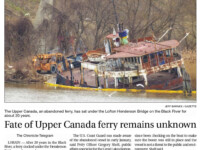
LORAIN — After 20 years in the Black River, a ferry docked under the Henderson Bridge may be moved.

The Upper Canada, a defunct ferry moored on the city’s east side, has seen little action since it came to Lorain. But earlier this week, a crane was seen working on the ferry.

The U.S. Coast Guard was made aware of the abandoned vessel in early January, said Petty Officer Gregory Shell, public affairs specialist for the Great Lakes Region.

At that time, the boat had started leaking an unknown substance and a boom was placed around it to absorb and contain any contaminants, he said.

The Coast Guard’s policing team has since been checking on the boat to make sure the boom was still in place and the vessel is not a threat to the public and environment, Shell said.

It is unclear if the Coast Guard was behind efforts to start righting the vessel, or if the owner had taken steps to do so as of Wednesday evening.

Mayor Jack Bradley said the city was not involved in the effort. The Ohio Department of Natural Resources is not involved, according to its spokesperson. The Ohio Environmental Protection Agency is aware of the vessel and the Coast Guard’s response to the leak from it last month, according to its spokesperson.

Lorain city Chief of Staff Rick Soto provided some background on the ferry gathered by the Lorain Police Department while he was still on the force.

Its owern, Alan Johnson, bought the boat from Ontario Northland in the early 2000s and brought it to Lorain. The boat’s registration, out of Ontario, was suspended in 2008, according to Transport Canada.

Johnson could not be reached for comment.

According to Soto’s documents, the Lorain Police Department talked to Johnson in 2015 after concerns of kayakers boarding the boat and requiring a rescue response from the Marine Patrol. At that time, Johnson told officers the boat has a hull made for traveresing through ice and that it floats with no leaks. He agreed to post a “no trespassing” sign on the vessel.

At that time, officers contacted the Coast Guard’s Marine Safety Unit, which deemed the boat not hazardous to the environment and not in a shipping channel.

“The USCG’s view at the time was that the vessel was grounded on private property and would need to be removed by private salvage,” according to the provided documents.

Built in 1949, the boat began its life as Romeo & Annette in the 1950s as car ferry, according to clippings posted by the Russel Bros. Shipbuilding company, which built the ferry in Owen Sound. It was renamed the Upper Canada in the mid-1960s.

An October 2021 story published by Thousand Islands Life Magazine chronicled the ship’s life before its fate below the Lofton Henderson, including its many changes in routes and ports.

– Chronicle Telegram (February 16, 2023)

#gallery-2 { margin: auto; } #gallery-2 .gallery-item { float: left; margin-top: 10px; text-align: center; width: 33%; } #gallery-2 img { border: 2px solid #cfcfcf; } #gallery-2 .gallery-caption { margin-left: 0; } /* see gallery_shortcode() in wp-includes/media.php */

Boatnerd News – February 16, 2023

Port Colborne businesses reaping the rewards from cruise ships

Port Colborne’s pivot to becoming a major port of call for cruise ships began last summer, and immediately, businesses along the canal began noticing something.

“The days when the cruise ships were coming through were some of our best days ever,” said Rob Carter, who owns Pie Guys Bakery and Cafe, which overlooks the canal on West Street. The café was packed each time a cruise ship came through, and while cruise ship passengers accounted for some of that bump, surprisingly, Carter found most of the increased business was coming from a more unlikely place.

“It was almost all boat watchers,” recalled Carter of the busy cruise ship days through the summer. “We were packed all day as people came in for coffee and lunch and then just sat along the canal to watch the ships go through.”

The sudden burst of activity from boat-gazing tourists caught many of the West Street businesses by surprise, but for its part, city hall was well aware of the phenomenon.

“There’s actually a word for those people,” said mayor Bill Steele. “They’re called gongoozlers.”

It comes from the old English word ‘gonzoole’ which means “To leisurely watch the passage of boats, from the bank of a canal.”

When city hall was putting together its plans for the cruise ship initiative, Steele said economic boosts were anticipated from three different groups of people arriving in the city.

“We looked at the passengers, the crew from the ships, and finally, the gongoozlers,” said Steele, who noted the economic benefits from that last group shouldn’t be underestimated. “The day those Viking ships came through there were hundreds of people, from Thorold right down to Port Colborne, all along the canal. West Street was packed those days.”

Coffee shops were doing swift business, Minor Fisheries had long lines of people waiting for some freshly caught perch, and even the local library and museum saw a boost as curious gongoozlers looked for more information about the history of boating and the canal.

The benefits for the local economy will only continue to grow as the cruise business gains steam, which Steele noted is happening faster than anyone could have anticipated. The city saw 66 cruise stops last year, with 72 scheduled for this year, and 122 already lined up for next year.

Newly opened West Street businesses, like Oak Tree Yoga which celebrated its ribbon cutting in January, already had an eye toward the cruise ships before they even opened their doors. Indigenous business owner Linsey Hill said she will be planning her schedule to make sure her yoga studio is open when the cruise ships dock. Passengers can stop in for a quick yoga session, or participate in an Indigenous moccasin-making workshop so they can return to the ship with an authentic Indigenous Canadian souvenir from their stop.

It’s not just existing businesses that can take advantage of the cruise ship initiative either, as Steele noted the project is also opening up brand new opportunities for budding entrepreneurs to set up shop.

In a recent meeting with cruise ship giant Viking Cruises, one of the things that came up was excursions for passengers during the time docked in the city.

“Viking use Canadian companies for their onshore entertainment, so we’re working with them to help develop some excursion packages,” said Steele. Whether it’s trips out on Lake Erie for some of the city’s world-famous fishing, or a scuba diving outing, or a cycling tour through the city, there’s no shortage of possibilities for those looking to adopt an excursion package for passengers.

The final piece of the cruise ship puzzle will be the waterfront welcome centre, which the city is building as a way to allow cruise ships to deposit passengers directly onto West Street. That project is still a few years away from reality, until then, Steele said they have a few different options.

In the meantime, Steele said the newly renovated dock near Sugarloaf Marina is able to accommodate some of the smaller cruise ships, while the larger ones will continue to dock on the east side, with a shuttle service bringing them around to the west side.

– Niagara This Week (February 14, 2023)

Mayor Bill Steele poses by the wintering ships in his city of Port Colborne, ON. Niagara This Week image, 2023

Boatnerd News – February 15, 2023

Opening date of the 2023 navigation season and maximum allowable drafts

The opening date for the 2023 navigation season is scheduled to take place on the following dates and time:

  • Montreal / Lake Ontario Section: March 22, 2023 – 0800 hours (D.S.T.)
  • Welland Canal: March 22, 2023 – 0800 hours (D.S.T.)

Ship transits will be subject to weather and ice conditions. Restrictions may apply in some areas until lighted navigation aids have been installed.

Sault Ste. Marie Locks and Canals
Opening of the Sault Ste. Marie Locks (U.S.A.) is currently scheduled for March 25, 2023. Please note the Notice to Navigation Interests released by the U.S. Army Corps of Engineers for further information.

Allowable Draft
In the Montreal / Lake Ontario Section, the maximum allowable draft will be 80.0 dm (26′ 3″). The maximum draft will be increased to 80.8 dm (26′ 6″) for all ships when the South Shore Canal is icefree and when water levels are favorable.

In the Welland Canal, a maximum allowable draft of 80.8 dm (26′ 6″) will be in effect from the start of the navigation season for all ships.

Ships equipped with an approved and operational draft information system will be permitted to transit at a draft of up to 7cm above the maximum allowable draft.

There will be zero tolerance for ships to transit at drafts in excess of those specified in this Notice.

– St. Lawrence Seaway Management Corporation (February 14, 2023)


Wisconsin awards $5.3 million in harbor maintenance grants

Wisconsin Gov. Tony Evers, together with the state’s Department of Transportation (WisDOT), announced grants totaling $5.3 million for seven harbor maintenance and improvement projects to promote waterborne freight and economic development.

“From the Great Lakes to the Mississippi River, Wisconsin’s unique geography provides our state opportunities to grow our economy and help our businesses reach markets worldwide,” said Gov. Evers. “These grants will help maintain our harbors and ensure our ports are secure and reliable, all while strengthening our supply chains and our commitment to our port cities.”

“Strong multimodal transportation infrastructure positions Wisconsin’s businesses to succeed in a global economy,” WisDOT Secretary Craig Thompson said. “We are committed to improving our ability to move freight, and our harbors are a critical part of this strategy.”

Projects supported by the $5.3 million in Harbor Assistance Program (HAP) grants include:

  • Perch Point LLC., Port Milwaukee – $540,000 to construct a dock wall to support the movement and delivery of shoreline protection materials along the Lake Michigan shoreline.
  • Port of Green Bay – $1,000,000 to stabilize the existing shoreline with bulkhead fill and dock wall construction on new Port property located at the mouth of the Fox River.
  • Hanke Terminals, La Crosse – $200,000 to repair a failing dock wall used to export ag-commodities and import miscellaneous bulk goods.
  • Briess Industries Inc., Manitowoc – $1,000,000 to dredge the bed of the Manitowoc River along frontage used by Briess to broaden maritime transportation options for agricultural commodities.
  • U.S. Venture Inc., Green Bay – $200,000 to dredge the bed of the Fox River to allow the continued import of petroleum products to Northeast Wisconsin.
  • FJ Robers, La Crosse – $1,170,000 to repair and construct a new dock wall to allow the continued operation of a bulk commodity transload facility. This section of wall is dedicated to the transfer of corn and soybeans and is critical to sustaining Wisconsin as an important origin for the export market.
  • Holcim US Green Bay Terminal, Green Bay – $1,200,000 to dredge the bed of the Fox River and construct a new docking facility to receive cement used in construction across the region.

“This is good news for Green Bay and our entire region,” said Dean Haen, Port of Green Bay Director. “These grant funds will allow the Port of Green Bay and our terminal operators to continue working to maintain and improve waterborne transportation that supports and grows our regional and state economy.”

Created in 1979, Wisconsin’s Harbor Assistance Program helps harbor communities maintain and improve waterborne commerce. Applications are reviewed by the Harbor Advisory Council, which includes members from the U.S. Army Corps of Engineers, University of Wisconsin (UW) Sea Grant, Wisconsin Coastal Management Program, Wisconsin Economic Development Corporation, Wisconsin Department of Natural Resources, and alumni from the Great Lakes Maritime Research Institute.

Applications are accepted from public or private harbor facilities for projects that benefit facilities used for cargo transfer, shipbuilding, commercial fishing, vessel cruises, or ferry service. All projects must have a transportation efficiency benefit-cost ratio greater than one over a 25-year project life and be identified in a current three-year harbor development plan. Selection criteria include economic impact, urgency, and project type. Those interested in the next round of Harbor Assistance Project grants should note that the deadline for the next cycle is August 1, 2023.

– Marine Link (February 3, 2023)

A tug and dredge at work in a Wisconsin harbor. Transportation Development Association of Wisconsin image, n.d.

Jump to a Date:

Archives