Divers plug holes in the hull of museum ship USS The Sullivans
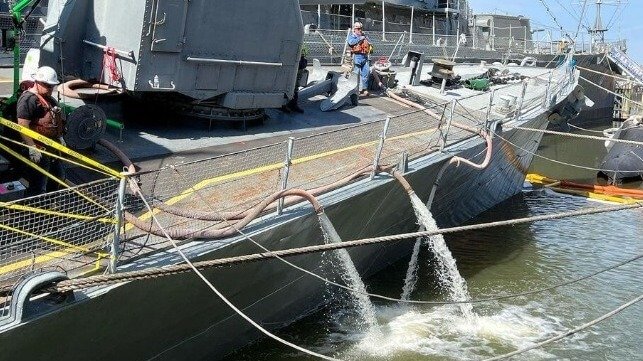
Buffalo, NY – Efforts to save the WWII-era museum ship USS The Sullivans are starting to pay off, according to the salvage team. Multiple holes in the hull have been patched, and the vessel’s condition is believed to be stable.
The museum ship USS The Sullivans experienced flooding on her starboard side and took on a heavy list on April 13. A joint effort involving the U.S. Coast Guard, T&T Salvage, local first responders and the museum operator have succeeded in keeping the ship afloat and stable at its berth.
The team is using multiple salvage pumps to keep flooding under control, and divers are using plugs, patches and epoxy to repair breaches in the aging vessel’s hull. The Sullivans has long been known to be in need of hull repairs, and a restoration effort to reinforce her hull with epoxy along the waterline began last year. It had been slated to continue this spring, once water temperatures warmed enough to do the work.
High winds have caused delays in the external dive operation, but so far, the dive team has found and plugged about one dozen holes in the hull. The penetrations range in size from about 0.75 to 2.5 inches, according to Buffalo’s ABC affiliate.
“We are seeing that the plugs and patches that the divers have installed are actually working. We talked about the divers installing 10 plugs on the starboard side, and three plugs on the port side. So those are all holding,” said U.S. Coast Guard Sector Buffalo Commander Capt. Lexia Littlejohn in a radio interview. “The list is actually less severe than it was [at the start of the incident].”
The vessel’s condition is stable enough that salvors allowed a rescue mission inside the ship to recover historical artifacts. As a museum ship, USS The Sullivans had many historical objects on display, including the scale model of the vessel herself. Over 40 items were rescued in hopes of preserving and returning them later.
The vessel’s long-term prospects are looking better as well: last week, U.S. Senator Chuck Schumer (D-NY), the Senate majority leader, said that he would commit to finding federal funding to pay for the refloat and restoration. “While the cleanup efforts have already begun, this is going to be an expense, and it shouldn’t be the city or county or the park that have to pay for this,” Sen. Schumer said.
The Maritime Executive
Video shows American Spirit, others in dry dock at Bayship
Sturgeon Bay, WI – American Spirit in dry dock at Fincantieri Bay Shipbuilding. In the backround is another 1,000-footer, Stewart J. Cort, plus Roger Blough and Cason J. Callaway. All three are in layup.. In the floating dry dock are Mary Ann Market and Mark W. Barker. Door County Drone by Mark Evenson ©
https://www.youtube.com/watch?v=JEaB4XslaqY
Picton Terminals: Moving goods on water in family-owned company’s blood
Prince Edward, ON., CN – An Ontario company is delivering on its wish to see the marine transportation industry better utilized. H.R. Doornekamp Construction Ltd., a family-owned business headquartered in Odessa, near Kingston, has reinvigorated Picton Terminals since it purchased the deep-water facility in 2014. And it has joined the ranks of marine transportation players with the launch of Doornekamp Lines to provide all-water services in Eastern Canada and into the Great Lakes.
“We have a lot of Dutch and European in our blood. So, moving items on water, the way the Europeans do, has always been of large interest to us,” said Ben Doornekamp, Owner of Doornekamp Construction. “When fuel prices did what they did (in 2008), it made it more evident that we had to become more efficient in moving product on water in the Great Lakes region.”
The first target on the Doornekamp radar was Picton Terminals, a facility built in 1953 for Bethlehem Steel to ship iron ore to the U.S. It closed in the 1970s following the closure of the nearby iron ore mine, then operated on a smaller scale under different leaseholders. Doornekamp saw the terminal as an opportunity to strengthen its construction services and support import and export services in the region.
“At that time we kept our eye on the port,” Doornekamp said. “The gentleman who owned it had mentioned to us that he was going to step away. He was a longtime construction guy in Kingston. My father was as well, so they knew each other well. They trusted each other. In 2014, the gentleman called us and asked if we were still interested. We said ‘yes.’ We met for breakfast and owned the port by the end of the meal.
“We had lots of huge visions and dreams for the port. We’ve been very fortunate. Not only have they come true, they’ve exceeded our goals. We’re extremely excited where we’re at right now.”
Among its efforts to redevelop, upgrade, diversify and modernize the terminal to be a pivotal hub in Eastern Ontario’s supply chain, Doornekamp has refurbished and fully computerized the shiploading conveyor systems, renovated buildings and retrofitted the port to store up to 2,300 containers. It also purchased a Liebherr LHM 420 Mobile Harbour Crane to handle bulk cargo.
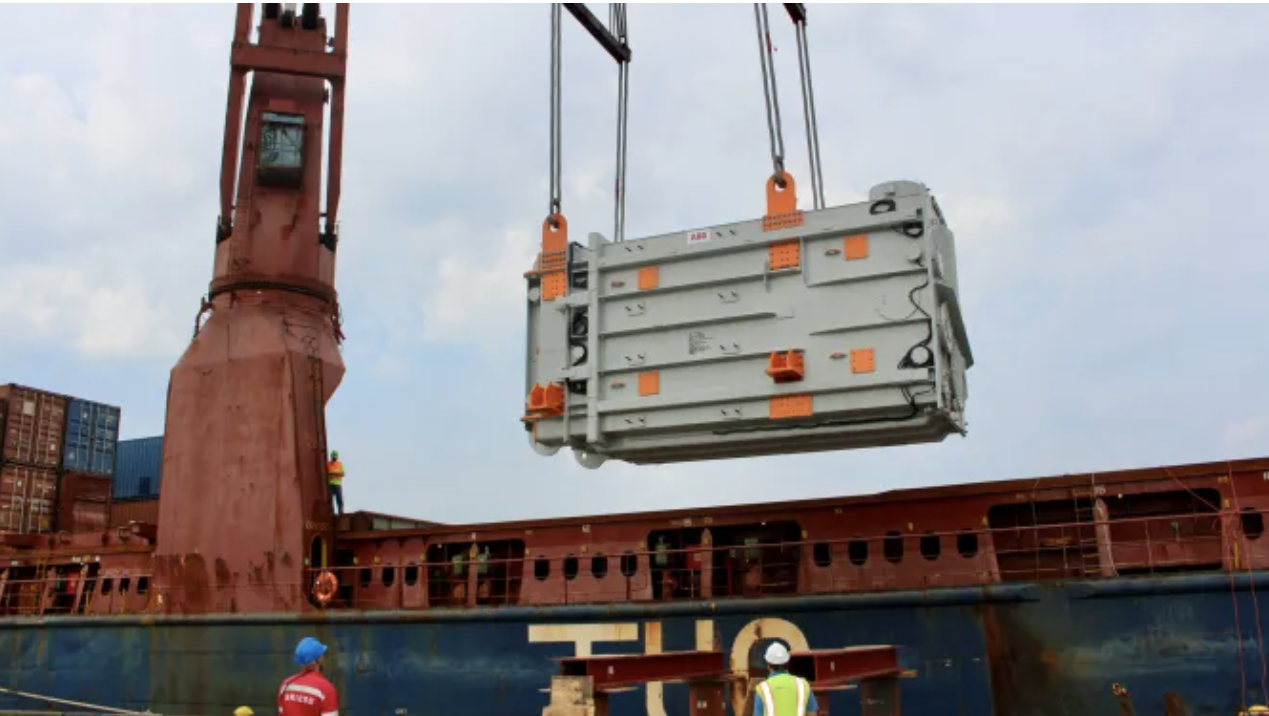
Today, Picton Terminals moves a wide range of products, including construction material, steel and steel beams, aggregates, stone, gypsum, dredged sand, farming products, breakbulk and heavy-lift cargo, containers and bulk sugar. It even unloaded and stored last autumn two electric ferries that will sail in the Kingston region this year.
Kimco Steel Sales Ltd. has a working relationship with Picton Terminals to facilitate the movement of the Kingston-based company’s structural steel into the port.
“When it comes to providing great service to your customers in today’s instantaneous, fast-paced world, supply chain logistics is more important than ever. Picton Terminals’ personal touch and attention to detail really seems to shorten the chain, allowing Kimco the opportunity to receive our imports with efficiency and accuracy,” said Cody Rosen, Kimco’s Executive Director.
Doornekamp, which has a workforce of 80 to 100 people, has invested close to $30 million in its marine industry initiatives. It operates two Damen tugs, the Amy Lynn D, delivered in 2021, and the Sheri Lynn S, two flat-deck barges, as well as hopper barges from Picton Terminals under the Doornekamp Lines banner. In an effort to further capitalize on new opportunities, Doornekamp Lines is investing in container shipping.
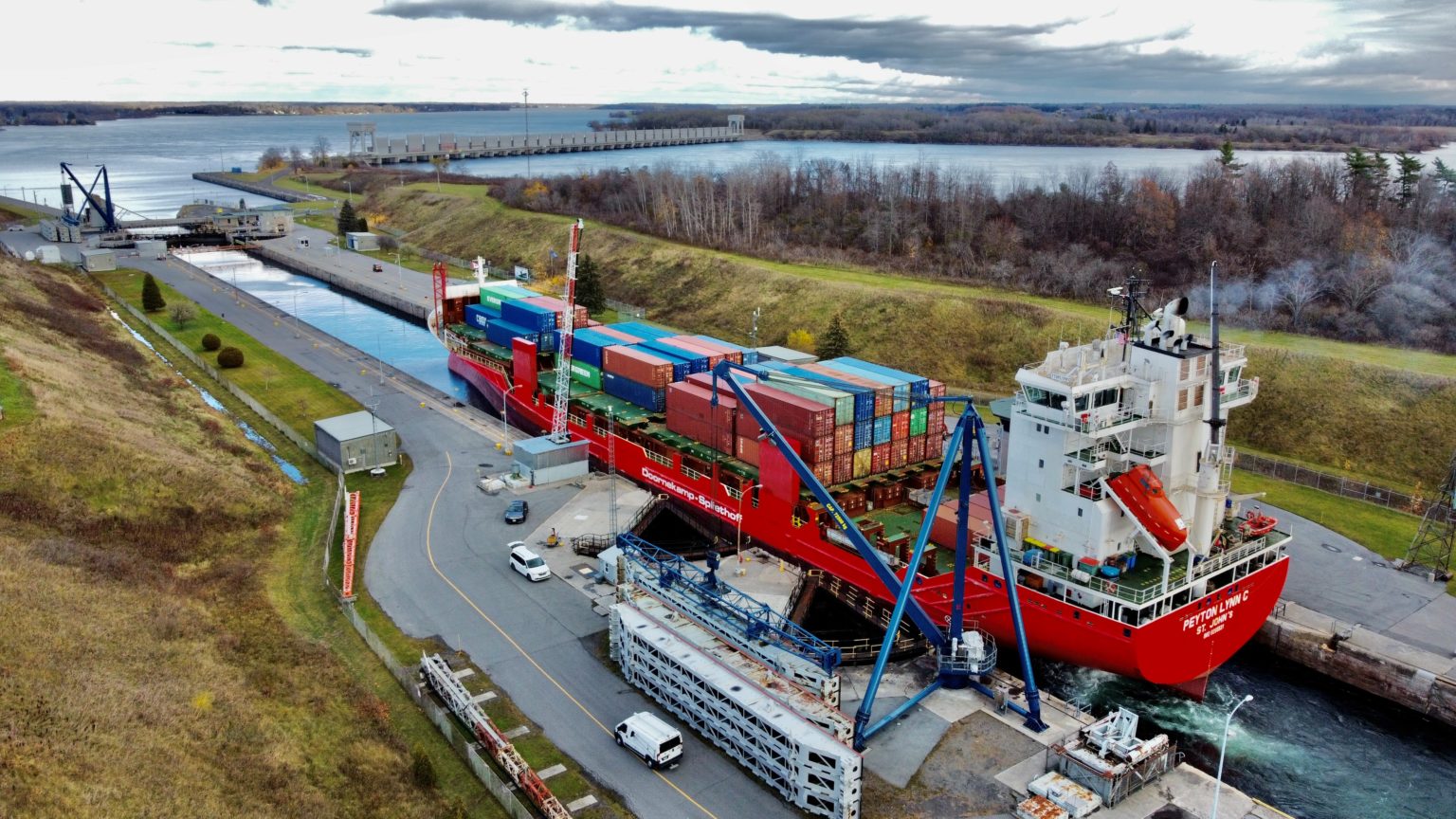
The company started looking about three years ago at launching a scheduled domestic container and bulk cargo service from Halifax to Picton, with Picton being the connection to Toronto. “We did a ton of research, brought in a bunch of experts to help us,” Doornekamp said. The company announced plans in spring 2021 for the service and purchased a vessel, which it named the Peyton Lynn C. But before the service could even take off, Spliethoff, which operates the twice-monthly Cleveland Europe Express (CEE) between Europe and Cleveland, approached Doornekamp LInes about entering into a partnership.
“It’s pretty interesting how it came to be,” Doornekamp said. “In March of last year, we decided we were going to move on the domestic service, which was Step 1 – buying a container ship. About a week after we purchased it, Spliethoff approached us. We had always been trying to work with Spliethoff on their service. They asked if they could charter the vessel from us. That’s basically how it came about. A bit of a surprise plan.”
The CEE is scheduled to start stopping in Picton, with connections to Toronto, this year. But Doornekamp is still looking “very seriously” at the Halifax-Picton service. “The vessel we had considered for that service has gone to Spliethoff on long-term charter and will stay there,” Doornekamp said. “We’re looking at what we’ve learned from the Spliethoff model, and we’re still looking very closely at another vessel for the domestic service that would sail Halifax into the Great Lakes.
“We would be looking at containers that move into Halifax that either move by rail or truck further into the U.S. or into the Great Lakes region. We’d be looking at moving that cargo by water – short-sea shipping.
“We are a small, private-sector player punching above our weight with the likes of large, established port authorities. Not many people start new ports today and, as such, there isn’t a prescribed process.
“We still have some challenges to get over. A lot of them have to do with government hurdles. It’s not as easy as you think getting over some of these hurdles. But we’re getting there. We are fortunate to be working with government staff who are helping us to stickhandle the many government agencies and policies to ensure regulatory compliance.”
Moving forward, increasing transportation efficiencies and providing an alternative to truck and rail transport and a more environmentally responsible option for domestic and international trade remain among Doornekamp’s main objectives and the cornerstone of its business plan.
“Stand by. We have some more projects coming down the pike in 2022,” Doornekamp promised. “It’s all related to Canadian shipping – improving it and expanding it for Canadian companies. Hopefully we can continue at the rate we’ve been going and make it a very positive experience for our customers.”
Chamber of Marine Commerce
Army Corps says $10M still on the table if port can fill funding gap for deepening project
Ogdensburg, NY – The Army Corps of Engineers says it is still committed to working with the Ogdensburg Bridge and Port Authority on a project to deepen the Port of Ogdensburg. But the corps says federal law prevents it from putting more than $10 million into the project.
The OBPA Board of Directors during its April regular meeting passed a resolution acknowledging that the Army Corps had withdrawn a $10 million funding commitment for the $29.5 million harbor deepening project that was initially estimated at $11.4 million. Between the federal funding and a portion contributed by the state Department of Transportation, there’s an $11.4 million gap that the OBPA has to cover, which it can’t afford. The project would have modified a 300-by-500-foot section of the federal channel to an authorized depth from 19 feet to 27 feet.
Shortly afterward, the corps released a prepared statement saying that the $10 million is still on the table, if the OBPA can fill the funding gap.
“The U.S. Army Corps of Engineers, Buffalo District remains committed to working with our partners at the Ogdensburg Bridge and Port Authority. The Ogdensburg Harbor deepening project is authorized under Section 107 of the River and Harbor Act of 1960 which requires the Corps of Engineers share the cost with a sponsor outside the federal government,” the statement from Army Corps Lt. Col. Eli S. Adams says. “We have had to put a pause on the project due to current non-federal sponsor funding limitations, but continuation is still possible. If the Port Authority is successful in securing the necessary funds, we will be ready to move ahead.”
During the OBPA’s April board meeting, board Chair Vernon D. “Sam” Burns said he asked federal officials to use money from the Infrastructure Investment and Jobs Act signed into law in November, but they wouldn’t go for it.
“They would not even request that from Congress to increase the $10 million because they wanted to spread out the additional funding for other states. That was the reply I received,” Mr. Burns said.
He called the response “a slap in the face to the Bridge and Port Authority and the state of New York.”
Mr. Adams said in his statement that federal law prevents the Army Corps from putting more than $10 million into the harbor deepening work.
Mr. Adams in his statement outlined reasons the project’s cost went to nearly $30 million.
“Among the cost challenges identified by government and industry stakeholders were restrictive underwater blasting requirements, labor intensive efforts, and project schedule. Other factors included the limited pool of available contractors to perform the work and the project’s remote location,” he wrote.
Clarifying Mr. Adams’ statement on Ogdensburg being a “remote location,” Army Corps Deputy Chief of Public Affairs Avery P. Schneider said it has to do with distance from major metropolitan areas.
“I don’t know if there’s a textbook definition” of remote location, he said. “The expertise needed for the project, you don’t necessarily find that just anywhere. Getting (necessary experts) from some farther locations up to Northern New York could be very difficult.”
NNY 360
Six U.S. ports winners of 2021 season “Pacesetter Award”
Oswego, NY – On Monday, the U.S. Great Lakes St. Lawrence Seaway Development Corporation (GLS) announced that six U.S. ports in the Great Lakes St. Lawrence Seaway System received the Robert J. Lewis Pacesetter Award from GLS for registering increases in international cargo tonnage shipped through their ports during the 2021 navigation season.
“The winners honored today showcase the critical role of Great Lakes ports in moving goods through our supply chain – and reflect the skill and dedication of the port workers who literally keep our economy afloat,” U.S. Transportation Secretary Pete Buttigieg said.
The six ports earning the Robert J. Lewis Pacesetter Award for 2021 are: Ports of Indiana – Burns Harbor (Ind.); Port of Chicago (Ill.); Port of Cleveland (Ohio); Detroit/Wayne County Port Authority (Mich.); Erie-Western Pennsylvania Port Authority (Pa.); and (N.Y.).
“Congratulations to the six Great Lakes ports being recognized as GLS Pacesetter Award recipients for their achievements during the 2021 Seaway navigation season,” GLS Deputy Administrator Craig H. Middlebrook said. “The sustained level of high performance is a testament not only to the Seaway System’s importance as a maritime supply chain but also to the hard work and resiliency of the dedicated men and women throughout our Great Lakes port community.”
This year marks the 30th anniversary of the Robert J. Lewis Pacesetter Award, which was established in 1992 to recognize the achievements of U.S. ports whose activities result in increasing international tonnage shipped through the St. Lawrence Seaway, excluding Canada, in comparison with the previous year. The Pacesetter Award name was officially changed in 2001 to posthumously honor the noteworthy career of former GLS Logistics Director Robert J. Lewis, who was instrumental in developing and implementing the GLS’s trade development program.
Oswego County Today