Jack Messmer is MHSD Historian of the Year for 2024
The Marine Historical Society of Detroit has named Jack Messmer as its 2024 Great Lakes Marine Historian of the Year.
Messmer was born in 1950 at Erie, PA, and moved to Buffalo in 1961. He graduated from Canisius College in 1973 with a B.A. in science education, after which he worked for 34 years as a science teacher. Always fascinated by the lakes, he took up the sport of scuba diving in 1969, and has said diving on wrecks resulted in a desire to know more about their history. He began reading books, then early Buffalo newspapers, gathering information about shipwrecks on the lakes, particularly Lake Erie.
He is a founding member of the Lower Lakes Marine Historical Society (now the Buffalo Harbor Museum) in 1988. He is a director, the editor of the Harbormaster newsletter for more than 30 years and docent at the Buffalo Harbor Museum. He has been a longtime member of the Marine Historical Society of Detroit, Great Lakes Historical Society and Toronto Marine Historical Society. Messmer is author of numerous articles about Great Lakes shipwrecks, and co-author of three books relating to Buffalo’s waterfront, Waterview Guide to Buffalo Harbor (1989), Fire and Water, Disasters on Buffalo Harbor and the Surrounding Area (2015) and Boats Built at Buffalo and Surrounding Areas (2018). He lives with Janice, his wife of more than 50 years, in Lancaster, NY.
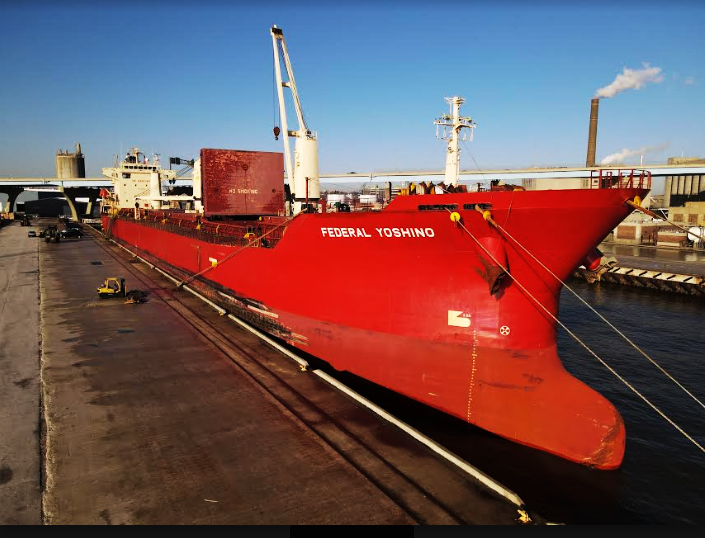
Federal Yoshino first saltie at Milwaukee
Federal Yoshino was the first international vessel of the season to call on Port Milwaukee. The vessel arrived from Antwerp, Belgium, as part of the Fednav FALLine service between Milwaukee and Europe, carrying vital commodities for local manufacturers.
Port Milwaukee
Transit authority ends evening-overnight Neebish Island ferry service
NEEBISH ISLAND, MI – The battle between Neebish Island residents and visitors and the Eastern Upper Peninsula Authority (EUPTA) on ferry scheduling continued late last week at the scheduled EUPTA board meeting.
At times, it got a little heated as people expressed their displeasure at EUPTA dropping evening and overnight service. “We are a busy society nowadays and they are curbing these people’s lives just unreasonably,” said Roger Parr, who attended the meeting.
Parr has had property on Neebish Island since the ’90s. His father was born there. Parr, himself, attended a one-room school house back in the day. His grandparents lived on the island until the ’70s. He says he has been going over to Neebish Island his entire life. “This new schedule sure is going to limit doing anything like golf or dinner in the evening… whatever the case may be just to get off the island, let alone getting back on,” Parr said.
A few at the meeting spoke up about property values possibly decreasing due to the lack of ferry service, and the inability to attend evening sporting events, functions or even shopping.
EUPTA Executive Director Pete Paramski spoke at the meeting. He said the Coast Guard is setting the regulations by which the ferry service can run. That can only be a twelve-hour shift for the two-person crew on the ferry.
Last month, the Coast Guard indicated to EUPTA that the ferry service and crew were out of compliance when running the service beyond their twelve-hour shift. That means there will be no scheduled service after the 6 p.m. run during the work week. The ferry service will start back up at 6:30 a.m. with several routes provided during the day.
“It’s a Coast Guard regulation that limits the amount of hours. It’s a manning and rest period and we cannot run our captains and our crew as long as we used to,” Paramski said.
Paramski says it would not be financially sustainable for EUPTA to add a second crew and shift. That alone, he said, would cost them an additional half-million dollars a year.
“We are trying to work with the island community to come up with a schedule that can better the life out there for them. We moved some times per their request. We have added some runs within the normal scheduled day but we couldn’t add runs outside of the parameters set from the p.m. to a.m.,” Paramski said.
Soo Today
The 4 factors that have led to a ‘golden age’ of discovery for Great Lakes shipwrecks
There’s never been a better time to find, explore and document shipwrecks on the Great Lakes, thanks to a combination of technology, environmental change and surge in public interest, according to those who uncover the sunken history of the world’s largest lakes.
The University of Buffalo estimates more than 6,000 shipwrecks are on the bottom of North America’s five Great Lakes, which, since the late 1600s, have been lost in wars, accidents, or frequent and powerful storms.
In the last 18 months, three previously unknown Great Lakes shipwrecks have made headlines around the world, from the steel bulk freighter Huronton, the 19th-century cargo steamer Africa, and in February, the Second World War-era freighter Arlington.
Explorers say the pace of new discoveries has quickened, thanks to new technologies, climate change, invasive species and a surge in public interest.
“I’ve lived at the most fortunate time possible for being an underwater explorer because of the developments in technology,” said Jill Heinreth, a full-time underwater explorer and explorer-in-residence for the Royal Canadian Geographical Society.
She said cameras, drones, underwater scooters, even breathing apparatus have all improved, and in many cases have become cheaper, over her 30-year diving career, during which she’s documented everything from underwater caves to ghostly shipwrecks.
“We’ve gone from just using a single scuba tank on our backs to using something that’s much more akin to what an astronaut wears for a space walk,” Heinreth said. “It’s called a rebreather and it increases our range, our time and our depth capabilities by recycling our exhaled breath.”
Underwater drones in particular have led to a number of shipwreck discoveries. Most recently, the Africa was found in Lake Huron by a husband and wife team while filming the upcoming TVO documentary All Too Clear: Beneath the Surface of the Great Lakes.
This winter saw the lowest level of ice ever recorded on the Great Lakes. It’s meant lower lake levels and higher rates of erosion along sandy bluffs, devastating coastlines and, in some cases, uncovering lost pieces of history.
Durrell Martin, president of Save Ontario Shipwrecks, told CBC’s Afternoon Drive on Friday that the shifting coastlines have unearthed a number of discoveries, including a 600-year-old dugout canoe in Salmon Trout Lake, a small inland lake about a 20-minute drive north of Bancroft.
“This came due to frost heaves and erosion from increased run-off of water,” he said. “This is about halfway between Peterborough and Ottawa, and the Ontario Marine Heritage Committee has been documenting this unusual find of Canada’s pre-colonial history.”
Martin said more discoveries are likely to be made this spring as communities around the Great Lakes experience increased erosion along their shores, caused by a lack of ice on the lakes.
The introduction of invasive zebra and quagga mussels from Europe through the ballast tanks of freighters on the Great Lakes has made the murky turquoise waters of the Great Lakes crystal clear.
“In the early days, I once literally ran face first into a ship I couldn’t see in front of me,” Martin said. “Now I can see 200 feet in front of me.
“There are wrecks being found on Google Earth and people are literally finding them on their computer through satellite imagery.”
Shipwreck videos and pictures rack up millions of views on social media, while social media groups dedicated to documenting the finds have tens of thousands of followers. New discoveries make headlines around the world, including in the New York Times, which recently declared this a “Golden Age” of shipwreck discovery.
Explorers say while this is a golden age, it won’t last long.
The cold, deep and relative darkness of the Great Lakes have proved to be ideal conditions for preserving shipwrecks dating back to the 17th century, but with climate change and the introduction of invasive mussels, that’s changing. Clearer water means more light filters down to the wrecks, many encrusted by zebra mussels that are eating their way through the wrecks.
“This really is the golden age of discovery,” Durrell Martin said. “We feel the window’s probably got about 20 to 30 years left.”
Martin said the slow disintegration of Great Lakes shipwrecks is another factor in the pace of discovery. “[It’s] why there’s such a drive to record all of these shipwrecks that are being found.”
CBC
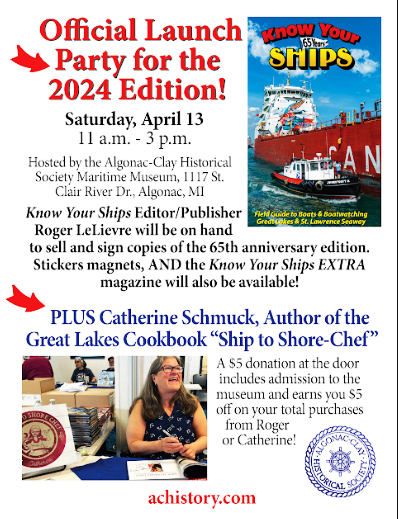
Know Your Ships hosts annual book release
celebration Saturday at Algonac museum
The official launch part for the 2024, 65th anniversary of the boatwatching field guide Know Your Ships is Saturday from 11 a.m.-3 p.m. at the Algonac-Clay Historical Society Maritime Museum, 1117 St. Clair River Dr., Algonac, MI.
Join Roger and other members of the KYS Crew will be special guest Catherine Schmuck, author of the book Ship To Shore Chef. Catherine sails the lakes for Canada Steamship Lines as a relief cook and her recipes are mouth-watering!
A $5 donation at the door gets you $5 off your total purchase from Roger and Catherine.
This replaces the book signing that used to be at the Great Lakes Maritime Center in Port Huron, as that facility has closed.
Opening For Chief Engineer – Interlake Logistics
Interlake Logistics Solutions, Inc. operates the versatile articulated tug-barge Undaunted-Pere Marquette, which carries diverse cargoes on the Great Lakes. Equipped to self-load cargo with an 800C John Deere excavator, long reach material handler, the uniquely outfitted vessel can utilize a clam bucket for flowable material or a five-tine grapple for large rocks and scrap metal. The tug Undaunted that powers the Pere Marquette 41 is a repowered Navy ATA/Rescue Tug that served in World War II. The barge Pere Marquette41 is the repurposed carferry City of Midland.
The Chief Engineer is responsible for the safe and efficient operation of the vessel’s (both tug and barge) machinery and propulsion plants.
Responsibilities:
- Both scheduled and unscheduled maintenance of equipment / machinery.
- Ordering needed supplies and maintaining inventories.
- Proper record keeping, documentation and adherence to rules and regulations.
- Working with the Engine Utility to maintain a clean, safe, and positive work environment.
- This is not an all-inclusive list, but an overview of responsibilities.
Qualifications/Certifications Required:
- Minimum requirement; Valid USCG license, Chief Engineer (Limited) with at least a 2000HP endorsement.
- TWIC Card
- Current Physical / USCG Medical Certificate.
- DOT Drug Screen
- Legally eligible to work in the USA (proof of identity or eligibility required.
The rotation is 28 days on the vessel and 28 days off. After completing a 90-day probationary period, your eligible for medical, dental, vision and a 401k plan.
Applicants please apply thru website: www.ssbadger.com