Will try to refloat grounded Seaway ship Saturday
UPDATE – SATURDAY 8 A.M. – Two Groupe Ocean tugs freed the Heemskerkgracht Saturday morning. There is no word yet as to when traffic will begin to move.
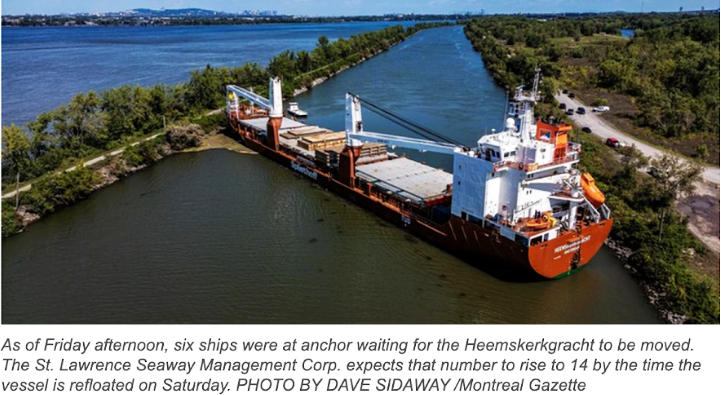
ORIGINAL REPORT: Kahnawake, QC – A cargo ship that ran aground near Kahnawake, QC, causing no injuries but blocking traffic in the busy St. Lawrence Seaway, will probably be refloated Saturday morning, the St. Lawrence Seaway Management Corp. said Friday.
The Heemskerkgracht, a 138-metre Dutch cargo ship bound for Spain with a load of scrap steel, lost power as it entered the South Shore Canal on Thursday evening after turning around in Lake St-Louis, said Jean Aubrey-Morin, vice-president of external relations at the St. Lawrence Seaway.
The loss of its engine caused the ship to run aground, he said. There were no injuries and no pollution caused by the incident. The ship has not taken on water.
“I have to praise the crew and the captain because they did everything they could to lose speed and minimize the situation,” Aubrey-Morin said. “The fact that they’re aground is not good, but they did a good manoeuvre.” However, the ship is blocking traffic in the seaway.
As of Friday afternoon, six ships were at anchor waiting for the Heemskerkgracht to be moved. Aubrey-Morin said he expects that number to rise to 14 by the time the vessel is refloated.
A salvage master was expected to arrive on the scene Friday afternoon to develop a plan, and two tugboats were being dispatched from Montreal, he said. He said he expects that plan to be executed Saturday at first light.
Aubrey-Morin said the seaway is working with the Coast Guard, the Laurentian Pilotage Authority and authorities in Kahnawake to resolve the situation as quickly as possible.
Myriam Plante, a spokesperson for Fisheries and Oceans Canada, which oversees the Coast Guard, said there are no hazardous materials on board the ship and the hold is being checked regularly to make sure it remains dry.
The Gazette
Uncertainty Reigns as Union Vows to Fight
Canada’s Move to End Rail Shutdown
MONTREAL/OTTAWA – The union representing over 9,000 Canadian rail workers vowed on Friday to challenge the federal government’s effort to mandate binding arbitration that would end an unprecedented rail stoppage at both of the country’s main freight rail carriers.
The Teamsters union also filed notice to strike on Monday at Canadian National Railway, Canada’s largest railway.
The shutdown is expected to impact trade between the U.S. and Canada, and would have a major effect on Great Lakes and Seaway shipping.
The union’s moves are the latest twist in labor disputes at CN and Canadian Pacific Kansas City, which locked out Teamsters members on Thursday, triggering a simultaneous rail stoppage that business groups said could inflict hundreds of millions of dollars in economic damage.
They further complicate the task of the Canada Industrial Relations Board (CIRB), which was meeting for hours on Friday with union and railway representatives, after the government asked it to end the impasse.
The Teamsters union on Friday night said the parties had concluded a day-long meeting, in which it argued that the government did not have absolute power to end the labor action. “The union will lawfully abide by any decision from the CIRB, and is prepared to file challenges in federal court if necessary,” it said.
Railroad CN in a statement said it would move forward with a recovery plan until a CIRB decision was issued.
Labour Minister Steven MacKinnon, citing the risk to the economy, also asked the board to impose binding arbitration on talks between the union and companies, and for operations at both railways to resume immediately.
Canada, the world’s second-largest country by area, relies heavily on trains to transport a wide range of commodities and goods.
The Canadian Chamber of Commerce said it was disappointed with the Teamsters’ decision to challenge the government’s directive.
“This action will prolong the damage to our economy and jeopardize the wellbeing and livelihoods of Canadians, including union and non-union workers across multiple industries,” the group said
Corps of Engineers removes WWII era gates
hidden in St. Marys River
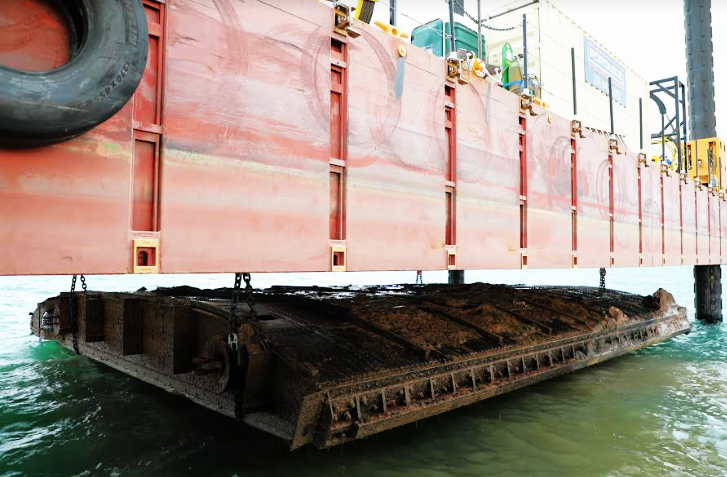
SAULT STE. MARIE, MI – The U.S. Army Corps of Engineers, Detroit District, removed a spare set of miter gates, constructed for the Davis and Sabin Locks, from the St. Marys River this summer. The miter gates were hidden in the river for over 80 years and weighed about 350,000 pounds each.
The gates were strategically stored downriver of the Soo Locks facility and out of the federal navigation channel in the 1940s during World War II. The purpose of storing the gates downriver was to have a spare set of replacement gates for either lock if the installed gates were damaged.
“The Davis and Sabin locks were built in 1914 and 1919 and at the time were the largest locks in the world,” said Chief Park Ranger Michelle Briggs.
As part of the national defense strategy during World War II, the MacArthur Lock was built, thousands of Soldiers were stationed in Sault Ste. Marie to protect the Soo Locks and spare miter gates were built and stored off-site. Torpedo nets were installed at the Soo Locks and sandbagging of critical areas was completed.
The protection of the Sault Ste. Marie Canal and the St. Marys River waterway was the only activity in the Central Defense Command during World War II that involved the use, stationing, deployment or assignment of Army combat units.
“The Soo Locks were critical to the wartime effort and ensured the passage of taconite (iron ore) from the active mines near Lake Superior to the lower Great Lakes for steel production,” said Soo Project Office Operations Manager LeighAnn Ryckeghem.
Physical defense of the Soo Locks and St. Marys River included: 702nd Battalion, Military Police Battalion; 39th Barrage Balloon Battalion; 100th Coast Artillery (AA) Regiment; Canadian 40th Antiaircraft Battery (Heavy); 131st Infantry Regiment; 266 Aircraft observation post in Northern Ontario; Construction of RACO and Kinross Army Airfields; Construction of six Early Warning Radar Stations at Grand Marais, Mich., and Kapuskasing, Cochrane, Hearst, Armstrong and Nakina, Ontario; establishment of the Central Air Defense Zone extending up to 150 miles from the waterway; establishment of the Sault Ste. Marie Military District; and a U.S. Coast Guard member was placed on every lake freighter.
“The spare gates have reached their end of life with the Sabin Lock being demolished to make way for the New Lock at the Soo and the Davis Lock being filled in, said Ryckeghem. “The Corps of Engineers environmental mission focuses on good stewardship and restoration of natural resources across our nation. The spare Davis and Sabin Lock gates were removed and recycled to restore the river bottom to a natural state.”
Funding in the amount of $975,000 was received in fiscal year 2024 to remove the Davis and Sabin Lock gates.
“The Soo Project Office, SPO, is actively working on design and procurement of a new heavy lift crane barge to replace the Gatelifter Paul Bunyan,” said St. Marys River Section Chief Justin Proulx. “Without a crane barge large enough to lift the gates from the river bottom, other methods had to be explored to execute the work requirement. The process of removing the gates was not an easy task and required some extraordinary measures.”
Several barges and vessels from the SPO’s St. Marys River Section were used to remove the gates including a dive barge, the Harvey crane barge, the Nicolet derrick barge, a custom assembled jack-up barge, an empty deck barge for receiving the gates, the Owen M. Fredrick tug and several small work boats.
To remove the gates, divers and a survey team were used to find the exact locations of each gate. Divers, using a small dredge pump, and the Nicolet derrick barge with a clamshell bucket were used to remove the clay, silt and overburden, material that settles on the bottom of the river, from the gates. Divers went back down to cut access holes in the four corners of each gate big enough to fit large metal chains through for lift points and rigging.
Once all rigging was in place, the jack-up barge, used as a self-elevated platform with strand jacks located on the deck and made up of 12 modular pontoons with 80-foot jacking spuds, was positioned over the gate. The four-strand jack cables were lowered down to the gates through moonpools on the jack-up barge. Divers then proceeded to hook up the rigging on the gate corners to the strand jack cables. The four stand jacks combined have a lifting capacity of 616,000 pounds. Together, they lifted the gate from the bottom of the river, breaking the suction from the clay each gate was embedded in.
When the gate was jacked up to the bottom of the jack-up barge, it had to move with assistance from the Nicolet derrick barge to a location in the river nearby with a hard bottom. Once in place and the Nicolet and Harvey positioned, the jack-up barge began jacking itself and the gate, in two-feet increments, into the air high enough to position the receiving barge under the gate. The gate was then lowered and positioned on the receiving barge and brought back to the SPO boat basin east of the Soo Locks.
“The mission went better than expected with no major surprises thanks to the continuous input from our experienced employees and support from SPO’s excellent equipment manufacturers and rental supply base, said St. Marys River Section Engineering Technician Theodore Clark.
The gates were both cut up into small enough sections to be lifted by a crane and disposed at a local metal recycling facility.
The first gate was removed from the St. Marys River the week of June 10 and the second gate the week of July 8, 2024. A Notice to Navigation Interest went out on June 3 detailing the work boundaries and U.S. Coast Guard Navigation Rules and Regulations for lighting the area during dark.
About 40 SPO employees worked on the project from beginning to end.
“The work completed by the great team at the SPO really continues to demonstrate the outstanding skills and talents that keep the Soo Locks running every day. We had participation from every work group at the facility to make this happen. The creativity in engineering a solution to meet the need and the safe and flawless execution of a very complex plan really exemplified the U.S. Army Engineer Regiment’s motto, ‘Essayons!’ The team did more than try, they delivered,” said Proulx.
Due to the gates being stored on the bottom of a freshwater river for nearly 80 years, they were in fair condition.
Source: U.S.Army
Autonomous surface vessel deployment in Lake Superior aims to unravel 1968 plane crash mystery
Olivia Fellows
08-22-2024 at 10:51:28 AM EDT| Updated 08-22-2024 at 02:43:45 PM EDT
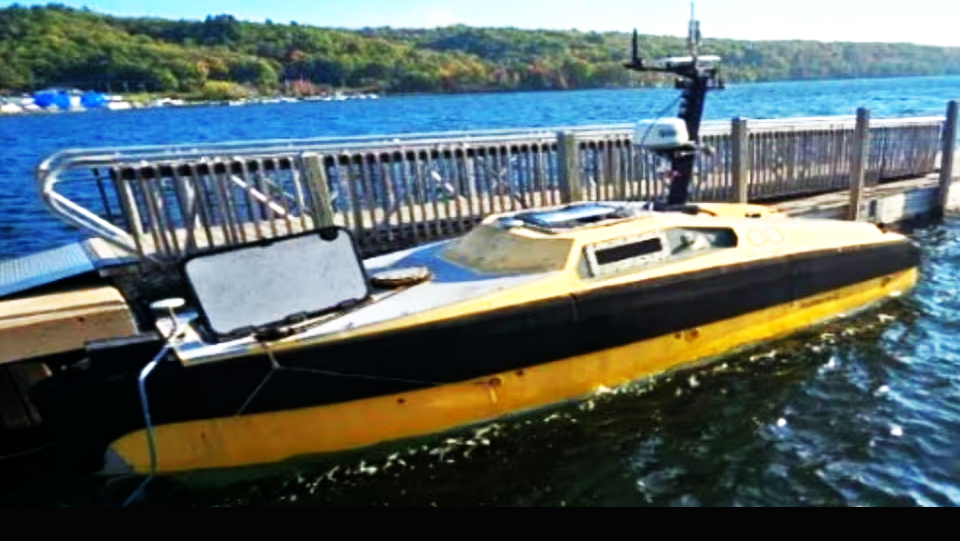
HOUGHTON — The Great Lakes Research Center at Michigan Technological University and members of the Great Lakes Smart Ships Coalition will gather to deploy an autonomous surface vessel in hopes of finding the wreckage of a 1968 plane crash.
According to an Aug. 6 news release, from 9-11:30 a.m. Sept. 9 the vehicle will begin conducting large-scale mapping and archaeological exploration in Lake Superior.
The crash occurred in late October of 1968, when a National Center for Atmospheric Research (NCAR) plane carrying two pilots and a graduate student disappeared over Lake Superior, sparking a decades-long mystery.
On a routine mission to collect water radiation and temperature data, the plane vanished without a trace after its last contact with the Houghton County Memorial Airport in Michigan.
Despite extensive search efforts, only a few pieces of debris have washed ashore between 1969 and 2014, baffling investigators.
The plane vanished in a region known for mysterious disappearances of airplanes and ships named the “Great Lakes Triangle.” The NCAR case remains open today.
Using Ocean Infinity’s Armada 8, an 8-meter state-of-the-art autonomous surface vessel (ASV) outfitted with an ultra-high-resolution 3D bathymetric sonar system, crews will map and explore Lake Superior in search of the wreckage.
The project is the first of a series of planned tests showcasing the diverse applications of autonomous technology in the Great Lakes.
Beyond solving specific challenges and enhancing existing techniques, these tests will contribute to developing the next generation of maritime professionals and solidifying the Great Lakes St. Lawrence region’s status as a hub for freshwater marine autonomy research and development.
“By demonstrating the benefits of autonomy in large-scale lakebed surveying, the Coalition aims to foster broad stakeholder support for future missions and ignite an interest in high-tech exploration and preservation of the Great Lakes,” the release said.
Guests and media will watch a live stream from the Great Lakes Research Center facility at 100 Phoenix Drive in Houghton and hear remarks from Coalition members, MTU leaders and other dignitaries.
Details of the event are as follows:
9-10 a.m. – Open house, display of ASV technology
10-10:30 a.m. – News conference with remarks from:
Dr. Tim Havens, Director, Great Lakes Research Center, Michigan Technological University
Mr. David Naftzger, Executive Director, Great Lakes St. Lawrence Governors and Premiers
10:30-11 a.m. – Launch of autonomous ship and support vessels; MTU remarks and photos.
The Great Lakes Smart Ships Coalition unites more than 60 universities, state and federal agencies, private and nonprofit companies, and international organizations that share a common interest in advancing and applying autonomous technologies operated in marine environments.
The Coalition is working closely with Great Lakes maritime archaeologists as they seek to unearth historical and cultural artifacts. Aligned with the objectives of Lakebed 2030, organizers will share data with the public, allowing uses beyond mapping and archaeology.
For more information on the Great Lakes Coalition and its initiatives click here: https://smartshipscoalition.org/
National Museum of the Great Lakes Second
Wave Capital Campaign Nears Completion
Toledo, OH – The National Museum of the Great Lakes is entering a new chapter as its Second Wave expansion project progresses. With the foundation set and structural build underway, the museum is reaching out to the community for a final push of support. Now is your chance to contribute to the future legacy of this historic institution.
The Second Wave expansion will add 5,000 square feet of new space, allowing the museum to showcase traveling Smithsonian exhibits, introduce new permanent exhibits, and create dedicated spaces for community education.
“By supporting this campaign, donors are actively preserving Great Lakes history, fueling ongoing education, revitalizing our neighborhood, and boosting the economic vitality of our region,” said Kate Fineske, Executive Director of the National Museum of the Great Lakes.
Donations can be made online at nmgl.org/thesecondwave or by calling the museum at 419-214-5000. Contributions of all sizes are welcome, and donors will receive exclusive Second Wave thank you gifts as a token of appreciation. Donors contributing more than $500 will also be recognized on our donor wall.
“This is the moment to make a lasting impact on our museum and the communities we serve,” said Sara Smith, the Museum’s Director of Institutional Advancement. As we conclude our public campaign, join in this effort and ensure the National Museum of the Great Lakes remains a beacon of pride and inspiration for generations to come. For more information or to make a donation,
The National Museum of the Great Lakes
Detroit’s Detroit River Cruise tickets now on sale to public
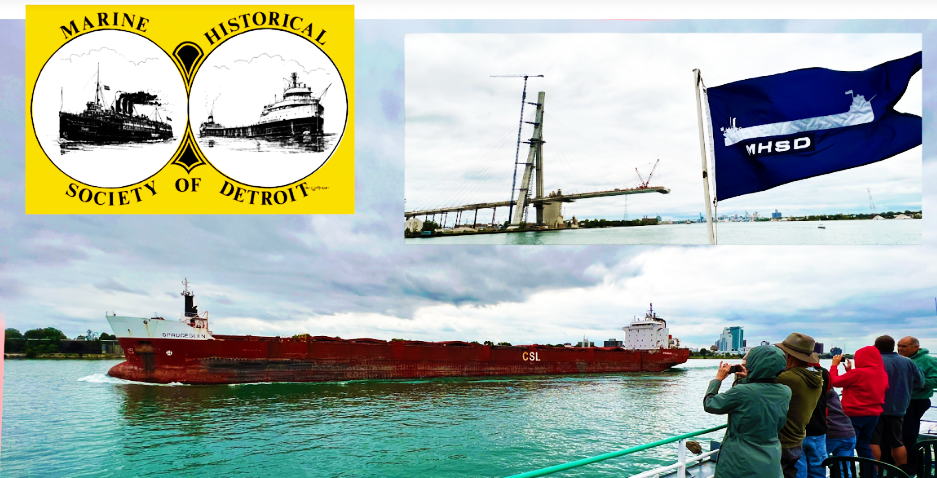
Ticket sales for the annual Marine Historical Society of Detroit’s Detroit River Cruise, scheduled for Saturday, September 7, from 1-4 p.m. aboard the the Diamond Jack River Tours boat DIAMOND QUEEN, are now open to the public.
Passengers will have the opportunity to photograph vessels and historic sites along the Detroit River and enjoy a narration by local history expert Ken Borg. The number of passengers will be limited to 100 so there will be lots of room to move about the boat. Tickets are now on sale at MHSD.org. Or pay by check to the Marine Historical Society of Detroit for $28.50 and mailed to MHSD Cruise,1020 Iroquois, Detroit, MI, 48214. If there are any tickets left the day of sailing, they will be sold at the dock for $30.
Marine Historical Society of Detroit