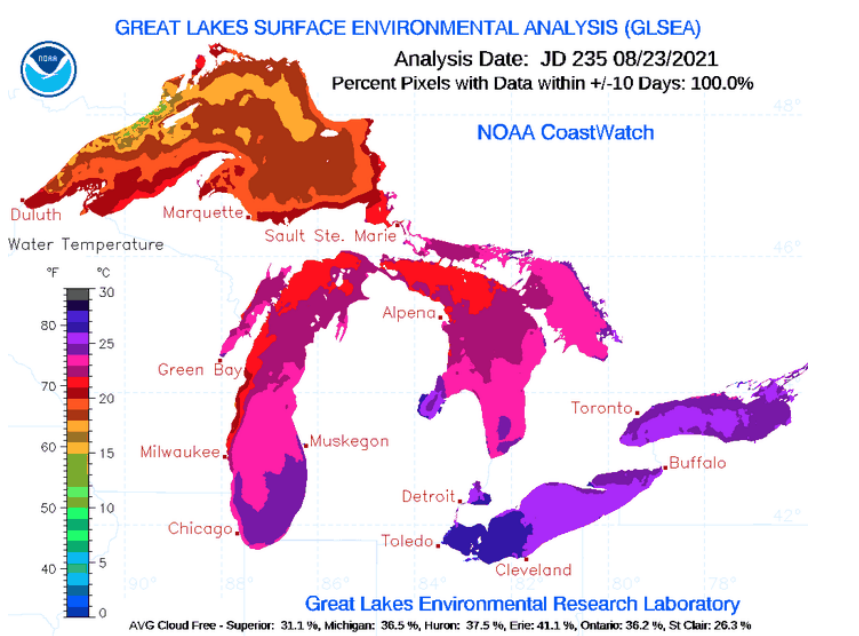
Great Lakes’ water temperatures soaring with recent hot weather
The hot weather in the past week, coupled with sunshine and light wind, have boosted the Great Lakes’ water temperatures. The western third of Lake Erie has warmed up to 80 degrees, or even higher in spots. The southern end of Lake Michigan is at least 75 degrees. Even Lake Superior, which always seems to have cold water, is up to 60 degrees in the coldest spots. The southern shore of Lake Superior has warmed up to around 70 degrees. Southern Lake Michigan has warmed into the mid-70s, and should get warmer over the next week.
Read more at this MLive link: https://www.mlive.com/weather/2021/08/great-lakes-water-temperatures-soaring-with-recent-hot-weather.html?fbclid=IwAR2veqgkGMWh2Xj0QImama8uLkSovbLabEeJPb-tBB41pyo5b1MO6FpvmY4
Duluth port sees ‘vigorous rebound’ as taconite shipments push records
Duluth, MN – The Port of Duluth-Superior has bounced back from last year’s pandemic slump with a standout start to the Great Lakes shipping season, driven largely by taconite shipments. Total tonnage through July reached 15.2 million tons — 31% above 2020 levels and 12% above the five-year average.
“It’s been a good first half of the shipping season so far and a vigorous rebound from the COVID challenges of 2020,” said Deb DeLuca, executive director of the Duluth Seaway Port Authority. Last year the port recorded its lowest tonnage totals since 1938.
“It’s been especially good to see iron ore tonnage jumping back above the five-season average,” DeLuca added, “because it’s a bellwether of positivity for our port and our region as a whole.”
Iron ore shipments from the port to steelmakers around the Great Lakes have reached 9.5 million tons so far in the shipping season, which began in March. At that pace it could be one of the strongest years in a decade.
“The outlook for iron ore appears steady,” said Duluth Seaway Port Authority spokesman Jayson Hron. “The first-half tonnage doesn’t faithfully predict the second half, but there are no major indications of a slowdown in sight.”
Taconite comprises the majority of the cargo that is shipped from the Port of Duluth-Superior, the busiest port on the Great Lakes.
U.S. Steel and Cleveland-Cliffs, which mine and process all the taconite produced on Minnesota’s Iron Range, have both reported record-setting starts to the year. That’s a sharp reversal from the drop in steel demand and steep losses that led to hundreds of layoffs at Iron Range mines last summer.
“Demand for steel is very strong across all sectors, and strong demand supports strong prices,” Cliffs CEO Lourenco Goncalves told investors in a July earnings call after the company reported a record $780 million quarterly profit. “Most of our customers are experiencing record profits and learning that higher prices are good for pretty much everyone in the supply chain.”
U.S. Steel CEO David Burritt said in a July 30 earnings call the 120-year-old company “has its best days ahead” after its best quarterly results — a $1 billion profit — in more than a dozen years.
Across the Great Lakes and the St. Lawrence Seaway, officials said grain is the cargo to watch in the second half of the season, as shipments are substantially behind last year’s pace.
The Port of Duluth-Superior in recent years moved an average of 1.3 million tons of grain annually but so far this season has shipped just 377,000 tons — 40% of last year’s tonnage through July.
“Crop quality, yields and pricing, as well as transportation pricing, will combine as they always do to affect shipments for the remainder of the year,” Hron said. “We’re monitoring the drought conditions to see what effect that will have on crop yield and pricing in the Upper Midwest as
Read the story here: https://www.startribune.com/duluth-port-sees-vigorous-rebound-as-taconite-shipments-push-records/600091171/
Lake Superior Summer: Blue-green algal blooms come to a lake once believed immune
On a calm morning in late summer 2019, Jim Bailey was kayaking on Lake Superior near Thunder Bay, Ontario, when he found himself paddling through thick green scum, the likes of which he’d never seen in those waters. Puzzled, he headed into the open bay where he could see green patches stretching out about 3 kilometers.
Bailey – recently retired as coordinator of the local Remedial Action Plan Office – had his suspicions about what he was seeing. It had been his job to oversee a government office tasked with identifying and controlling local sources of pollution.
He emptied his water bottle, scooped up some scum and headed for shore. Ten minutes after handing his sample to Lakehead University for analysis, his suspicions were confirmed – it was cyanobacteria, a type of algae that can produce toxins harmful to people and wildlife.
“I’ve lived on the lake my entire life, and I’d never seen algae before,” said Bailey. “I knew if it was algae, it would be a landmark and not a good one.”
The incident was the first documented case of a cyanobacteria bloom along Lake Superior’s northern shore in Canada. The previous summer had seen reports of a massive bloom of cyanobacteria – also known as blue-green algae – on the southern side of the lake in the United States.
“The 2018 bloom was the largest ever recorded on the lake,” said Robert Sterner, director of the Large Lakes Observatory at the University of Minnesota Duluth. “One hundred kilometers of shoreline turned opaque green. It was quite extraordinary.”
As the deepest and most northern of the Great Lakes, Superior was once thought immune to algal blooms. It was considered largely devoid of algae-promoting nutrient runoff from surrounding land. But more importantly, it was just too cold, even in summer.
Today, Superior is one of the fastest warming lakes in the world, said Sterner.
Still, it was a shock when the first report of blue-green algae came in 2012, on the shoreline in Wisconsin near the Apostle Islands. There have been several minor blooms since then, the biggest one happening in 2018. This year, a mild winter and hot start to the summer means Superior’s waters are warmer than normal, possibly setting the stage for another substantial bloom.
Read the full story here: https://www.greatlakesnow.org/2021/08/lake-superior-summer-algae-bloom/