Grain gushing out of the Great Lakes this year
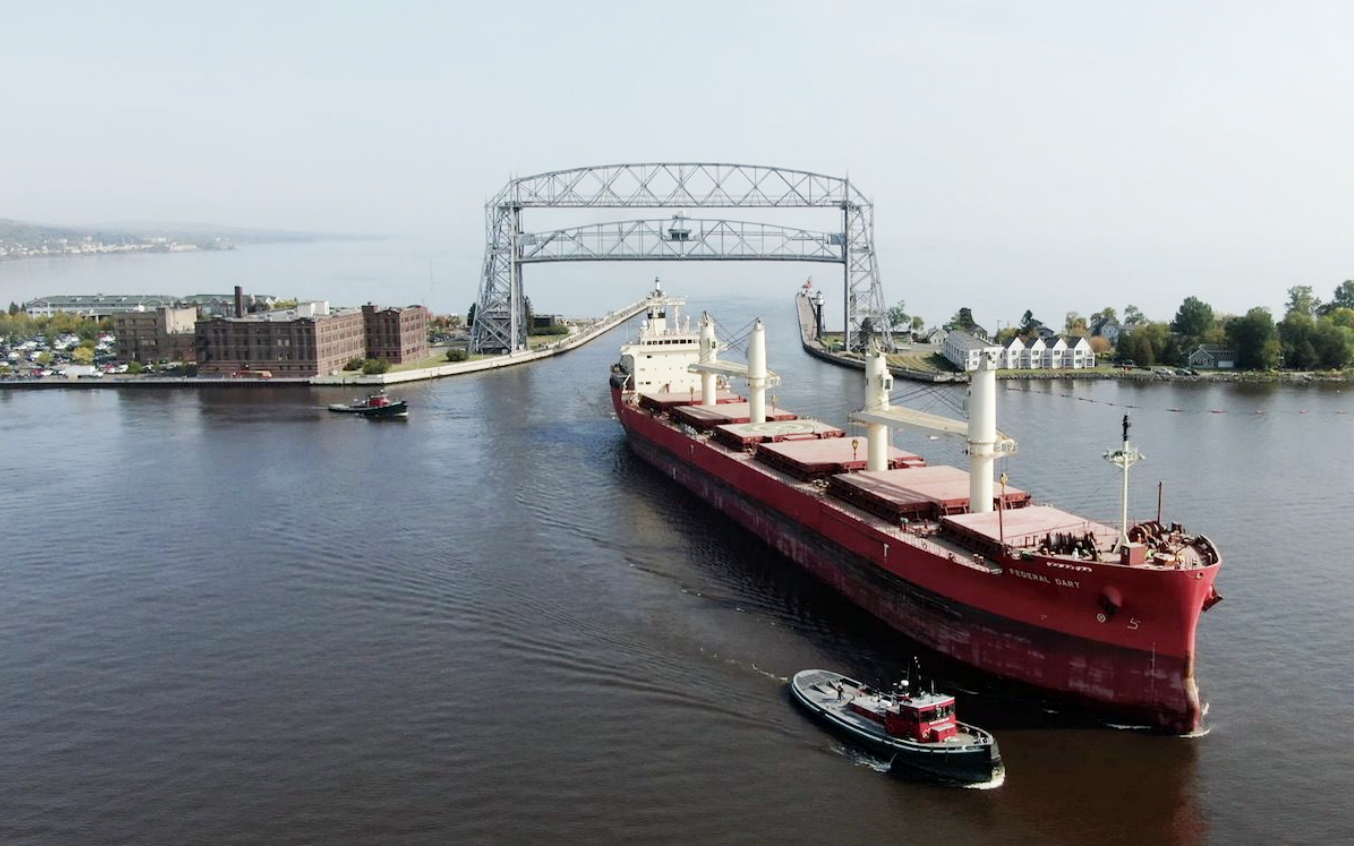
The St. Lawrence Seaway transported 514,000 tonnes of grain out of the Great Lakes between March 22 to the end of July this year. This represents a 37% increase from the same period last year.
The Great Lakes Seaway Partnership’s August report shows that the surge in US grain shipments will help alleviate global food concerns in the wake of the Ukraine war. A minimum of 27 nations have received US Great Lakes grain during the month of July, up from 26 in June.
Ports on the Great Lakes are also increasing investments in facilities and equipment. This is due to a surge in grain exports, road congestion, increasing energy prices, and a supply chain crisis.
“We’re seeing the results of a surge in maritime business that once was the hallmark of Oswego. Our continuing investments of over $26 million include upgrades to our facilities to make the port once again a leader on the lakes,” said William W. Scriber, executive director of the Port of Oswego. “We’re particularly proud that our revenue not only supports our operations but also supports local jobs and businesses without relying on tax dollars.”
Read more at this link: https://gcaptain.com/grain-is-gushing-out-of-the-great-lakes-this-year/?fbclid=IwAR05MfNqgvDmDFdkQ5CYpboK_mFrdteCSUbkC9Q4uzm9STtfVIEe3QYTkjs
gCaptain
Coast Guard Center of Expertise will research possible Great Lakes oil spills
SAULT STE. MARIE. MI – On Aug. 24, Senator Gary Peters officially opened the U.S. Coast Guard National Center of Expertise for the Great Lakes in Sault Ste. Marie.
Located at Lake Superior State University’s Richard & Theresa Barch Center for Freshwater Research and Education, the Center of Expertise will conduct research examining the impacts of oil spills in freshwater environments to help develop effective responses.
Officials said this research is considered critical for the Great Lakes, because it is the largest source of surface freshwater in the world. The Great Lakes are also an important resource to the American and Canadian economies, but because they are freshwater there doesn’t exist any reliable methods to clean up oil spills.
When oil is spilled into saltwater there are various methods of cleaning the oil out of the water. Many of these methods include dispersing the oil and relying on saltwater microbes to eat up the oil particles. These microbes do not exist in freshwater like the Great Lakes, meaning that some of the most effective methods of cleaning oil spill contaminations will not work in the Great Lakes.
The center will have several areas of focus, including:
· Working with academic and the private sector to develop and standardize maritime oil spill response training
· Identifying gaps in Great Lakes oil spill research, including providing assessments of major scientific or technological deficiencies in responses to past spills in the Great Lakes and other freshwater bodies
· Monitoring and assessing the current state of knowledge regarding freshwater oil spill response technologies
· Conducting research, development, testing and evaluation for freshwater oil spill response equipment, technologies and techniques to mitigate and respond to oil spills in the Great Lakes
· Helping train first responders on the federal, state and local level on the incident command structure system and response technologies and strategies
The establishment of this center comes just a few months after an oil spill, originating in Sault Ste. Marie, Ontario, leaked over 5,300 gallons of morgoil oil into the St. Marys River. The Coast Guard and LSSU’s Freshwater Research Center both participated in efforts to clean the river and surrounding Great Lakes areas. This is the same kind of response that will be expected from the Center of Expertise.
The Center of Expertise came to be after Peters was told by the U.S. Coast Guard during a hearing in 2017 that it was not prepared for an oil spill in the Great Lakes. At the time, the Coast Guard cited a lack of science and research in freshwater oil spills compared to saltwater oil spill research. In 2018, Peters signed legislation into law to establish the Center of Expertise and secured $4 million in funding for the initiative. The pandemic delayed the establishment of a permanent location for the center until this year.
The Center for Freshwater Research and Education was chosen because of its unique placement being so close to multiple Great Lakes. Between its location and the fact that it was already conducting research into oil spills in partnership with the U.S. Coast Guard made it the perfect location for this new center.
“We’ve got to understand how we can clean up oil spills, and we’ve got to figure out the science,” Peters said during the ribbon cutting ceremony. “I want to make sure we can respond really quickly should there be a disaster in the Straits of Mackinac.”
Lake Superior State University President Dr. Rodney S. Hanley, U.S. Coast Guard Assistant Commandant for Response Policy Rear Admiral Jo-Ann Burdian and Sault Ste. Marie Mayor Don Gerrie all spoke at the ceremony to open the center.
Sault News
Destroyer celebrates 10 years on the Saginaw river
BAY CITY, MI – A piece of naval history is celebrating a decade of being docked on the Saginaw River.
Visitors of the USS Edison have the chance to learn about the remarkable history of the destroyer while walking through the museum.
“We wanted this to be a community event. We wanted to bring people here and that’s why we were giving away the hot dogs and cake and ice cream,” said Peter Gotzenski, the Vice President of the Saginaw Valley Naval Ship museum. “It was built in 1958 and it served until 1988. It was towed here up on the Saint Lawrence river. It took a month to tow it here.”
The navy destroyer took part in both the Vietnam war and the Cold war, earning a reputation as a top gun ship.
“We’re in the planning stages to make it a more educational thing, do more educational things on the ship. We have a lot of overnights on the ship where we have scout troops come and stay overnight,” Gotzenski said.
“We’re having a ton of fun, and it’s actually really cool to be here in person,” said Drew Matzinger, a boy scout.
All proceeds from the museum go to restoring the ship.
WNEM 5
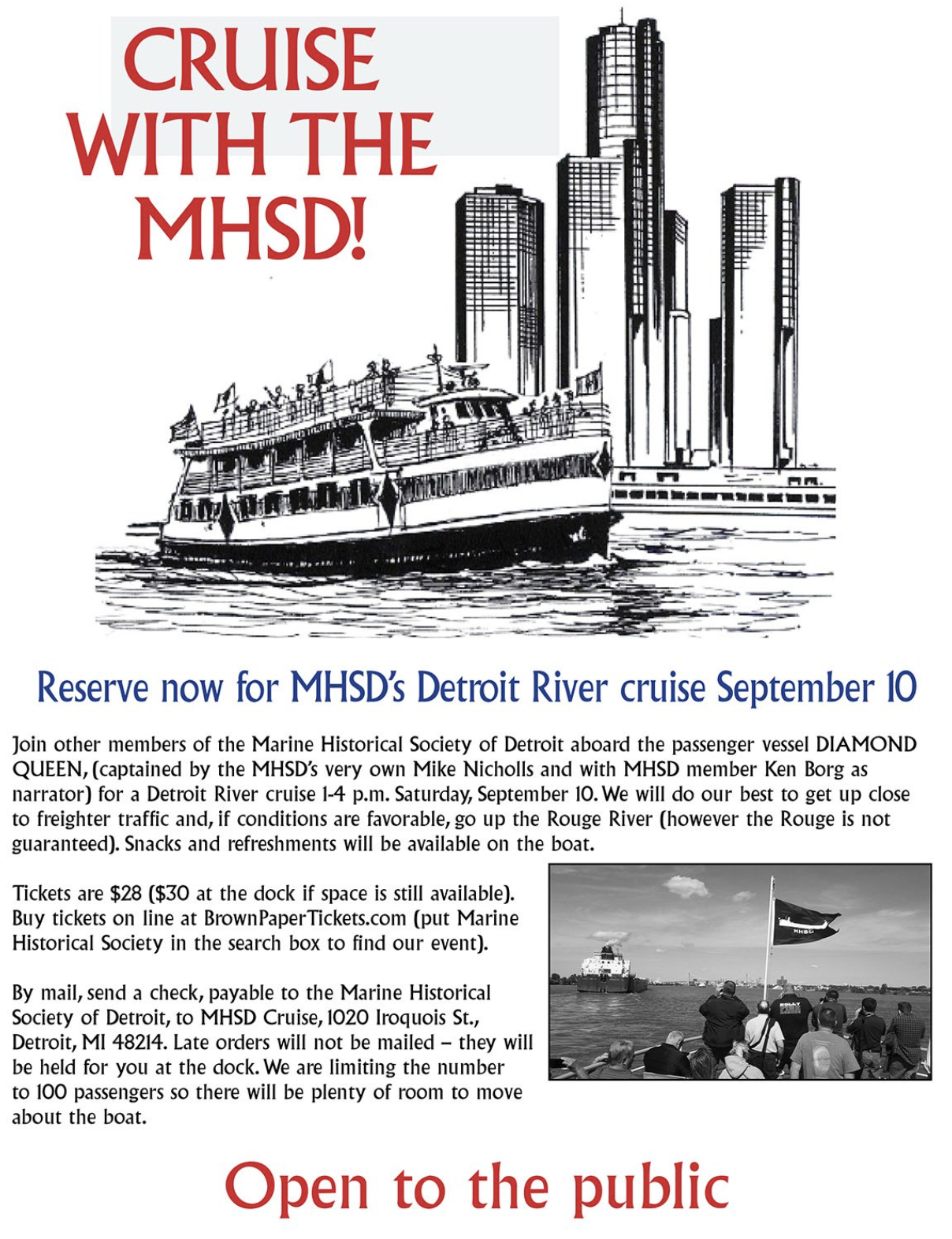
Reserve now for MHSD’s Detroit River cruise on September 10
Join other members of the MHSD aboard the passenger vessel Diamond Queen, (captained by MHSD’s very own Mike Nicholls and with MHSD member Ken Borg as narrator) for a Detroit River cruise 1-4 p.m. Saturday, September 10. We will do our best to get up close to freighter traffic and, if conditions are favorable, go up the Rouge River (however, the Rouge is not guaranteed). Snacks and refreshments will be available on the boat.
Tickets are $28 ($30 at the dock if space is still available). Buy tickets online at BrownPaperTickets.com (put Marine Historical Society in the search box to find our event).
By mail, send a check, payable to the Marine Historical Society of Detroit, to MHSD Cruise, 1020 Iroquois St., Detroit, MI 48214. Late orders will not be mailed – they will be held for you at the dock. We are limiting the number to 100 passengers so there will be plenty of room to move about the boat.
MHSD