BBC Tokyo heads for Great Lakes on maiden voyage
BBC Tokyo arrived at Montreal Friday morning for a stopover on its maiden voyage. She is headed to Erie, PA, with wind turbine components from Tuticorin, India where it left 37 days ago.
René Beauchamp
Sailors sorely needed in Michigan, US. Can Trump push help?
TRAVERSE CITY, MI — Cary Godwin has spent this summer training a group of 10 cadets at the Great Lakes Maritime Academy to sail a tugboat.
During the last week of class this month, he leaned back and watched as his students navigated a vessel called the Robinson Bay — which is new to the academy’s training fleet — in and out of the academy’s harbor in Grand Traverse Bay on Lake Michigan.
“It’s a difficult harbor to make an approach to, because there’s not a lot of room to make a mistake,” he said. “I’ll speak up if I see anything that’s wrong.”
Cadets have come from all over the country to earn a bachelor’s degree and a Coast Guard third mate license in Traverse City. The Great Lakes Maritime Academy, part of Northwestern Michigan College, is one of just seven Coast Guard-credentialed maritime academies in the country where students learn to operate the nation’s fleet of commercial ships.
From the outside, US commercial shipping may look like an industry past its prime. The American fleet, called the US Merchant Marine, comprised 16% of the global commercial fleet in 1960. Now, it makes up less than half of a percent of commercial ships worldwide. In 2024, there were 185 US-flagged oceangoing cargo ships and 43 cargo ships on the Great Lakes, numbers that have steadily declined for decades.
But from the vantage point of the Robinson Bay, mariners are optimistic.
Newly graduated cadets have been in high demand after the coronavirus pandemic led to a wave of early retirements of merchant marine officers. And the Merchant Marine has a powerful new supporter interested in expanding its ranks: President Donald Trump, whose administration has called for “resurrecting America’s maritime industry.”
“The job opportunities for cadets graduating from a maritime academy — any of them — have not been seen since the end of the Vietnam War,” said Rear Admiral Jerry Achenbach, who has led the Great Lakes Maritime Academy for 15 years.
A 2017 study by the US Maritime Administration estimated that the US was short at least 1,800 mariners, and, though it’s hard to find more recent numbers, most in the industry say things have gotten worse since the pandemic.
The US Naval Institute considers that a vulnerability, since the Merchant Marine can be called up to serve the military during a war.
“Each administration has their passions… This is not pro-current administration, nor is it con — I’m fiercely independent,” said Achenbach. But he said the Trump administration “understands the importance of the maritime industry to the United States.”
Shipping industry looking for new mariners
The Great Lakes Maritime Academy is like the smallest, scrappiest sibling of the seven official maritime academies across the country. It enrolls just 200 students, compared to schools in Texas, California and New York that enroll more than 1,000 students each. It’s the only one run out of a community college.
But the graduates are getting jobs. Some make more than $100,000 a year upon graduation. Companies all over the country are competing for a relatively small group of recent graduates from the country’s maritime academies.
“The companies will come in,” explained instructor Dan Zassick, “and they’re like, ‘We’re buying pizza … who wants to work for us?’”
It’s a non-traditional lifestyle. The job involves months-long contracts on a ship or port, and sometimes, months of paid vacation in between. Godwin, the Great Lakes Maritime Academy instructor, caught up with one cadet this summer who has made the most of it.
“He graduated a few years ago. He basically doesn’t own a house. He works for two or three months, and then gets off, and then travels through Asia, travels through Europe,” said Godwin. “He just goes wherever he wants, does whatever he wants, and then goes back to the ship.”
The months at sea can be a hard sell, and many cadets opt for jobs that are “portside,” where they can stay in one place.
Nonetheless, the industry is trying to attract some new energy.
“The maritime force is getting older,” said Eric Hansen, port officer at Andrie LLC, a shipping company based in Muskegon. “A lot of the captains right now are getting close to retirement … In the next five years, at least with our company, there’s probably going to be a big push to hire more.”
That is true for many companies on the Great Lakes. The Interlake Steamship Co., which operates the largest US-flagged fleet on the Great Lakes, confirmed there’s high demand for third mates with the right certifications.
“A very large number of senior people retired due to COVID,” said Achenbach, of Great Lakes Maritime Academy. “And when that happened, everybody (else) moved up quickly. So all of a sudden you have this real void at the entry-level position.”
In an April executive order titled “Restoring America’s Maritime Dominance,” Trump called for expanding federal funding for building ships, making them competitive in international commerce, and “strengthening the recruitment, training, and retention of the relevant workforce.”
According to Achenbach, the federal Department of Transportation reached out to each maritime academy this spring with a survey on what it would take to expand their school.
“We had to tell them what resources would be needed to add 50 seats to the academy, 100 seats, 150 or 200 seats,” he said. “I think right now, the Department of Transportation is determining the best approach to developing more mariners.”
The Department of Transportation’s Maritime Administration did not make anyone available for an interview about plans for expanding the pool of maritime cadets, nor did the agency answer specific questions about the survey. Instead a spokesperson provided this statement:
“President Trump’s Executive Order gave Transportation Secretary Duffy and the Maritime Administration a mandate to restore America’s maritime dominance. While the previous administration put offshore wind projects ahead of hardworking American mariners, we are laser-focused on revitalizing the maritime workforce pipeline to ensure our ships have the talent needed to protect our national security and drive economic prosperity.”
The Traverse City school hasn’t gotten any extra boosts yet, beyond the existing support they get from the federal government for boat maintenance and fuel costs. The Robinson Bay, the school’s new boat, was donated in 2024 under former President Joe Biden’s administration.
So far, the Trump White House has only announced federal investment in building ships and developing shipyards. That won’t do much for training mariners to enter the US Merchant Marine.
“You need mariners to man the ships, and you need shipyards or shipyard workers to build them. I think right now we’re lacking both capabilities.” said Jim Weakley, of the Lake Carriers Association, a Great Lakes shipping lobby. “That’s why we need places like Great Lakes Maritime Academy to keep churning out graduates.”
There are serious hurdles to building up the nation’s maritime industry to the extent that Trump proposes. Ships are far more expensive to build here than in other countries, especially China and South Korea. Even if they are built here, shipping companies may choose not to sail under a US flag because it’s cheaper to hire officers and crew from overseas.
But if the ships do sail under a US flag, companies will compete for the same pool of maritime grads who already have their pick of entry-level jobs.
Much like the rest of the US shipping industry, the Great Lakes Maritime Academy’s new training tugboat is steeped in nostalgia.
The Robinson Bay was launched in 1958. It was donated to the school from the federal government last year, after decades operating on the St. Lawrence Seaway. It has an almost entirely wooden interior that Zassick says would violate modern fire safety codes.
“It’s called a Class A fire hazard,” he said, but “if your boat was laid down and built before that was a rule, you can keep it so long as you don’t rip it out.”
Weakley, of the Lake Carriers Association, said that, in his 40 years in the industry, he’s only seen a federal boat donated to a state academy two or three times.
The boat was decommissioned at an official ceremony in Massena, New York. Both Weakley and Achenbach were there, among a crowd of former crew members.
“(The crew) saved some people’s lives,” said Weakley, “and some of the people that had been saved were there.”
“I made a comment that there weren’t a lot of jackets and ties in the audience,” said Achenbach. “There were a lot of flannel shirts there. There is a real love and pride for that vessel on the Great Lakes Seaway.”
The Robinson Bay has a small kitchenette where cadets brew coffee and cook breakfast and lunch each day. And behind a door in the lounge, past a couple old couches, cadets can access the boat’s giant, roaring engine, strong enough to push and pull on cargo barges.
The cadets and their deck instructors have spent most mornings this summer looking out over Lake Michigan from the boat’s pilothouse, which Godwin called “the best office in town.” They’ve travelled much of northern Michigan’s coastline, from Traverse City to Mackinac Island.
The official endorsement cadets get aboard the tugboat will open up more job opportunities for them. There are 5,000 vessels made for towing in the US fleet, compared to just a couple hundred US shipping vessels the grads usually look for work on. And job opportunities on articulated tug and barges (ATBs) — tow vessels attached to cargo vessels — are growing throughout the industry.
Cadet Bryce Wise-Brown, from Louisiana, chose to get his tugboat endorsement this summer in Traverse City because he heard about growing job opportunities on ATBs back home.
“I plan on making a career out of the maritime industry,” he said. “I’m trying to get any and every endorsement the academy offers.”
Achenbach, the school’s superintendent, said he’d like to see the school offer an associate degree one day, specifically for operating towboats.
“There are a lot of people in Michigan that would love to go to GLMA, but four years is beyond what they can afford. If we could develop a program where they get an associate degree and a license to work on towboats in two years, then they will make 90(% to) 95% of what you do on the deep draft, the larger vessels,” he said.
And Achenbach thinks Northwestern Michigan College is the right place for a program like that.
“Being a community college where, if you give us a dollar we beat it like it owes us a dollar, I think it could be a really positive thing for northern Michigan,” he said. “Actually, for the entire state.”
This reporting is made possible by the Northern Michigan Journalism Project, led by Bridge Michigan and Interlochen Public Radio, and funded by Press Forward Northern Michigan.
Read the story and view photos at this Bridge Michigan gallery:
Edmund Fitzgerald Memorial Swim completes 411-mile journey across Michigan
DETROIT, MI – The Edmund Fitzgerald Memorial Swim has successfully completed its 411-mile journey across Michigan, symbolically tracing the route of the famous freighter that sank in Lake Superior in 1975.
Though the relay took one day longer than planned, the swimmers finished the route on Wednesday (Aug. 27) at the Detroit Yacht Club on Belle Isle. The month-long swim began near the Fitzgerald shipwreck site. The finish was met with applause, including from family members of the Fitzgerald sailors, honoring the memory of those lost in the tragedy.
View videos here: https://www.clickondetroit.com/news/local/2025/08/27/edmund-fitzgerald-memorial-swim-completes-411-mile-journey-across-michigan/
Davie Shipyard Begins Construction of Canada’s Flagship Polar Max Icebreaker
Davie shipyard has officially commenced construction on Canada’s flagship Polar Max icebreaker, marking a significant milestone in the country’s Arctic capabilities development. The steel cutting ceremony, held today in Lévis, launches a project that will deliver one of the world’s most advanced polar vessels by 2030.
The Polar Max represents a departure from traditional Canadian shipbuilding approaches, employing a hybrid construction strategy between facilities in Finland and Canada. Initial hull construction will begin at Davie’s Helsinki Shipyard, which has established itself as a premier icebreaker builder, having constructed all complex medium to heavy icebreakers delivered from Finland over the past quarter-century.
The majority of construction work and final delivery will occur at Davie’s home facility in Lévis, which is currently undergoing an CAD $840 million modernization. This strategic approach aims to accelerate delivery by several years compared to the original timeline while facilitating technology transfer and expertise development within Canada’s maritime industry.
“Today’s steel cutting ceremony is more than the start of construction of one very special ship. It’s the start of a new chapter in Canadian Arctic leadership,” said James Davies, CEO of Davie. “The Polar Max represents how trusted allies can collaborate to deliver strategically vital projects when they are needed most. We want to thank the governments of Canada and Québec for their vision, and we are determined to deliver this ship on time and on budget.”
The Polar Max will be 22,800 tonnes with a length of 138.5 meters. It will be the first newbuild project at the Helsinki Shipyard under Davie’s ownership.
The project features several notable aspects, including a fixed-price contract structure designed to ensure on-time delivery, approximately $200 million investment in small and medium-sized Canadian businesses throughout the supply chain, and the creation of thousands of high-value jobs across Québec and throughout Canada’s marine sector.
A key industrial partnership within the project involves Le Groupe ALMACO, a Canadian subsidiary of ALMACO Group, which will handle a major outfitting contract for the vessel. This collaboration is expected to establish Canada’s first modular cabin factory in Québec.
Alex Vicefield, Chairman and CEO of Inocea, Davie’s parent group, highlighted the company’s unique position: “Davie is uniquely positioned to deliver a ship as advanced and strategically important as the Polar Max. With a global footprint, including our soon-to-be upgraded Lévis facility and the renowned Helsinki Shipyard, we combine the world’s best polar shipbuilding expertise with the strength, skill and unique Davie spirit of our Canadian workforce.”
The Polar Max project forms part of the Icebreaker Collaboration Effort (ICE Pact), a trilateral initiative between Canada, Finland, and the United States focused on polar icebreaker development. When completed, it will be the first polar icebreaker built through collaborative efforts between European and North American facilities.
Designed to operate in extreme conditions, the vessel will support Canada’s Arctic sovereignty, scientific missions, environmental protection, and maritime security operations.
gCaptain
National Museum of the Great Lakes announces fall lecture series lineup
TOLEDO, Ohio – The National Museum of the Great Lakes (NMGL) has announced its 2025 fall lecture series lineup, featuring historical talks and presentations on Great Lakes history.
In a press release, NMGL said the three-lecture series would be offered in a hybrid format, with in-person attendance and virtual options offered. It is free to attend the lectures, but registration is required.
NMGL said these lectures are a way for the museum to expand the scope of its educational and historical programming beyond its permanent exhibits.
Below are the lectures the museum has planned for the coming months:
“Transports and Blockade Runners: Great Lakes Steam and Sea in the Civil War”
Tuesday, Sept. 10, 2025 | 7 p.m. – 8:30 p.m.
This lecture explores steamers involved in Great Lakes trade that were pressed into Civil War service. These steamers vanished, leaving behind rumors and mysteries. Maritime historian Walter Lewis will lead this lecture.
“Iron Diamond: The Living Legacy of the Shenango Fleet”
Wednesday, Oct. 15 | 7 p.m. – 8:30 p.m.
Paul C. LaMarre III, Port Director for the Port of Monroe, as well as award-winning photojournalist Christopher Winters, will talk about a fleet of Great Lakes liners that rivaled trans-Atlantic ships in their engineering quality and magnificent guest quarters. This talk will also feature information on NMGL museum ship, the S.S. Col. James M. Schoonmaker, as well as the museum’s recent expansion.
“The Gordie Howe International Bridge: Opening Soon”
Wednesday, Nov. 19, 2025 | 7 p.m. – 8:30 p.m.
Associate Vice President of Stakeholder and Community Relations for the Windsor-Detroit Bridge Authority Stephanie Campeau will discuss the ongoing construction of the Gordie Howe International Bridge, which will serve as a new bridge connecting Detroit to Windsor, Canada.
To register for individual lectures: https://nmgl.org/events/
Marine Historical Society of Detroit
Now Accepting New Members, Renewals
DETROIT, MI – You don’t have to live in the Motor City to join the Marine Historical Society of Detroit. Its focus includes all the Great Lakes and St. Lawrence Seaway as well as the ships and sailors keeping the economies of two countries moving.
The 81-year-old non-profit group is now accepting new memberships and membership renewals.
“The MHSD has plenty to offer anyone interested in and concerned with the history of the Great Lakes and its vibrant maritime heritage,” says long-time group President Roger LeLievre. “We have members across the U.S. and Canada and even overseas.”
Membership includes the monthly publication The Detroit Marine Historian, which offers a variety of articles exploring Great Lakes shipping past and present. It also includes an annual, full-color calendar featuring superb, often rare, photos of Great Lakes ships of the past.
Last year the group published the 300-page, hardcover book Ahoy & Farewell III, documenting the vessels built and those that left the lakes during the past 30 years. The book recently won an award for excellence from the Historical Society of Michigan.
In keeping with society’s goal of preserving historical images, the MHSD’s image portal, featuring photos and details of many historic vessels, is now online at www.marinehistorydetroit.historyit.com
The Society has named an annual Historian of the Year since 1969. The award is voted on by past winners and honors those who have contributed significantly to the research, presentation or publication of Great Lakes ships and the shipping history.
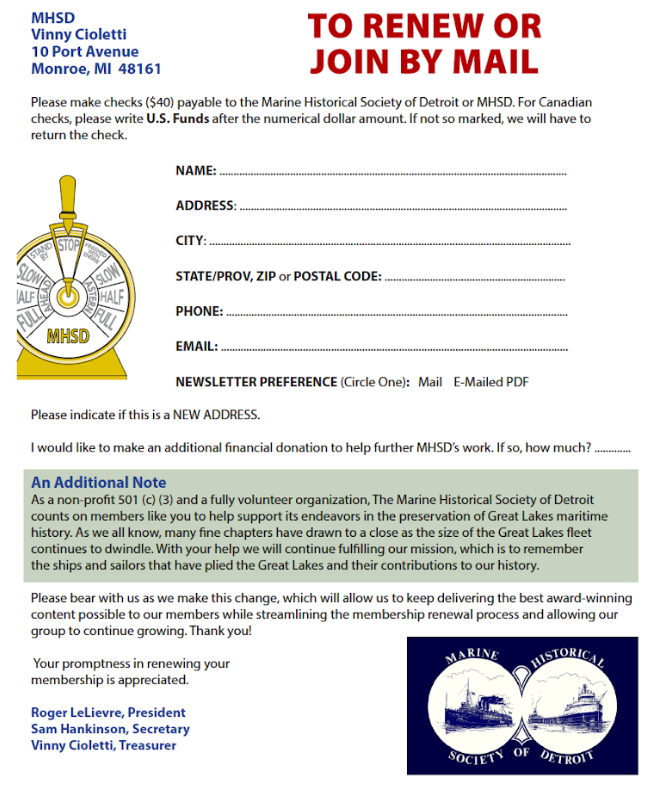
Membership is $40 (U.S. and Canada). Join online at www.mhsd.org. To join or renew by mail, please print out the form in the gallery below.
MHSD
Cleveland Boatnerd Gathering Planned Sept. 6
Cleveland’s first annual Boatnerd get together will be at the Whiskey Island Still & Eatery in Cleveland on September 6 at noon. Join us for an informal gathering of food, fellowship and hopefully some boat watching as well. Meet your fellow area boat fans! Food will be ordered off the menu and table service provided by the staff of the restaurant, which is located adjacent to the historic C&P Dock, where the 1,000 footers unload.
Directions and info for the restaurant: https://www.whiskeyislandstillandeatery.net/
Bill Kloss
See “Captain Bob” September 11th
See “Captain Bob” former Captain of the Paul R Tregurtha, in Cheboygan next month for his speaking engagement, GREAT NEWS!! Due to his first show SELLING OUT in record time, they are adding a SECOND SHOW!! Same day but at 5:30pm so if you’re interested, head to the website shown at the bottom of the image (Open it up to see it full size) and grab tickets!! They are only $10 each!! Hurry before this show sells out as well!!
See Photo Gallery below
2025 Luck of the Lakes Raffle Includes Ship Trips
Your raffle ticket purchase supports the Great Lakes Historical Society and its National Museum of the Great Lakes whose mission is to preserve, share, and celebrate the past, present, and future of the Great Lakes story.
Details here:
https://nmgl.org/2025lolraffle/?fbclid=IwY2xjawMDBTFleHRuA2FlbQIxMABicmlkETFZUGV4UFMxNFFGYUpPbTZ2AR5OikAHiWMuo30CZrAqM9nuK93_xmmqYBsoAerabXJ3sBlZWNxpz7mZwoLuFw_aem_1pxrUONQfReTGS4dlnAgzg
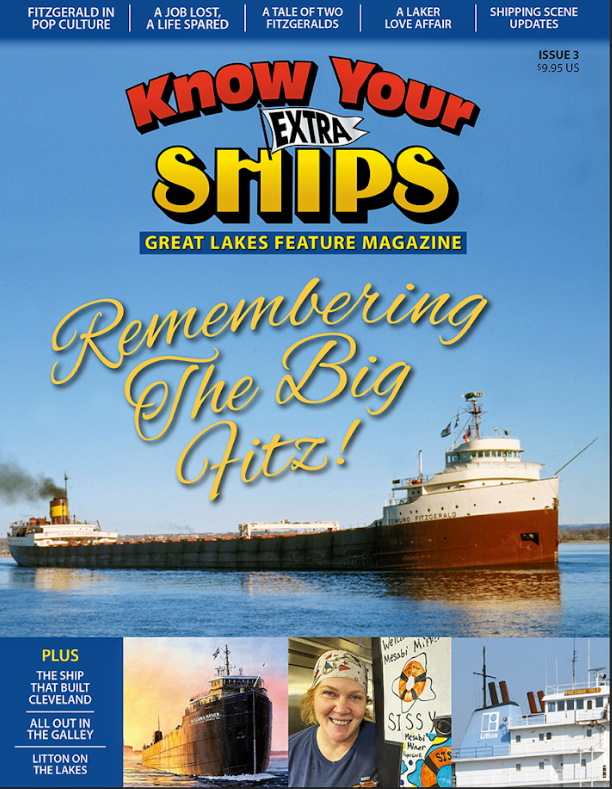
Know Your Ships EXTRA Magazine 2025 Released
When Patrick Devine found out, in the summer of 1975, that he was being moved over to the Edmund Fitzgerald as a relief deckhand he was on top on the world. He had gone from one of the oldest boats in the fleet to one of the newest and best. He was devastated when union rules forced him off that September. He had lost his dream job. Then came the sinking and its horrific aftermath. He hasn’t talked about his experience until recently, and he gave Know Your Ships an exclusive interview for the 2025 Know Your Ships EXTRA midsummer magazine, now on sale.
The magazine also includes an interview with Great Lakes top cook Sissy Payment. Find out her recipe for success and learn something surprising about her in the story.
EXTRA 2025 remembers the loss 50 years ago of the EDMUND FITZGERALD with four stories.
- EXCLUSIVE! Meet Patrick Devine, who thought he had found his dream job when he signed on to the Fitz as a relief deckhand in June 1975.
- Explore the Fitzgerald’s influence in popular culture: Music, art, literature and – yes – souvenirs.
- Did you know there were two vessels named Fitzgerald on the Great Lakes, and both were lost in November storms? And yes, their namesakes were related.
- Consider what might have been if the Fitz had not gone down.ALSO
Check out the Great Lakes Lore Museum at Rogers City, MI, where sailors are in the spotlight.
- Read about the William G. Mather, the ‘Ship That Built Cleveland,’ which turns 100 this year.
- Litton on the Lakes: Find out how a group of California upstarts turned the Great Lakes shipping industry upside down in the 1970s with their fancy ideas about 1,000-footers.
- Catch up with the latest Great Lakes/Seaway news.
- Enjoy even more images from readers in the ongoing series FAN-TASTIC PHOTOS.
This is the third year for the Know Your Ships EXTRA Magazine, which offers even more ship, sailor and industry stories, recent shipping news and many more of the stunning photos – current and historic – for which Know Your Ships has become known for the past 66 years. Please note that the Extra, which is a feature magazine, does not duplicate the vessel and fleet listings found in the regular Know Your Ships book.
Order at www.knowyourships.com