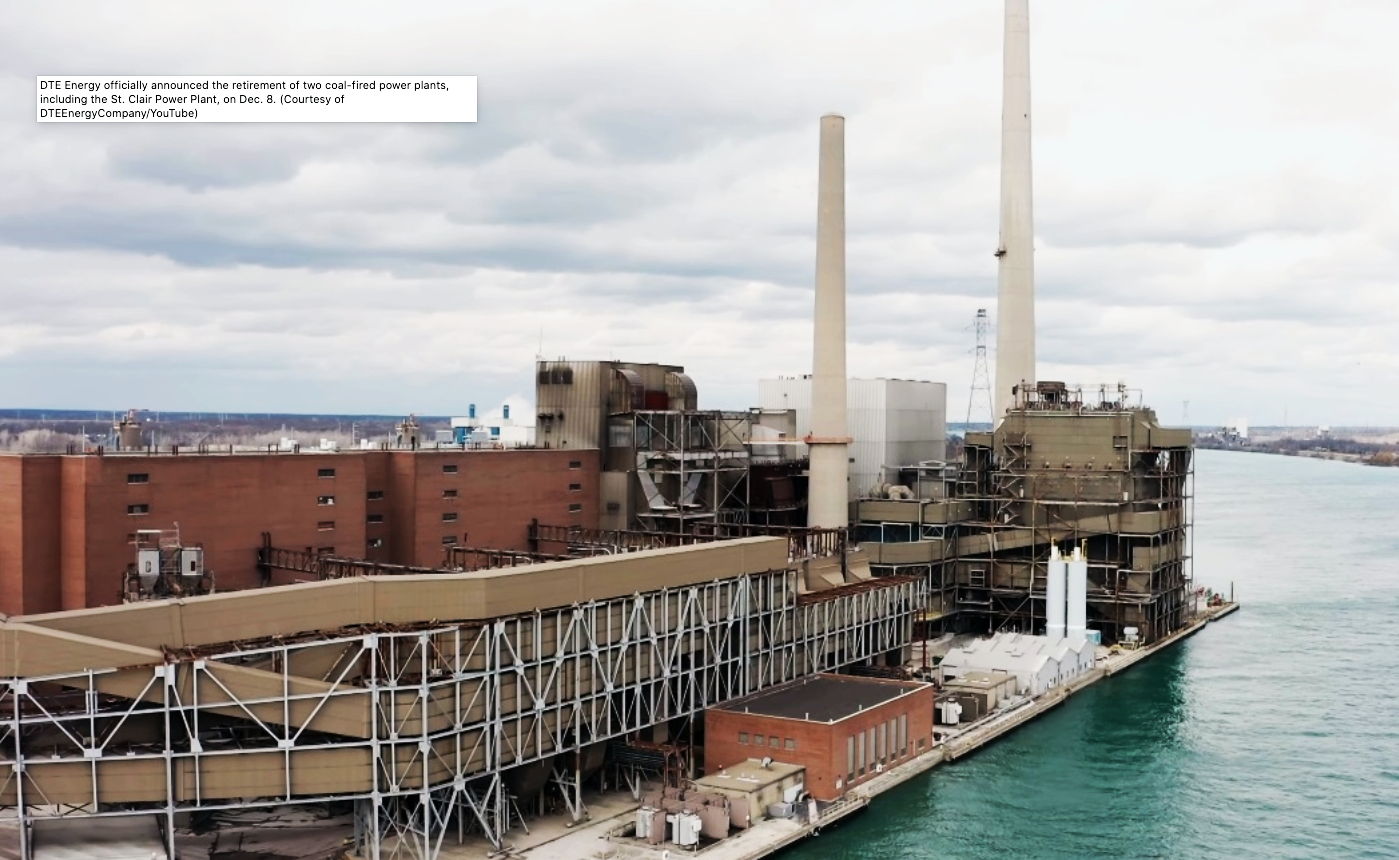
DTE Energy officially retires St. Clair Power Plant
ST. CLAIR, MI – DTE Energy last Thursday officially announced the retirement of the St. Clair Power Plant and is retraining displaced workers for jobs elsewhere in the company.
Michigan’s largest producer of clean energy has retired the facility, along with the Trenton Channel Power Plant in Trenton, in an effort to bring southeast Michigan closer to a carbon-free future with more affordable and reliable energy.
“Retiring these plants is another step in DTE’s plan to deliver affordable, reliable and clean energy through a modern grid that meets the needs of our customers’ changing lifestyles and our state’s new economy,” DTE Chairman and Chief Executive Officer Jerry Norcia said in a news release. “These steps today will lead to a cleaner environment and energy future for Michigan families, communities and businesses.”
For nearly 100 years, the St. Clair and Trenton Channel power plants served southeast Michigan residents. The St. Clair Power Plant began operations in 1953, while the Trenton Channel Power Plant was built in 1924 to address the growth of Michigan’s post-World War I and II economy. Following the end of WWII, the St. Clair plant was commissioned, and at its peak, provided nearly 2,000 MW of electricity to power the growth of Michigan’s businesses and manufacturing sector.
This past summer, DTE began the long-planned retirement of both plants, placing the St. Clair facility on standby-only status to meet periods of high customer demand or extreme temperatures.
With the year drawing to a close, DTE has officially retired both plants, and employees at both locations were offered opportunities to continue to work for the enterprise.
DTE said it is continuing to make progress on its clean energy journey by transitioning from coal to cleaner sources of energy such as renewables and natural gas. On Nov. 3, the company released its CleanVision Integrated Resource Plan, a 20-year proposal to transform how the company generates electricity as part of its clean energy journey.
The Voice
Federal labor regulators and Superior police investigating death of worker at Superior shipyard
SUPERIOR, WI – Federal labor regulators and Superior police are investigating the death of a worker who fell off a ship Monday at Fraser Shipyards in Superior.
The Superior Police Department said police, fire and emergency services responded to a call around noon yesterday for a man who fell about 50 feet from a boat in dry dock at the shipyard.
Police said the deceased is a 64-year-old man from Watertown, Wisconsin. His name is being withheld pending notification of the worker’s family. Authorities say they don’t suspect foul play at this time.
A spokesperson with the U.S. Occupational Health and Safety Administration confirmed Tuesday the federal workers’ safety agency is also investigating the incident. The agency said the man was employed with Gillett-based sandblasting company C&L Contracting.
“Preliminary information is that an employee was standing on a railing in order to pull a tarp, and he slipped and fell, landing in the dry dock area,” an OSHA spokesperson said in an email.
Officials with Fraser Shipyards were not immediately available for comment on Tuesday.
The man’s death is the second at the shipyard in five years. Welder Joe Burch died in 2017 after being severely burned on the job. Federal labor regulators fined Fraser around $12,000 after discovering the man wasn’t wearing protective gear.
The next year, more than 60 workers reached a $7.5 million settlement with the shipyard for exposure to unsafe lead levels while working on a Great Lakes ship in 2016. A report by Wisconsin and Minnesota health officials released in 2017 showed 171 out of 233 workers tested had blood lead poisoning.
A federal worker’s safety agency fined Fraser $1.4 million for safety violations in 2016. The shipyard later reached a $700,000 settlement without admitting fault or liability after the agency cited them for 14 violations related to lead exposure.
Fraser Shipyards has been operating in Superior for more than 130 years.
Wisconsin Public Radio
Lake Superior gains astounding 6 trillion gallons in same time Lakes Michigan, Huron lose 7 trillion
Lake Superior’s water level has moved dramatically in the opposite direction from the other four Great Lakes.
The Great Lakes are in the normal seasonal decline. As the air turns colder, precipitation amounts are lower. At the same time, the big temperature difference between near the water surface and higher altitudes creates more evaporation. Lake Superior water levels and the rest of the Great Lakes usually decline from November to December.
This year, Lake Superior declined one inch from November to December. The rule of thumb from Keith Kompoltowicz of the U.S. Army Corps of Engineers is one inch of water on Lake Superior equals 550 billion gallons of water. Lake Superior lost 550 billions gallons of water then in the last 30 days.
Last week I wrote how Lakes Michigan and Huron actually declined quite a bit for November, losing over 3 trillion gallons of water.
When we look at the bigger picture of water level movement on the Great Lakes, most of the Great Lakes had receding water levels in the past year. This is not the case for Lake Superior.
Read more at this MLive link: https://www.mlive.com/weather/2022/12/lake-superior-gains-astounding-6-trillion-gallons-in-same-time-lakes-michigan-huron-lose-7-trillion.html
Related story at this MLive link: https://www.mlive.com/weather/2022/12/lake-michigan-lake-huron-lose-over-3-trillion-gallons-of-water-in-november.html