Salvage vessels head to Tim S. Dool
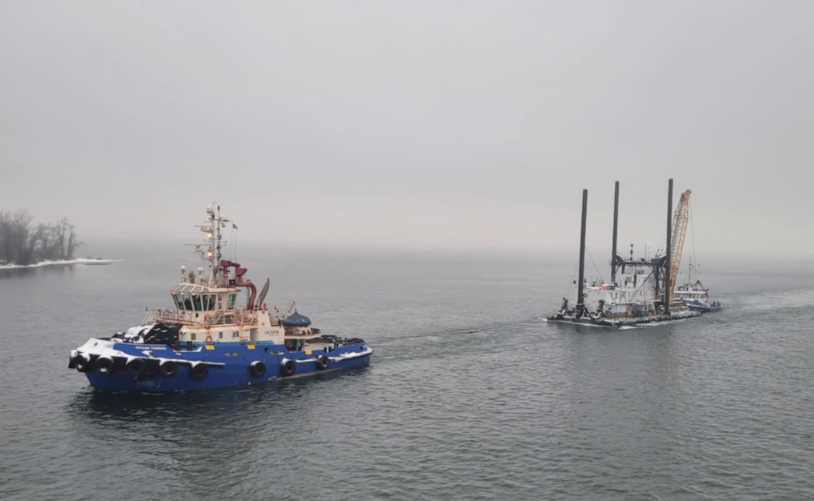
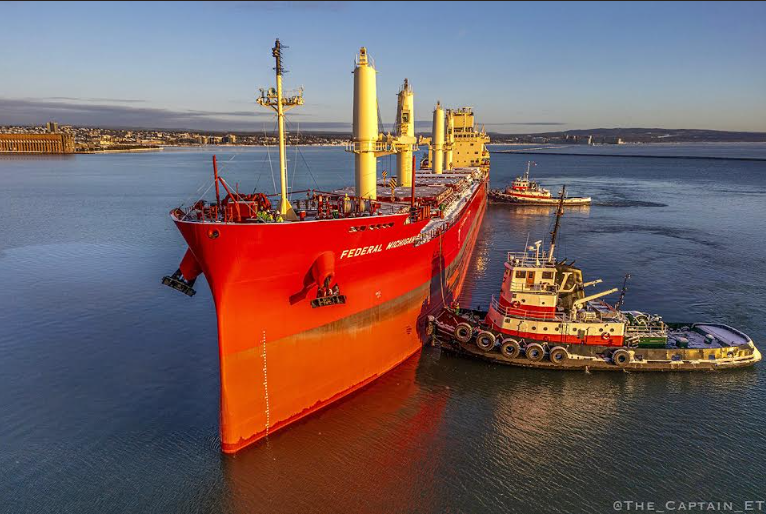
The Océan Group team of tugs and barges is on its way to Chrysler Shoal where the Tim S. DOOL has been grounded since Nov. 23, with no success with refloating her.
Who’s assigned to the recovery team so far?
OCÉAN CATATUG 2 – A small catamaran tug built in 2016 by Industries Ocean Inc. for Le Groupe Océan. She’s usually used for dredging and construction projects. She will be used to move the barges around and keep them in place.
OCÉAN TUNDRA tug and OCÉAN AQUA tug – at the bow and stern of the barges.
OCÉAN BORROMÉ VERREAULT dredger/crane barge will be spudded down and hopper barges tied off her.
OCÉAN BARGES BIG 01 & 02 – these are big bulk cargo hopper barges – approximately 200′ long/36′ wide/13′ tall. Carrying capacity of 1750 MT.
Ship Junkies – Lakes, Locks & Rivers (LL&R)
Great Lakes Iron Ore Trade Down in November
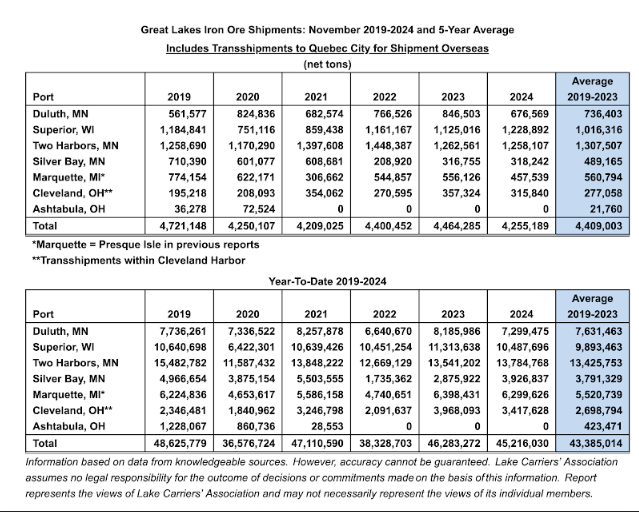
CLEVELAND – Shipments of iron ore on the Great Lakes totaled 4.3 million tons in November, a decrease of 4.7 percent from 2023. Shipments were below the month’s 5-year average by 3.5 percent.
Year-to-date the iron ore trade stands at 45.2 million tons, a decrease of 2.3 percent compared to the same point in 2023.
Through November iron ore loadings are 4.2 percent above their 5-year average for that timeframe.
Since 1880, Lake Carriers’ has represented the U.S.-flag Great Lakes fleet, which today can move more than 90 million tons of cargos annually that are the foundation of American industry, infrastructure, and power: iron ore, stone, coal, cement, and other dry bulk materials such as grain, salt, and sand.
[See Charts in gallery below]
Lake Carriers’ Association
Port of Thunder Bay enjoying ‘generational’ cargo records
THUNDER BAY, ON — With about one month still left in the shipping season, the Port of Thunder Bay is enjoying what port officials are describing as “generational” cargo volumes this year.
“We’re expecting a really good finish here,” said Chris Heikkinen, CEO of the port authority.
To the end of November, the port has established modern-era records for key cargoes including potash and phosphate fertilizer.
Fertilizer shipments, which are handled inbound at Keefer Terminal, have also contributed to the terminal seeing its highest annual cargo volume in decades.
Potash, shipped from the port’s dry bulk terminals, has doubled in tonnage from the same month last year, reaching a level last reported four decades ago.
The Thunder Bay Port Authority also reported Monday that grain volumes in November held strong in the wake of significant gains experienced over the previous two months, leaving the year-to-date volume more than 500,000 metric tons higher than the five-year average.
Heikkinen said that, overall, this is shaping up to be the best shipping season in over 25 years.
“It’s great to see increases especially in the diversity of the cargoes we’re having. Every ton means more work for local people. So it’s our objective always to try to increase and diversify the marine cargoes coming through the port. Right now, we’re having some success, and that means more dollars for our local economy.”
The strong shipping season is reflected, as well, in the number of ships visiting Thunder Bay, with 432 vessels tying up by the end of last month, compared with only 388 a year ago.
According to the latest data provided by the port authority, activity in the port contributes $370 million to the city’s economy each year and is responsible for maintaining about 1,000 jobs.
Michigan Infrastructure Office Announces
Drummond Island Infrastructure Project
LANSING, Mich.—On Monday, the Michigan Infrastructure Office announced the start of upgrades at the Drummond Dolomite facility on Drummond Island, a project designed to improve efficiency, enhance safety for vessel workers, and reduce delays caused by turbulent conditions.
Made possible by the U.S. Department of Transportation’s Port Infrastructure Development Program (PIDP), funding for these improvements will increase the annual volume of materials shipped by 20%. The $10,154,024 investment from the Bipartisan Infrastructure Law will help modernize the facility and support more reliable operations.
The PIDP funds will enable the facility to serve larger vessels, reducing the number of trips required and supporting more sustainable operations. Planned enhancements will allow larger, more efficient freighters to transport materials, reducing the number of trips required. As a result, the investment will lower fuel consumption, decrease shipping costs, and minimize logistical challenges, bolstering Michigan’s steel and agricultural industries by ensuring consistent, cost-effective transport of essential materials.
Key components of the project include significant ship loader system improvements, such as installing a new, state-of-the-art ship loader with a longer boom and increased height to accommodate wider and taller vessels. Additionally, sea wall enhancements will involve demolishing a sunken vessel (Editor’s note: Earl W. Oglebay i), installing new sheet pile and tie-back structures, constructing a new mooring cell, adding bollards, and undertaking comprehensive repairs to address deficiencies identified in a 2019 inspection.
“The Bipartisan Infrastructure Law investment on Drummond Island highlights Michigan’s commitment to supporting critical industries like steel and agriculture,” said Zachary Kolodin, chief infrastructure officer and director of the Michigan Infrastructure Office. “By upgrading the freighter loading dock, we’re enabling more efficient transport of essential materials like dolomite, which strengthens steel for manufacturing and enriches soil for agricultural productivity. These upgrades will reduce costs, improve reliability, and support the industries that are vital to Michigan’s economy and the region’s success.”
Drummond Island, located one mile east of Michigan’s Upper Peninsula across Lake Huron’s De Tour Passage, has underlying limestone rock with high magnesium and calcium carbonate content that is mined at Drummond Dolomite’s quarry. The magnesium-rich limestone, known as dolomite, produced from this facility is primarily used in the steel, agricultural, and construction industries. The project, led by the Chippewa County Economic Development Corporation in partnership with Drummond Dolomite, will advance ongoing efforts to meet the large and growing product demand.
MHSD’s Ahoy & Farewell III book documents 30 years of laker history
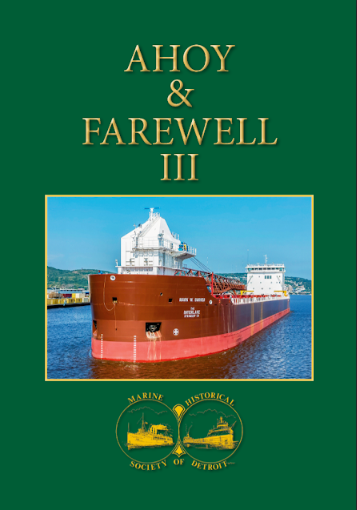
Ahoy & Farewell III, the third installment of the Marine Historical Society of Detroit’s long-running series marking the MHSD’s 80th anniversary, is now available. The book documents the vessels we welcomed, and those to which we had to bid farewell, during the last 30 years. This 308-page, hardcover book features many color photos, with multiple images of each vessel referenced.
In a departure from the MHSD’s previous volumes, the nearly 308-page, hardcover book includes color photos, with multiple images of every vessel. The book’s authors are marine historians William Moran and Viktor Kaczkowski, and Know Your Ships publisher Roger LeLievre.
“Putting the book together has been a much greater challenge than any of us had expected,” Kaczkowski said. “With the influx of foreign-built new and used tonnage, writing the histories required a lot more research to ensure the information was correct, particularly due to the wide variety of languages that came into play.”
Order Ahoy & Farewell III now at MHSD.org.