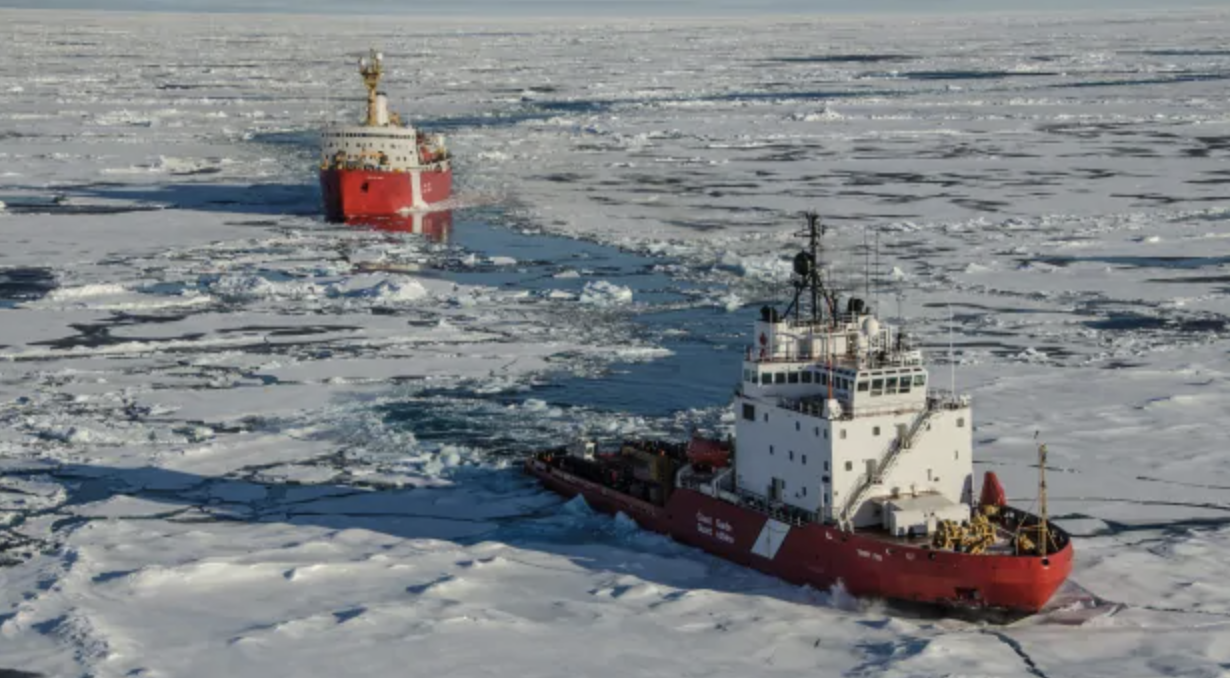
St. Lawrence Seaway closing December 31
The shipping season is once again coming to an end.
For the 2022 navigation season, all vessels have been directed by Great Lakes-St. Lawrence Seaway officials to clear the seaway by 11:59 p.m. on December 20, according to a Seaway notice.
The closing period officially began on December 1 and will continue until the last ship has completed its transit.
The Montreal-Lake Ontario section of the Great Lakes-St. Lawrence Seaway System is set to close on Saturday, December 31.
This means that all vessels must be out of this portion of the seaway by noon on December 31. Officials stated that any transit of the Montreal-Lake Ontario section after December 24 will have to have a prior written agreement.
Corporations have also waived operational surcharges for vessels from December 21 to December 24.
Regarding the rest of the Seaway, the Welland Canal portion is set to close at noon on Saturday, January 7, 2023. The Sault Ste. Marie Locks and Canal will close on Sunday, January 15, 2023.
The full closing notice can be found on the Seaway’s website.
Inform NNY
Coast guards in Canada and U.S. working together to protect Great Lakes
Shared waters from the Atlantic and Pacific oceans, Beaufort Sea, through to the Great Lakes will be protected from threats of pollution under an agreement between the Canadian and U.S. coast guards.
Last month, Canadian Coast Guard Commissioner Mario Pelletier and U.S. coast guard Commandant Admiral Linda L. Fagan renewed the Canada-United States Joint Marine Pollution Contingency Plan.
“The agreement reflects the excellent continuing bilateral collaboration between our two organizations, including in preparedness and response to marine pollution incidents in our shared waters,” said Pelletier, in a release from the Canadian Coast Guard.
It provides a co-ordinated system for planning, preparedness and response to spills occurring in the waters between the two countries, a release said.
Pelletier said the plan represents a model framework for how two like-minded countries can work effectively together with a common purpose.
The plan allows for a co-ordinated mechanism for planning, preparing for and responding to spills in transboundary waters and establishes procedures for the co-ordination of spill response efforts between the two nations.
Fagan said it signifies the excellent partnership between the two agencies and advances their preparedness for responding to transboundary oil spills and marine incidents.
“The U.S. coast guard looks forward to continuing our collaborative work to protect our shared maritime environment,” she said.
The two agencies work closely together on a wide range of coast guard services, including environmental response, search and rescue, icebreaking, marine traffic management and aids to navigation.
Welland Tribune
Lake Superior gains astounding 6 trillion gallons in same time Lakes Michigan, Huron lose 7 trillion
Lake Superior’s water level has moved dramatically in the opposite direction from the other four Great Lakes.
The Great Lakes are in the normal seasonal decline. As the air turns colder, precipitation amounts are lower. At the same time, the big temperature difference between near the water surface and higher altitudes creates more evaporation. Lake Superior water levels and the rest of the Great Lakes usually decline from November to December.
This year, Lake Superior declined one inch from November to December. The rule of thumb from Keith Kompoltowicz of the U.S. Army Corps of Engineers is one inch of water on Lake Superior equals 550 billion gallons of water. Lake Superior lost 550 billions gallons of water then in the last 30 days.
Last week I wrote how Lakes Michigan and Huron actually declined quite a bit for November, losing over 3 trillion gallons of water.
When we look at the bigger picture of water level movement on the Great Lakes, most of the Great Lakes had receding water levels in the past year. This is not the case for Lake Superior.
Lake Superior is now 11 inches higher than this time last year. With the rule of thumb for gallons per inch, Lake Superior now holds around 6 trillion gallons more water than December 2022.
The lake level graph for Lakes Michigan and Lake Huron looks much different. Lake Michigan and Lake Huron are nine inches lower than December 2021. This represents a decrease of 7 trillion gallons of water over the past year.
While the rest of the Great Lakes are falling, Lake Superior is rising.
The reason is simple, according to Kompoltowicz. Lake Superior’s drainage basin had above normal amounts of precipitation while Lake Michigan and Lake Huron had less precipitation than normal.
The chart above shows Lake Superior’s basin had one inch more rain than normal for November. Over the past year, Lake Superior has had 100 percent of its average precipitation. At the same time, Lakes Michigan and Huron had only 70 percent of average rainfall. In the past 12 months Lake Michigan and Lake Huron only received 88 percent of normal precipitation.
MLive