Cleveland maritime sector is big business
The Port of Cleveland and the maritime-dependent industrial sector are showing resiliency and growth as an economic force in Northeast Ohio, according to a new study commissioned by the Ohio Department of Transportation (ODOT). The latest analysis reveals the port and maritime sector generates more than 23,000 jobs and over $7 billion in economic impact, a notable increase of $2.3 billion since 2021.
The report, conducted by John C. Martin Associates LLC, an internationally recognized leading transportation economics firm, underscores the vital contribution of port and maritime-based activity to the region’s economy and its expanding impact on jobs, income and tax revenue. Notably, the report wasn’t commissioned by the Port of Cleveland.
Key findings from the report include
Total Economic Impact: $7.07 billion (up from $4.7 billion in 2021)
Total Jobs (direct and indirect): 23,758
Personal Income: $1.89 billion
Local and State Taxes: $189 million
This surge in economic impact is attributed to increased iron ore tonnages — up to nearly 9 million metric tons in 2023. Another factor was higher output — cargo throughput, vessel traffic, etc. plus and improved salaries and income multipliers.
“Cleveland’s harbor and river system is not just a local maritime and recreational asset — it’s a major economic powerhouse,” said Port President and CEO Will Friedman in a written statement. “As the public guardian of the maritime sector, the Port of Cleveland continues to prove itself as an economic engine for Cuyahoga County and Northeast Ohio.”
“These numbers demonstrate we are headed in the right direction, and I am especially gratified to see this report as I conclude my tenure,” he said.
Friedman made those remarks as he wraps up his work at the port. In October, he announced his decision to step down at the end of the year following the expiration of his contract. Friedman and the port authority’s board could not reach agreement on a new contract.
The data was developed as part of ODOT’s Ohio Maritime Plan — Economic Value Analysis.
The Port of Cleveland’s influence extends far beyond maritime operations, leveraging its unique authority under Ohio law to finance transformative job-creating and neighborhood projects. In 2024 alone, the Port approved a record 20 real estate projects for approximately $753 million in development financing.
“This milestone reinforces that the Port’s economic development tools are more relevant than ever,” Friedman added. “Our unique combination of shipping services, infrastructure investment, and financing capabilities has proven to be a potent combination for driving growth and job opportunity across the region.”
Bill that includes study on St. Marys River
navigation improvements passes U.S. senate
U.S. Senator Debbie Stabenow (D-MI), a member of the Senate Committee on Environment and Public Works, secured major wins for Michigan in the bipartisan Water Resources Development Act, which passed the Senate Thursday night. This bill will authorize projects through the U.S. Army Corps of Engineers to stop invasive carp, prevent coastal erosion and flooding, and improve navigation in waterways. The bill now heads to President Biden’s desk to be signed into law.
“The Water Resources Development Act invests in essential water infrastructure projects and addresses critical problems impacting our Great Lakes and waterways,” said Senator Stabenow. “Getting so many priorities included in this bill is a big win for our state.”
The Water Resources Development Act includes major wins for Michigan, including:
- Increasing the federal cost share for the Brandon Road Lock and Dam project: The federal cost share for operating and maintaining the Brandon Road Lock and Dam project will increase from 80% to 90%. This project is vital to preventing invasive carp from entering the Great Lakes. This change further decreases the cost for our state partners.
- Addressing destructive coastline erosion and flooding: The bill authorizes the U.S. Army Corps of Engineers to work with Grand Traverse, Brighton, Marysville, and Ludington to promote shoreline restoration and prevent future erosion and flooding.
- Identifying and addressing flood risks in Southeast Michigan, Northern Michigan, and the Kalamazoo River watershed: The bill authorizes the U.S. Army Corps of Engineers to work with Dearborn and Dearborn Heights, the City of Cheboygan, Grand Traverse County, and the Kalamazoo River watershed to identify and address flood risks in their communities impacted by flooding from extreme precipitation.
- Improving waterway navigation: The bill allows the U.S. Army Corps of Engineers to study navigation improvements for the St. Marys River and Grand Traverse Bay Harbor so that they are safe, accessible, and continue to play a critical role in our economy and national security.
- Expediting critical projects in Michigan: The bill allows the U.S. Army Corps of Engineers to expedite the Menominee River Navigation project to help ensure that materials can continue to be shipped through this harbor. It also allows the Corps to expedite projects to improve navigation at the Big Bay Harbor of Refuge and repair the George W. Kuhn Headwaters Outfall.
Soo Today
Share your boat-themed Christmas and holiday cards
Continuing a Boatnerd tradition, we invite you to share your boat-themed Christmas and holiday cards on our discussion board at https://newsearch.boatnerd.com/viewforum.php?f=6 (attachments must be under 2 MB. Please add to the existing thread.
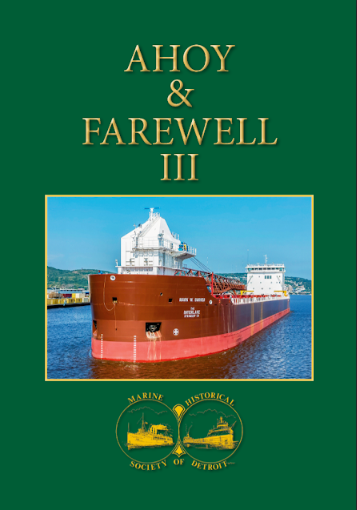
MHSD’s Ahoy & Farewell III book
documents 30 years of laker history
Ahoy & Farewell III, the third installment of the Marine Historical Society of Detroit’s long-running series marking the MHSD’s 80th anniversary, is now available. The book documents the vessels we welcomed, and those to which we had to bid farewell, during the last 30 years. This 308-page, hardcover book features many color photos, with multiple images of each vessel referenced.
In a departure from the MHSD’s previous volumes, the nearly 308-page, hardcover book includes color photos, with multiple images of every vessel. The book’s authors are marine historians William Moran and Viktor Kaczkowski, and Know Your Ships publisher Roger LeLievre.
“Putting the book together has been a much greater challenge than any of us had expected,” Kaczkowski said. “With the influx of foreign-built new and used tonnage, writing the histories required a lot more research to ensure the information was correct, particularly due to the wide variety of languages that came into play.”
Order Ahoy & Farewell III now at MHSD.org.