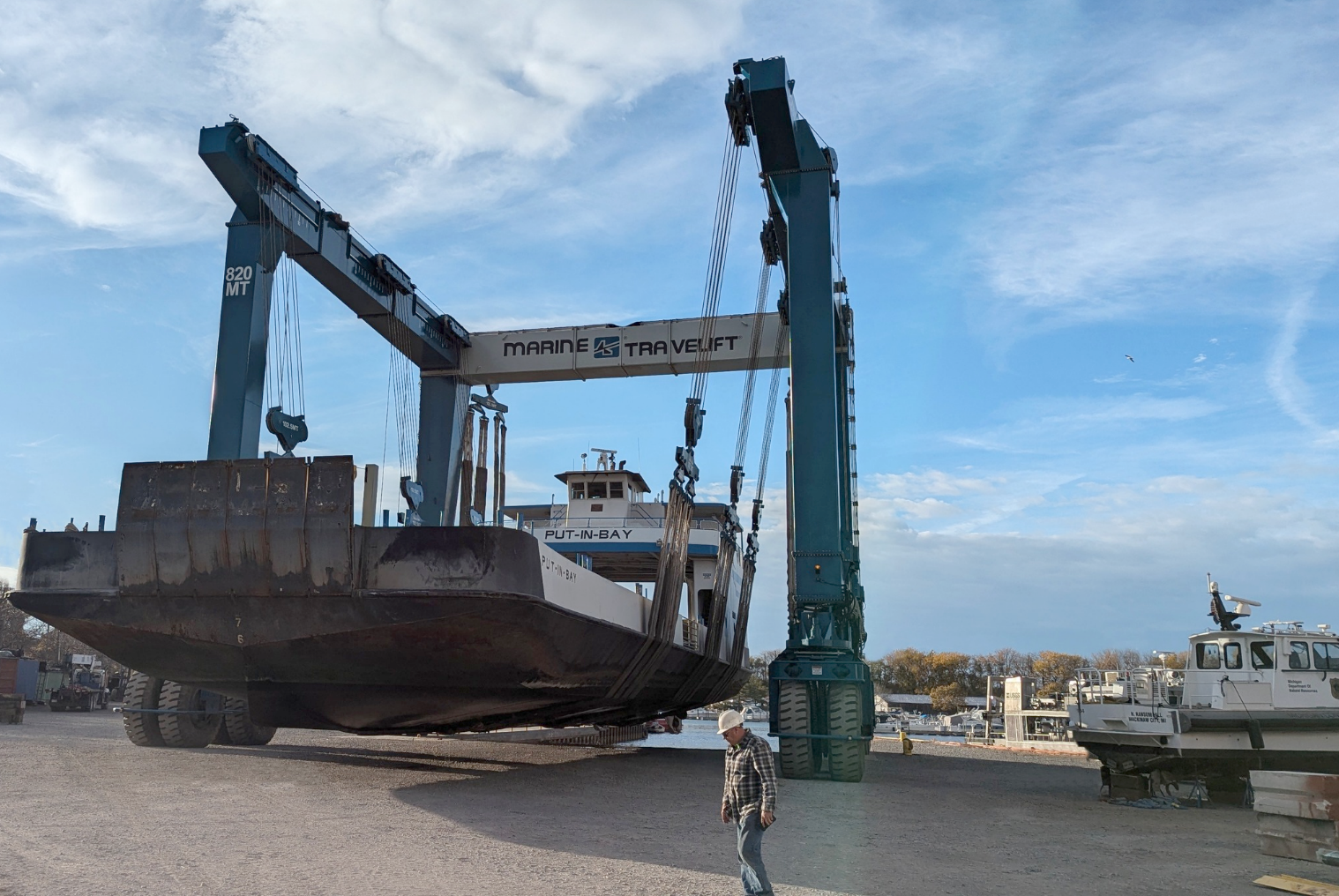
Put-In-Bay ferry will get mid-life refit in Cleveland
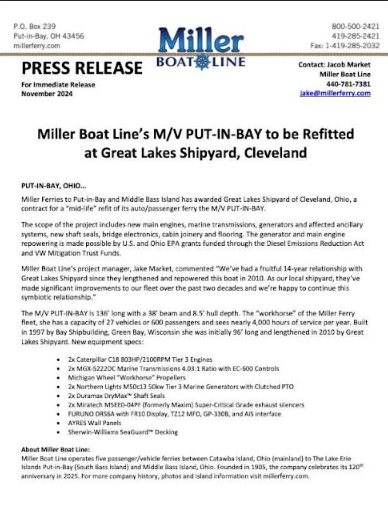
Miller Ferries to Put-in-Bay and Middle Bass Island in Lake Erie has awarded The Great Lakes Towing Co. and Great Lakes Shipyard of Cleveland, Ohio, a contract for a mid-life refit of its auto/passenger ferry the M/V Put-In-Bay. Read the press release in the image gallery below.
St. Lawrence Seaway Invests Over $350 Million
in Infrastructure to Strengthen Supply Chain
CORNWALL, ON – The St. Lawrence Seaway Management Corporation (SLSMC) has announced an investment of over $350 million in infrastructure upgrades over the next three years. This investment will ensure the Seaway’s continued reliability and efficiency, while creating jobs and strengthening local communities.
Spanning from April 1, 2024, to March 31, 2027, the investments include more than $170 million in the Montreal to Lake Ontario (MLO) region and $180 million in the Welland Canal region. These upgrades will enhance critical infrastructure, ensuring strong supply chain links and reliable transportation for goods.
Highlights of the planned work include:
- maintaining and upgrading locks and bridges
- improving energy infrastructure
- upgrading mechanical and structural systems to extend the lifespan of critical assets
“This investment reflects our commitment to providing a resilient and sustainable supply chain for Canadians,” said Jim Athanasiou, President and CEO of the SLSMC. “By enhancing the reliability of our infrastructure, we are highlighting the vital role of the Seaway in ensuring goods reach their destinations efficiently while supporting innovation and sustainability in marine transportation.”
Marine shipping is the most sustainable way to move goods, offering an alternative to road and rail. These infrastructure upgrades position the Seaway to meet future demands, ensuring resilient supply chains.
Canadian shippers in the Great Lakes express concern over Trump’s tariff plan
The multi-billion-dollar Great Lakes shipping industry is bracing for the impact of a potential 25% tariff on Canadian imported goods, as recently promised by President-elect Donald Trump.
Trump cited concerns over illegal immigration and fentanyl trafficking over the border as the motivation for the tariffs. He’s promised several times on the campaign trail to implement tariffs on imports to other countries. Mexico is also included in Trump’s 25% tariff promise.
The Great Lakes-St. Lawrence Seaway generated over $50 billion in economic activity last year. Over 350,000 people work on the lakes in the shipping industry. The shipping companies are raising alarm about what a 25% tariff would do.
Bruce Burrows is the CEO of the Chamber of Marine Commerce, a group representing Canadian and American shipping stakeholders. He said the 25% tariffs would hurt agriculture companies he represents on both sides of the border.
“They manufacture products that they sell to the American consumer. And if their input costs go up by 25%, then that’s going to be passed on very quickly to the U.S. consumer,” he said. “This is not good.”
Burrows said that several noteworthy Canadian components are used in American industries, and that tariffs would cause price shocks. “Steel, oil, cement, aluminum, stone and other aggregate, salt, which is, used for safety purposes on people’s roads,” he said naming examples.
“Products like steel and aluminum, it’s feeding the car assembly system and manufacturing system in the U.S. Some of these products go back and forth across the border numerous times before they’re finally put into the finished vehicle.”
Canadian politicians have echoed concerns over the tariff plan. Ontario premier Doug Ford said in a social media post that the plan “would be devastating to workers and jobs in both Canada and the U.S.”
Burrows called for Canada to work diligently on the issues Trump mentioned. “I think it’s important for our government to, to get to the bottom and have a really good frank conversation with Mr. Trump and, come up to a mutually agreeable solution here and try not to sideswipe the economy,” Burrows said.
As for what those conversations might look like Alan Deardorff, an international economics professor at the University of Michigan, said they’ll likely be focused on tightening the border.
“I don’t think they necessarily have to clamp down instantly, and so that we observe zero migration or zero fentanyl crossing the border,” he said, referring to Canada and Mexico.
“Just persuade him, that they will take action sufficiently. He is subject to that, I mean, he likes to make deals. So, if he can point to a deal, he’ll be happy with that,” Deardorff added.
The economist also said retaliatory tariffs, of the sort Mexico’s President Claudia Sheinbaum is mulling over, likely wouldn’t hurt America much.
“The U.S. import so much more from Mexico than they import from us,” he said. “A tariff by them, I don’t think, would stop Trump and it would mainly just hurt them. I think it hurt us a little bit but, but I don’t think it would at all be effective.”
WCMU