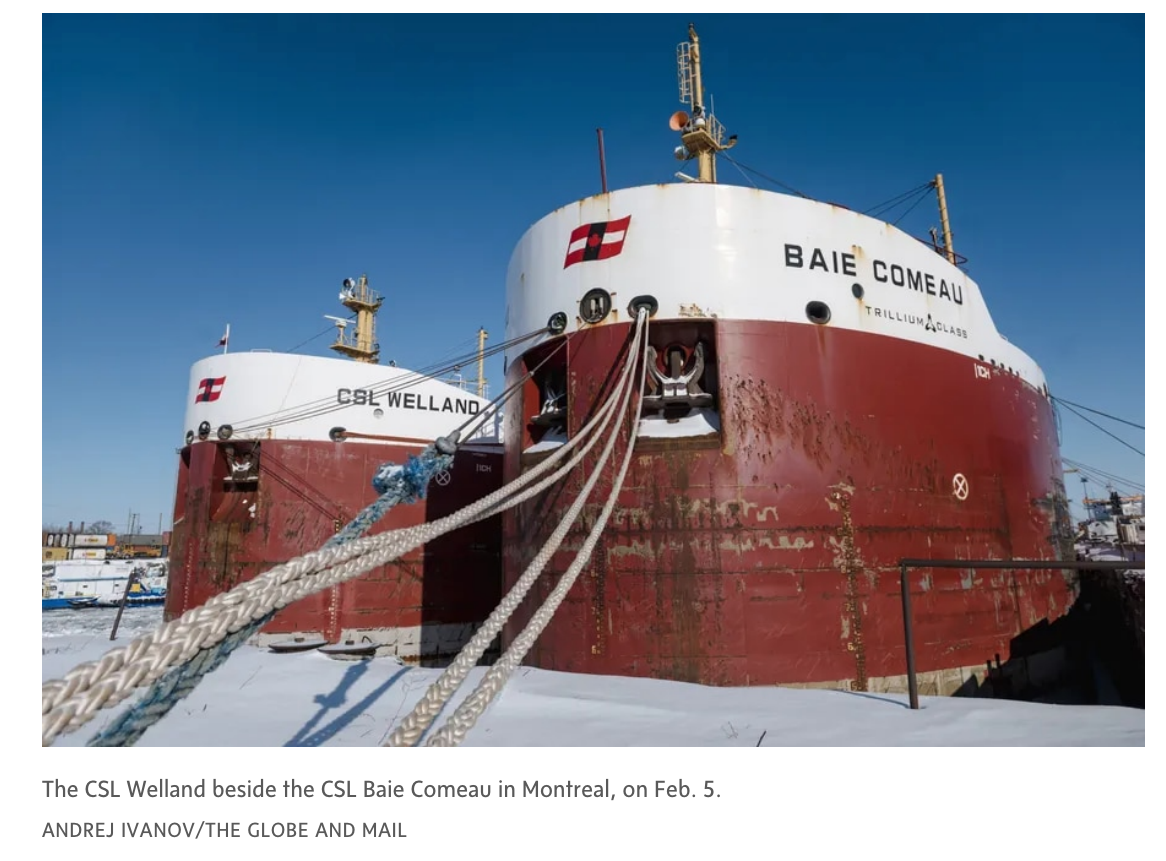
In the search for less carbon-intensive fuels, freighters powered by soybeans may be the answer
Toronto, ON – When the lights in the ship’s galley didn’t flicker, CSL Group’s Louis Martel knew he was on to something.
The Atlantic Huron’s power generator, which fed electricity to the cabins, unloading machinery and other auxiliary functions on the Great Lakes freighter, was running on a blend of marine diesel and biofuel made from soybeans. The successful test was the first step in what is believed to be the world’s largest trial of powering massive cargo ships with biodiesel.
Canada Steamship Lines, the domestic arm of CSL, expanded the trial over the past few years, gradually increasing the fuel mix to 100-per-cent soybean-derived diesel and running eight of its 16 ships on the St. Lawrence River and Great Lakes in 2021. The fuel swap reduced carbon emissions at each ship’s smokestack by almost 12 per cent without requiring any modifications to the engine. There were no failures, and repeated mechanical teardowns and inspections showed no excessive wear.
“Reducing our environmental footprint has been an objective of the company for many years,” said Mr. Martel, chief executive officer of the Montreal-based shipping company. “It showed that we can operate our fleet with biodiesel as a drop-in fuel, we don’t have to modify any piece of our engine or equipment.”
In the search for less carbon-intensive fuels, the transportation industry is exploring wider uses of electric batteries, hydrogen and ammonia to power ships, planes, cars, trains and trucks. Canadian Pacific Railway Ltd. has converted one locomotive to run on hydrogen and is working on two more, with financial aid from the province of Alberta. Several global ship operators are developing vessels powered by ammonia. Plane makers are working with electric- and hydrogen-powered propulsion.
However, most of these innovations are years from being commercially viable, and require big investments in engines and fuel storage and other infrastructure. Ammonia, most hydrogen and often electricity require the production of petroleum, undercutting their emissions-free claims.
Eric Galbraith, a professor in McGill University’s department of atmospheric and oceanic sciences, said it is “absolutely essential” the shipping industry moves away from fossil fuels, which are the main cause of climate change.
Maritime transport, which moves 90 per cent of the world’s goods, emits 2.5 per cent of greenhouse gases, or 940 million tonnes a year, according to the European Commission.
“Transportation, of which shipping is a major part, adds up to a major source of CO2 emissions, as well as particulate aerosols, which are bad for health,” Prof. Galbraith said. “I doubt biodiesel will be the best long-term solution for shipping – hopefully, we will have other options in future that will have even lower impacts. But for now, it’s an easy change to make, and it’s essential that we get off fossil fuels as quickly as possible.”
CSL turned to biodiesel, made from the refuse oil that is a byproduct of crushing soybeans into livestock feed, because it is a direct replacement for diesel. Biodiesel pollutes less when burned and is biodegradable if it spills, an important consideration for the marine industry. It also replaces petroleum production, reducing greenhouse gas emissions by 80 per cent from the oil well to the ship’s wake.
“It’s a very simple way to green your operation,” said Giovanni Angelucci, vice-president of Canada Clean Fuels Inc., which supplies biodiesel to CSL as well as cities, trucking companies and other consumers across Ontario.
However, biodiesel thickens in cold weather and has a shorter shelf life than diesel. It is also almost twice as expensive as marine diesel, costing about $2,200 a tonne compared with $1,200 for marine diesel. In a ship that burns 15 or 20 tonnes a day, that can make moving such low-value goods as iron ore or wheat a money-losing venture. (For the trial, CSL said it split the added costs with its partners.)
CSL had to get a permit from the federal government to run its trial because biodiesel is not an approved marine fuel. Mr. Martel said CSL plans to extend the trial this year, and there are plans to widen biodiesel’s use to the dozens of ships it sails on international waters.
Hicham Ayoun, a Transport Canada spokesman, said the government will study the safety and emissions results of the trial before a decision is made on the widespread approval of 100-per-cent biodiesel.
Read more at this Globe and Mail link: https://www.theglobeandmail.com/business/article-in-the-search-for-less-carbon-intensive-fuels-great-lakes-freighters/?fbclid=IwAR13biWWd48YpnCoQEA6RRiEHDX5Gq1GEYbf-SBlNiBsvMp2bFo-A_KGvUQ
Icebreaker shortage slows deliveries to Alpena, other ports
Alpena, MI – A shortage of U.S. Coast Guard icebreakers slowed cargo destined for Great Lakes ports last month.
January ice trapped sailors on freighters trying to get through the Soo Locks – including crew members from Alpena, Rogers City, and the surrounding area – as breakdowns forced the Coast Guard to remove icebreakers from service, according to Eric Peace, secretary of the Great Lakes Maritime Task Force.
Every ship delayed in the Soo, the Sault Ste. Marie passage between Lake Superior and the lower Great Lakes, means a delay for those waiting for the goods onboard the freighters, from salt for slippery roads to raw materials to build infrastructure, Peace said.
A provision in the federal Build Back Better Act, which passed the House but has stalled in the Senate, would allocate $350 million for the construction of a new Coast Guard icebreaker for the Great Lakes.
Meanwhile, 20 voyages and 750,000 tons of carrying capacity for iron ore, coal, and cement were delayed in January because the Coast Guard lacked the capacity to keep up with Great Lakes ice, Peace said.
Coast Guard cutters lost a total of 68 icebreaking days in the first weeks of January because of equipment fires or engine breakdowns, in addition to scheduled maintenance. At one point in January, five of eight Coast Guard icebreakers were simultaneously unavailable because of mechanical failures.
Icebreakers were unable to dislodge the freighter American Century, the last upbound ship of the season, when it got stuck in ice in the St. Mary’s River on its way to the Soo Locks, delaying three ships trying to leave Lake Superior before the locks closed for winter maintenance on Jan. 15.
That forced the U.S. Army Corps of Engineers to begin draining the locks for maintenance a day later than planned, and “a day late to the Army Corps is a big deal,” Peace said.
The Army Corps closes the locks from Jan. 15 until March 25 each year, performing needed maintenance on the locks in a tight timeframe so shipping operations can resume as quickly as possible to keep the country’s flow of commerce moving.
Tugboats like the tug Manitou, which frequents Thunder Bay to break ice for vessels headed for the Lafarge Alpena harbor, ensure freighters and barges reach small piers, docks, and harbors but are not built to withstand the heavier ice in the middle of Great Lakes and in federal navigational channels, Peace said.
In addition to slowing the transportation of cargo and potentially threatening dock workers’ jobs, lack of icebreakers can endanger vessels and the people aboard them. In past years, ice has sliced ships open and caused collisions, Peace reported.
One Canadian vessel was nearly forced aground in the Straits of Mackinac by ice this year, with the closest Coast Guard icebreaker more than 12 hours away.
The freighter Alpena, too, struggled in ice near the end of the season as it tried to get through the Straits of Mackinac on its way to Thunder Bay, according to Peace.
With Great Lakes temperatures at record-breaking warmth this fall, ice breaking did not begin until December 29 this season, two weeks later than usual.
Alpena News
https://www.thealpenanews.com/news/local-news/2022/02/icebreaker-shortage-slows-deliveries-to-alpena-other-ports/?fbclid=IwAR1QiOLrwgAhInv7-vEcVR7ceI6X56EpP46e94AS3P6K_f8kZTUd8wlQVJc
Port of Cleveland sees 69% increase in tonnage in 2021
Cleveland, OH – Cleveland’s port was well used in 2021 amid ongoing supply-chain issues across the U.S.
The Port of Cleveland on Thursday reported a 69% increase in tonnage across its docks compared to 2020. The port said significant increases in goods both in and out of containers, and iron ore shipments to the Cleveland-Cliffs Cleveland Works steel mill, drove the increase.
The general cargo terminal – which includes steel, containers, project cargo, salt and cement – saw 649,324 metric tons go across the docks, a 57% increased from 2020. It’s the second-highest total in 10 years, slightly behind 2015 numbers. The bulk terminal, where iron ore and limestone are delivered, saw a 71% increase over 2020 with 6,943,139 tons.
The Port said shipping container volume also doubled. “Our cargo volumes bounced back in a big way in 2021 across the board, which indicates business is up at regional firms that depend on our Port,” said William Friedman, president and CEO of the Port of Cleveland. “We are particularly pleased to see containerized cargo grow significantly because we’ve worked for years to position Cleveland as an alternative to congested coastal ports.”
The Port expanded its iron-ore tunnel and its main gate at the general cargo facility in 2021. It also reactivated its foreign trade zone.
According to the port, cargo owners used Cleveland as a new solution to avoid coastal ports, which have been backed up in the last year. The Cleveland port is the only one on the Great Lakes with container shipping.
Cleveland.com
https://www.cleveland.com/business/2022/02/port-of-cleveland-sees-69-increase-in-tonnage-in-2021.html?fbclid=IwAR04Js8mltu2bMaMgq_vjv6b78_T-TLXYkCuI5bx3TqFWaIuvtisoaU1jOk