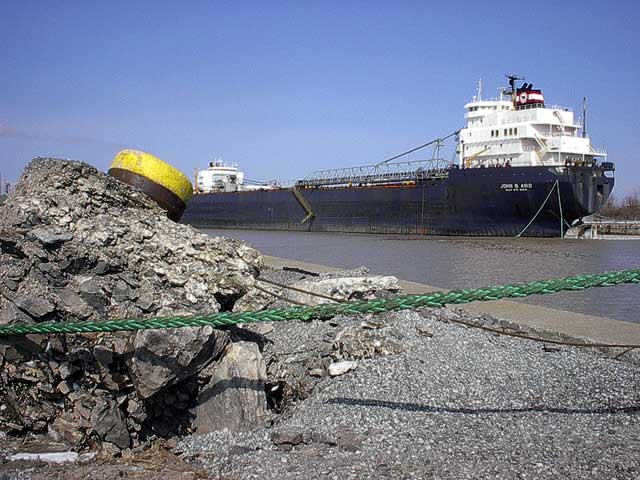
Michigan museum explores intriguing history of Great Lakes Yemeni sailors
Abdullatif Ahmed was just 23 years old when he first stepped foot on the Medusa Challenger, a 1906-built Great Lakes bulk freighter. “Before I came to America in 1990,” he said, “I had never even seen the sea.”
Born and raised in Juban, a rural district in southern Yemen, Ahmed was drawn to the Great Lakes by family history and opportunity.
His grand-uncles and father, who came to the U.S. in the 1950s, worked on Great Lakes ships including the Ford Motor Company’s fleet, delivering raw materials from around the region to the massive Rouge plant in Dearborn.
“I wanted to be a sailor for two reasons,” he said. “I like water and as a sailor, at that time, you could save more money.”
Ahmed and his relatives aren’t alone. Records show Yemeni sailors working in the region as far back as the 1910s.
Back then the Great Lakes region was a hive of industrial activity.
Millions of laborers from around the world streamed into Detroit, Chicago, Milwaukee and elsewhere to work in automotive and other industrial plants.
Much of the economic activity in Detroit was fueled by manufacturers such as the Ford Motor Company, which owned iron ore and graphite mines in Wisconsin and in the Upper Peninsula of Michigan — materials essential in building its vehicles in Dearborn and Hamtramck.
In the 1920s, the company is believed to have faced a major problem: a lack of sailors to man the ships transporting raw materials south to Detroit.
In the 1800s, Yemeni seafarers were employed by the British navy in the Gulf of Aden and across the Indian Ocean. Although it has been difficult to verify, oral stories suggest that many who came to Detroit were reportedly sought out for their sailing skills and because of their abstinence from alcohol.
Later, waves of Yemeni immigrants who came to the U.S. in the 1950s and 1960s settled in Michigan to work in the Great Lakes shipping industry.
Today, around 30,000 people of Yemeni heritage are believed to live in Michigan, and Ahmed estimates that around 600 to 700 of those work on Great Lakes ships.
“Now there are Yemeni captains, first mates, bosuns and [Yemenis in] other high-ranking positions,” he said.
Recording history
About 15 years ago, this little-known history of Yemeni Great Lakes sailors caught the attention of Professor Sally Howell, director of the Center for Arab American Studies at the University of Michigan-Dearborn.
“I had been running into Yemeni-Americans over the years and once I became aware that people’s parents worked on the Great Lakes, I became really curious about it, because there didn’t seem to be a record of this,” she said.
“Once I became aware of the history, it seemed like almost every Yemeni I talked to had somebody in their family who worked on the lakes. It was a much bigger story than I imagined, and it was a really important economic niche for this community.”
This prompted her to make the topic of Yemeni sailors a research project for her students in 2019, who set out to find and interview current and former sailors and ship workers. In total, 22 interviews were conducted, often by the sailors’ younger family members and in their own homes.
“A lot of people we interviewed, their fathers had come in the 1950s,” said Howell. “Especially when the auto industry began requiring a high school education [in the 1950s], a lot of men who were coming in that period were working on the lakes because [the shipping industry] didn’t have the same education requirements.”
In the interviews, the sailors speak of the pain of spending lengthy periods of time away from family, the monotony of life at sea, the back-breaking work of shuffling coal and working in ship “smokehouses” in the 1950s and 1960s. Others talk about how securing a position that included a private room was a goal as they could “pray my prayers and not worry about others.”
Professor Howell said what stood out to her was the skill level acquired by some of the Yemeni-American mariners.
“Some of the people we talked to become navigators,” she said. “There is one who is known [for his skill] guiding ships through the Detroit River, which is a challenging waterway. People have risen through the ranks.”
Another interesting observation, she said, was how it affected women in families whose fathers were absent for long periods. How some wives were empowered in the absence of their husbands.
In the past, many Yemeni-Americans chose to work on Great Lakes ships because the winter months saw shipping shut down, which offered extended periods of time off, allowing them to return to Yemen to see and support their families.
Today, however, most Yemeni sailors reside in southeast Michigan with their families.
Professor Howell said that several times the sailors, often in their 70s and 80s, came to her classes to listen to the student presentations.
The oral histories, which include photos and video footage of life on the frozen Great Lakes, were deemed to be of such importance that the work is now housed as a Digital Special Collection at the Arab American National Museum (AANM) in Dearborn.
“We’re happy to have these donated oral histories. It ties in with speaking about this recent immigrant community that we have in Dearborn and Detroit, this was their experience as a way of coming into the US,” said Shatha Najim, Community Historian at the AANM and who transcribed several of the interviews.
“A lot of people were also doing this back in Yemen, it was passed down in the family. It’s an important story to tell to create a complete picture of who is in Dearborn, Detroit and the surrounding areas. I’m really glad this project started and was done in such an authentic way.”
Central to Great Lakes life
At the Dossin Great Lakes Museum on Belle Island in Detroit, the role Yemeni and Arab sailors have played in the history of Great Lakes shipping is honored in a small way.
The museum contains the cabin house of the SS William Clay Ford, a bulk freighter.
Inside the ship’s pilot house is a dedication to its sailors, who on November 10, 1973 “voluntarily left a safe harbor to face the dangers of gale-force winds and vicious seas, in the blackness of a storm … to search for possible survivors of that disaster, exemplifying the finest traditions of the maritime profession.”
The “disaster” is in reference to the SS Edmund Fitzgerald, which went down northwest of Lake Superior’s Whitefish Bay with the loss of all on board in one of the worst tragedies in recorded Great Lakes maritime history.
The dedication bears the names of Ahmed B Ali and Mosaed Ali — Arab and Yemeni-American sailors who served on the ship that night.
Illustrating the close-knit nature of seafaring life on the Great Lakes, upon seeing one of the names in a photo of the dedication, Abdullatif Ahmed’s face lights up.
“I know Mosaed Ali; he was my mother’s uncle,” he said. “I’m sure [it is him], because he was a well-known name in the community. One hundred per cent.”
Read more at this Bridge Michigan Link: https://www.bridgemi.com/michigan-environment-watch/michigan-museum-explores-intriguing-history-great-lakes-yemeni-sailors
Invasive carp barrier to Great Lakes on hold as Illinois governor seeks Trump assurances
Detroit Free Press
A project to keep invasive carp species from reaching the Great Lakes could be in jeopardy as the state of Illinois halted its work, seeking assurances from the Trump administration that federal funding for the more than $1.1 billion project will not be revoked.
The Brandon Road Interbasin Project is a joint project between the federal government and the states of Illinois and Michigan on the Des Plaines River, about 27 miles southwest of Chicago in Joliet, Illinois, and about 40 miles from Lake Michigan. A planned lock and dam system there would include an electric barrier, unappealing sounds for fish and gates of bubbles as deterrents — all designed to deter invasive bighead, silver, black and grass carp from entering the Great Lakes.
The carp were imported from Asia to the southern U.S. in the 1960s and 1970s to control algae blooms in aquaculture facilities, farm ponds and sewage lagoons. Floods and human mismanagement helped the carp escape into the Mississippi River system, where their spread exploded.
The carp grow fast, eat voraciously and breed prolifically. A single female can produce a million eggs or more, and the fish can grow up to 100 pounds. Scientists believe the invaders would out-compete native species and Michigan’s prized sports fish, creating ecological chaos on the Great Lakes. Bighead and silver carp are now within 47 miles of Lake Michigan, according to the Great Lakes Fishery Commission.
The U.S. Army Corps of Engineers’ Rock Island Illinois District and the states of Illinois and Michigan last July 1 announced the signing of a project partnership agreement for the Brandon Road lock and dam, moving it into the construction phase. The agreement allowed $274 million in federal funding, including $226 million provided by then-President Joe Biden’s Bipartisan Infrastructure Law, and $114 million in state funding from Illinois and Michigan to be used for construction of the first of three construction increments of the $1.15 billion project.
But Illinois Department of Natural Resources Director Natalie Phelps Finnie, in a Feb. 10 letter to Col. Aaron Williams, commander of the Army Corps’ Rock Island District, advised that state officials were postponing a Feb. 11 property rights closing on riverbed property needed in the first phase of construction.
“The Trump administration’s lack of clarity and commitment to delivering funds from the Bipartisan Infrastructure Law to the Illinois Department of Natural Resources leaves the state to anticipate a lack of federal funding for the Brandon Road Project,” Phelps Finnie stated.
She stated that the state would seek a potential new property rights closing date in May “to allow Illinois to receive written assurances of federal funding.”
“We stand ready to move forward if the administration provides the certainty to fund this critical project,” Phelps Finnie stated.
Illinois Gov. JB Prizker said the Trump administration, since taking office Jan. 20, has withheld $117 million in federal grants for the Illinois DNR, forcing the state to pause contracts and put nearly 70 infrastructure projects on hold.
“Despite court orders, the Trump administration continues to withhold funding from the Bipartisan Infrastructure Law for the Illinois Department of Natural Resources — to create jobs cleaning up abandoned mines and gas wells that are polluting air and water in rural communities,” Pritzker, a Democrat, said in a statement.
“I have a responsibility to protect Illinois taxpayers. If the federal government does not live up to its obligations, Illinois could unfairly suffer the burden of hundreds of millions of dollars of liability. We cannot move forward until the Trump administration provides more certainty and clarity on whether they will follow the law and deliver infrastructure funds we were promised.”
Michigan DNR Director Scott Bowen also expressed his concern.
“It is imperative that the work at Brandon Road continues in order to protect the Great Lakes commercial and recreational fishery, which is valued at $7 billion annually and supports more than 75,000 jobs,” he said.
The Brandon Road lock and dam “is one of the most important Great Lakes protection projects of the 21st century,” said Joel Brammeier, president and CEO of the nonprofit, Chicago-based Alliance for the Great Lakes.
“Everybody who lives in Michigan, and lots of people elsewhere, understands the damage that invasive species have done to the Great Lakes — to tourism, costs to industries and utilities, to recreation, to the quality of life of people who live there.”