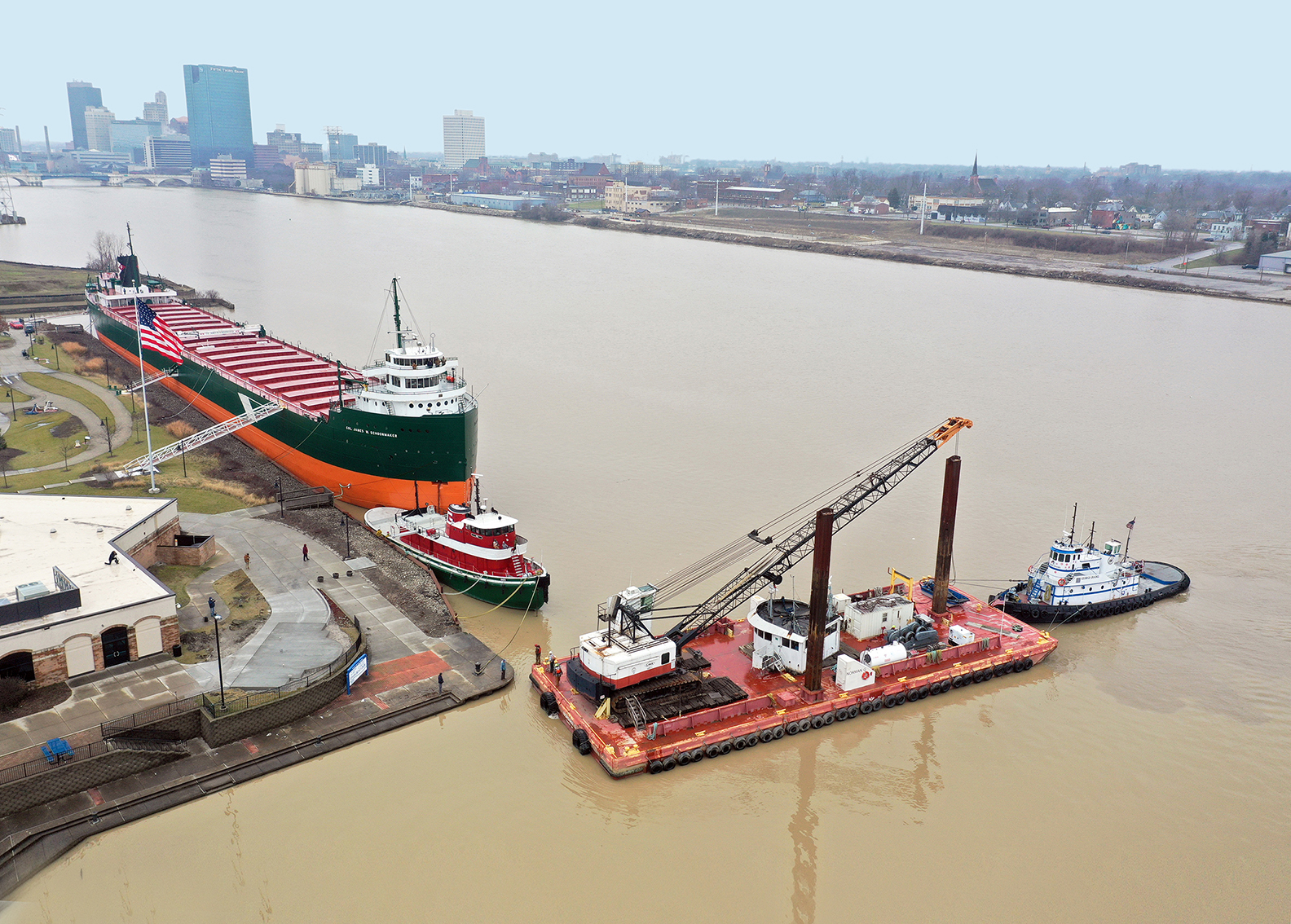
Port board pays for pilothouse display at National Museum of the Great Lakes
Toledo, OH – The National Museum of the Great Lakes will receive aid totaling $150,000 from the Toledo-Lucas County Port Authority for the museum’s new pilothouse attraction, following action by the port’s board of directors Thursday.
The board approved a grant of $25,000 and a loan of $125,000 to reimburse the museum’s construction of a concrete foundation on which to display a historic Great Lakes freighter pilothouse.
The pilothouse belonged to the St. Mary’s Challenger, a lake freighter that has been repurposed as a barge. The structure was acquired in 2015 amid competition from other entities that wanted it, said Kate Fineske, spokesman for the museum, located next to the Glass City Metropark on Front Street in East Toledo.
The St. Mary’s Challenger was a “fleet mate” to Col. James M. Schoonmaker, the museum’s floating lake freighter exhibit.
Ms. Fineske said the pilothouse was removed because the St. Mary’s Challenger was taken out of service as a steamship. When it sailed its last as a steam-driven ship in 2013 it was the oldest vessel on the Great Lakes.
Originally, the pilothouse was planned to be part of the second floor of the museum. The plan now is to make it part of the exterior grounds with an enclosed connection to the main building so it can be used year-round, she said.
“The end goal is to be able to connect to it from the interior of the museum so people can have a pilothouse experience all year long,” Ms. Fineske said.
Ms. Fineske said the Challenger pilothouse will be more accessible than the pilothouse in the Schoonmaker, and it will be more contemporary, unlike the Schoonmaker, which was restored to an older condition.
She noted that while the pilothouse was being floated from the storage space to its display place at the museum on Dec. 30 that was provided by Midwest Terminals it passed the hull of the former St. Mary’s Challenger in use on the Maumee as a barge.
Christened the S.S. William P. Snyder, the vessel that would become the Challenger was the first of six vessels built for Shenango Furnace Co. in the early 20th century; the Schoonmaker became that fleet’s flagship in 1911.
Read the Toledo Blade story here: https://www.toledoblade.com/local/city/2022/02/24/port-board-pays-for-pilothouse-display-at-national-museum-of-the-great-lakes/stories/20220224102?fbclid=IwAR2i94F6mp4NqVM94qnOxvQjf5ppkOuzCRhCrIK-kj_nwY_TydzvdHI_Klc
2.2 million tonness of cargo moved through Toronto’s port in 2021
If you’ve ever taken a stroll along Toronto’s waterfront, maybe had a night out at Rebel nightclub (or one of its predecessors) or a visit to Sugar Beach, you’ve undoubtedly come across the massive lake freighters that move cargo in and out of Canada’s largest urban centre.
Shipping takes many forms, with cargo aircraft, freight trains, and trucks transporting goods around the region, but when it comes to moving heavy masses of raw materials, large freight vessels that can transit the St. Lawrence Seaway and Great Lakes locks systems are still the most cost-effective solution out there.
Imported materials including cement, steel, sugar and salt moving into Toronto ports surpassed 2.2 million metric tonnes for the fifth consecutive year in 2021, with 190 cargo vessels in the city last year. The total of 2,295,815 metric tonnes delivered marks a four per cent increase from 2020.
But just what do 2.2 million tonnes of cargo look like in relatable terms? It turns out it’s a pretty difficult weight to quantify with even the largest of artificial objects, as even the single-tallest freestanding structure in the western hemisphere is merely a fraction of this weight. You’d need to break down 18.65 CN Towers worth of material to reach that colossal volume of material shipped.
If you’re still struggling to visualize just how vast this quantity is, here’s another comparison. If you collected all of the approximately 1.1 million cars in Toronto as of 2014, you’d still be about 232,000 cars short of the weight of cargo that flowed through the city’s ports last year.
So how did this incredible mass of materials break down? A considerable contribution came from cement cargo and steel imports, which soared to 19 and 18-year highs, respectively, with more than 734,000 metric tonnes of cement and 185,000 metric tonnes of steel supplying the wave of construction transforming the city.
Whether it was all the pandemic home-baking projects or our reliance on calories as a source of comfort, sugar imports from Central and South America were way up, 572,683 metric tonnes of the sweet stuff keeping the city’s food and beverage industries supplied through hard times.
Countering all that sweetness, 583,425 metric tonnes of salt also arrived at city ports last year.
There were a few big 2021 deliveries that you may have already heard about, with three bridge spans arriving from Nova Scotia to connect the new Villiers Island with the city’s road network.
And that’s not all that’s arriving in Toronto, with Geoffrey Wilson, CEO of PortsToronto, stating that “while the Port of Toronto will continue to play an essential role in our national supply chain in 2022, it will also play an important role supporting Toronto’s tourism sector as we anticipate hosting a record 37 cruise ships in 2022, including a number of new cruise ships designed for expedition cruising on the Great Lakes.”
Blog TO
Neebish Island residents warned service may stop due to ice
Neebish Island, MI – We have no current plans to shut down but the crossing continues to get worse and we may need to get to the point of shutting down. Our goal is to continue to run, but mother nature will dictate and we cannot risk damaging the vessel. Please make arrangements to store extra supplies, i.e. propane, groceries, medications, and any other needs if a prolonged shutdown is necessary. Stage vehicles on the mainland if so needed. We will continue to monitor and communicate any changes.
The Eastern Upper Peninsula Transportation Authority