OSHA fines company behind Cuyahoga ship fire,
says ‘fate’ saved crew
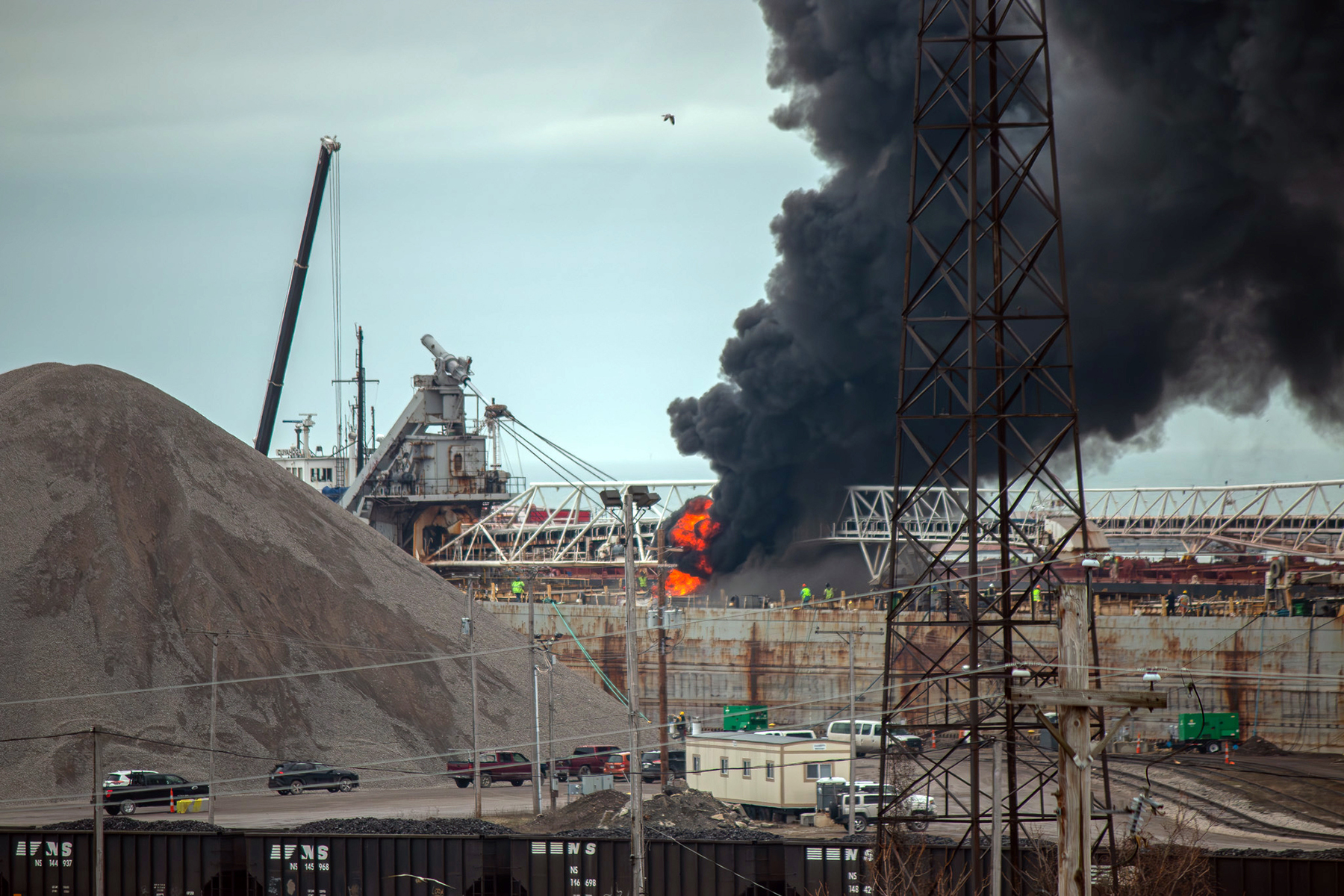
ASHTABULA, OH – The company responsible for a commercial iron ore vessel in Ashtabula in March 2024 is facing federal discipline after investigators said the fire that broke out could’ve been prevented by following regulations.
The Cuyahoga, one of Canada’s oldest shipping vessels, caught fire at the Port of Ashtabula while a crew member was using welding equipment to get paint off in the ship’s cargo hold while others were on break below the cargo hold.
Thankfully, nobody was injured in the fire but the U.S. Department of Labor’s Occupational Safety and Health Administration (OSHA) was called in to investigate at the U.S. Coast Guard’s referral.
After investigating, OSHA said South Marine Systems of Westlake, OH, failed to designate a competent person to identify hazards and did not have a marine chemist present to test for hazardous atmospheres before welding started.
OSHA also said the company didn’t stop work on the vessel after small fires broke out that caused hazardous conditions and other risks.
OSHA said South Marine Systems failed at the following:
- Determine the flammability of the preservative coating on the bulkhead before hot work.
- Provide a 1-1/2 inch or larger fire hose with fog nozzle while employees use a welder to remove Amerthane 490 off the bulkhead, which would have protected workers from exposure to fire hazards and asphyxiation.
- Provide workers with a ladder to exit the water if they fall in, to prevent exposing them to hypothermia.
- Develop a fire safety plan.
- Establish an internal and external fire response organization.
- Ensure a Chinese-speaking employee performing hot work activities was able to communicate with a Spanish-speaking employee conducting fire watch, to ensure awareness of potential fire hazards.
- Verify employees received a medical examination to ensure fitness for duties involving fighting fires and using fire extinguishers.
- Provide employees exposed to asphyxiation hazards with a self-contained breathing apparatus.
- Train fire watch employees on the very basic elements of fighting a fire, including extinguishing agents and methods of extinguishing fires.
- Provide OSHA 300 Logs and Summary Form 300As for 2021-2023.
As punishment, South Marine Systems received 15 serious violation citations resulting in over $164,000 in fines with one OSAH official saying the company played no part in the crew avoiding disaster.
“Fate, not South Marine Systems, helped the cargo vessel’s crew avoid disaster. The company’s failure to comply with basic safety requirements for welding operations and working in confined spaces exposed workers to fires, asphyxiation and other dangers,” explained OSHA Area Director Howard Eberts in Cleveland. “South Marine Systems must review its training program and its work operations immediately to make certain everyone on their work crews can recognize hazards and safely respond to emergencies.”
The U.S. Coast Guard and National Transport Safety Board have also opened investigations of their own into the incident.
Fox 8 News
Lake water levels continue to be low: ILSBC
Water levels on Lake Superior and Lake Michigan-Huron continue to be below the seasonal long-term average, and below last year’s level. That’s according to the International Lake Superior Board of Control. The board says the gate setting on the St. Marys River will be maintained at the typical winter gate setting.
Find the full news release from the board below:
The Board expects the total St. Marys River flow in February to be 1,690 m3/s (59,700 cfs), as prescribed by Regulation Plan 2012. Actual hour-to-hour and day-to-day flows may vary depending on hydrologic conditions, as well as variations in flow from the hydropower plants.
The gate setting of the Compensating Works will be maintained at the typical winter gate setting (Gate #1 and Gates #7 through #10 open 20 cm each) equivalent to approximately one-half gate open. Therefore, the average St. Marys Rapids flow in February is expected to be approximately 83 m3/s (2,900 cfs). Gate #1 will remain at its typical setting which supplies a flow of about 15 m3/s (500 cfs) to the channel north of the Fishery Remedial Dike.
Water level changes over the month of January
Water supply conditions were drier than average in both Lake Superior and Lake Michigan-Huron basins in January.
Lake Superior declined by 8 cm (3.1 in) last month while the seasonal long-term average pattern is for Lake Superior to decline by 7 cm (2.8 in) in January.
Lake Michigan-Huron declined by 9 cm (3.5 in) last month, while the seasonal long-term average pattern is for Lake Michigan-Huron to decline by 2 cm (0.8 in) in January.
Water levels as of the beginning of February
At the beginning of February, the lake-wide average water level of Lake Superior was 16 cm (6.3 in) below the seasonal long-term average (1918-2023) and 14 cm (5.5 in) below the level of a year ago.
At the beginning of February, the lake-wide average water level of Lake Michigan-Huron was 18 cm (7.1 in) below the seasonal long-term average (1918-2023) and 28 cm (11.0 in) below the level of a year ago.
Forecast outlook
Water level changes based on water supplies over the month of February.
If weather and water supply conditions are near average, Lake Superior may decline by approximately 4 cm (1.6 in.) and Lake Michigan-Huron may decline by approximately 1 cm (0.4 in).
If conditions are much wetter than average, Lake Superior may decline by approximately 1 cm (0.4 in) and Lake Michigan-Huron may rise by approximately 5 cm (2.0 in).
If conditions are much drier than average, the water level of Lake Superior may drop by as much as 8 cm (3.1 in), and Lake Michigan-Huron may decrease by as much as 6 cm (2.4 in).
The International Lake Superior Board of Control is responsible for managing the control works on the St. Marys River and regulating the outflow from Lake Superior into Lake Michigan-Huron. Under any outflow regulation plan, the ability to regulate the flow through the St. Marys River does not mean that full control of the water levels of Lake Superior and Lake Michigan-Huron is possible. This is because the major factors affecting water supply to the Great Lakes (i.e. precipitation, evaporation, and runoff) cannot be controlled, and are difficult to accurately predict. Outflow management cannot eliminate the risk of extreme water levels from occurring during periods of severe weather and water supply conditions. Additional information can be found at the Board’s homepage: https://ijc.org/en/lsbc or on Facebook at: https://www.facebook.com/InternationalLakeSuperiorBoardOfControl
Soo Today