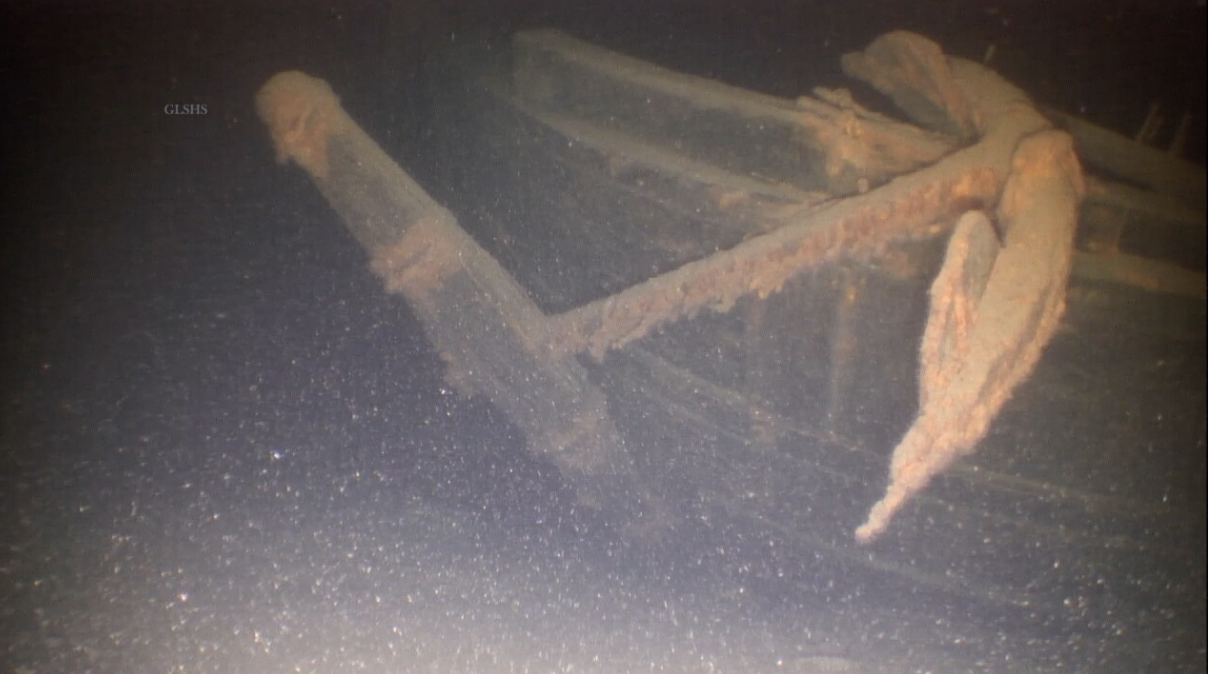
Crews discover 153-year-old shipwreck in Lake Superior
The Great Lakes Shipwreck Historical Society announced the discovery of the 144-foot Barquentine “Nucleus,” which sank more than 150 years ago in Lake Superior.
According to the society, the “Nucleus” was found under 600 feet of water, about 40 miles northwest of Vermilion Point on Lake Superior.
The “Nucleus” sank on Sept. 14, 1869, when it was going downbound from Marquette with a load of iron ore. It had already sunk twice, and in 1854, it rammed and sank the S.S. Detroit in Lake Huron.
On Sept. 14, 1869, the Nucleus was caught in a bad storm on Lake Superior and started to take on water. The crew reportedly abandoned ship and took the lifeboat, with the “Nucleus” sinking shortly after.
Thankfully, the crew did not suffer loss of life after they were picked up by the schooner “Worthington,” but another ship kept on steaming and left them behind before the Worthington showed up.
The “Nucleus” is one of the oldest ships to go down along the Lake Superior Shipwreck Coast.
“This is a pretty significant shipwreck…considering its age, the fact that it is a barquentine and we can’t overlook the vessel’s checkered past. The wreck site is littered with shovels too…and a few dinner plates, which speaks to their work and shipboard life,” Shipwreck Society Executive Director Bruce Lynn said in a statement.
The society used a marine sonic technology side-scan sonar in the summer of 2021 and positively identified the wreck in 2022
“The stern was intact. It had a straight back stern and then the port side also was intact. And so, I was more excited about it because at first, I thought it was totally in pieces on the bottom,” Society Director of Marine Operations Darryl Ertel Jr. said.
WXYZ
Cargill shutters Indiana grain elevator
PORTAGE, IND. — Cargill has closed its grain elevator at Burns Harbor in Portage as of Jan. 31, saying a variety of current and expected market conditions led to the decision to not renew its lease.
The elevator handled soybeans, corn and wheat on Lake Michigan with a storage capacity of 7.768 million bus, according to Sosland Publishing’s 2023 Grain & Milling Annual. The Ports of Indiana grain export terminal at Burns Harbor received by truck and rail and loaded barge, rail and truck.
Cargill said it notified customers of its decision in September 2022.
“There were several different contributing factors that led us to make this decision, which include the current and projected market environment,” Cargill said. “Cargill’s other local operations in the area continue, as do the larger network of grain and oilseeds facilities around the US, and we will utilize those operations to serve customers to ensure they continue to have access to markets for their grain.”
Cargill said it is retaining current employees at Burns Harbor through the duration of operations while also assisting them in finding other employment opportunities at Cargill.
Baking Business
Great Lakes ice coverage is well below average; what are the impacts?
Ice coverage along the Great Lakes is significantly below average, according to the latest data from the National Oceanic and Atmospheric Association.
As of Feb. 7, the average ice coverage on the Great Lakes is just 13.5%, and the average for this time of year is 37%.
When you compare the ice coverage from Feb. 7, 2023 to previous years on Feb. 7, it is below average. Ice coverage was 28.9% on Feb. 7, 2022, 18% on Feb. 7, 2021, 10.2% on Feb. 7, 2020, 42% on Feb. 7, 2019 and 55.5% on Feb. 7, 2018.
Breaking it down by each Great Lake, the ice coverage is below. The average ice cover per lake is in parentheses)
Lake Superior – 11.08% (15%)
Lake Michigan – 10.49% (10%)
Lake Huron – 18.42% (45%)
Lake Erie – 20.97% (60%)
Lake Ontario – 5.69% (5%)
The ice coverage for many of the Great Lakes had been in the single-digit percentages for most of the winter until a cold snap last week that spike ice coverage on much of the lakes.
Read the rest here: https://www.wxyz.com/news/great-lakes-ice-coverage-is-well-below-average-what-are-the-impacts
WXYZ
Chi-Cheemaun special events to continue in the 2023 season
OWEN SOUND, ON — Special events onboard the MS Chi-Cheemaun will once again be the norm when the ferry begins operating for the 2023 sailing season in May. This is only one of a few changes passengers will be seeing this year.
“We are hoping to be able to have the same type of special events regularly and have entertainment on board as there used to be on the ship,” said Carl Kuhnke, president and chief executive officer of the Owen Sound Transportation Company (OSTC), last week. “The whole world has changed over the past three years due to the COVID-19 pandemic.”
Mr. Kuhnke pointed out the full schedule and rates for the Chi-Cheemaun sailing season have not yet been released but confirmed the Chi-Cheemaun 2023 season will begin on May 5.
“We are going to able to provide several special events again this (sailing) season, and have had several requests come forward,” continued Mr. Kuhnke.
“We will also be offering a new point of sale wireless system on the ship through Starlink Satellite Company and passengers will be able to use their cellphone and tablets on the ship.”
Manitoulin Expositor
The short life of the new USS Little Rock: Design flaws, setbacks lead to decommissioning
Some 8,500 people turned out on Dec. 16, 2017, to watch the commissioning of the new $440 million USS Little Rock — draped in red, white and blue bunting — at Buffalo and Erie County Naval and Military Park.
That now appears to have been the ship’s only bright moment.
Not even six years later, the USS Little Rock will be decommissioned on March 31 at Mayport Naval Station in Florida, where it is stationed.
The 387-foot-long vessel was imperiled from the start with significant design flaws that the Navy has concluded cannot be overcome.
U.S. Navy officials first announced at a media briefing almost a year ago that nine Freedom-class littoral combat ships would be decommissioned as part of the 2023 fiscal year budget.
“It’s somewhat of an embarrassment,” said Paul Marzello, the Naval Park’s executive director. “It was a happy moment, a proud moment on Dec. 16, 2017, and here it is five and a half years later, and she’s being decommissioned.”
“It is really a disappointment,” said Maurice Naylon, who chaired the commissioning committee. “We were so proud of the way we joined forces for this historic event, and it certainly put a nice sheen on Buffalo’s reputation.”
The Little Rock suffered a major failure at sea in 2020, six weeks after departing Mayport on its first deployment due to a flaw in the propulsion system, according to defensennews.com.
The nine Lockheed Martin-built high-speed vessels were designed to operate in shallow waters, and they were outfitted with some 8,000 computer sensors. All were hit with the propulsion problem. The ships will likely be scrapped or sunk to the bottom of an ocean — the fate of many decommissioned ships.
Rear Adm. John Gumbleton, the deputy assistant secretary of the Navy for budget, put the cost of the nine vessels — the newest of which was commissioned in 2020 — to be decommissioned at $4.5 billion, according to defensenews.com.
“That’s a lot of money going, literally, right down the drain,” said Mike Vogel, president of the Buffalo Lighthouse Association. “It was a very expensive ship that had all kinds of potential, and it was certainly an honor to have it commissioned here in Buffalo. It’s kind of heartbreaking to see it a little bit later being decommissioned and probably scrapped.”
The modular, reconfigurable ship was built to engage in surface warfare, hunt enemy submarines and eliminate mines. The ship had the rare capacity to change from one mission to another within 96 hours, and, in some cases, just 24 hours.
It’s “plug and play” mission versatility also accommodated different weapon systems delivered at sea in steel cargo containers and lowered into the ship on a freight elevator, then maneuvered into place with overhead cranes and plugged into the ship’s computers.
Littoral combat ships can also maneuver in water just 13 1/2 feet deep, well below the 30 feet most naval ships require. That allows the ships to enter more ports, particularly in islands from Sri Lanka to the Philippines.
But the $762 billion defense budget for fiscal year 2023 included a request from the Navy to decommission 39 warships, including the nine Freedom-class littoral combat ships.
U.S. Rep. Steve Womack, who represents the Fayetteville, Ark., area, and takes pride in the two ships named for the state capital, told the Arkansas Democrat-Gazette in October that the littoral combat ship program represented “a sad chapter in the history of the Navy.”
“It’s sad that the USS Little Rock is one of those out of the Freedom class,” Womack said. “The Freedom class had more problems than the others, but the entire littoral combat ships program has suffered from a lot of setbacks.”
Deactivated ships are taken to one of three locations where mothballed fleets of naval vessels wait for disposal: Philadelphia, Bremerton, Wash., and Pearl Harbor, Hawaii.
The ships are often disassembled for the steel to be recycled. But that’s not always the case. Ships are also deliberately sunk, generally in locations where they can become artificial reefs to promote sea life, Vogel said.
The Navy’s Ship Donation Program decides if a vessel can be donated as a floating museum. But that rarely happens with ships with short lifespans. The Naval Park’s USS Little Rock, commissioned in 1945, served until 1976, six times the length of service of the newer namesake.
Marzello recalls fondly the commissioning of the newer ship. Former Secretary of the Navy Ray Mabus, who once served on the-now museum USS Little Rock, and 300 former crew members and relatives, were on hand for the historic occasion. So was Commander Paul Burkhart, a Western New York native who served as the new Little Rock’s first commander while under construction.
“We’re going to certainly take a look at any opportunity that could possibly bring her back to Buffalo as a museum ship,” Marzello said. “It would be an interesting opportunity to see a 1940s ship called the USS Little Rock versus a 2017 version.
“It didn’t look like much from the outside, but the inside was a technological marvel.”
Stars and Stripes